TRUE FIRE for baritone and orchestra
Music by Kaija Saariaho (2014)
Dramaturgy by Aleksi Barrière
Texts by Ralph Waldo Emerson, Mahmoud Darwish, Seamus Heaney (adapted from Marin Sorescu) and the Tewa people
Published by Chester Music Ltd.
Premiered on May 14, 2015, by Gerald Finley and the LA Philharmonic conducted by Gustavo Dudamel.
Kaija Saariaho had wanted to write a male counterpart to Château de l’âme (1996), her song cycle for solo soprano, eight female voices and orchestra. In 2014 came the possibility to write a cycle for the deep baritone voice of Gerard Finley, which she saw as an opportunity to explore a certain vocal color, associated with the physical reality of the male body and a full range of cultural gender archetypes. She was at the time working on her opera Only the Sound Remains, which as an adaptation of two Noh plays is centered on male soloists, and can be understood at its core as a deconstruction of destructive masculinity: the two stories feature respectively a warrior who suffered a violent death in battle and whose soul finds peace by reconnecting with his sensual love for music, and a fisherman who grows out of his brutish desire to dominate nature by worshipping it with a dance.
In a reversal of perspective from the bulk of Western musical tradition, to Kaija the male self was something alien and mysterious that she needed to approach and examine from the outside, but also challenge in its purported opposition to the female experience. Namely, would all the ‘female traits’ explored by Kaija in previous works and by extension or essentialization often attributed to Kaija herself and her music – nature, shadows, oceanic fluidity, reconnection to the realms of emotions and dreams, mystical forms of knowledge – be absent from a male perspective? Traditional binaries of the masculine and the feminine had to be questioned, including in the most material associations pertaining to the social tasks.
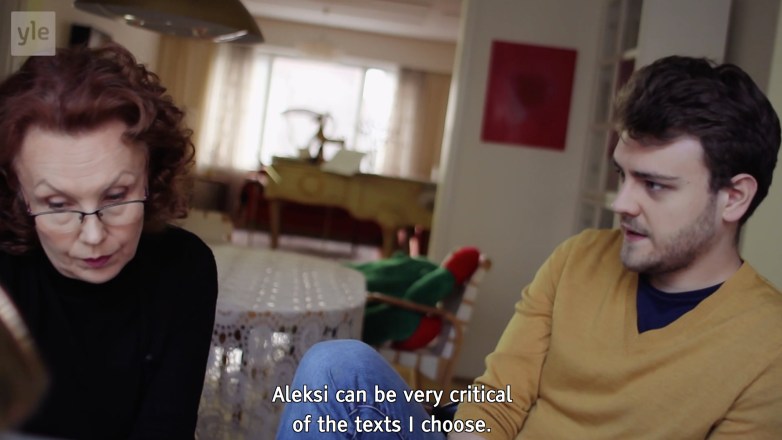
Knowing that she wanted to work in an exploratory manner with a collage of texts as in Château de l’âme, Kaija asked me to work on the new piece as a dramaturge, with the assumption that I could offer texts that she wouldn’t know and that would resonate with my own ‘male voice’. The prompt was rather broad and there was a lot of back and forth. The first suggestion I made was creating a cycle around the Israeli-Palestinian recipes recently collected by Yotam Ottolenghi in his book Jerusalem (2012). This concept was soon dismissed because of its limited expressive range, but the idea of fragmented realities (the text collage) bound by a broader unity (the music), as well as the element of bringing the lyrical subject into unusual places, felt like directions that needed to be pursued.
From a recent trip to the US, Kaija had brought back the collected writings of Ralph Waldo Emerson (1803-1882), and we discussed them a lot. Emerson’s relationship to the Vedantic corpus made him a natural link to Château de l’âme, which drew directly from that same source. However Emerson is his own brand of mysticism, blending an eclectic relationship to ancient traditions and to nature, with a modern, scientific vocabulary. His essays are an invitation to a global cosmology that has multiple possible entry points in different cultures, different ways of inhabiting the world and interacting with the forces of nature. Emerson became quite naturally the overarching voice of the piece, under the guise of three exalted yet speculative ‘propositions’ that frame the other texts and give the work its title.
This allowed for us to expand the idea I was then developing – which had drifted from Levantine cuisine to an intertwining of Israeli and Palestinian poets – to address a broader spectrum of fragmented realities, that could be firmly held together by Emerson’s mystical Over-Soul. The embodied homeland of Mahmoud Darwish, whose text also expands on the opposition between Narcissus and Echo that had been at the heart of my previous choir libretto for Kaija (Écho !, 2007), could itself echo in and be expanded to multiple geographical and cultural contexts. I suggested poems by Seamus Heaney, whom I had been reading a lot in the wake of his passing in 2013. Juxtaposed by translation into the unifying English language, Darwish’s “The last train has stopped” and Heaney’s “The First Words” (adapted from a poem by Marin Sorescu) seemed to belong to the same contemporaneous reality, with its trains and newspapers, and discouragement with political oppression, and to be simultaneously connected and separated by a similar kind of solitude, amid an oddly deserted world. Every solo song cycle has to find its own impetus to the situational reality of a singer singing alone, and it ought not necessarily be by resorting to Romantic archetypes of heartbroken, cursed loners: maybe a new solution could be found for our century in the collaging of isolated voices, amid a world that in these texts feels eerily unpopulated.
The missing piece was found as we researched Native American oral art. Kaija and I had a shared interest in the cultures of the Pueblo people sparked by the time we had spent together in the American Southwest (which later took a more comprehensive form in the Hopi section of our madrigal Reconnaissance, a work that revolves generally around the notions of koyaanisqatsi and collapse of worlds). The old English-language collection Songs of the Tewa happened to contain a beautiful, repetitive lullaby that immediately attracted Kaija, and we realized that there was no reason to assign such material to a female voice. This playful “Cloud-Flower Lullaby” found its designated place as the cycle’s centerpiece, in a moment both elemental and tender, and the only moment when the lyrical subject of the piece is addressing someone present: his child. When I later remembered that the same text had previously been set by John Adams in his opera Doctor Atomic (2005), I wondered if that might inspire unwelcome comparisons, but for musical and dramaturgical reasons these two settings proved to be radically different.
A few combinations were explored before the collage found its final form, one that would allow the same ‘true fire’ to be glimpsed throughout the insulated realities of a Palestinian man, a Northern Irish Catholic (channeling a Romanian poet under Ceaușescu), and a Tewa parent in a reservation. Articulated within one voice and one language, without any attempt at musical local color that would exotify them, these realities become one without losing their singularity. True Fire was thus also a laboratory for the multilingual dramaturgies I later developed for Kaija (Innocence, Reconnaissance) and other composers (e.g. Juha T. Koskinen and Diana Syrse), that aimed at giving collage and the multiplicity of voices a linguistic reality that allowed for a finer negotiation of the tension between individuality and polyphony, with the tools of poetry understood as montage.
And yet there is no definite answer to the matter we had set out to explore through this choice of texts: what we could learn about the male voice, not as an essentialization but as a transcultural phenomenon, here cast in unusual parts, where the lyrical subject offers himself as a ‘receptor’, a photometer, rather than as a heroic active character or an ego flooding the listeners with his feelings and desires. As a tool of exploration of the male self, True Fire still holds many mysteries that need to be challenged in performance. I myself see it as a valuable learning curve as to navigating the world as a man: a lesson in listening to all the voices that can only be heard in your own silence.
Full sources of the collaged texts:
– Ralph Waldo Emerson, fragments from Spiritual Laws (in Essays, 1841)
– Seamus Heaney, “The First Words”, from the Romanian of Marin Sorescu, in The Spirit Level, Faber & Faber, 1996
– “The Cloud-Flower Lullaby”, in Songs of the Tewa (collected and translated by Herbert Joseph Spinden, 1933)
– Mahmoud Darwish, “The Last Train”, in Fewer Roses, 1986 (translated by Munir Akash and Carolyn Forché)

 >marginalia*