A Staged Oratorio
Partial premiere at the Bergen Autunnale on October 27, 2018.
Full premiere at the Folkoperan in Stockholm, on January 29, 2024.
Libretto & Music by Djuro Zivkovic
Musical Direction: Christian Karlsen
Stage Direction: Aleksi Barrière
Stage & Costumes: Anke Laerenbergh
Lighting (Stockholm): Tomas Heyman
Cast in Bergen
Carina Vinke (alto solo), Jacob Kellermann (guitar solo), The Choir of the Monastery of Holy Archangels in Kovilj & BIT20 Ensemble.
Cast in Stockholm
Carina Vinke (alto solo), Jacob Kellermann (guitar solo), Viktoria Andersson (dancer), The Greek Byzantine Choir & BIT20 Ensemble.

Staging Note for the Bergen performance
BOGOLUCHIE takes its inspiration from the 58 Hymns by the 10th century Byzantine monk and mystic St. Symeon The New Theologian. Radical for his own time, the monk’s ideas and writings challenged his readers to embrace Christ as a personal and individual experience.
BOGOLUCHIE is the inner drama of a soul working her way from a state of war to a state of peace. Music is not the language in which this quest is told, but the medium in which it is realized. The Orthodox method of the ‘prayer of the heart’, which has equivalents in many other spiritual traditions, is a concrete procedure of focus and breathing, that through silence culminates in inner spiritual serenity and peace. In the poetry of St. Symeon The New Theologian it is made tangible as a love story of the self with God.
In times of division, wars and displacement, Djuro Zivkovic and the monks of the Kovilj Monastery offer a manifesto against the spirit of individualism and secession, in the form of a collective meditation and process of fine-tuning.
The work ends with the gradual abolishment of separations, and a wordless reinterpretation of fragments of The Book of Psalms – one of the cornerstones of all three monotheistic religions – in which a cry of solitude is transformed into singing.
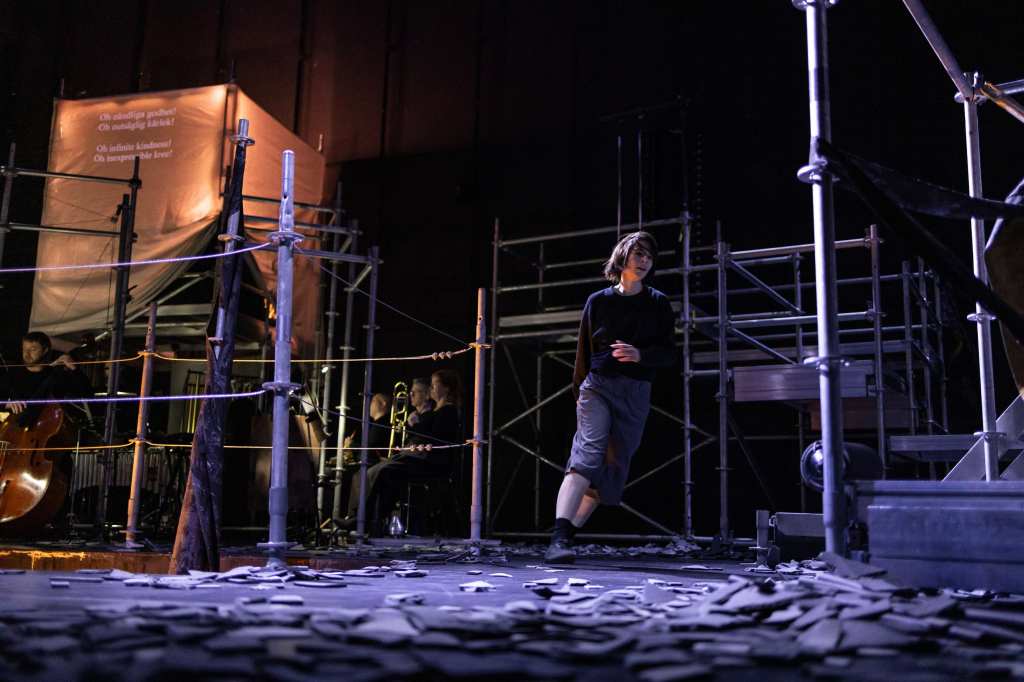
Staging Note for the Stockholm performance
St. Symeon lived at the heart of the Byzantine Empire in a time of almost continuous warfare and repeated internal crisis. It was in exile that, in the last part of his life, he rebuilt the monastery of St. Marina, where he penned most of the Hymns of Divine Eros. The relation between inner and political chaos was not a metaphor to him: his spiritual quest to heal from a state of war was to have a concrete impact on the world.
Unlike approaches that place their entire hopes and trust in the world beyond, the tradition to which Symeon the New Theologian belongs believes in the role images can play in our world – that if Christ has appeared down here in the form of flesh, then the light of God must be felt in this life already. Icons and theatricality are then not deceitful illusions, but ways of accessing the invisible by way of the senses, that can be an integral part of spiritual contemplation.
Albeit Djuro Zivkovic’s score for Bogoluchie plays with images, gestures, and contrast between visible and invisible sound sources, it was composed as an acoustic liturgical theatre of the mind, devoid of stage directions. Our approach in creating this production has been to add a visual and dramatic layer with which it may interact and reveal itself, through not commentary or explanation, but visual associations.
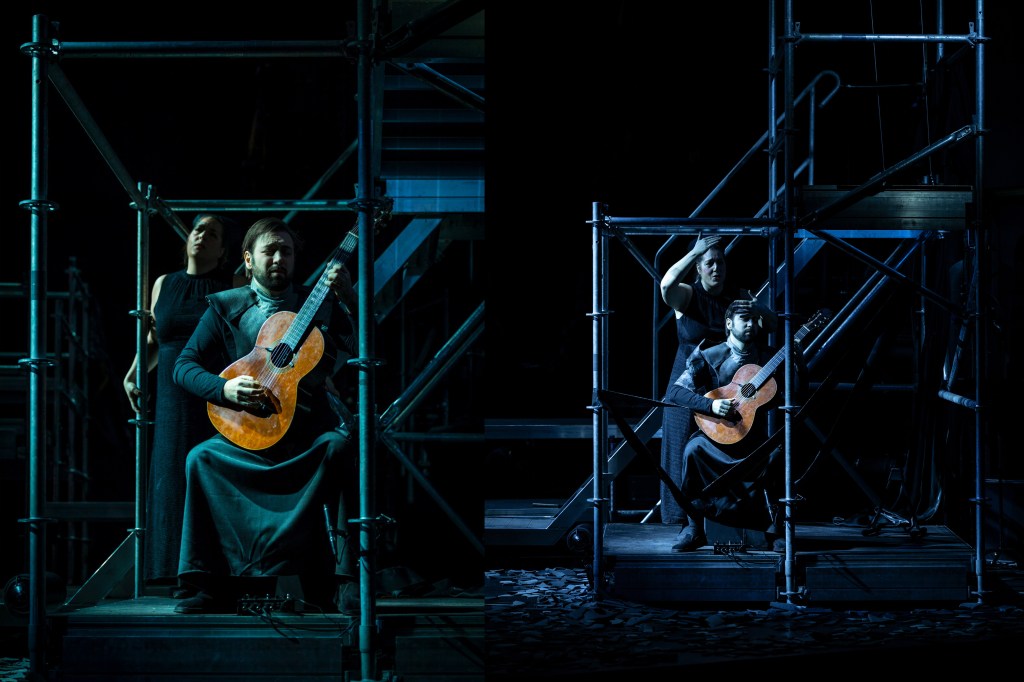
The story we tell on stage against Djuro Zivkovic’s musicalization of St. Symeon’s Hymns of Divine Eros may be the narrative of a community facing the challenges of destruction, mourning, and rebuilding through the power of introspection and ritual; or perhaps the drama of three characters, a Guardian (singer), a Wounded Visitor (guitarist), and a Youth (dancer), whose trajectories briefly intersect.
Although based on the score, these images are not contained in it. Maybe they can act like the wall of icons that separates the audience from the holy of holies in Eastern churches: an obstacle that is also an opening and a bridge to the unknown beyond.

 >marginalia*
Un commentaire