Heterochrony (Heterokronia) was a concert series curated by Aliisa Neige Barrière and Aleksi Barrière for the Turku Music Festival in August 2024.
“Inside our history, in the folds of the great linear timeline, other stories live, other timelines and heartbeats, wrapped around each other, hiding each other, answering to each other sometimes centuries apart. These we call heterochronies. They challenge the main historical narrative and open our minds to new routes, tunnels, bridges we didn’t know could be taken. Secret histories that are backdoors to our society’s dreams. This is a collection of musical heterochronies – a triptych that form a journey of women finding their place in the world.”
12.8. SONGS OF JUDITH with mezzo Christina Herresthal, harpist Claire Moncharmont and the Finnish Baroque Orchestra: looking at 17th-century scores and paintings for the possibility of revenge and what lies beyond (Strozzi, Jacquet de la Guerre, Bembo, Leonarda, et al. + premieres by Juha T. Koskinen and Mioko Yokoyama).
13.8. RESONANT HUMOURS with Aliisa Neige Barrière (violin) and Jakob Kullberg (cello): the crossover nobody knew they needed between Tobias Hume (1569–1645) and Kaija Saariaho (1952–2023), trying to tune and going on an adventure in the process.
22.8. THE SECOND HEART: Turku Philharmonic Orchestra conducted by Aliisa Neige Barrière, feat. mezzo Fleur Barron, actor Akseli Kouki, telling of the path through which new stories came to the concert halls and opera stages, how they were welcomed (not well), and why they matter in imagining another future.
Songs of Judith: Full Text
Élisabeth Jacquet de la Guerre (1665-1729): Prélude
Pièces de clavecin, 1687, Suite n° 3 en la mineur
Barbara Strozzi (1619-1677): Riamata de chi amava
Cantate, ariette, e duetti, no. 18, Venice, 1651
SPEAKER:
You liked that, didn’t you? Suffering has never been so beautiful, so ornate, so sensual. It’s not just that you can relate to the bittersweet torment of love: you are allowed to take aesthetic pleasure in someone’s pain, because her pain is designed to be enjoyable to others. We are in Venice in the early 1650s, the genre of opera is being codified around this idea, and a young singer and composer, Barbara Strozzi, is trying to make herself a name on that scene.
Barbara’s father, Giulio Strozzi, was a librettist and one of the masterminds of the genre. He started the trend of spectacular madness scenes for female singers, followed for instance by Francesco Cavalli, who also accepted to teach composition to his daughter. Giulio Strozzi passed on to her the best musical education and his network, but that also meant showing her off in the concerts he organized, exhibiting her, because only as a performer and a courtesan did she stand a chance to make her music heard. Look at this portrait of Barbara Strozzi, entirely exposed amongst her instruments, and try to read the expression of this woman who rose to fame because her musical lamentations were so beautiful.
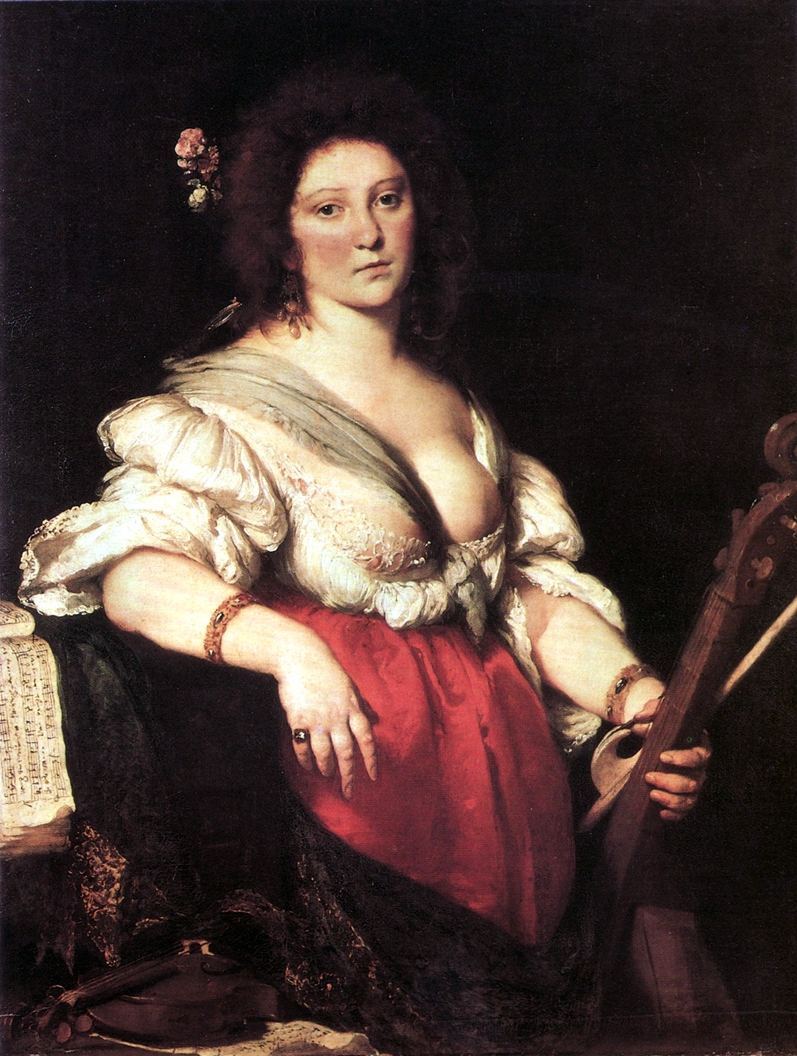
A woman is a strange animal. Her moanings of desire and agony are an opportunity to hear strange and beautiful colors that can be found nowhere else. Barbara Strozzi used that fascination to create music for her own voice that is unlike that of others. But that was (is) regarded simply as a strange, exotic flavor, like the Baroque trend of copying Turkish music, or later when Rameau famously harmonized a dance from Native Americans, simply described as Savages. Something different, something wild, with the exciting flavor of not being entirely respectable – but that has to be kept carefully under a lid, in a cage, under control.
Jean-Philippe Rameau: Les sauvages (1728)
Compare Strozzi’s portrait to this painting of Élisabeth Jacquet de la Guerre, whose Prelude we heard in the beginning. After being noticed as a child prodigy behind the harpsichord, Jacquet received the protection of Louis XIV. She never could get an actual position at the court; but a family of musicians and a career as a concert performer, an improviser, allowed her to achieve wider recognition as a composer than any other woman at the time. This portrait is truly remarkable: Élisabeth, leaning on her harpsichord, holds music paper and a quill, in full control of her creative forces, and she looks at us straight in the eye. Of course, she is dressed to please, but she is not at our disposal. However, the reality is not that rosy. That respectability Jacquet gained was her limit. Her attempts to write larger works for the stage didn’t amount to much. If she wasn’t going to be a courtesan, she had to know her place, which was not at the court or at the theatre, but behind the harpsichord, the instrument of salons and living rooms.

At the same time, which is the end of the 17th century, this problem was solved differently by Antonia Bembo, an Italian singer and composer like Strozzi – like her a student of Cavalli, and like Jacquet trying to make it in Paris and Versailles. She could only survive as a lay sister in a convent. A religious community was a safer place for music-making women: music was a part of the daily life, there was need for performances and instruction, and many opportunities to create repertoire. Like Isabella Leonarda, a nun and composer of the same era, Antonia Bembo used this chance creatively, and brought into religious music all the influences that were heard in the secular music circles. Bembo and Leonarda wrote music that diverged dangerously from the ideals of modesty and simplicity that preside over church music. Private, invisible opera.
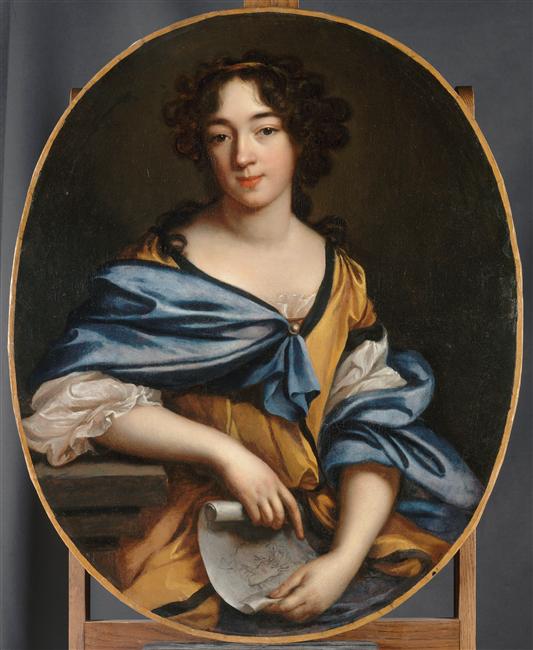
This is often believed to be a portrait of Antonia Bembo, but we have no such thing. It is actually a self-portrait of Élisabeth-Sophie Chéron, who achieved great recognition not only as a painter, but also as a musician and woman of letters, and whose French verse adaptations of the Psalms were set to music by Bembo. A woman holding a sketch, again in full control of her artistic expression, using it to present herself with poised, almost antique demeanor. Chéron painted portraits of high society women and biblical scenes, nothing too provocative, and in 1672 she was accepted into the Académie Royale de Peinture et Sculpture – she was not the first woman to do so, but the first who painted people and not just flower compositions. Again, a woman has to know her place – but slowly, one by one, small steps are taken. In very controlled environments.
The Counter-Reformation is on, and to fight the Protestants with their own weapons, it has become acceptable to handle sacred subjects in common language instead of Latin, and use the seductions of modern arts that the Church shunned as sensual, decadent pleasures, to speak of higher truths. Through this small door, under the guise of respectability, a space of personal female expression is created, seized by Chéron with her translations, Bembo with her musical settings, Jacquet de la Guerre with her spiritual cantatas.
But of Antonia Bembo, again, there is no image. And of Isabella Leonarda we have only a small medallion painted into her family tree, showing her in her nun’s attire. This music is some of the most expressive written at the time. But it came at the price of erasure.
Antonia Bembo (ca. 1643-1715): De profundis (Les Sept psaumes de David)
Psalm 129/130, French text (1694) by Élisabeth-Sophie Chéron (1648-1711)
Isabella Leonarda (1620-1704): Sonata Duodecima
12 Sonatas, op. 16, 1693
Juha T. Koskinen (*1972): She who saw things to come (2024)
Text by Aleksi Barrière, based on the myth of Libuše
Antonia Bembo: Mi basta così
Produzioni Armoniche, ca. 1701
SINGER:
Mi basta così. Yes, I’ve had enough. Those images of the past, how can we turn them around?
Look at Libuše the prophetess painted by Karel Mašek. She is dark and dangerous. Can we finally unleash that dark power that for so long has been harnessed or exhibited on stage like in a zoo?

There have been many attempts to seize the old images, reactivate their power. The painter Artemisia Gentileschi, like Élisabeth Jacquet de la Guerre, expressed the suppressed violence of her own story through the Biblical story of Judith the avenger. In 1613, she depicted the general Holofernes in the same submissive position in which she had herself been raped by her painting teacher, through this picture she executed the revenge that she couldn’t achieve elsewhere.
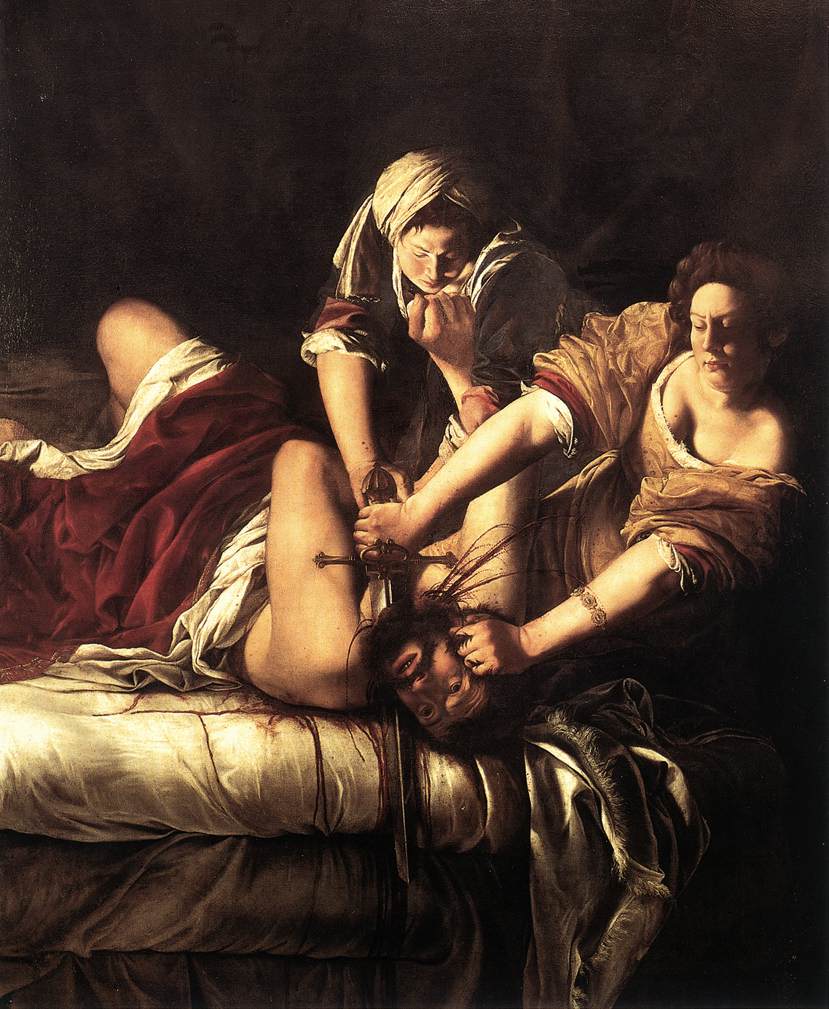
If we have to speak through available stories and images, then let us take those that allow us to turn the violence around. I will be the Avenger. I will break through the prisons made of fine French lace that covers the bruises on my skin. I will break the images through which my body is being sold to the highest bidder, or given out in exchange of favors. I will destroy the tools of my submission and make them the tools of my liberation. I’ve had enough. Listen to the revenge of Judith.
Élisabeth Jacquet de la Guerre: Judith
Sixième Cantate à Voix seule, avec Symphonie
Cantates françoises sur des Sujets tirez de l’Écriture (Livre I, Paris, 1708)
Livret d’Antoine Houdar de La Motte
Silence of the vacuity of vengeance
Élisabeth Jacquet de la Guerre: Sarabande)
Pièces de clavecin, 1687, Suite n° 1 en ré mineur
SINGER:
Why can I be heard only when I scream at the top of my lungs? The dangerous part in me is another way to make me the seductress, to make me the spectacle you come to watch through the bars of a cage, through the window of a peep show. And you keep adding coins. Alcina, Medea, Carmen, you turned the rebel into the femme fatale, from whom nothing more is to be expected than cheap thrills, maybe mutual destruction.
Throughout the centuries we have been kept indoors. There we have created secret rooms for ourselves. We can reclaim those spaces, expand them to create something that is not the same old zoo for our sufferings, the same museum of our submission. I think of this lute player carefully tuning her instrument, painted by Orazio Gentileschi, the father of Artemisia, maybe depicting his daughter. Quietly she listens to a soft tune only she can hear. But she can invite us in. And I think of another painter, the first of her kind, Lavinia Fontana, and her self-portrait at the virginal from 1577. Nothing can stop a woman with an instrument in her hands: she is more than an allegory, she is alive.
We need to move beyond this past. Create new stories and images.
We need to hear a new prelude.

Mioko Yokoyama (*1989): Postlude (2024)
Resonant Humors: Epigraph
PLACE DE LA CONCORDE. On the public square where a king was
beheaded there could be no agreement on a symbol of peace
restored. In 1830, Egypt’s gift of an obelisk from Luxor proved
providential: peace with the rest of the world would grant peace
within the kingdom would it not (once removed the marginalia of
sun-worshipping, erect baboons on the pedestal). It suited a
space designed to welcome parades and to corral riots, subject
to traffic jams. They called the place Concord, con-cordia,
togetherness-of-hearts. The plural cordais a reminder that the
Latin words for heart and string share the same origin: they come
from the word for guts. Bowels after all were used to make the
strings of instruments. Concordia: a harmony of guts, of strings,
of guts played like strings. Musica mundana, musica humana,
from stars to clouds to city to inner organs to lute, all reined in
and singing in accord finally… But in the middle of klaxons we can
secretly re-tune. Take down the monoliths, harmonize without
dominants: the ever-shifting scordatura of instruments combined.
Peace is not the mere suspension of war but rehearsed music.
Tense your strings, lift up your hearts – Sursum corda.
The Other Heart: Full Text
“The Conservatoire Orchestra had recently performed an overture composed by Madame Farrenc. The undersigned was surprised by a work most serious and perfectly constructed, revealing masterly craftsmanship and style. Madame Farrenc’s overture is a most decent instrumental work. Rarely does one find in a woman such vigor and intelligence in the combination of effects.”
This is what a Parisian critic wrote in April 1840 after the premiere of Louise Farrenc’s Ouverture n° 2. At the time, Farrenc’s career as a pianist and piano teacher was (with the support of her husband) in full swing. She is not the only female piano virtuoso of her century to be allowed to compose chamber music. Besides, “A woman’s decent education is always to comprise music,” say the books of good manners. But orchestral music? Despite its quality and originality, the reviews of Farrenc’s music always seem to default to the same uneasy vocabulary: “her inspiration and skill are male in magnitude,” “Madame Farenc’s Nonetto bears the mark of masculine craftsmanship” – “even if we admit that women lack both the vigor demanded when planning the writing of a tragedy and the energy necessary to its execution, we must admit that we have in our company a female symphonist, as curious a phenomenon as a female playwright would be.”
Louise Farrenc composed three symphonies after this overture. But teaching the piano was the only way to support her family, and day-to-day it absorbed all of her energy. A composer’s career requires time and energy, especially the larger orchestral works that would have finally taken Farrenc beyond the small circles of the salons. 19th-century Paris was the century of the symphony orchestra, the century of opera, but who would have imagined that a woman’s work would be performed on the stage of the Paris Opera – ever? Fatigue prevailed, and when Louise’s only child died in 1859, her often-emphasized vigor was shattered. She devoted herself once and for all to chamber music and piano lessons.
An overture? To what then?
Louise Farrenc, Ouverture n° 2
“Although Mademoiselle Holmès has taken on the expressive accent and painfully morbid character that has marked modern music since Robert Schumann, her phrases are always handsomely broad. A closer look might, of course, reveal a woman’s mind, but a superior one, one that has no reason to envy the privileges of our sex, for her style is surely more vigorous and her imagination mightier than that of many fashionable composers.”
This is what a Parisian critic wrote in May 1881 about an early work by Augusta Holmès. Augusta Holmès was born half a century after Louise Farrenc, and things have moved on – by an inch.
In keeping with the times, Holmès is a Wagnerian, and believes that music reaches its full power by taking the form of a narrative, by giving life to situations, backdrops, drama. Each of her works is inspired by a poem he has written. Opera is her obvious calling. All her music reaches towards it. But when she finally gets the chance to present her opera The Black Mountain, set during the war between Montenegro and Turkey, the reviews are unanimous: Augusta Holmès is a Valkyrie, a strangely masculine woman who is out of place in a genre dedicated to men; after all, her epic symphonic style has always seemed suspicious, and not just because of it sounds so German. “The opera’s theme as much as its treatment show that Mademoiselle Holmès is once again trying to make the audience forget her sex,” writes another critic.
Although she was a popular song composer at the beginning of her career, Augusta Holmès managed to leave the salons and piano lessons behind. But she never had the chance to pursue a career as an opera composer. Her most popular works are short symphonic poems, suitable for the first half of orchestral concerts – after the overture, but before the larger works.
Holmès’s final symphonic poem, Andromède, gives the impression of an opera that never got to be composed.
Andromeda, an Ethiopian princess, is being sacrificed to a sea monster to appease the forces of the ocean. She is chained to a rock. The monster approaches. But from the sky soars the hero Perseus, on his winged steed Pegasus. Perseus slays the sea monster and takes Andromeda as his wife. The traditional tale of hero-and-damsel-in-distress? In a poem written for this work, Augusta Holmès gives the story another meaning:
“O human soul, captured from heaven,
Victim of your chained humanity,
Believe in Freedom and thus be free!
Believe in Life, and you shall live as is suited to your worth!
Far from the abyss where a sea of Torments howls,
Far from the monster Pain that eats the light of day,
Winged Poetry and Love immortal
Lift you to the stars, where truer gods have their abode.”
Augusta Holmès, Andromède
“The fragile Saariaho, tackling a large-scale form, and on the theme of violence, too – the sight is as embarrassingly naive as Sylvester Stallone trying to dance ballet.”
Kaija Saariaho’s second opera Adriana Mater premiered in Paris in the spring of 2006. The first work commissioned from a woman by the Paris Opera, this drama of violence was commented on by a Parisian critic in a way that recalls the ancient local tradition.
Sure, early in her career, Saariaho’s music was said to be too cutesy, unsuited to large-scale forms, undramatic, downright boring. “Not many people would listen to Kaija Saariaho’s music if she happened to be ugly and fat. But since she happens to be this ethereal and doleful woman, people think it must be great,” wrote a Helsinki critic. But in the end she was accepted. As long as she was composing that meditative music of hers, reflecting the phenomena of nature – as long as the female composer knew her place. Dramatics and large forms are not for her.
Fortunately, times have changed. Outi Tarkiainen, for example, didn’t have to ask permission, as a woman and a musician with a jazz background, to compose works of even large scale. But I wonder what another Helsinki-based critic must have meant when he wrote, about the music on Tarkiainen’s first album, of the composer’s ability for “elegant orchestration and pretty melodics?” Why, in the critic’s view, do the so-called “dramatic ascents” of Tarkiainen’s monodrama create an “confused yet very serious, heroic vision”? Surely this could have been written about a male composer, right?
Kaija Saariaho and Outi Tarkiainen have composed extensive orchestral works and operas. In Adriana Mater, as well as in The Ring of Fire and Love, which you are about to hear, they have found inspiration in their own experiences: Saariaho in the pulse of the unborn child’s heart beating alongside the mother’s, and Tarkiainen in the euphoria and burns of childbirth. They compose for the big stage about the experiences that make them human, and there is nothing cutesy about their music. From them we learn how layered the birth of the new is, and how much hope it inspires: the birth of a new human being is the promise that the world, that we ourselves, can be something else than what we have been until now.
Outi Tarkiainen, The Ring of Fire and Love
~ INTERMISSION ~
Kaija Saariaho / Amin Maalouf, Adriana Songs
SPEAKER:
A distant country, or perhaps not so distant, on the brink of civil war. The people in each neighborhood are avoiding the neighborhoods next door. They, the Others, have their own shops, their eateries, their places of worship – other than ours. Come nightfall, a woman should not walk alone in the streets of this city. Come nightfall, young Adriana, dreaming of another life, a life without fear, sits on the porch and sings to herself.
SINGER [Adriana Songs – I Jardin d’automne]:
When the eyes of the city close
I reveal my voice!
The voice I gathered
In an autumn garden
And pressed in the pages of a book;
The voice I brought back from my country
Between my brimstone-coloured sheets;
The voice I tucked into my bodice
Under the folds of my heart.
When the eyes of the city close
I reveal my heart!
The heart I gathered
In an autumn garden
And pressed in the pages of a book;
The heart I brought back from my country
Between my stone-coloured sheets;
The heart I tucked into my bodice
Under the folds of my skin.
When the eyes of the city close I reveal my skin!
SPEAKER:
The war has started, the war between them and us. All men in town have been given guns. Fathers, brothers, sons – all join the militia, in defense of ‘our blood.’ This includes Tsargo, a young man of Adriana’s age from the same neighborhood, who in the war has found himself: Tsargo is no longer the low-life and drunkard Adriana doesn’t want to go dancing with, he is Tsargo the local warlord, Tsargo the Protector. One night, Tsargo breaks into Adriana’s house, one of the houses the Protector claimed to be protecting, and forces Adriana to do everything she had denied him before the war.
After the truce, the militias are disbanded – Tsargo has fled the city, and Adriana is pregnant. She is determined to keep the child that is like a wound that was stabbed into her body. She wants to believe that out of the darkest darkness, a light may have appeared. She tells her sister Refka about her decision, her hopes and her fears.
SINGER [Adriana Songs – II Je sens deux cœurs]:
No, I’m not sure of anything.
I only feel, I feel a heart,
Another heart beating close to mine.
Who is this stranger inhabiting me?
A brother? Another self? An enemy?
In his veins two bloods flow
— mingled together:
The blood of the victim and the blood of the aggressor.
How can you spill one without spilling the other?
One day my child will be born.
I’ll hold him in my arms,
Feed him at my breast.
But that day,
Yes, even that day,
I’ll still be wondering,
as I’m wondering now,
as I wonder every moment,
day and night,
Who is it that I carry?
Who is it that I feed?
To comfort myself I sometimes think
That every woman, ever since Eve,
Might have asked herself these questions,
these very same questions:
Who is it that I carry?
Who is it that I feed?
Which will my child turn out to be — Cain or Abel?
SPEAKER:
Seventeen years later, Adriana’s son Yonas is almost an adult. Yonas has learned from Adriana the value of honesty and compassion. But when he hears of the circumstances of his conception, and that Tsargo has recently dared to return to his hometown, he is overcome with rage. [III Beginning of Music] He decides to find Tsargo and avenge his mother, avenge that fateful war night and his fatherless life. Yonas acquires a weapon and sets out to hunt Tsargo… [III Rages]
Yonas has found Tsargo: a human ruin with nothing left but regrets about what he once could have become. Tsargo is ready to die, and has therefore put an end to his life-long flight. Yonas wants Tsargo to look him in the eye before he shoots him, he wants him to see the face of his child, his killer. But war and wandering have taken Tsargo’s sight, his exhausted eyes are blind. Yonas is unable to do it.
[IV La vie retrouvée] In his hand, a weapon is shaking that could avenge his mother, and all of Tsargo’s other victims, but he is unable to press the trigger. Instead, he runs back home to Adriana. Yonas is confused, guilty. I’m sorry. Mother, I betrayed you. [Music climaxes.] Mother, I chickened out. I could have killed him right then and there, but I wanted to see his face, I wanted him to see my face. I saw it, and I couldn’t do it. He didn’t deserve mercy. He deserved to die. Mother, forgive my cowardice. I betrayed you.
SINGER:
That man deserved to die.
But you, my son,
Did not deserve to kill.
Ever since you were born, and even before that,
I’ve wondered if you would be
one day capable of killing.
Even when you were in your cradle
I couldn’t help weighing your cries,
your expressions, your movements.
I had to know
If the blood that flows in your veins
Is that of the killer,
Or mine.
Around me, people were anxious, suspicious,
But I did my best to believe
That blood was neutral and silent.
That blood determined nothing,
That it was enough that I loved you,
spoke to you, brought you up honourably,
For you to be loving,
thoughtful and honourable yourself.
But there was always in me
the endless torture of doubt,
the endless obsessive,
unrelenting question:
If one day you should find yourself, weapon in hand,
Before a man you hate,
A man who deserves the harshest of punishments,
That day, would you kill him?
Or, at the last moment,
would you draw back?
If you’d really been that man’s son
You’d have killed him.
So now at last I have my answer…
The murderer’s blood has been calmed
by flowing near mine.
Today my life, which I had thought was lost,
Is found again at last.
We are not avenged,
but we are saved.
Come close and put your arms around me.
I need to rest my head for a momen
on a man’s shoulder.

 >marginalia*