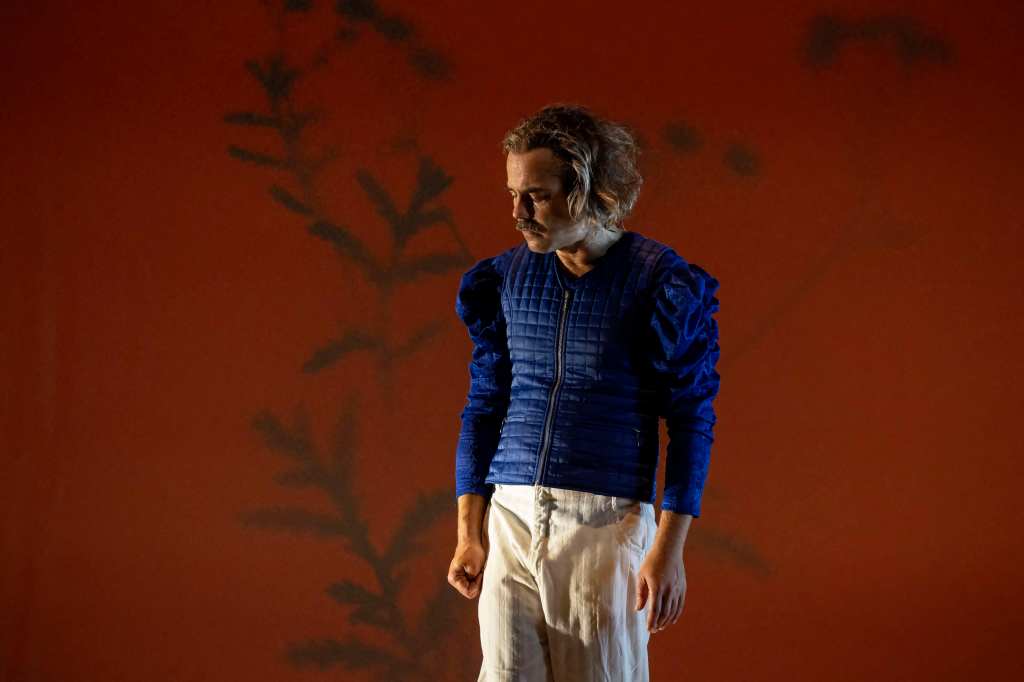
A performance of music theatre at the crossroads between early and contemporary music, Earthrise brings to the stage an age of scientific revolutions, science denial and witch trials: our own. Astronomer Johannes Kepler and his mother Katharina Kepler are the unexpected guides inviting us to look for answers in our dreams.
Earthrise tells of a world that is losing its mind. In the year 1624 (or 2024) while political and religious forces fight for influence, scientific research unravels crucial data that calls into question our way of thinking about our place in the universe – and we react with nothing but confusion and embarrassment.
In his science-fiction novel The Dream, astronomer Johannes Kepler (1571 – 1630) tried to advance a new worldview by speaking to his readers’ imagination: what would our world look like if seen from the Moon? Kepler toiled against all forms of dogmatism, and even had to defend his own mother Katharina Kepler (1546 – 1622) in a witchcraft trial. However, he never ceased to believe in a secret harmony governing the world; a harmony we get to experience fully only with the help of science and the arts.
Inspired by the lives of Johannes and Katharina Kepler, Earthrise combines 17th-century compositions with genre-bending new music by composer Juha T. Koskinen and vocal artist Anni Elif Egecioglu. The libretto is devised by writer-director Aleksi Barrière, providing his frequent collaborator, actor Thomas Kellner, with a new multilingual tour-de-force. Helming the Finnish Baroque Orchestra, cembalist Marianna Henriksson invites music by Kepler’s contemporaries such as Scheidt, De Monte, Harant, or Praetorius to enter a dialogue with the music of our time. Embracing a dramaturgy of multimedia collage, the piece’s visual world is created together with lighting designer Étienne Exbrayat and video artist Lucia Schmidt.
EARTHRISE
Premiered at the Finnish National Opera, Helsinki, on October 17, 2024.
Text & Stage Direction: Aleksi Barrière
New Music: Juha T. Koskinen
Early Music Montage & Cembalo: Marianna Henriksson
Songs & Vocal Improvisations: Anni Elif Egecioglu
Actor: Thomas Kellner
Instrumental Ensemble (7 players): Finnish Baroque Orchestra (FiBo)
Lighting: Étienne Exbrayat
Stage Design: Aleksi Barrière & Étienne Exbrayat
Video Design: Lucia Schmidt
Sound Design: Timo Kurkikangas
Early Music Composers: Kryštof Harant, Philippe de Monte, Michael Praetorius, Samuel Scheidt, Johann Hermann Schein, Romanus Weichlein
Production by the Helsinki Early Music Festival, in collaboration with La Chambre aux échos, the Finnish Baroque Orchestra, and the Finnish National Opera
Excerpts
SONG OF LIBUŠE (in Czech)
There were three sisters in Bohemia,
born from the blood of Čech:
Kazi the healer, Teta the priestess,
and Libuše, who saw things to come.
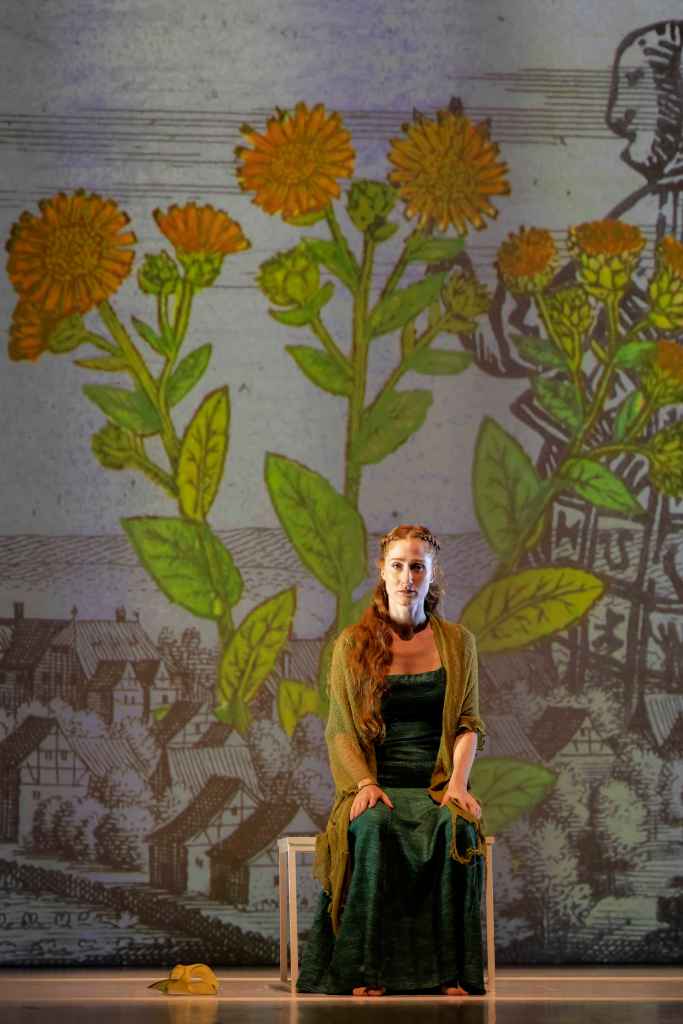
Kazi knew the power of plants
and could ease any ailment,
Teta conversed with the gods
of springs, mountains, and fire.
But the wisest sister
was the youngest of the three,
who read the stars and the Moon:
Libuše, who saw things to come.
But when the princess solved disputes,
her fairness was disliked.
So she said: “Our nation shall have a kin
Who will rule with a stern male mind.”
She chose herself a king
and built a castle too –
and so Prague was born,
thanks to Libuše, who saw things to come.
When all three sisters were dead,
the nation was ruled by men only,
and the names of plants were forgotten,
the spirits of the forest disappeared,
and the future was obscured.
And when women rebelled
to restore the order of Libuše
the men crushed them in Divoká Šárka,
and the rule of women was over for good.
Since then you are nothing but an old story,
even though you saw things to come,
oh our mother, Libuše.
(…)
DURACOTUS: (in Latin)
We ventured on the far side, in the hemisphere that is invisible to man. Oh what vision. The fixed sphere of the stars, shining in all its glory, offered to our endless contemplation – for the nights of the Moon each last as long as two of our weeks, followed by two weeks of day, as we are accustomed to notice from its monthly cycle.
But the greatest wonder was on the other hemisphere of the Moon. Walking towards it, over the horizon we saw Her rise. The Earth. This side of the Moon is always facing it, and our planet appears as if nailed to its place, albeit rotating in a daily cycle. The inhabitants of the Moon do not call it Earth – as they themselves have earth under their feet – but Revolva.
(In German) (I have noticed that the Latin name for the moon, Luna, comes from the same root as lumen, the light. Being white and luminous is the Moon’s most obvious characteristic, hence the name. Likewise, inhabitants of the Moon would name our Earth according to what is most striking – to them – about her, namely, that she revolves.)
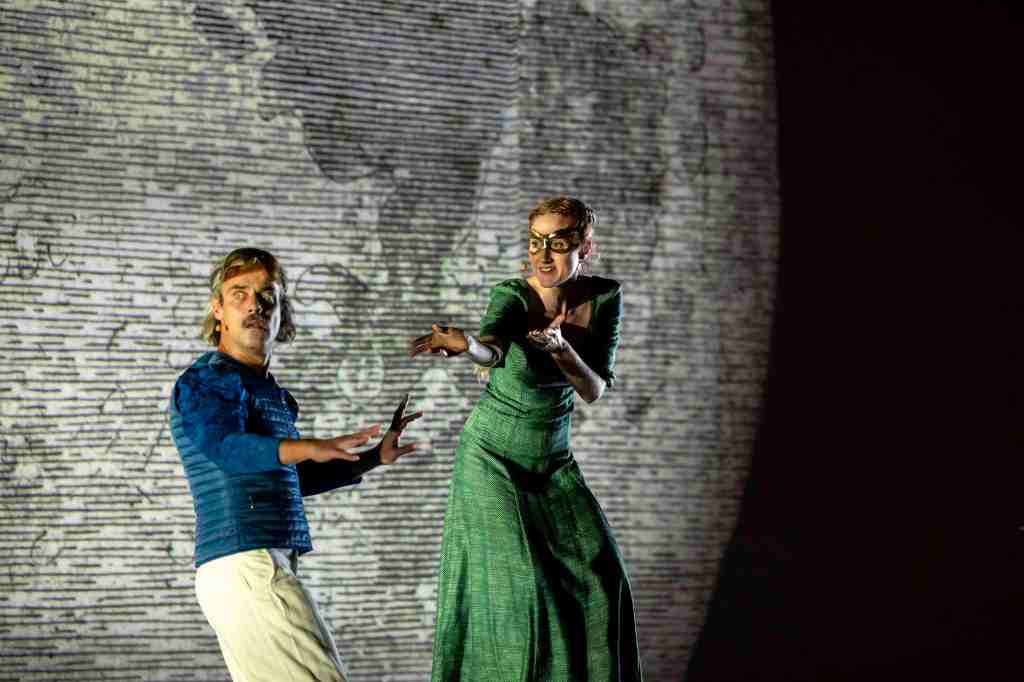
You are certainly curious of the lives of these Moon-dwellers. Because each Moon-day lasts two Revolva-weeks, and the powerful earthshine also carries its own heat, you can only imagine how hot the climate must be, comparable to what travelers describe of the tropical weather of Peru… This must be the explanation to these strange circular, hollow structures that are found everywhere on the surface of the Moon…
For these perfect circles couldn’t have been produced by anything else than intelligent architects. I can only conjecture that these hollows are the result of digging: the center is cultivated as fields that, due to their shape, most excellently capture rainwater, while the inhabitants dwell in the mounds of soil from the dug, arranged into a rampart that provides protection from both intruders and the scorching sun… The Moon-dwellers, then, can move along these circles and follow their shade…
(…)
JOHANNES: (in German)
The honorable and distinguished magistrates have been giving credence to unreliable gossip meant to tarnish my mother’s name. It has even been suggested that it is her abuse that has driven away my father Heinrich. Nothing could be further from the truth. My father repeatedly abandoned our home to pursue the unruly life of a hired soldier, and my mother has raised me and my siblings alone through hardships. Nothing in her conduct indicates anything but piousness and interest in medicinal herbs, and every illness she is being accused of can be attributed to natural causes, as she has herself pointed out. It is a disgrace to cast doubt on an aging woman simply because she presents the common traits of her age and sex, and even more so to threaten her with torture, which is in our century contested by many great legal authorities of our Evangelical faith, as an unreliable method of interrogation, and a desecration of God’s image in man. What are we, Catholics?!
KATHARINA’S LITANY: (in English)
In January the widow Margaretha Frisch
confessed under torture that she was a witch
who sometimes slept with the devil in the forest of Sindelfingen
and followed his perverse orders and danced at his Sabbath.
She died in prison two nights later, before they could burn her.
In February they tortured the widow Lena Stüblerin
who confessed to making bad weather with her spells
and plaguing villagers with disease and calamities.
She was beheaded and her corpse was burnt to ashes…
In March…
JOHANNES: (in German)
My mother’s lack of tears in court has been used by the honorable, most distinguished, respectable and wise magistrates as proof of her moral corruption is in complete disregard of the severity of her upbringing and the destitutions she has suffered. Was she ever one to indulge in great displays of affection? Certainly not. But every testimony indicates nothing but her desire to help members of her community, and ask for their help when she needed it, as an ageing woman whose children have all moved out of town. She is in no condition to freeze in a cell through the winter, with a chair in lieu of bedding, chained to the wall, which is torture in itself.
KATHARINA-ish: (in English)
Despite months of legal proceedings, Johannes could only stall.
Only when Katharina was showed the torture instruments as way of intimidation, and still refused to confess, was she acquitted for lack of evidence,
after fourteen months in prison.
She died four months later, at the age of seventy-five.
JOHANNES: (in German)
My wife Barbara, our child Friedrich, my mother…
One after another taken from me…
Disease, oppression, superstitions rule on all sides…
I hunt for employment from city to city, while the continent is set aflame by wars between Christians and Turks, Catholics and Protestants, Lutherans and Calvinists…
I can barely tend to my scientific work, and craft astrological predictions for warlords instead…
Galileo is taken to trial, for stating what has been proven over decades by countless observations and calculations…
This is not what this century was supposed to be about.
This was supposed to be our great Enlightenment,
our great march towards the knowledge of God’s perfect design,
our new science that carried freedom and piece.
There must be a hidden harmony behind this chaos.
I cannot prove it, but ignorance cannot prevail. I refuse.

(…)
ACTOR:
During Katharina’s trial, Johannes Kepler read a treatise by the lutenist and composer Vincenzo Galilei, the father of the astronomer. The old man was complaining about the florid and intricate polyphonic writing that had become the fashion in the late 16th century. “Confusing, corrupt, foreign to the true method of ancient music,” he said. Soon, a derogatory word was invented for this, they called it baroque.
That is when it dawned on him. The Ancient Greeks had used musical proportions to describe the perfection of the heavens as a Music of the Spheres, but the problem was, their music wasn’t complex enough! Without polyphony, how could they imagine how sophisticated the music of the cosmos would be to our ears if we could hear it.
He, Johannes Kepler, lived in an age when new dimensions of complexity could be achieved in music, with four, five, six voices, or more, playing at the same time and yet forming music, music in which new harmonies and even dissonance had a role to play. Only such music can make us begin to understand the enigmatic motions of the universe that he and his mother had tried to decipher. Through such an exquisite collaboration of the mind and the senses, not only our intellect, but also our imagination is moved, which is the only power that can truly, in turn, move us to change.
(…)
FINAL SONG (after Johannes Kepler’s Harmonices Mundi, IV)
What kind of animal is the Earth?
You may ask –
What kind of animal is the Earth?
The Earth grows trees and beasts
Like a dog grows hair and lice.
The Earth is an animal like a dog.
But the Earth is slow and calm,
While its rage is daunting when it shakes.
The Earth is an animal like an ox.
But look at the ebb and flow of the sea,
Like the breathing of a fish:
The Earth is an animal like a fish.
But the Earth feels and remembers,
And erupts like a man does.
The Earth is an animal like a man.
But the Earth’s soul is of fire,
Like the fire of the sun.
The Earth is an animal like the sun.
But the Earth contains all images
Like the Zodiac of the stars.
The Earth is an animal
like everything that is.

 >marginalia*