ÉMILIE, Opera in Nine Scenes, by Amin Maalouf (libretto) and Kaija Saariaho (music).
New production premiered at Avanti! Suvisoitto Festival on June 26, 2025.
Pia Freund & Meeri Pulakka, sopranos
Ada Freund & Janne Marja-aho, dance and choreography
Sanni Antikainen, harpsichord
Avanti! Chamber Orchestra
Aliisa Neige Barrière, conductor
Aleksi Barrière, stage direction, dramaturgy, video
Étienne Exbrayat, set and lighting design
Timo Kurkikangas, sound design
Satu Muurinen, costume design
Teija Paananen, tayloring
Alisa Kaksonen, hair and makeup
Rehearsal pianists: Tiina Karakorpi, Elias Miettinen, Joel Papinoja
Production by Kokonainen/Musequal, Avanti! Chamber Orchestra, Dialogia -festivaali ry
Linda Suolahti, artistic curator, executive producer
Sera Syvänen, project coordinator
Anni Kallioniemi, media manager

A Prism. Émilie du Châtelet (1706–1749) was many things, like all of us. Amin Maalouf and Kaija Saariaho sought to create as multilayered a portrait of her as possible, and to achieve this they chose the most multilayered art form, opera. Orchestra, solo harpsichord, singing voice, electronics to expand them, and the full possibilities of the stage: all come together in a performative form that speaks to the complexity of who that one person has been.
Émilie was many things indeed: a scientist, a writer, a harpsichordist, a singer, a mother of three, one man’s wife, another man’s partner and muse, the lover of a few others. She relished the pleasures of life as much as scientific and philosophical discussions, embracing the sensual and the cerebral with equal passion, both privately and as an author and scientist.
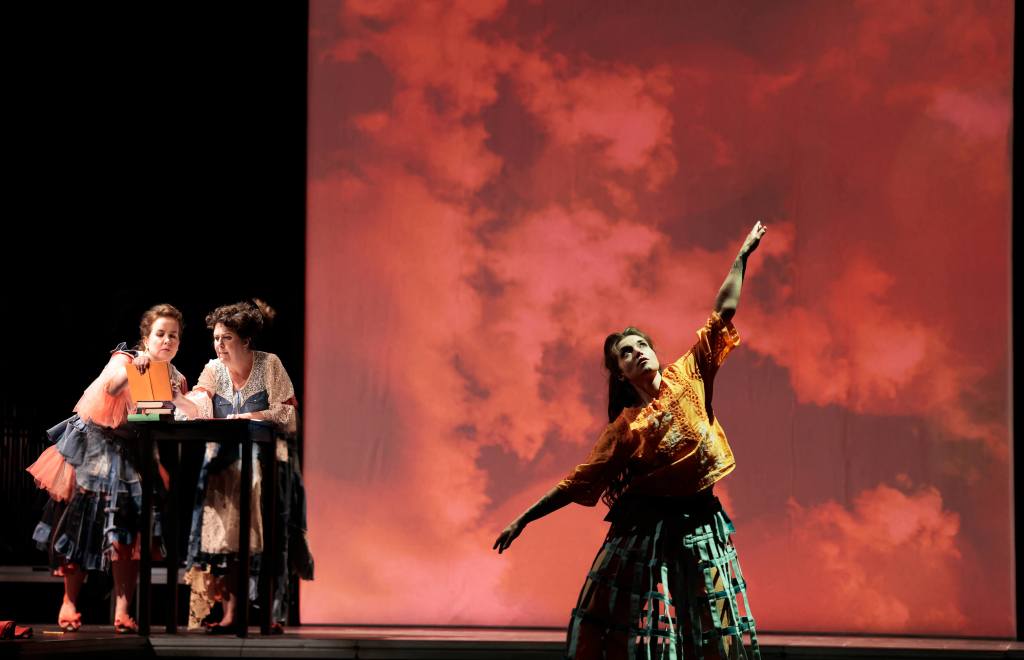
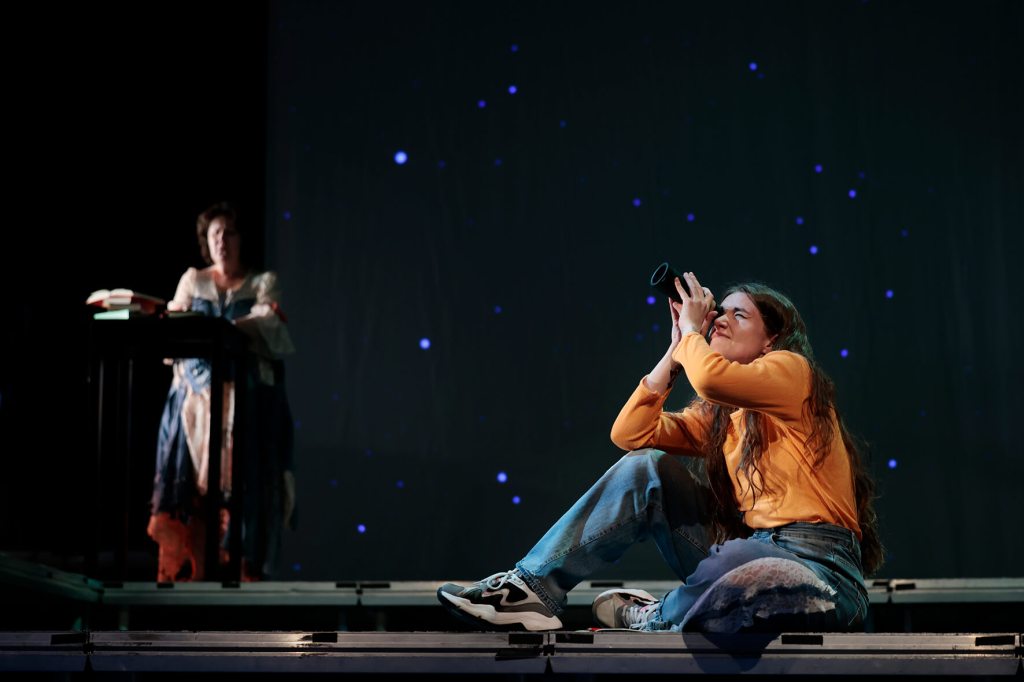
The opera Émilie does not attempt to tell everything about Émilie du Châtelet’s life, or lives. For just over an hour, we meet her in a critical state – pregnant, in love, at work, fearing death: her translation of Newton’s Principia Mathematica must be completed before she gives birth, her survival prospects being poor at the age of 42. The past fills the stage and coexists with the emotions of the present, hopeful visions of the future, and the unfolding of a scientific and translational process. As death approaches, all levels of Émilie’s life are present and in conflict. To flesh out this mental theatre, we have elected to divide the monodrama’s vocal line between two singers, representing Émilie in the present and at a younger age, who enter a dialogue. In addition, dancers appear as, respectively, a younger Émilie (indistinguishable from her imagination of her future daughter) and the men whose memory haunt her. The harpsichord player is another Émilie figure that bridges the operatic world of psychological drama and the choreographic world of raw emotions, archetypal situations, and abstract images.
In this staging, we aim to look at Émilie through a glowing prism. As an object, the prism was a source of fascination for both Émilie du Châtelet and Kaija Saariaho in two interconnected ways: as a scientific instrument that dissects visible reality to reveal its secrets, and as a source of endless aesthetic pleasure. Both Émilie and Kaija believed in science as an aesthetic experience – it is therefore no surprise that the prism proved to be an artifact of personal importance to them both. If there is something that we try to learn and pass on from the Age of Enlightenment in this performance, let it be the Rococo’s sensual interest in the mysteries of nature and the pleasures of good company, its fondness for iridescent surfaces and ever-transforming clouds.

A Heroine or a Human Being. Émilie du Châtelet is not a hero(ine), and no such figure is to be found in any of Kaija Saariaho’s other operas either. Kaija was interested in the ambivalences that make up both the world of sounds and human life. She has herself explained how she had, at the beginning of her career, focused more on belonging to a world of men than on solidarity between women, in particular when it came to protecting younger female colleagues from problematic men and sharing opportunities with them. In the 2000s, her stance evolved into outspoken feminism. Émilie also tells of such a growth, one that is deeply rooted in the history of exceptional women.
Émilie du Châtelet was a trailblazer, but it must be acknowledged that she has defended the status of women by example alone. An example that has been a great inspiration to many. But does idolization truly serve any cause? “Pity the nation that needs heroes,” mumbles Bertolt Brecht’s Galileo, when realizing that he’d maybe rather not die for science after all. Real people – for instance Galileo Galilei and Émilie du Châtelet – are much more interesting than heroes, if only because real people – for instance us – have much more to learn from them.
All of Châtelet’s advocacy for equality was motivated by the furthering of her own scientific career; she never defended or assisted other female writers or scientists. Moreover, like most women of her class, Châtelet rarely even met her own children as they were growing up, and she didn’t support her daughter’s potential intellectual achievements. She did provide her son Florent-Louis with a home education befitting his status, but her first-born Gabrielle-Pauline spent her adolescence in a convent, awaiting the marriage her mother would eventually arrange. In her youth, Gabrielle-Pauline was reported to be curious and studious, but from the onset her life was scripted to be limited to the most traditional courtly role. To Florent-Louis, Émilie dedicated her textbook Institutions de physique, hoping that it would “inspire in him love of science and desire to develop his intellect.” Florent-Louis, however, had no taste for science. He later became a marshal and a diplomat, and until the very end embodied the old world to which his family belonged – during the French Revolution, his life ended under the blade of the guillotine. What Gabrielle-Pauline’s life might have been like, had she had a similar upbringing, we will never know.

A Child. In the summer of 2008, Kaija Saariaho handed me Amin Maalouf’s libretto draft, then titled Émilie: The Last Letter. The entirety of the text was one long letter written by Émilie du Châtelet to her lover Saint-Lambert, and the form felt somewhat stiff. My own career as a librettist and theatre-maker was in its very early stages, but I ventured to give feedback on two points: there could be more recipients, including Émilie’s unborn child, and the use of different languages could also be more varied. The multilingualism was developed further – yet the question of taking it to the next level kept haunting Kaija and myself, and it was only years later that we brought to life our vision of a thoroughly multilingual opera: Innocence. In retrospect, the most important insight I had to offer was instead the idea that Émilie du Châtelet’s pregnancy perhaps also meant something else to her than impending death: the possibility of another future. Although she had not cared about the matter earlier in her life, she might have, in the critical moment depicted in the opera, with deeper life experience, considered everything that she could pass on to a potential daughter, and what the life of the next generation(s) of women might look like.
This possibility remains a question mark: Émilie died in childbirth, and her daughter Adélaïde died an infant a year and a half after her mother. But the hope contained in every new life is one that each generation rekindles – the hope for a somewhat better life and world, to which we too might still contribute. What else could be the point of creating such works as this? In addition to the prism metaphor, my early insight concerning this child motive’s importance grew into this staging’s central idea.
Émilie tells of an age dominated by individualism and rigid class structures, but it also allows us to dream of a future that makes different choices, first and foremost choices of solidarity. As a musical score, it proposes something even more important: an actual enactment of this ideal, by bringing together the diverse constellation of performers that is present in this performance, each one of them a soloist. Women of many disciplines and generations, who, at the highest level, allow us to experience what Émilie has been and what all the Adélaïdes of the world might be, if given the chance.
A Woman. In 1736, upon hearing of a forthcoming opera by a composer known to posterity only as Mademoiselle Duval, Voltaire wrote to a (male) friend of his: “I would be delighted at the success of an opera composed by a woman. It would prove that women can achieve everything we can.” Voltaire supported Émilie du Châtelet’s achievements throughout his life, and posthumously published her Newton translations, but in the realm of opera he was not to see his hopes fulfilled. It was only much later – three hundred years after Émilie du Châtelet’s birth – that a woman achieved universal success in the field of opera and entered the canon. It has been a privilege to be there when it finally happened.
June 2025
Programme note translated from the Finnish original.

 >marginalia*