Monologue written to be spoken inside the music of Kaija Saariaho’s concerto Graal Théâtre.
Premiered by Thomas Kellner (actor), Peter Herresthal (violin) and Clément Mao-Takacs (conductor) at Sentralen in Oslo on May 21st, 2018, with the Oslo Filharmonien. Stage Direction and Video by Aleksi Barrière, Stage Design by Étienne Exbrayat and Aleksi Barrière.
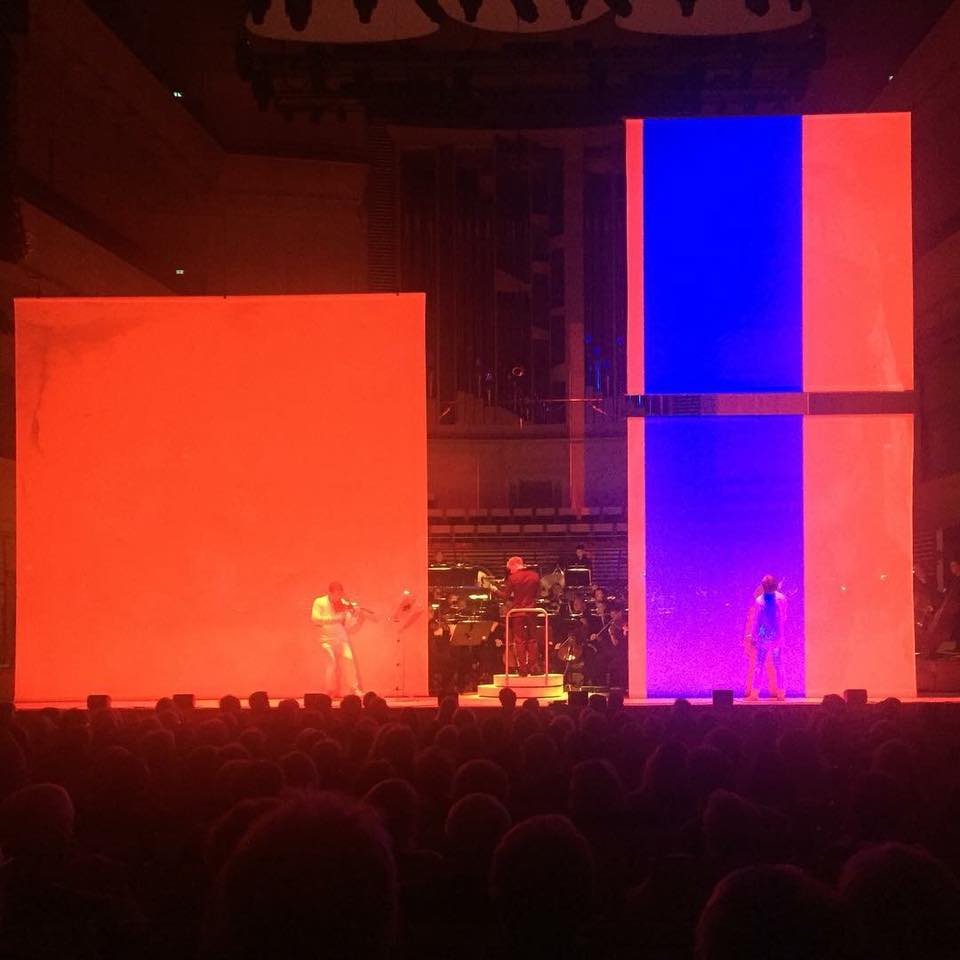
The mouth speaks:
I have great admiration for people who are able to organize a tree into a book
And number the forest
But I speak of a time when books and stringed instruments had one thing in common, they were made out of the carcasses of animals, their skin their guts
Such was the medium in which God was praised : )
Deserving of the most serious stories. However, the monks who copied them with utmost care also adorned the margins with colorful illuminations, jesters, tricksters, baboons, drolleries, that wouldn’t let the black letters stand still.
Broken images from a broken mirror
Unrelated to the story
Or maybe forcing us to ask what the story really is
?
The curved line of a question: a quest
A detour around the world on the way back home
A thousand-year-old caravan
All stories can be told in one sentence
But then where is the pleasure?
Three-times-a-knight comes to the castle of the wounded king
He is treated like a guest, offered dinner,
A procession presents a hollow dish
Only if the knight asks the question will the king be cured of his rotting wound:
What ails you?
[Enter the Knight]
The drum, the sound parchment, keeps watch in the night
The silverpoint forest stands much taller than me or you
You see The armor of innocence sparkles darkly
Heavy with dreams of conquest
[ADVENTURE 1]
Bless —
Lead and follow
Dance with that beast
Lead and follow
How hard is it to listen?
The forest is burning / Saffron storm / Weightless ashes fly
Learn the art of falling
Learn how to take a fall
Breathing is not a matter of experience
But it can be unlearned
[Castle, Procession, etc.]
You converse and
The castle cracks open like wood in the winter
Why can’t you act on what you see?
You want to ask the question but you dare not
This is not a quest at all
[Grave Interlude]
Let us resume
[ADVENTURE 2]
“Scene of love interrupted by the clamor of battle”
The sheets are warm Metal against naked skin
Heavy seats Embroidered something Thirsty flowers in a vase
War is calling It is the hour of the drum
[Castle, Procession, etc.]
How well he falls!
How has life been treating you, are you learning how to rot?
How well he falls
He falls in love
He falls asleep
A dream of endless falling
A garden that is a labyrinth
Electric lights flashing in the branches
The sound of a party far away
In the darkness you recognize a familiar foreign face
And the dance is never too much on your limbs
And then you know the feeling of royalty
[Broken Mirror, Ablaze]
You wake up into another dream
We stare into each other
Who is whose Commentary?
Are you mine or am I yours?
We begin to understand who our enemy is in this war
And we wake up all over again
She with carmine smile gone
Sea of blood washing your head
This was not fall this was loss
That crack in the mirror – is you
Indigo water lilies
Winding around your legs in the pond where the castle stood
Shadows swimming in muddy waters
Juggler. Juggler walk the tightrope.
𝄐
¡What a silence Listen!
It’s upon impact only that you know
Whether you have mastered the art of falling
I wonder As you go
Do you not wonder sometimes why you are there
Not because it’s meaningless but simply because you forgot?
I walk the world with very little wisdom
And like a swimmer without leaving a trace
Soft and fierce
Like someone’s scream in the palm of my hand
Like the cracking of black ice under my foot
Atmosphere piled up on us into hazy cobalt mountains
Heavy body surface pressure
Body useless if not taken apart to make an orchestra
Do you think
I cannot speak the language of birds too?
Do you think
I cannot make the thin air sing?
Well you are right
Read me You can feel how words make my skin blush
They won’t carve my flesh away
This is no instrument yet
Look at this parchment peppered with eyes
Look at this drum that breathes and listens
Look at these strings Bowels still
How they read how they sound
Ink me
What ails you.
[ADVENTURE 3]
What ails you?
We embark on a boat without sails
It takes a cathedral of cartilage to play an eardrum
Hollow Echo Echo!
The Dark Ages have ended so they say
Symphonies Printing press All meridians crossed
White rhinoceros White lead White dust on your hand
Mind the backwash brothers sisters as you drift
“Shipwreck of a colonial vessel in a tropical storm”
Ochre cloud on the black ocean for a useless war
Burnished nameless faces and shiny eyes watching
You belong to the same world of terror as me:
We tell the same stories about it
[Jester Sings Along]
Take me to the silence
Talk me through the silence
Be my hollow and let me grow
[Castle, Procession, etc.]
We
relinquish
all
destination
Hundred ways and lives all lived at once
Behold the transformation of the knight into the thousandfold tree:
[Transformation of the Knight Into the Thousandfold Tree]
Oh the precious two thousand nerve terminals in
Each square millimeter of your fingertips
Here comes the song of the beast with a hundred mouths:
[Song of the Beast With a Hundred Mouths]
What more? Whereto now?
You wish you could read from the morning stars
Your own shadow dancing among shadows:
The echo of what you were looking for
[Exit the Knight]
Hush
Bless
And ink the silence
𝄐
Composer’s Note
When Aleksi Barrière came to me and suggested writing a text that would be spoken over my violin concerto Graal Théâtre, I did wonder what he had in mind. But by then the piece had had a performance history of nearly 25 years and I had heard so many different versions of it, good or bad, that I thought: why not try something new. Aleksi came with very precise proposals about where to place the text in the music, conceived as to require little more adaptation than a few fermatas and repeats. He started writing his text only when I had green-lit those placements, and at that point I still had no idea what he could possibly be writing about.
I was astonished by the result when I first heard it. The text had found its place naturally, at times surfing over the music like a melodrama, at times actually supporting it – or simply challenging it into a conversation between equals. I got similarly puzzled feedback from listeners who knew the original version and now tried to remember what might have ‘filled the holes’ now occupied by text. The result was so integrated that I decided to make this new rendition available as a version on its own right, alongside the original for symphony orchestra from 1994 and the chamber version from 1997. Both instrumentations can be and have been used in conjunction with the new text.
The text was premiered by a male actor, Thomas Kellner, but there is no obvious limitation to the kind of voice that can perform it. The only requirement is that it cannot be performed by the solo violinist, as this is clearly another voice commenting on the adventures of the ‘hero of the night.’
Kaija Saariaho, 2022
Librettist’s Note
The text Not a Knight was written in 2018. The conductor Clément Mao-Takacs had seen me struggle with my staging of the violin concerto Graal Théâtre, born at the behest of star violinist Peter Herresthal, and gently suggested I might need to attempt a bolder gesture – the same kind a young Kaija Saariaho had made when deciding to write her first concerto, herself inspired by the boldness of Jacques Roubaud’s and Florence Delay’s rewriting of the Grail legends, from which she borrowed her title.
No return was possible to Roubaud’s and Delay’s text, nor to any other version of the legends: Kaija had moved into another dimension entirely, and boiled down the layered tales to their essential structure in order to create, in the form of the solo violin part, her first fleshed out protagonist, foreshadowing her accomplishments as an opera composer. A concerto is etymologically a fight between a soloist and an orchestra, and in this specific concerto I perceive three arcs that can be seen as three separate adventures, by three heroes or three aspects of the same archetypal hero: in the first one, the soloist is sheer self-affirmation and seems to either ignore the orchestra or coerce it into mere accompaniment; in the second one, a more flirtatious and bilateral relationship is established, but the point seems to get lost along the way; only in the third arc does a more original way of dancing together develop, redefining the binary notion of the concerto itself. The story of the solo violin can be understood as the story of all stories in its purest form; one can also choose to think of it in relation to the legends of different knights coming to the wounded Fisher King and (like Percival and Lancelot) failing to ask him the one question that can cure him, symbolic of listening, the core of both basic human empathy and of music-making – the question that will ultimately be asked by Galahad the redeemer: What ails you?
To the question of why these fine musical adventures, that function more than well on their own right, would require or even tolerate textual gesticulations in their midst, we answer with another open question: why were the most serious medieval manuscripts illuminated with illustrations, sometimes little more than silly doodles filling up the blank space left between the lines of the text? Not a Knight gives a voice to the jester who accompanies the knight on his most glorious adventures, offering in his lowly manner scathing comments that can turn out to be essential reality checks for the hero, or at least new entry points for the reader. Intently colorful in all possible senses and accidentally mystical, this text is no more than the dance of a jester, or a monk’s idle, spicy marginalia, to a scripture perfect in and for itself.
As a subordinate to the music – a pleasant reversal of roles to toy with – the text does sometimes borrow its logic, more associative than narrational. It is designed to open new avenues in the listener’s imagination rather than limit it. As such it follows the tradition of earlier texts that have brought the Grail legends into our times of nihilism: Roubaud’s and Delay’s Graal Théâtre as much as Eliot’s The Waste Land. But in contrast to those forerunners, Not a Knight joyfully embraces the absence of chivalry characteristic of us hollow men, and the very emptiness of the mythical chalice itself. Listening, becoming resonant, finding or gouging into oneself that void that will allow for other voices to echo, is a strange quest that unveils its meaning only after many adventures, in the same way that it can take half-an-hour of complex music to create a beautiful silence. This silence became particularly loaded when Kaija decided to revisit the world of this collaboration in her final, posthumously premiered work, HUSH, which is based on musical material from Graal Théâtreand textual motives of Not a Knight. In her last fight against brain cancer, she had come to find the Fisher King a more relatable figure than the knight.
This version owes much to its co-creators, Kaija Saariaho, Peter Herresthal, Clément Mao-Takacs, and of course the titular buffoon: the actor Thomas Kellner, who workshopped it with me until it found its shape and tone. With this work now widely available, I am curious to see who else will engage in the same quixotic quest.
Aleksi Barrière, 2023


