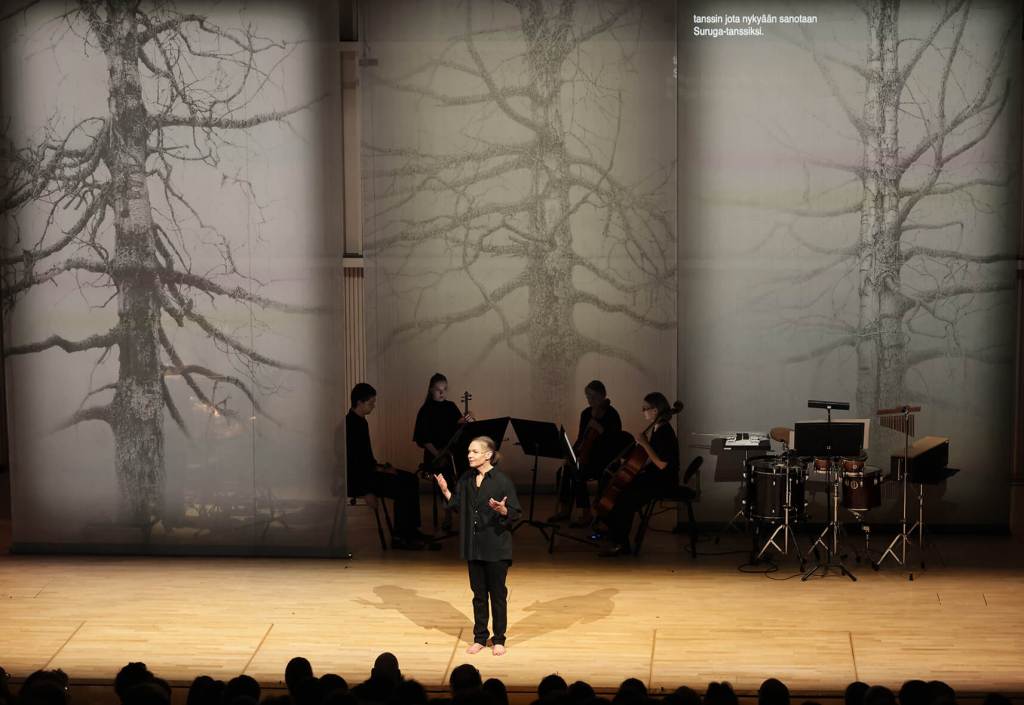
A musical monologue for actor and percussion, created to serve as a prelude to the music/theatre performance SECRET FLOWERS, including Noriko Baba’s Hagoromo Suite and Juha T. Koskinen’s and Selja Ahava’s The Woman on the Sixth Street. The text of PROLOGUE was published as the preface to the latter work’s libretto (Kimaira, 2026).
Music by Juha T. Koskinen
Text by Aleksi Barrière
World premiere on April 18, 2026 at Tampere-Talo within the Tampere Biennale, by Petriikka Pohjanheimo (actor) and Tuija-Maija Nurminen (percussion). Staging by Aleksi Barrière.
Libretto
(Intimate aura ~.)
I want to tell you a story. This is not a secret. This is all public record.
The inhabitants of Suruga Bay, in Japan, say that a heavenly maiden, a tennyo ~, once descended to the beach of Miho no Matsubara. She removed her feather robe, probably to have a swim. ~ While she was away, a fisherman discovered the robe hanging on a pine tree and found it so beautiful that he decided to keep it for himself. When the tennyo ~ returned, she begged to have it back – the feather robe was what gave her the power to fly back home to the heavens ~, and without it she was stranded on earth. ↘ The fisherman refused, and would rather see the maiden die than give up such a treasure. However after extensive negotiations, he gave in and returned the robe, in exchange for learning a dance from the maiden~, a dance we know today as the Suruga Dance. ⇅ You can still see this dance performed, you can even go have your picture taken next to the pine tree on which the feather garment was found. If this is not a true story, I don’t know what is.
And yet, ↓ it is somewhat suspicious isn’t it that nearly the same story
is told in the province of Ōmi, ↓
where they say the robe was found on the shore of Lake Yogo, ↓
and on the island of Okinawa, ↓
where the tennyo ~ is said to have bathed in a river. ↓
But there, things played out differently, they say –
the man who found the feather robe concealed it,
and the heavenly maiden had no choice but to marry him, start a family with him,
until the day when, years later, she recovered the robe and could fly away from this world. ↗
(Widening gestures.)
It also happens to be so, it came to my attention
that centuries before these feather robe incidents started in Japan,
a story was recorded in China
about a young man in the province of Jiāngxī,
who stole a bird-maiden’s feather mantle while she was bathing in a pond,
and forced her to become his wife.
And the same story is told with small variations – also as a local incident –
in different parts of Korea and Siberia.
Always the man traps the bird-maiden ↓
and always the bird-maiden flies away eventually. ↗
Actually, and you will have to bear with me on this,
stories of trapped bird-maidens appear in many other places too.
Down the South Seas, ↓ in Aboriginal tales.
In Central Asia, ↓ among the Tatars.
The Norse told a similar story, ↓
and they must have wondered how
the Slavic, ↓ Germanic, ↓ Celtic, ↓ Sámi, ↓ Inuit people ↓
whom they met on their travels
could all have their own versions of it. (⇅ Suruga Dance.)
And we wonder the same. (Libero.)
What is it that these stories are trying to teach us?
Is the point that, statistically, heavenly maidens
are incredibly careless about their feather mantles?
Or is there maybe another reason this story is being told in so many places and times?
(Crescendo.)
Did the story travel, as a useful tool that people pass on to each other,
like stone blades are, musical instruments, or domesticated fire,
but then useful for what? ⇅
Or was the story maybe reinvented over and over again,
in places whence birds migrate,
to celebrate their arrival in the spring ↘ and their departure in the fall, ↗
or was it because everywhere men are the same,
and in every village the women made a story of their callous impulse
to trap, to cage, to control what they don’t understand,
to collect beautiful feathers? ~ ↗ !
(Sharpening the focus.)
Do you also tell this story?
What do you make of it?
What will make this story true for you?
Will you believe it better if I tell you it happened yesterday,
right here, [on the Tammerkoski next to the power station,]1
and you know it could and it probably did,
or does it hold more truth when I tell you they told
the same old story already in 8th-century Japan?
Is there more veracity in the archetype,
the universal outline that all these stories have in common,
the story’s immortal core,
or in the small variations that every storyteller
adds specially for their audience, here and now?
This is not a secret, I told you.
The greatest mysteries it seems are hidden in plain sight.
(~ Whispers of the dead storytellers take over the stage. Total sun eclipse.)
1 The part between [brackets] is to be adapted to the location in which the text is performed.


