Introducing the collection
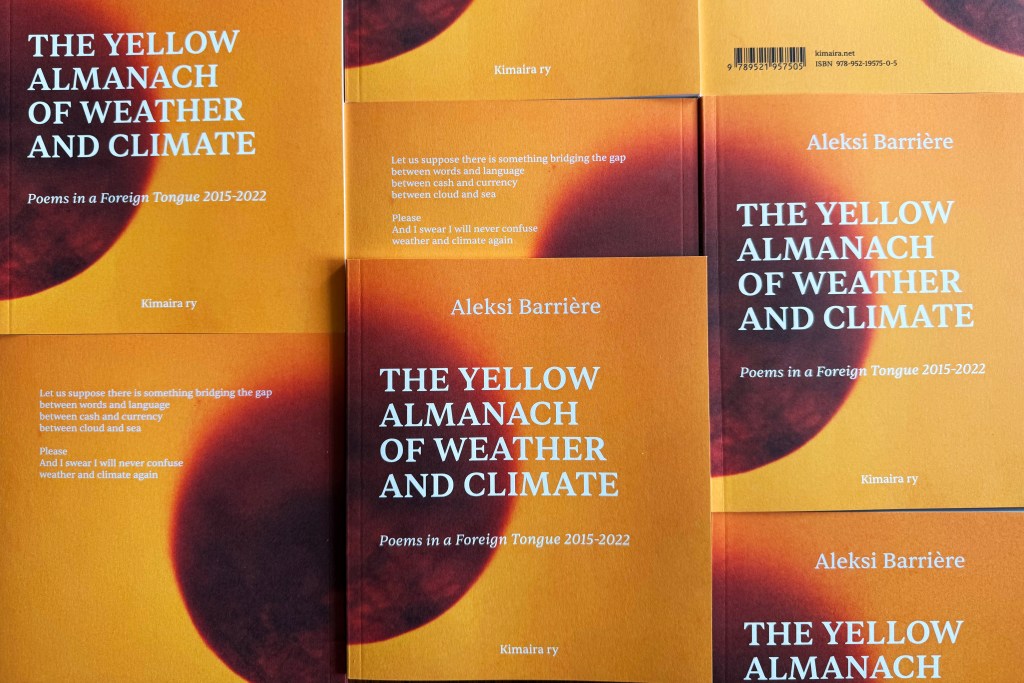
THE YELLOW ALMANACH OF WEATHER AND CLIMATE
Poems in a Foreign Tongue 2015–2022
by Aleksi Barrière
Published by Kimaira ry (2026)
68 pages
ISBN 978-952-19575-0-5
Layout and cover: Lucia Schmidt
What are these poems?
Most of my published ‘poetry’ only appears as part of musical scores, because it falls under the category of ‘libretto’, meaning text written specifically to be set to music. Per se this is not a misrepresentation of my literary work – most my writing is collaborative in that way, as working for the stage, with composers and performers, has been the core of my creative activity in the past two decades. However I also write things that are not meant to be set to music, which is a very different thing. When you write for the stage or for a composer, you leave a certain amount of room for someone else to step in and ‘finish the work’, it’s like tailoring clothes: the seams have to allow for a body to move in them. When you write a self-enclosed poem, you can use that same space yourself. Of course there still has to be room for a reader, but it is appropriate for them to struggle a little more. From the perspective of a reader, opening a poetry collection shouldn’t be like going to a tailor, it should be more like trying thing out in a thrift shop and making findings there.
You mean the poems in this collection were literally written for the drawer?
Not exactly… A lot of these English-language poems actually were first published one by one on social media. They were born from situations in which I wanted to create something self-contained, that I could both write and publish within a day or two, in contrast to projects that take months or years to meet an audience. However they were rarely ‘one-offs’, most of them turned out being part of what I called series. This was the case for instance of the Calendar series, where coincidences between generally meaningful dates (solstices, holidays, etc.) and personal events or anniversaries prompted the writing of a poem, or the Condensations series that was about capturing a situation or a mood into a closed form (‘condensation’ being of course the literal translation of the German word for poetry, Dichtung), while the Temperamentswere character studies. A special category was formed by short captions that were originally posted with pictures I took – I realized they were much more interesting without the images, and thus became Captions to Absent Images. And then there are the Unanswered Letters, that were originally written to be shared only privately, but were reworked into a cohesive series. In the period covered by the collection, meaning between 2017 and 2022, when I wrote a poem in English it usually organically fell under one of these categories, and the fact that it did helped me shape it and make sense of what I was trying to do with it.
Did the original online publication format have an influence on the poems?
It did, tremendously, insofar that I was frustrated by the limited formatting possibilities (at the time) of social media, the lack of control over how text is presented, so I started deliberately writing the poems to be published as images, which in turn made me think of them more and more visually. I took pleasure in crafting them as pictures that needed to be deciphered, and that made the scrolling user pause to read, sometimes even having to tilt their screen to follow the text, in stark opposition to the easily digestible content (including post-O’Hara feelgood poetry) that fills our timelines. This is why the book is square-shaped: basically my starting point, my canvas for most of these poems was not the traditional page that is filled line by line, but a blank square in which text can unfold on multiple axes.
Another influence that turned out to define the collection’s identity was language. I didn’t by any means gather what they call a ‘following’ by publishing these poems online, but there were some readers out there, and I wanted to be able to address people among my contacts who were far removed from me, acquaintances from different countries, and not just the closest linguistic bubble. So English, the global communication language which I use every day in my work, came to be repeatedly selected as a language of writing, until I couldn’t ignore it anymore and had to deal in my writing with all the problematic things that it entailed.
What do you mean?
Of course English shouldn’t be a go-to – we are surrounded by it because of mass-media, and the pressure that it puts on us to use it as a language of expression, to think even for ourselves in the terms that this globalized version of the language provides you, that is something that should be resisted. Besides, of course my command of the language if not the same as a native speaker’s, so that also begs the question of whether what I do with it makes for even remotely palatable reading. But I realized that I, for one, was interested in trying to figure out my relationship to that language. The labor that is at the core of writing is precisely to realize that you inherit a language full of readymade phrases and words that are contaminated by other use, and making something out of the conflict between trying to think for yourself, feel what you feel, and having such a problematic tool available to verbalize it, a tool so deeply ingrained in your brain that it filters your every thought and even perception. I would argue that writing in a foreign tongue makes that labor more visible to the writer. There is an added distance to the language that hopefully can help approach it more lucidly. At least that it what I have attempted in these poems, using abundantly the tools that are central to my textual practice in general: montage, translation, and multilingualism.
It does re-wire things in an interesting way, when you cannot use the words that would come to you in the language you speak better, but also to have different interlocutors. And I don’t just mean the readers (which had a very concrete impact, as I stated earlier) but the whole literary tradition. I believe writing in the language of writers who have been meaningful to me in one way or another like James Baldwin, Ezra Pound, Sylvia Plath, or Jim Morrison necessarily creates a literary dialogue with those people. The most important conversation partner for these poems is e.e. cummings, whose poetry has nurtured me immensely. I am pretty sure I wouldn’t have metabolized it in the same way without writing myself in English.
How did the idea of this collection come to be?
In the same way individual poems cohered into series, the series started growing together organically. I guess there is nothing surprising about that growth. Similar methodologies create affinities between texts, and a person’s subjectivity prompts them to return that certain motives and themes that are then revealed to be personal obsessions. I never planned to make something like ‘a poetry collection about climate change’, but the themes of weather and seasons kept returning, and as explained in one of the Unanswered Letters, it became more than a circumstantial detail that the words and concepts we have for seasons are becoming inadequate; it turned out to be a core element of writing poetry itself, because poetry is dealing with the fact that words don’t fit, it’s dealing with the hiatus between words and reality, with trying to mend the relationship between words and reality. The friction between the collective and individual experiences is something that you encounter endlessly when you live in big cities (which form these poems’ usual landscape), and should I say when you live in this civilization in which images and narratives travel fast, so the poems are a lot about that, far beyond the specific question of weather and seasons. However, I do find the issue to be beautifully encapsulated by the common confusion between the weather we endure and the global dynamic system of climate, hence the title.
So gradually over the years I had the idea of collecting a selection of these poems into one book with that title. The opportunity came this year when we created the arts organization Kimaira in Finland, and decided to publish small books that are related to performance projects we produce. In this case, the occasion was that the composer Juha T. Koskinen is preparing a setting of the Minotaurus series that concludes the book.
These poems are not entirely divorced from your libretto writing, then?
The Minotaurus poems were never intended to be composed, but Juha was attracted to them precisely because they are formally quite challenging, being multilingual. And he had to struggle quite a lot to map out his own way into them, precisely because that room I usually leave in for the composer wasn’t there. But that is also an interesting dynamic. In the best cases those situations add an extra edge to the stimulation of one medium by another which is the whole point of text setting. The Minotaurus poems pushed some limits for myself too: they are the extreme point to which I could take writing in foreign tongues and fragmenting subjectivity through montage, which is why they could only be the collection’s epilogue.
There is another exception to my earlier statement concerning the origins of the poems, however: the poem CIRCE – Monologue in Shards, which I placed at the center of the book, is originally a libretto written for composer Diana Syrse. I included it because it thematizes the question of language quite explicitly, expands on some of the other figures that appear in the collection, and was a natural and convincing counterweight to the Minotaurus poems.
However the book doesn’t say that the text is a libretto, by choice, in the same way I left out the images that prompted the Captions, erased the dates and occasions that were explicit in the versions of the poems published online, and never say to whom the Unanswered Letters were originally addressed. It felt important to entirely decontextualize all those texts in order to make them into that book. I guess that is why the result is not a journal or a diary, but an almanac.
By the way, why did you spell ‘almanach’ with an H?
It’s the French spelling, so that is how I first wrote it intuitively, and then I realized that it was not incorrect, since the word originally was ‘loaned’ to English by Old French, in that spelling. It seemed like a simple way to show where I was coming from when writing in English. Despite the subtitle ‘Poems in a Foreign Tongue’, in actuality it’s obviously not the tongue that is foreign in this whole affair. It’s me.
August 2026


