EARTHRISE

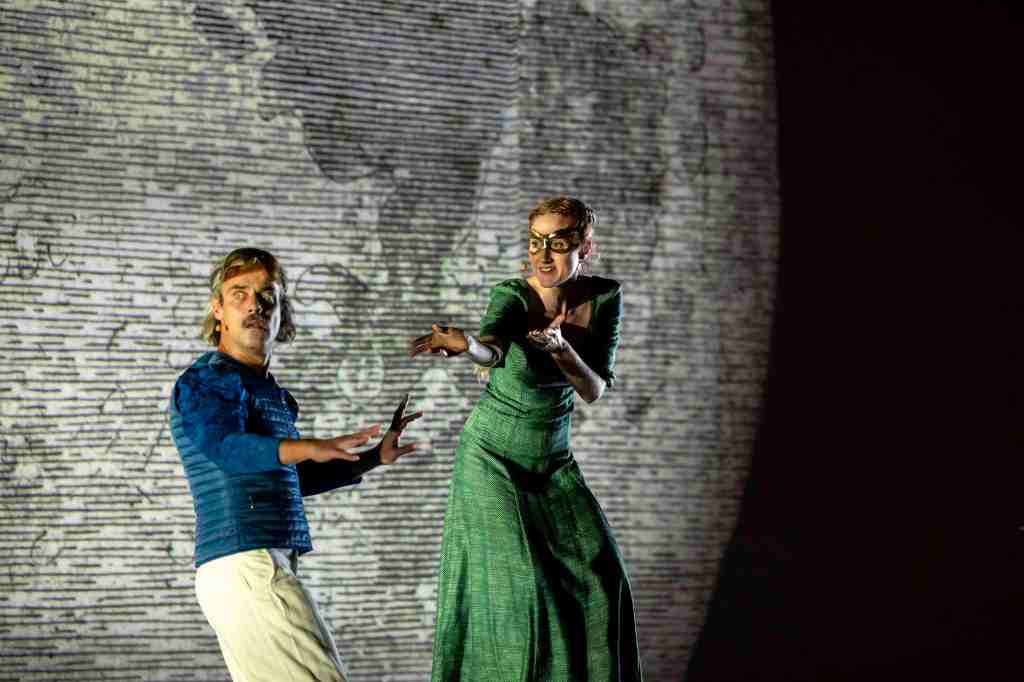
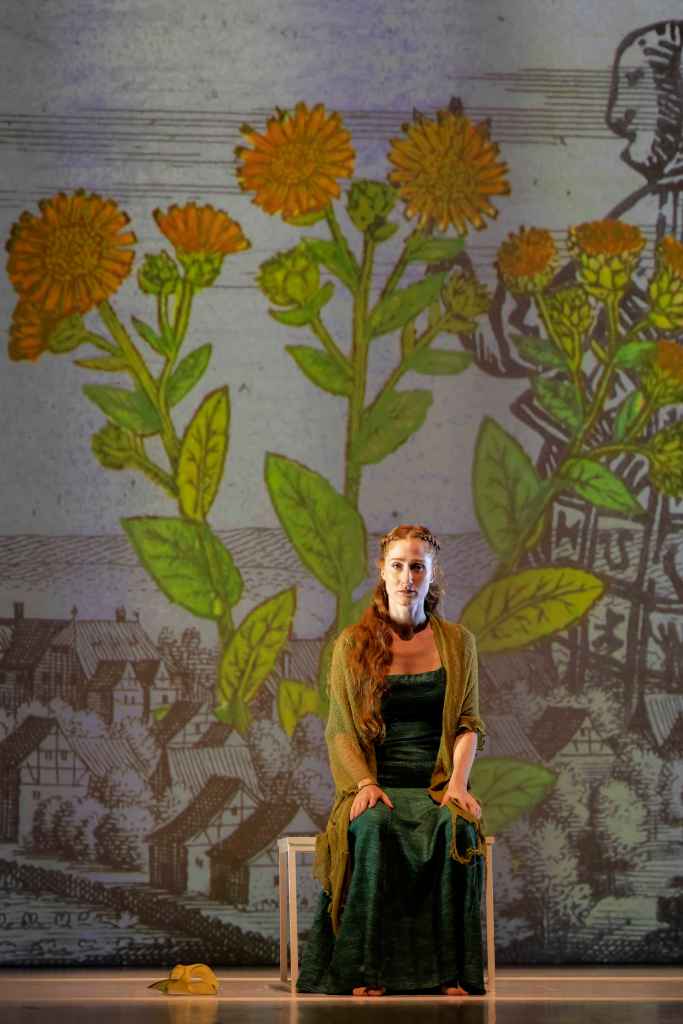
A performance of music theatre at the crossroads between early and contemporary music, Earthrise brings to the stage an age of scientific revolutions, science denial and witch trials: our own. Astronomer Johannes Kepler and his mother Katharina Kepler are the unexpected guides inviting us to look for answers in our dreams.

Earthrise tells of a world that is losing its mind. In the year 1624 (or 2024) while political and religious forces fight for influence, scientific research unravels crucial data that calls into question our way of thinking about our place in the universe – and we react with nothing but confusion and embarrassment.

In his science-fiction novel The Dream, astronomer Johannes Kepler (1571 – 1630) tried to advance a new worldview by speaking to his readers’ imagination: what would our world look like if seen from the Moon? Kepler toiled against all forms of dogmatism, and even had to defend his own mother Katharina Kepler (1546 – 1622) in a witchcraft trial. However, he never ceased to believe in a secret harmony governing the world; a harmony we get to experience fully only with the help of science and the arts.

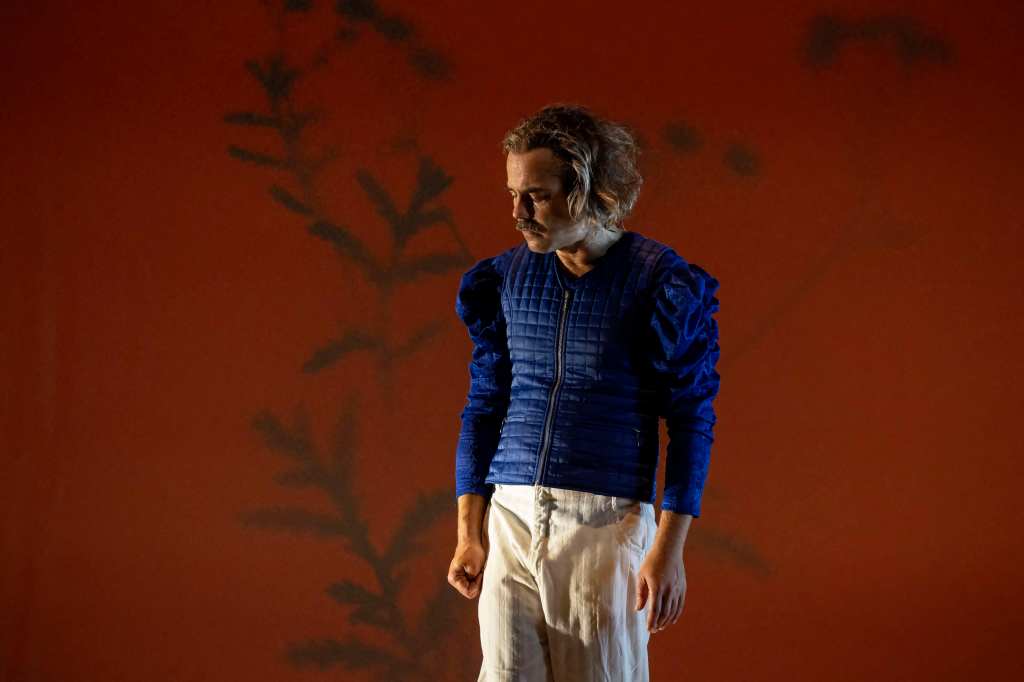
Inspired by the lives of Johannes and Katharina Kepler, Earthrise combines 17th-century compositions with genre-bending new music by composer Juha T. Koskinen and vocal artist Anni Elif Egecioglu. The libretto is devised by writer-director Aleksi Barrière, providing his frequent collaborator, actor Thomas Kellner, with a new multilingual tour-de-force. Helming the Finnish Baroque Orchestra, cembalist Marianna Henriksson invites music by Kepler’s contemporaries such as Scheidt, De Monte, Harant, or Praetorius to enter a dialogue with the music of our time. Embracing a dramaturgy of multimedia collage, the piece’s visual world is created together with lighting designer Étienne Exbrayat and video artist Lucia Schmidt.

EARTHRISE
Premiered at the Finnish National Opera, Helsinki, on October 17, 2024.

Text & Stage Direction: Aleksi Barrière
New Music: Juha T. Koskinen
Early Music Montage & Cembalo: Marianna Henriksson
Songs & Vocal Improvisations: Anni Elif Egecioglu

Actor: Thomas Kellner
Instrumental Ensemble (7 players): Finnish Baroque Orchestra (FiBo)

Lighting: Étienne Exbrayat
Stage Design: Aleksi Barrière & Étienne Exbrayat
Video Design: Lucia Schmidt
Sound Design: Timo Kurkikangas

Early Music Composers: Kryštof Harant, Philippe de Monte, Michael Praetorius, Samuel Scheidt, Johann Hermann Schein, Romanus Weichlein

Production by the Helsinki Early Music Festival, in collaboration with La Chambre aux échos, the Finnish Baroque Orchestra, and the Finnish National Opera

Photo by Minna Hatinen

Excerpts

SONG OF LIBUŠE (in Czech)

There were three sisters in Bohemia,
born from the blood of Čech:
Kazi the healer, Teta the priestess,
and Libuše, who saw things to come.

Kazi knew the power of plants
and could ease any ailment,
Teta conversed with the gods
of springs, mountains, and fire.

But the wisest sister
was the youngest of the three,
who read the stars and the Moon:
Libuše, who saw things to come.

But when the princess solved disputes,
her fairness was disliked.
So she said: “Our nation shall have a kin
Who will rule with a stern male mind.”

She chose herself a king
and built a castle too –
and so Prague was born,
thanks to Libuše, who saw things to come.

When all three sisters were dead,
the nation was ruled by men only,
and the names of plants were forgotten,
the spirits of the forest disappeared,
and the future was obscured.

And when women rebelled
to restore the order of Libuše
the men crushed them in Divoká Šárka,
and the rule of women was over for good.

Since then you are nothing but an old story,
even though you saw things to come,
oh our mother, Libuše.

(…)

DURACOTUS: (in Latin)
We ventured on the far side, in the hemisphere that is invisible to man. Oh what vision. The fixed sphere of the stars, shining in all its glory, offered to our endless contemplation – for the nights of the Moon each last as long as two of our weeks, followed by two weeks of day, as we are accustomed to notice from its monthly cycle.

But the greatest wonder was on the other hemisphere of the Moon. Walking towards it, over the horizon we saw Her rise. The Earth. This side of the Moon is always facing it, and our planet appears as if nailed to its place, albeit rotating in a daily cycle. The inhabitants of the Moon do not call it Earth – as they themselves have earth under their feet – but Revolva.

(In German) (I have noticed that the Latin name for the moon, Luna, comes from the same root as lumen, the light. Being white and luminous is the Moon’s most obvious characteristic, hence the name. Likewise, inhabitants of the Moon would name our Earth according to what is most striking – to them – about her, namely, that she revolves.)

Photo by Minna Hatinen

You are certainly curious of the lives of these Moon-dwellers. Because each Moon-day lasts two Revolva-weeks, and the powerful earthshine also carries its own heat, you can only imagine how hot the climate must be, comparable to what travelers describe of the tropical weather of Peru… This must be the explanation to these strange circular, hollow structures that are found everywhere on the surface of the Moon…

For these perfect circles couldn’t have been produced by anything else than intelligent architects. I can only conjecture that these hollows are the result of digging: the center is cultivated as fields that, due to their shape, most excellently capture rainwater, while the inhabitants dwell in the mounds of soil from the dug, arranged into a rampart that provides protection from both intruders and the scorching sun… The Moon-dwellers, then, can move along these circles and follow their shade…

(…)

JOHANNES: (in German)
The honorable and distinguished magistrates have been giving credence to unreliable gossip meant to tarnish my mother’s name. It has even been suggested that it is her abuse that has driven away my father Heinrich. Nothing could be further from the truth. My father repeatedly abandoned our home to pursue the unruly life of a hired soldier, and my mother has raised me and my siblings alone through hardships. Nothing in her conduct indicates anything but piousness and interest in medicinal herbs, and every illness she is being accused of can be attributed to natural causes, as she has herself pointed out. It is a disgrace to cast doubt on an aging woman simply because she presents the common traits of her age and sex, and even more so to threaten her with torture, which is in our century contested by many great legal authorities of our Evangelical faith, as an unreliable method of interrogation, and a desecration of God’s image in man. What are we, Catholics?!

KATHARINA’S LITANY: (in English)
In January the widow Margaretha Frisch
confessed under torture that she was a witch
who sometimes slept with the devil in the forest of Sindelfingen
and followed his perverse orders and danced at his Sabbath.
She died in prison two nights later, before they could burn her.

In February they tortured the widow Lena Stüblerin
who confessed to making bad weather with her spells
and plaguing villagers with disease and calamities.
She was beheaded and her corpse was burnt to ashes…

In March…

JOHANNES: (in German)
My mother’s lack of tears in court has been used by the honorable, most distinguished, respectable and wise magistrates as proof of her moral corruption is in complete disregard of the severity of her upbringing and the destitutions she has suffered. Was she ever one to indulge in great displays of affection? Certainly not. But every testimony indicates nothing but her desire to help members of her community, and ask for their help when she needed it, as an ageing woman whose children have all moved out of town. She is in no condition to freeze in a cell through the winter, with a chair in lieu of bedding, chained to the wall, which is torture in itself.

KATHARINA-ish: (in English)
Despite months of legal proceedings, Johannes could only stall.
Only when Katharina was showed the torture instruments as way of intimidation, and still refused to confess, was she acquitted for lack of evidence,
after fourteen months in prison.
She died four months later, at the age of seventy-five.

JOHANNES: (in German)
My wife Barbara, our child Friedrich, my mother…
One after another taken from me…
Disease, oppression, superstitions rule on all sides…
I hunt for employment from city to city, while the continent is set aflame by wars between Christians and Turks, Catholics and Protestants, Lutherans and Calvinists…
I can barely tend to my scientific work, and craft astrological predictions for warlords instead…
Galileo is taken to trial, for stating what has been proven over decades by countless observations and calculations…
This is not what this century was supposed to be about.
This was supposed to be our great Enlightenment,
our great march towards the knowledge of God’s perfect design,
our new science that carried freedom and piece.
There must be a hidden harmony behind this chaos.
I cannot prove it, but ignorance cannot prevail. I refuse.

Photo by Minna Hatinen

(…)

ACTOR:
During Katharina’s trial, Johannes Kepler read a treatise by the lutenist and composer Vincenzo Galilei, the father of the astronomer. The old man was complaining about the florid and intricate polyphonic writing that had become the fashion in the late 16th century. “Confusing, corrupt, foreign to the true method of ancient music,” he said. Soon, a derogatory word was invented for this, they called it baroque.

That is when it dawned on him. The Ancient Greeks had used musical proportions to describe the perfection of the heavens as a Music of the Spheres, but the problem was, their music wasn’t complex enough! Without polyphony, how could they imagine how sophisticated the music of the cosmos would be to our ears if we could hear it.

He, Johannes Kepler, lived in an age when new dimensions of complexity could be achieved in music, with four, five, six voices, or more, playing at the same time and yet forming music, music in which new harmonies and even dissonance had a role to play. Only such music can make us begin to understand the enigmatic motions of the universe that he and his mother had tried to decipher. Through such an exquisite collaboration of the mind and the senses, not only our intellect, but also our imagination is moved, which is the only power that can truly, in turn, move us to change.

(…)

FINAL SONG (after Johannes Kepler’s Harmonices Mundi, IV)

What kind of animal is the Earth?
You may ask –
What kind of animal is the Earth?

The Earth grows trees and beasts
Like a dog grows hair and lice.
The Earth is an animal like a dog.

But the Earth is slow and calm,
While its rage is daunting when it shakes.
The Earth is an animal like an ox.

But look at the ebb and flow of the sea,
Like the breathing of a fish:
The Earth is an animal like a fish.

But the Earth feels and remembers,
And erupts like a man does.
The Earth is an animal like a man.

But the Earth’s soul is of fire,
Like the fire of the sun.
The Earth is an animal like the sun.

But the Earth contains all images
Like the Zodiac of the stars.
The Earth is an animal
like everything that is.

Photo by Minna Hatinen

DU BALAI DU BELLAY – lectures du 16e siècle français

L’identification du cercueil de Joachim Du Bellay sous Notre-Dame est l’occasion d’exhumer des poètes aujourd’hui moins célèbres, que la brigade aristocratique de la Pléiade a contribué à éclipser de la Renaissance francophone par son rejet des « vieilles poésies françaises », « épiceries qui corrompent le goût de notre langue », et le choc de simplification qu’elle a imposé au vers et à la grammaire. Ne nous laissons pas décontenancer par la graphie sauvage de ces poètes chatoyants, on s’y habitue comme à un accent, et ils nous parlent un français vivant et dérégulé.

Joachim (1522-1560), neveu placé du cardinal Jean du Bellay, se découvre tel qu’en lui-même et à sa place au kilomètre zéro sous la cathédrale. Avant de nous intéresser à ses contemporains, oublions un instant qu’il a fait marcher le mètre au pas et enferré la langue française dans ce qui allait devenir son mélange caractéristique de galanterie monotone et de poésie du trait d’esprit, il faudrait en présentant ses respects à cette tombe désormais béante avoir une pensée pour les trésors de fraîcheur permis malgré tout par son style confessionnel et égotique.

ÉPITAPHE D’UN PETIT CHIEN

Dessous ceste motte verte
De lis et roses couverte
Gist le petit Peloton,
De qui le poil foleton
Frisoit d’une toyson blanche
Le doz, le ventre, et la hanche.
Son nez camard, ses gros yeux
Qui n’estoient point chassieux,
Sa longue oreille velue
D’une soyë crespelue,
Sa queue au petit floquet
Semblant un petit bouquet,
Sa gembe gresle, et sa patte
Plus mignarde qu’une chatte
Avec ses petits chattons,
Ses quatre petits tetons,
Ses dentelettes d’ivoyre,
Et la barbelette noyre
De son musequin friand,
Bref tout son maintien riand
Des pieds jusques à la teste,
Digne d’une telle beste,
Méritoient qu’un chien si beau
Eust un plus riche tumbeau.
Son exercice ordinaire
Estoit de japper et braire,
Courir en hault et en bas,
Et faire cent mille esbas,
Tous estranges et farouches,
Et n’avoit guerre qu’aux mousches,
Qui luy faisoient maint torment:
Mais Peloton dextrement
Leur rendoit bien la pareille:
Car se couchant sur l’oreille,
Finement il aguignoit
Quand quelqu’une le poingnoit:
Lors d’une habile soupplesse
Happant la mouche traitresse,
La serroit bien fort dedans,
Faisant accorder ses dens
Au tintin de sa sonnette,
Comme un clavier d’espinette.
Peloton ne caressoi
Si non ceulx qu’il cognoissoit,
Et n’eust pas voulu repaistre
D’autre main que de son maistre
Qu’il alloit tousjours suyvant,
Quelquefois marchoit devant,
Faisant ne sçay quelle feste,
D’un gay branlement de teste.
Peloton tousjours veilloit
Quand son maistre sommeilloit,
Et ne souilloit point sa couche
Du ventre ny de la bouche,
Car sans cesse il gratignoit
Quand ce désir le poingnoit:
Tant fut la petite best
En toutes choses honneste.
Le plus grand mal, ce dict-on,
Que feist nostre Peloton
(Si mal appellé doit estre),
C’estoit d’esveiller son maistre,
Jappant quelquefois la nuict,
Quand il sentoit quelque bruit;
Ou bien le voyant escrire,
Sauter, pour le faire rire,
Sur la table, et trepigner,
Follastrer, et gratigner,
Et faire tumber sa plume,
Comme il avoit de coustume.
Mais quoy? nature ne faict
En ce monde rien parfaict,
Et n’y a chose si belle,
Qui n’ait quelque vice en elle.
Peloton ne mangeoit pas
De la chair à son repas:
Ses viandes plus prisées,
C’estoient miettes brisées,
Que celuy, qui le paissoit
De ses doigts amollissoit:
Aussi sa bouche estoit pleine
Tousjours d’une doulce haleine
Mon dieu quel plaisir c’estoit,
Quand Peloton se grattoit,
Faisant tinter sa sonnette
Avec sa teste folette!
Quel plaisir, quand Peloton
Cheminoit sur un baston,
Ou coifé d’un petit linge,
Assis comme un petit singe,
Se tenoit mignardelet
D’un maintien damoiselet!
Ou sur les pieds de derrière,
Portant la pique guerrière
Marchoit d’un front asseuré,
Avec un pas mesuré!
Ou couché dessus l’eschine,
Avec ne sçay quelle mine
Il contrefaisoit le mort!
Ou quand il couroit si fort,
Qu’il tournoit comme une boule,
Ou un peloton, qui roule!
Bref, le petit Peloton
Sembloit un petit mouton:
Et ne feut onc creature
De si benigne nature.
Las, mais ce doulx passetemps
Ne nous dura pas long temps:
Car la mort ayant envie
Sur l’ayse de nostre vie,
Envoya devers Pluton
Nostre petit Peloton,
Qui maintenant se pourmeine
Parmy ceste umbreuse plaine,
Dont nul ne revient vers nous.
Que mauldictes soyez-vous,
Filandieres de la vie,
D’avoir ainsi par envie
Envoyé devers Pluton
Nostre petit Peloton:
Peloton qui estoit digne
D’estre au ciel un nouveau signe,
Tempérant le Chien cruel
D’un primtemps perpetuel.


Premier sur notre liste, le grand Jean Molinet (1435‒1507). Quoiqu’on ne l’enseigne guère aujourd’hui, Molinet était universellement admiré de ses pairs, et l’anthologie de ses textes FAITZ ET DICTZ DE JEAN MOLINET a été republiée plusieurs fois au 16e siècle. Chroniqueur des ducs de Bourgogne, Molinet représente les derniers feux de la tradition des poètes de cour à la manière féodale, autant que le brasier naissant de la Renaissance franco-flamande, dont il est un acteur aussi important que son ami et collaborateur Johannes Ockeghem. Il était lui-même également musicien et auteur d’œuvres scéniques (passions et mystères) — sa poésie même, d’ailleurs, est faite pour la déclamation, et se décline en chansons, harangues et dialogues.

Molinet fait partie des poètes que le 19e siècle a, avec condescendance, surnommés « les Grands rhétoriqueurs », ces héritiers des formes poétiques médiévales qui en ont poussé le jeu formel et musical jusqu’à l’emballement du moteur. Son ART DE RHÉTORIQUE exalte un véritable bestiaire de formes, « comme lignes doublettes, vers sizains, septains, witains, alexandrins et rime batelee, rime brisiee, rime enchayennee, rime a double queue, et forme de complainte amoureuse, rondeaulx simples d’une, de deux, de trois, de quatre et de cinq sillabes, rondeaux jumeaux et rondeaux doubles, simples virelais, doubles virelais et respons, fatras simples et fatras doubles, balade commune, balade baladant, balade fatrisie, simple lay, lay renforchiét, chant royal, serventois, riqueraque et baguenaude » – de quoi aviver la curiosité de l’Oulipo quatre siècles et demi plus tard.

Car Molinet est amoureux des contraintes et des jeux phoniques, en particulier pour leur potentiel d’ambiguïté et de polysémie. « Qui veult pratiquer la science choisisse plaisants équivoques », écrit-il. Ses poèmes ne se plaisent pas seulement à dissimuler des double-sens, notamment dans un contexte grivois où il tire leur substantifique moelle de mots comme « comporte » et « confesse » — leur force carnavalesque est de faire délirer la production du sens elle-même. Et ils ne s’en affrontent pas moins à leur époque, témoin « Le Testament de la guerre » qui détaille les victimes et les complices des conflits qui dévastent le « povre plat paÿs », ou « La Ressource du petit peuple », sans doute sa vindicte la plus célèbre :

Tranchez, coupez, détranchez, découpez,
Frappez, happez bannières et barons,
Lanchiez, hurtez, balanciez, behourdez,
Quérez, trouvez, conquérez, controuvez,
Cornez, sonnez trompettes et clairons,
Fendez talons, pourfendez orteillons,
Tirez canons, faites grands espourris :
Dedans cent ans vous serez tous pourris.

Non moins sonores sont les énumérations du « Mandement de froidure », dans lequel le roi de la boisson convoque ses troupes, cette fois, pour la débauche de Carnaval :

(…) Hativement a tous vous commandons
Et, comme il faut, aïde vous mandons,
Fremiers de bois, larronceaux et bringans,
Fars papillans, sus le minche fringans,
Pendeurs, traineurs, putiers, houlliers, paillars,
Flatteurs, menteurs, batteurs, rifleurs, pillars,
Marchans de cuyrs, brelenqueurs, orlogeurs,
Bouteus de feu, esgueulleurs, vendengeurs,
Hars parees, barguineurs de caignons,
Faulx crocheteurs, desleaux compaignons,
Escornifleurs de trippes et d’andoulles,
Joindeurs de culz, ratripelleurs de coulles,
Pervers, perjurs, effondreus de toccasses,
Jueurs de dez, combatteurs de ducasses,
Vieux guisterneurs, vieux trompeurs, viés ivrongnes,
Vieux batteleurs, vieux gueux a rouges trongnes,
(…) Goutteux, boitteux, piffres, espoitronnés,
Tricheurs, pippeurs de vie peu prisie,
Ribaux quassés, frappés d’apoprisie,
Cartiers, morveux, sans aleine ne poux,
(…) Et vous trouvés prestz pour livrer bataille
Qui se fera plus de plat que de taille
Entre Baccon et le chasteau Belin,
Pour nous aidier contre ce gobellin,
(…) Car en aïde, avec poix et baccons,
Nous avons bien onze ou douze mil cons :
Cons a detail avons et cons en gros,
Cons a ung blanc et cons a demy gros,
Cons a deux rengs, cons a doubles foeullés,
Cons a manches, cons a doubles oeillés,
Cons a besage et cons a bridelieres,
Cons a maches et cons a grans culieres,
Cons a bourreaux, cons a rouges afficques,
Cons a grands baux et cons a mirlificques… (etc.)

Dans un genre aussi ludique mais plus personnel, finissons sur un fragment de « donat », c’est-à-dire de jeu sur la grammaire latine, en l’occurrence l’occasion pour Molinet de méditer sur le vieillissement à partir de la conjugaison du verbe latin amare.

Je vis le temps que j’estoye verbe,
Les noms et pronoms gouvernoye,
Mais souvent n’avoye ung adverbe,
Par quoy je me determinoye ;
L’adverbe de lieu demandoie,
Ut hic, vel ibi, pour sçavoir
Ou il y avoit quelque proie,
Affin que je la peusse avoir.
Amavi, j’ay amé de faict,
Tellement que c’estoit oultraige,
Mais ce temps preterit, parfait,
Est plus que parfait, veu mon eage ;
Amaveram de bon coraige,
Mais ce train la me samble dur
Pour present et voeul, comme saige,
Laisser amabo le futur.


Notre deuxième specimen : Guillaume Cretin (~1460-1525), contemporain et ami de Jean Molinet, comme lui classé par la postérité parmi lesdits « Grands rhétoriqueurs ». Clément Marot l’appelle dans une dédicace rien moins que « souverain poète français », et dans l’épitaphe pour lui écrite dit de ses œuvres : « Chose éternelle en mort jamais ne tombe, / Et qui ne meurt n’a que faire de tombe ». Chantre de la Sainte-Chapelle, chroniqueur de François Ier, vainqueur de plusieurs puys (concours de poésie), Cretin a joui de toutes les reconnaissances de son vivant. On peinera pourtant à trouver aujourd’hui ses poèmes. Outre les genres obligés de la poésie de cour de forme fixe (chant royal, ballade, etc.), les épîtres en vers — pratique que remet à la mode le goût renaissant de la littérature latine — constituent un pan majeur de œuvre, et c’est par là que nous pouvons l’explorer un peu.

Comme Molinet, Cretin a le goût de « l’équivoque », c’est-à-dire des jeux d’homophonie, poussés par lui peut-être plus loin encore. Mais ici non plus, le jeu langagier n’est pas refermé sur lui-même. L’épître, sous prétexte de donner des nouvelles et d’en prendre, se présente comme une petite chronique qui se déploie dans l’ombre de la grande, celle que Cretin écrit pour le roi. La description qu’il fait à son ami Honorat de la Jaille de la difficulté de poétiser en temps de guerre, en faisant bégayer la rime, touche plus qu’un simple jeu d’esprit :

(…) En divers lieux se font apretz à prest,
Fermans la voie où sont Marchans marchantz,
Cruelle guerre ores aspre és aprestz,
Donc fais larrons estre parchans par champs:
Doulx sons n’en puis mettre en chantz, mais trenchans,
Car l’aigreur rend trop grands debas de bas ;
En chant piteux ne treuve point d’esbas.
(…) Guerre a tousjours Dieu sçait quelle sequelle,
Livres en sont de plainctz & cryz escriptz. (…)

On atteint, dans l’épître qui suit à François Charbonnier, son ami et futur éditeur, des niveaux de virtuosité qui ne facilitent pas la lecture, surtout cinq siècles plus tard : la rime équivoquée est étendue aux premiers hémistiches, produisant des vers quasiment entièrement homophoniques. Avant de rejeter en bloc ces effets comme le feront les poètes de la Pléiade, il faut pourtant prendre la mesure de l’effet qu’ils produisent à la déclamation : un tâtonnement de la langue et de l’oreille qui jette une suspicion absolue, à travers les mots, sur le monde et ses faux-semblants (en l’occurrence, liés à la débauche) :

(…) Quel signe auray de voir cueurs contritz tant
Qu’es si navré, & te vas contristant
Comme s’avant l’effroi ne sçusse pas
Qu’homme sçavant dust souffrir sur ce pas ?
Souffrir, hélas ! quand feu ou souffre irait
S’offrir ès lacz, l’eau claire en souffrirait
Soubz franc courage en souffrette souffrons
Souffrans qu’orage au nez nous blesse au front ?
L’ire des Roys faict or dedans ce livre
Lire defroys, & tour de dance livre
Si oultrageux, que du hault jusqu’à bas
Si oultre à jeux on ne met jus cabatz ;
Doubter dust-on que ne soyons des ans seurs,
D’aster du ton la dance & les danceurs,
Tournay en tour, sa folle oultrecuydance,
Tourney enter, s’affolle oultre qui dance,
Dye au lyepard le sien retour nuant,
Dyaule y ait part que es droict chy tournoyant.
En tes combatz Dame Venus te fache,
Hantes cons bas, & par venuste fache (…)

Pour finir sur une dernière épître un brin plus intelligible, goûtons celle adressée à Macé de Villebresme, collègue courtisan et co-traducteur de poésie italienne, à qui Cretin dit depuis Vincennes tout le bien qu’il pense de Paris (qui est en cette année 1510, de surcroît, en proie aux épidémies) :

(…) Je ronge icy mes croustes & mon lard,
Et je dis bien, pour nous qui aymons l’art
Des orateurs, c’est le lieu plus amene
Qu’oncques trouvay, & qui le mieulx ameine
Mon foible sens à repos d’esperit ;
Tout est tranquille, & rien n’y desperit,
Icy suis hors des durs remords et goustz
Des troux puans, ordes places, esgoustz
Et lieux infectz de l’antisque Lutesse
Dicte a luto, aigre, forte lutte esse
A resister a peste si mortelle :
C’est cas par trop repentin que mort telle.
Icy n’ay poinct le bruit des tumbereaulx,
Je n’oy que vens souffler, & tumber eaux,
Ne n’ay soucy si beuf ou vache arreste
Je n’ay le heurt quand vient ou va charrette,
Je n’ay poinct peur de ses ribleurs de nuict,
Ne du tabut qui tant le monde nuyct (…)


Nous rencontrons maintenant un troisième dit « Grand rhétoriqueur » qui s’est distingué par sa carrière d’homme de théâtre — quoique l’écriture théâtrale n’ait pas été en général inconnue des poètes de l’époque, comme on a pu le voir à propos de Molinet. On connaît parfois le nom de Pierre Gringore (1475-1539) car, en tirant un peu sur les dates, Victor Hugo en a fait, sous le nom de Gringoire, un personnage de son NOTRE-DAME DE PARIS, ce qui le place dans l’imaginaire collectif (nourri des meilleurs tubes de comédie musicale) au « temps des cathédrales ». Mais nous sommes bien au 16e siècle, Luther enseigne à Wittenberg, Érasme publie son ÉLOGE DE LA FOLIE à Paris, le royaume de France se centralise, on traite avec les Borgia et avec Charles Quint, la poésie s’imprime — mais elle se dit aussi sur les tréteaux, dans les rues où l’on célèbre effectivement la Fête des Fous que fantasmera Hugo, la France ne connaît pas ses frontières actuelles, la cour du roi, une parmi d’autres, est à Blois et non à Fontainebleau, et encore moins à Paris ou Versailles. Le récit rétrospectif d’une séparation claire entre les ères est une fiction qui appauvrit notre compréhension de l’époque.

De même, contre une idée des spectacles de rue anarchiques et anarchistes, il faut imaginer un univers théâtral structuré, régenté, surveillé, même s’il est plein de truculente irrévérence et se déploie en plein air, en l’occurrence aux mains des étudiants de la confrérie des Enfants-sans-souci, qui jouent un répertoire satirique : sotties, moralités et farces. Voilà l’arène de Gringore, qui écrit des pièces et endosse le personnage de Mère Sotte — personnage carnavalesque sans doute, mais explicite dans ses commentaires d’actualité et de société, et à la merci d’où souffle vent politique du moment. Gringore est également l’auteur-metteur en scène de tableaux vivants connus sous le nom de mystères. Sa veine satirique est au service des puissants dont il convoitait le patronage (le roi contre le pape, et contre les hérésies qui montent), et fait appel aux outils rhétoriques brillants que l’on connaît à ses contemporains comme Molinet et Cretin. Gringore finira sa vie écrivain pensionné à la cour du duc de Lorraine. Mais ce n’est sans doute pas pour rien qu’on retient de lui surtout l’image chamarrée du saltimbanque, auteur de « crys » servant à haranguer le public sur les marchés, comme celui-ci :

Sotz lunatiques, Sotz estourdis, Sotz sages,
Sotz de villes, de chasteaulx, de villages ;
Sotz rassotéz, Sotz nyais, Sotz subtilz,
Sotz amoureux, Sotz privéz, Sotz sauvages,
Sotz vieux, nouveaux, et Sotz de toutes âges,
Sotz barbares, estranges et gentilz,
Sotz raisonnables, Sotz pervers, Sotz rétifz :
Vostre Prince, sans nulles intervalles,
Le mardy gras, jouera ses jeux aux Halles. (…)

Pour autant, Gringore a également fait carrière de poète publié, et même fait carrière par la publication, faisant partie des premiers poètes et dramaturges qui ont pris en main l’imprimé comme canal de diffusion et source de revenu. Et inversement, l’aspect oral, carnavalesque de son usage des jeux phoniques éclaire ce qui, chez lesdits « Rhétoriqueurs » de papier, peut sembler pur jeu intellectuel si on ne le perçoit pas dans le contexte d’une poésie largement oralisée, scénique, fêtarde — quoique inquiète.

Pour en finir avec ce qui n’est pas une école, mais comme nous le voyons plutôt un continuum littéraire, rendons hommage à un dernier « rhétoriqueur », André de La Vigne (1470-1526), chroniqueur de François Ier comme Cretin, mais aussi dramaturge et pamphlétaire comme Gringore, traducteur comme le sont tous ces poètes, avec cette énumération agressive d’un style que ressusciteront les zutistes et les surréalistes, sans parler des diss tracks des rappeurs :

O Atropos, pluthonique, scabreuse,
Furie aride, sulphurinée, umbreuse,
Fière boucquine, bugle, cerbère, cabre,
Beste barbare, rapace, tenebreuse,
Gloute celindre, cocodrillde vibreuse,
Chymère amère, megerin candalabre,
Arpie austère, cheziphonie alabre,
Gargarineux, steril, colubrin abre,
Lac cochitif, comblé de pleurs et plains,
Palut boueux, vil, acheronic mabre,
Lubre matrone du cru tartarin flabre,
J’ay juste cause se de toi je me plains.


Nous ne pouvions pas esquisser ce panorama sans évoquer une célébrité, Clément Marot (1496-1544), dont le statut canonique de réformateur est amplifié par son statut de fils de Jean Marot, « rhétoriqueur » emblématique de l’ancienne manière, dont l’héritage serait dans le siècle nouveau sursumé. La postérité réduit ainsi souvent (en croyant l’élever) Clément à un rôle de précurseur de la Pléiade et de « l’élégant badinage » vanté par Boileau au siècle suivant. Sa verve vient pourtant directement de la précédente pratique — et à l’âge où les écrivains s’organisent aussi en ce qu’on appellerait aujourd’hui un « monde de l’édition », il est notamment éditeur de Marot père et de Villon.

Littéralement né dans le milieu des cours où les poètes trouvent encore leur emploi, Clément hérite de son père une culture mais aussi une charge au service de François Ier. Il pratique comme ses aînés les formes classiques du rondeau et de la ballade, cultive « l’équivoque » homophonique, et si transition il y a, elle est encore une fois en pente douce : en s’appropriant le genre de l’épître en vers, Clément se pose davantage en sujet singulier, qui parle en son nom propre au-delà des figures imposées. On aurait mauvaise grâce à séparer des « Rhétoriqueurs » celui qui écrit, dans sa « Petite Epistre au Roy » :

En m’esbatant je faiz Rondeaux en rime,
Et en rimant bien souvent je m’enrime [= enrhume] :
Brief, c’est pitié d’entre nous Rimailleurs,
Car vous trouvez assez de rime ailleurs,
Et quand vous plaist, mieulx que moy, rimassez,
Des biens avez, et de la rime assez. (…)

(Chaque rime est composée sur un terme dérivé de « rime », évidemment.) Et si Marot introduit la mode du sonnet à la Pétrarque — qu’il traduit — et celle du genre du « blason » (la fixation-variation virtuose sur un détail anatomique du corps aimé) ce n’est pas simplement par imitation du goût italien, mais aussi en ce que celui-ci fait signe vers la mémoire culturelle médiévale.

Marot avait par ailleurs, comme ses aînés, l’intelligence des échanges avec les compositeurs, dont les mises en musique ont beaucoup fait pour la diffusion de sa poésie, de Clément Janequin et Claudin de Sermisy à Roland de Lassus à la génération suivante. Ses chansons paraissent dans le recueil musical de Pierre Attaignant (inaugurateur de l’édition musicale en 1528) avant même que d’être publiées au livre. Il n’y a pas encore, chez lui, le goût de la simplification radicale, le refus des jeux phoniques expressifs, le systématisme du vers long qui se rapproche de la prose, qui entraîneront le divorce entre les créations poétique et musicale.

Comme tous les poètes du Moyen-Âge, Marot est traducteur, et comme chez eux ce travail-là est une force de renouvellement au moins aussi importante que toute supposée « invention » (au sens contemporain, amnésique de la signification latine d’invenire : trouver, qui a donné aussi troubadour). Chez lui cependant la traduction comme projet prend une dimension particulièrement existentielle : ses traductions des psaumes (à partir des années 1530), reflets de ses convictions luthériennes et mémoire des calamités qu’elles lui ont valu, sont des œuvres poétiques originales, conçues pour le chant, et entrées comme telles au répertoire des protestants francophones (complétées plus tard par Théodore de Bèze). Ainsi la détresse et la claudication du psaume 38 dans cette version hétérométrique :

Las, en ta fureur aigue
Ne m’argue
De mon faict, Dieu tout puissant:
Ton ardeur ung peu retire,
N’en ton ire
Ne me punys languissant.

Car tes flesches descochées
Sont fischées
Bien fort en moy sans mentir:
Et as voulu (dont j’endure)
Ta main dure
Dessus moy appesantir.

Je n’ay sur moy chair ne veine
Qui soit saine,
Par l’ire en quoy je t’ay mys:
Mes os n’ont de repos ferme
Jour ne terme,
Par les maulx que j’ay commys.

Car les peines de mes faultes
Sont si haultes
Qu’elles surmontent mon chef:
Ce m’est ung faix importable
Qui m’accable,
Tant croist sur moy ce meschef.

Mes cicatrices puantes
Sont fluantes
De sang de corruption:
Las, par ma folle sottie
M’est sortie
Toute ceste infection.

Tant me faict mon mal la guerre,
Que vers terre
Suis courbé totallement:
Avec triste, et noyre mine
Je chemine
Tout en pleurs journellement.

(…) Je le dy, et si t’en prie
Qu’on ne rie
De mon malheureux esmoy:
Car des qu’ung peu mon pied glisse,
Leur malice
S’esjouyt du mal de moy.

Vien doncq, car je suis en voye
Qu’on me voye
Clocher trop honteusement:
Pource que la grand’ destresse
Qui m’oppresse
Me poursuyt incessamment.

Las apart moy, avec honte,
Je racompte
Mon trop inique forfaict,
Je resve, je me tourmente,
Je lamente
Pour le peché que j’ay faict.

Et tandis mes adversaires,
Et contraires,
Sont vifs, et fortifiés:
Ceulx, qui m’ont sans cause aulcune
En rancune,
Sont creuz, et multipliés.

Touts encontre moy se bandent,
Et me rendent
Pour le bien, l’iniquité:
Et de leur hayne la source,
Ce fut pource
Que je suivoye equié.

Seigneur Dieu ne m’abandonne,
Deschassé d’ung chascun.
Loing de moy la grâce tienne
Ne se tienne,
D’ailleurs n’ay espoir aulcun.

Vien, et approche toy doncques,
Vien, si oncques
De tes enfants te chalut:
De me secourir te haste:
Je me gaste,
Seigneur Dieu de mon salut.


De Clément Marot, nous ne passerons pas à Ronsard ou Du Bellay, mais à un poète plus curieux et moins politicien, celui que Marot a désigné vainqueur de son concours de « blasons » en 1536 : Maurice Scève (~1501-1564), habile chantre du sourcil.

Sourcil tractif en vouste fleschissant
Trop plus qu’hebene, ou Jayet noircissant.
Hault forgeté pour umbrager les yeulx
Quand ilz font signe, ou de mort ou de mieulx.
Sourcil qui rend paoureux les plus hardis
Et courageux les plus accouardis.
Sourcil qui faict l’air clair, obscur soubdain,
Quand il froncist par yre, ou par desdain (…)

Scève se distingue de la Pléiade, mais aussi d’aînés comme Marot ou Gringore, notamment par une invisibilité volontaire. Ses recueils sont publiés sans nom d’auteur et se dispensent de préface, et sa poésie est avare d’informations biographiques. Bourgeois et non aristocrate, mais ne dépendant pas de l’écriture pour vivre, il n’y a chez lui rien de cette mise en scène par soi-même du poète à fins de marketing qui donnera lieu au statut moderne de l’Auteur, mais pure orfèvrerie verbale. On le sait pourtant au cœur d’un cercle lettré lyonnais, ville de livres et d’influences culturelles mêlées — cependant, nous ignorerons probablement à jamais par exemple son rôle exact, sans doute considérable, dans les activités de son éditeur, le prolifique Jean de Tournes, et même l’étendue complète de son œuvre.

Comme Marot, Scève absorbe à grandes gorgées l’influence de Pétrarque, laquelle fera aussi à travers la mode du sonnet la fortune de la Pléiade. Mais Scève ne succombe pas à l’homogénéisation littéraire qui caractérise ce que le Classicisme voudra retenir du siècle, et entremêle l’inspiration méridionale à la dextérité des « Rhétoriqueurs ». Sa manière la plus célèbre fait revivre en la variant la configuration courtoise (dans sa version pétrarquisante tourmentée) dans DÉLIE, recueil cryptique orné d’étranges emblèmes gravés, dédié à l’impossible aimée éponyme. Qu’on en juge par un des 449 dizains qui composent ce recueil comme autant de carrés de texte posés sur les pages, jouant ici de la symétrie jusqu’à la confusion :

En toi je vis, où que tu sois absente :
En moi je meurs, où que soye présent.
Tant loin sois-tu, toujours tu es présente :
Pour près que soye, encore suis-je absent.
Et si nature outragée se sent
De me voir vivre en toi trop plus qu’en moi :
Le haut pouvoir qui, oeuvrant sans émoi,
Infuse l’âme en ce mien corps passible,
La prévoyant sans son essence en soi,
En toi l’étend comme en son plus possible.

Compressée dans une forme dense qui force la contorsion de la syntaxe (forme héritée de la ballade médiévale, dont la strophe carrée est l’unité de base selon Molinet), la langue élastique de l’époque est désormais moins prolixe, concentrée qu’elle est sur les antithèses caractéristiques de la symptomologie amoureuse de Pétrarque. Ainsi retrouve-t-on chez lui l’hermaphrodite, image platonicienne de l’idéale fusion du masculin et du féminin, ou encore les opposés classiques chaud/froid, évoqués par exemple sous la figure de l’antipéristase, c’est-à-dire leur augmentation mutuelle — non content de caser un tel terme au dernier vers d’un poème, Scève le fait rimer avec extase :

(…) Et quant a moy, qui sçay qu’il ne luy chault
Si je suis vif ou mort ou en estase,
Il me suffit pour elle en froit & chault
Souffrir heureux doulce antiperistase.

La quête, on le devine, n’est pas simplement amoureuse au sens terrestre, et le sujet poétique compare son esprit torturé à un Prométhée dévoré que l’espoir fait « au mal renaistre incessamment ». Délie est par anagramme L’Idée, et si le poète traque l’idée fixe dans une forme obsessive-compulsive et malgré tout charnelle, sensorielle, l’hermétisme de Scève suggère des attentes alchimique vis-à-vis du brasier amoureux transfigurateur : amour-lab-oratoire. Et de fait Scève est aussi l’auteur du poème épique MICROCOSME (1562), où l’écriture comprimée de DÉLIE se libère en 3003 vers exaltant la beauté du cosmos et la connaissance scientifique. Restons sur un extrait de cette poésie unique dans son genre :

De poinct, ligne, cerne, angle, en divers corps formés
Mesure la figure aux traits theoremés
A disproportion pour se prospectiver,
Comme par contrepoints à Musique arriver :
Musique, accent des cieux, plaisante symfonie
Par contraires aspects formant son harmonie :
Don de Nature amie à soulager à maints
Voire à tous, nos labeurs, & nos travaux humains.
Qui par l’esprit de l’air, noeu du corps, & de l’ame,
Le sens à soy ravit, & le courage enflamme :
Et par son doux concent non seulement vocale,
Mais les Demons encor appaise instrumentale,
Comme au Prophete saint l’esprit divin excite
Par le Harpeur sonnant le futur, qu’il recite,
Promettant s’accointer par melodieux sons
Terrestres animaux, & marineux poissons :
En guerre s’animer, & obtenant victoire
Par hymnes, & chansons rendre au Toutpuissant gloire.
Louable faculte du sens, & de raison
Differentant les tons par la comparaison
Des graves aux agus en nombre mesuree
Monstrant speculative, & chantant figuree.


Dans l’école dite lyonnaise, c’est-à-dire le cercle de Maurice Scève que nous avons précédemment évoqué, on ne peut rester sans mentionner une rare figure un peu fameuse, celle de Louise Labé (~1523-1566). La particularité de ce cercle-là a été le nombre de femmes qui en ont fait partie — un des points par lesquels il se démarque du men’s club de la Pléiade — et Labé se distingue à travers cette singularité-là aussi, en plus d’être une des voix poétiques les plus intéressantes tous genres confondus, par la seule force des trois élégies et vingt-quatre sonnets qu’elle a laissés.

Eu égard au genre, les productions des trobairitz, « troubadouresses » des 12e et 13e siècles avaient été et étaient restées exceptionnelles : littérairement, par le précédent qu’elles proposaient en inversant les rôles traditionnellement distribués entre le désirANT et la désirÉE, mais aussi statistiquement, en tant que travaux de femmes de la noblesse qui pouvaient se permettre de participer au commerce fermé des chansons, entre autres privilèges dûs à leur classe. Même Christine de Pizan (1364-ca. 1430), première écrivaine de métier d’Europe et metteuse en voix d’un sujet amoureux féminin, est restée un cas à part, comme beaucoup de briseuses de plafonds de verre. Lyon, ville de poètes et d’éditeurs, par ailleurs en contact direct avec la scène italienne (où émergent des poétesses comme Tullia d’Aragona et Gaspara Stampa), permet cette figure entièrement nouvelle d’une bourgeoise publiant des livres (des ŒUVRES, dit la première édition de ses poèmes) — en mesure, écrit-elle espièglement, de « non en beauté seulement, mais en science et vertu passer ou égaler les hommes ». Cette anomalie continue de susciter des théories réduisant « Loïze Labbé Lionnoize » à un canular de Scève et compagnie. Traitons-la ici comme une autrice de plein droit.

Labé ne se contente pas de jouer sur l’inversion des rôles traditionnels en se mettant en scène aimante d’un homme réduit au silence, elle exhibe et fait jouer l’asymétrie — par exemple, en faisant mine de railler à l’intérieur même du poème d’amour la difficulté de faire le blason d’un homme :

Quelle grandeur rend l’homme venerable ?
Quelle grosseur ? quel poil ? quelle couleur ?
Qui est des yeus le plus emmieleur ?
Qui fait plus tot une playe incurable ? (…)

Aussi bien, elle moque l’objectification poétique dont elle est l’objet en tant qu’aimée, et ses figures controuvées :

Las ! que me sert, que si parfaitement
Louas jadis & ma tresse dorée
Et de mes yeus la beauté comparee
À deux Soleils, dont Amour finement

Tira les trets causes de ton tourment ?
Ou estes vous, pleurs de peu de duree ?
Et Mort par qui devoit estre honorée
Ta ferme amour & itéré serment ?

Donques c’estoit le but de ta malice
De m’asservir sous ombre de service ?
Pardonne moy, Ami, à cette fois,

Estant outrée & de despit & d’ire :
Mais je m’assure, quelque part que tu sois,
Qu’autant que moy tu soufres de martire.

Le scandale véritable de Labé, que permet l’imagerie empruntée à Pétrarque, est surtout l’expression d’une passion féminine dévorante et sans repentir ; les formulations en sont les vers les plus célèbres de Labé : Je vis, je meurs : je me brule & me noye / J’ay chaut estreme en endurant froidure… Baise m’encor, rebaise moi & baise… J’ay senti mile torches ardantes… Tu es tout seul tout mon mal & mon bien, / Avec toy tout, & sans toy je n’ay rien… Dans le « Débat de Folie et d’Amour » qu’elle orchestre en prose, à partir d’une forme dialogue naguère affectionnée par les Rhétoriqueurs, c’est à la manière d’Érasme au service de la Folie qui rend Amour aveugle que se met toute son éloquence : « Qui eût traversé les mers, sans avoir Folie pour guide ? » Comme chez Scève, le genre amoureux et ses codes ne sont pas pris en et pour eux-mêmes, mais sont le moyen d’une scrutation du monde.

Libre des tentatives de Clément Marot et Jacques Peletier de fixer le schéma de rimes du sonnet, qu’elle mitige d’influence italienne directe, autant que des prescriptions de Du Bellay qui voudrait proscrire les rimes équivoques des Rhétoriqueurs (chez Labé, espris [épris] rime avec esprit), cette poésie affiche son indépendance à l’égard des partis pris du maître Scève lui-même, en proposant, une décennie après DÉLIE, une poésie selon le goût du moment, qui pousse l’impératif de clarté jusqu’à l’éblouissement, et pour autant infiniment créative et joueuse.


L’idée même d’une Pléiade alternative qu’on pourrait voir se dessiner ici, dans cette série de sept qu’il est maintenant temps de clore, ne ferait que perpétuer la sottise d’une constellation fermée d’astres flamboyants. La richesse de ce qu’on a pu appeler la Renaissance ne se laisse pas réduire à quelques têtes d’affiche : nous avons peut-être un peu touché du doigt le fait que, de la même manière qu’elle ne s’est pas séparée de la fin du Moyen-Âge par une rupture franche, la Renaissance s’est constituée par continuums géographiques, milieux, échanges interpersonnels et interdisciplinaires, qui ont permis les positionnements et les singularités. En évoquant quelques noms, on ne fait que prélever des échantillons. Cette évidence pour rappel de tout ce qui nous échappe ici, nous seulement à cause de l’immensité du corpus, non seulement même parce que toutes les œuvres n’ont pas survécu, mais aussi parce qu’elles n’ont pas toutes été écrites. Au nom des oubliées et oubliés, des inconnues et inconnus, je convoque pour finir Pernette du Guillet (~1518-1545), étoile filante de l’école lyonnaise dont nous ne savons pas grand-chose, et dont on parle généralement surtout au titre de sa relation amoureuse supposée avec Maurice Scève. Sa poésie a pourtant été mise en musique plusieurs fois de son vivant déjà, et le volume posthume de ses RYMES réédité plusieurs fois dans les années qui ont suivi.

Les 73 poèmes de du Guillet qui nous restent, qui forment un précédent essentiel dix ans avant la publication des ŒUVRES de Louise Labé, ont suscité des lectures contrastées, et on a pu y voir tantôt un ensemble cohérent quoique inégal, tantôt une forme de journal du développement de la jeune poétesse, qui se détache progressivement du modèle de Scève pour trouver sa voie propre en combinant épigrammes (poèmes courts), chansons, traductions… et en se positionnant en discussion à la fois avec les modèles français et l’héritage de Pétrarque.

La figure de la discussion domine de fait l’écriture de du Guillet, non seulement dans ses influences, mais dans ses énoncés. Non contente de refuser par sa prise de parole même le statue d’aimée silencieuse, elle conteste aussi la position de disciple :

Si je ne suis telle, que soulois estre,
Prenez vous en au temps, qui m’à appris,
Qu’en me traitant rudement, comme maistre,
Jamais sur moy ne gaignerez le prys. (…)

Alternant points de vue masculin et féminin, elle remet aussi sur ses pieds le discours amoureux qui préfère l’amour lui-même à l’objet/co-sujet de l’amour :

A qui est plus un Amant obligé
Ou a Amour, ou vrayement a sa Dame ?
Car son service est par eulx redigé
Au ranc de ceulx, qui ayment los, & fame.
A luy il doibt le cueur, a elle l’Ame,
Qui est autant, comme a tous deux la vie :
L’un a l’honneur, l’autre a bien le convie :
Et toutesfois voicy un tresgrand poinct,
Lequel me rend ma pensee assouvie,
C’est que sans Dame Amour ne seroit point.

Dans le conflit du corps et de l’âme, le trivial d’une relation à négocier se mêle sans solution de continuité avec un genre à réinventer :

Le Corps ravy, l’Ame s’en esmerveille
Du grand plaisir, qui me vient entamer,
Me ravissant d’Amour, qui tout esveille
Par ce seul bien, qui le faict Dieu nommer.
Mais si tu veulx son pouvoir consommer :
Fault que par tout tu perdes celle envie :
Tu le verras de ses traictz se assommer,
Et aux Amantz accroissement de vie.

Au moins subjectivement, il m’est difficile de lire Pernette du Guillet sans y associer les épigrammes qu’écrira trois siècles plus tard Emily Dickinson, autre poétesse à la carrière posthume :

A Charm invests a face
Imperfectly beheld—
The Lady dare not lift her Veil
For fear it be dispelled—

But peers beyond her mesh—
And wishes—and denies—
Lest Interview—annul a want
That Image—satisfies—

Dickinson a lu et recopié la poésie des poètes métaphysiques anglais du tournant du 16e siècle, en particulier George Herbert (continuateur de l’inspiration psalmiste et protestante de Marot), et dans ce soin de la miniature rythmée, d’une discussion allusive où les petites choses se mêlent aux grandes par l’usage de la capitalisation, quelque chose se préserve, tradition secrète d’une écriture équivoque qui refuse la réduction à l’intime et pourtant ne se soucie pas de faire Grande Chronique — dans une équation que tient le serrage de la forme. Cette poésie musicale, souvent ludique, a pris différentes formes parallèlement aux formes institutionnalisées qui appauvrissent notre langage et nos expériences, et il importe d’en chérir les apparitions, dont le 16e siècle, au seuil de l’invention d’une France centralisée et homogénéisée également linguistiquement et littérairement, aura parmi d’autres regorgé.

J’ai dit !
HETEROCHRONY

Heterochrony (Heterokronia) was a concert series curated by Aliisa Neige Barrière and Aleksi Barrière for the Turku Music Festival in August 2024.

“Inside our history, in the folds of the great linear timeline, other stories live, other timelines and heartbeats, wrapped around each other, hiding each other, answering to each other sometimes centuries apart. These we call heterochronies. They challenge the main historical narrative and open our minds to new routes, tunnels, bridges we didn’t know could be taken. Secret histories that are backdoors to our society’s dreams. This is a collection of musical heterochronies – a triptych that form a journey of women finding their place in the world.”

12.8. SONGS OF JUDITH with mezzo Christina Herresthal, harpist Claire Moncharmont and the Finnish Baroque Orchestra: looking at 17th-century scores and paintings for the possibility of revenge and what lies beyond (Strozzi, Jacquet de la Guerre, Bembo, Leonarda, et al. + premieres by Juha T. Koskinen and Mioko Yokoyama).

13.8. RESONANT HUMOURS with Aliisa Neige Barrière (violin) and Jakob Kullberg (cello): the crossover nobody knew they needed between Tobias Hume (1569–1645) and Kaija Saariaho (1952–2023), trying to tune and going on an adventure in the process.

22.8. THE SECOND HEART: Turku Philharmonic Orchestra conducted by Aliisa Neige Barrière, feat. mezzo Fleur Barron, actor Akseli Kouki, telling of the path through which new stories came to the concert halls and opera stages, how they were welcomed (not well), and why they matter in imagining another future.


Songs of Judith: Full Text

Élisabeth Jacquet de la Guerre (1665-1729): Prélude
Pièces de clavecin, 1687, Suite n° 3 en la mineur

Barbara Strozzi (1619-1677): Riamata de chi amava
Cantate, ariette, e duetti, no. 18, Venice, 1651

SPEAKER:
You liked that, didn’t you? Suffering has never been so beautiful, so ornate, so sensual. It’s not just that you can relate to the bittersweet torment of love: you are allowed to take aesthetic pleasure in someone’s pain, because her pain is designed to be enjoyable to others. We are in Venice in the early 1650s, the genre of opera is being codified around this idea, and a young singer and composer, Barbara Strozzi, is trying to make herself a name on that scene.

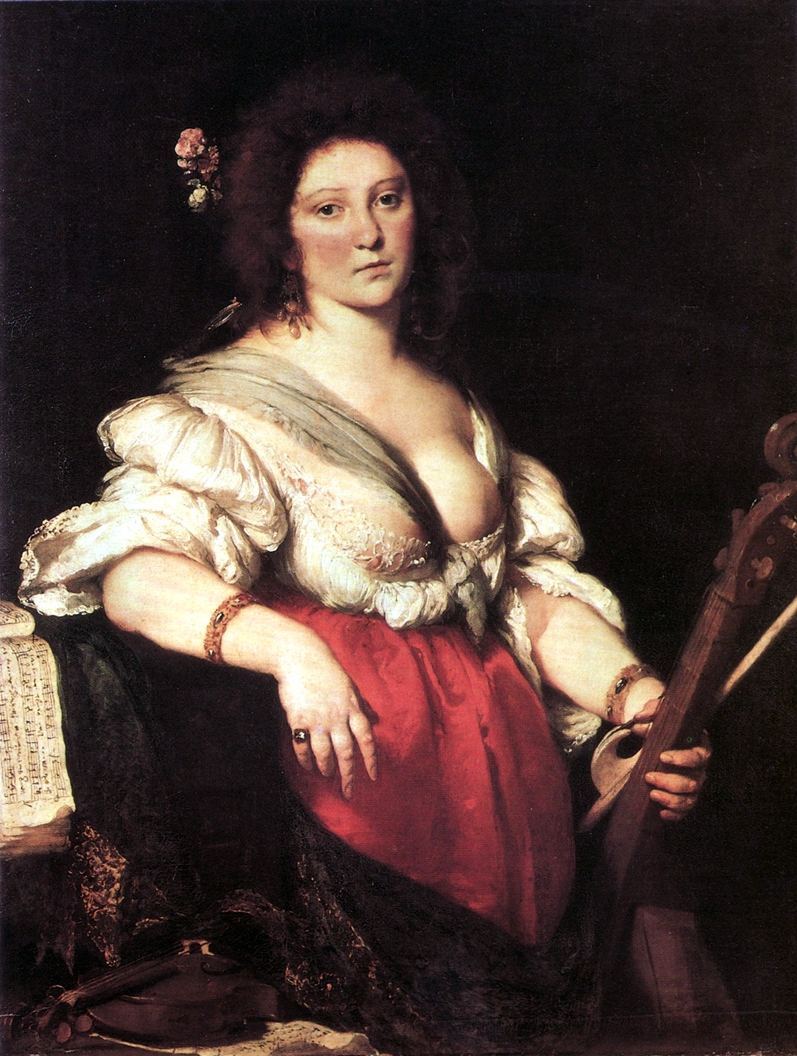
Barbara’s father, Giulio Strozzi, was a librettist and one of the masterminds of the genre. He started the trend of spectacular madness scenes for female singers, followed for instance by Francesco Cavalli, who also accepted to teach composition to his daughter. Giulio Strozzi passed on to her the best musical education and his network, but that also meant showing her off in the concerts he organized, exhibiting her, because only as a performer and a courtesan did she stand a chance to make her music heard. Look at this portrait of Barbara Strozzi, entirely exposed amongst her instruments, and try to read the expression of this woman who rose to fame because her musical lamentations were so beautiful.

A woman is a strange animal. Her moanings of desire and agony are an opportunity to hear strange and beautiful colors that can be found nowhere else. Barbara Strozzi used that fascination to create music for her own voice that is unlike that of others. But that was (is) regarded simply as a strange, exotic flavor, like the Baroque trend of copying Turkish music, or later when Rameau famously harmonized a dance from Native Americans, simply described as Savages. Something different, something wild, with the exciting flavor of not being entirely respectable – but that has to be kept carefully under a lid, in a cage, under control.

Jean-Philippe Rameau: Les sauvages (1728)

Compare Strozzi’s portrait to this painting of Élisabeth Jacquet de la Guerre, whose Prelude we heard in the beginning. After being noticed as a child prodigy behind the harpsichord, Jacquet received the protection of Louis XIV. She never could get an actual position at the court; but a family of musicians and a career as a concert performer, an improviser, allowed her to achieve wider recognition as a composer than any other woman at the time. This portrait is truly remarkable: Élisabeth, leaning on her harpsichord, holds music paper and a quill, in full control of her creative forces, and she looks at us straight in the eye. Of course, she is dressed to please, but she is not at our disposal. However, the reality is not that rosy. That respectability Jacquet gained was her limit. Her attempts to write larger works for the stage didn’t amount to much. If she wasn’t going to be a courtesan, she had to know her place, which was not at the court or at the theatre, but behind the harpsichord, the instrument of salons and living rooms.

At the same time, which is the end of the 17th century, this problem was solved differently by Antonia Bembo, an Italian singer and composer like Strozzi – like her a student of Cavalli, and like Jacquet trying to make it in Paris and Versailles. She could only survive as a lay sister in a convent. A religious community was a safer place for music-making women: music was a part of the daily life, there was need for performances and instruction, and many opportunities to create repertoire. Like Isabella Leonarda, a nun and composer of the same era, Antonia Bembo used this chance creatively, and brought into religious music all the influences that were heard in the secular music circles. Bembo and Leonarda wrote music that diverged dangerously from the ideals of modesty and simplicity that preside over church music. Private, invisible opera.

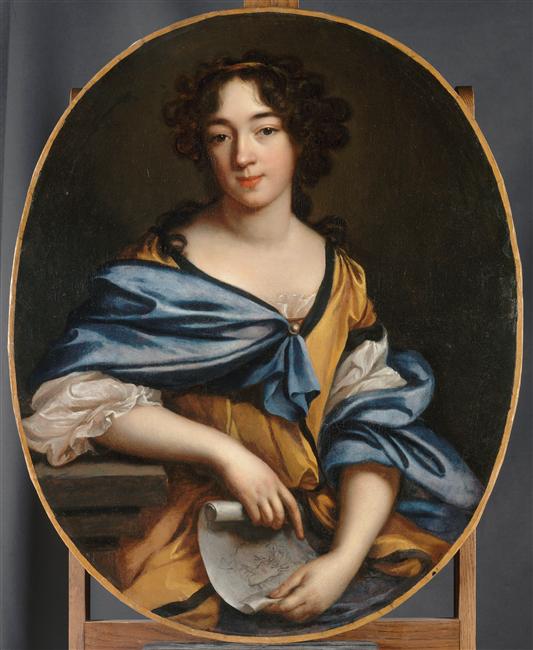
This is often believed to be a portrait of Antonia Bembo, but we have no such thing. It is actually a self-portrait of Élisabeth-Sophie Chéron, who achieved great recognition not only as a painter, but also as a musician and woman of letters, and whose French verse adaptations of the Psalms were set to music by Bembo. A woman holding a sketch, again in full control of her artistic expression, using it to present herself with poised, almost antique demeanor. Chéron painted portraits of high society women and biblical scenes, nothing too provocative, and in 1672 she was accepted into the Académie Royale de Peinture et Sculpture – she was not the first woman to do so, but the first who painted people and not just flower compositions. Again, a woman has to know her place – but slowly, one by one, small steps are taken. In very controlled environments.

The Counter-Reformation is on, and to fight the Protestants with their own weapons, it has become acceptable to handle sacred subjects in common language instead of Latin, and use the seductions of modern arts that the Church shunned as sensual, decadent pleasures, to speak of higher truths. Through this small door, under the guise of respectability, a space of personal female expression is created, seized by Chéron with her translations, Bembo with her musical settings, Jacquet de la Guerre with her spiritual cantatas.

But of Antonia Bembo, again, there is no image. And of Isabella Leonarda we have only a small medallion painted into her family tree, showing her in her nun’s attire. This music is some of the most expressive written at the time. But it came at the price of erasure.

Antonia Bembo (ca. 1643-1715): De profundis (Les Sept psaumes de David)
Psalm 129/130, French text (1694) by Élisabeth-Sophie Chéron (1648-1711)

Isabella Leonarda (1620-1704): Sonata Duodecima
12 Sonatas, op. 16, 1693

Juha T. Koskinen (*1972): She who saw things to come (2024)
Text by Aleksi Barrière, based on the myth of Libuše

Antonia Bembo: Mi basta così
Produzioni Armoniche, ca. 1701

SINGER:
Mi basta così. Yes, I’ve had enough. Those images of the past, how can we turn them around?

Look at Libuše the prophetess painted by Karel Mašek. She is dark and dangerous. Can we finally unleash that dark power that for so long has been harnessed or exhibited on stage like in a zoo?

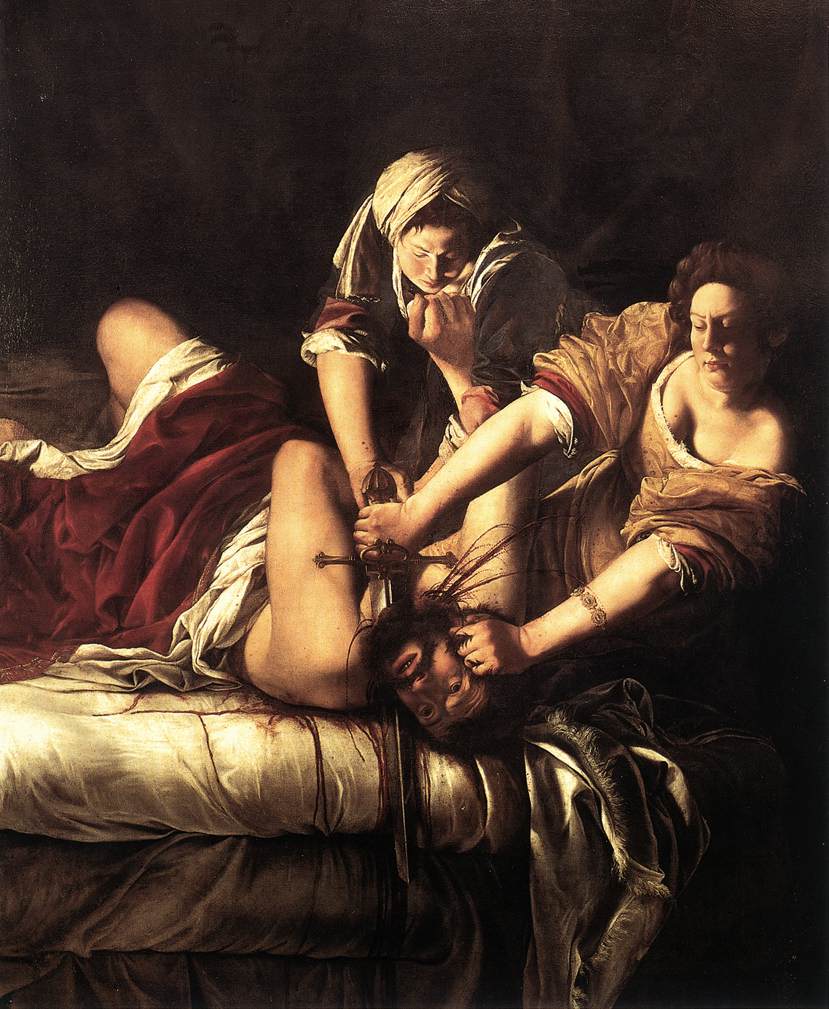
There have been many attempts to seize the old images, reactivate their power. The painter Artemisia Gentileschi, like Élisabeth Jacquet de la Guerre, expressed the suppressed violence of her own story through the Biblical story of Judith the avenger. In 1613, she depicted the general Holofernes in the same submissive position in which she had herself been raped by her painting teacher, through this picture she executed the revenge that she couldn’t achieve elsewhere.

If we have to speak through available stories and images, then let us take those that allow us to turn the violence around. I will be the Avenger. I will break through the prisons made of fine French lace that covers the bruises on my skin. I will break the images through which my body is being sold to the highest bidder, or given out in exchange of favors. I will destroy the tools of my submission and make them the tools of my liberation. I’ve had enough. Listen to the revenge of Judith.

Élisabeth Jacquet de la Guerre: Judith
Sixième Cantate à Voix seule, avec Symphonie
Cantates françoises sur des Sujets tirez de l’Écriture (Livre I, Paris, 1708)
Livret d’Antoine Houdar de La Motte

Silence of the vacuity of vengeance

Élisabeth Jacquet de la Guerre: Sarabande)
Pièces de clavecin, 1687, Suite n° 1 en ré mineur

SINGER:
Why can I be heard only when I scream at the top of my lungs? The dangerous part in me is another way to make me the seductress, to make me the spectacle you come to watch through the bars of a cage, through the window of a peep show. And you keep adding coins. Alcina, Medea, Carmen, you turned the rebel into the femme fatale, from whom nothing more is to be expected than cheap thrills, maybe mutual destruction.

Throughout the centuries we have been kept indoors. There we have created secret rooms for ourselves. We can reclaim those spaces, expand them to create something that is not the same old zoo for our sufferings, the same museum of our submission. I think of this lute player carefully tuning her instrument, painted by Orazio Gentileschi, the father of Artemisia, maybe depicting his daughter. Quietly she listens to a soft tune only she can hear. But she can invite us in. And I think of another painter, the first of her kind, Lavinia Fontana, and her self-portrait at the virginal from 1577. Nothing can stop a woman with an instrument in her hands: she is more than an allegory, she is alive.

We need to move beyond this past. Create new stories and images.
We need to hear a new prelude.

Mioko Yokoyama (*1989): Postlude (2024)


Resonant Humors: Epigraph

PLACE DE LA CONCORDE. On the public square where a king was
beheaded there could be no agreement on a symbol of peace
restored. In 1830, Egypt’s gift of an obelisk from Luxor proved
provi­den­tial: peace with the rest of the world would grant peace
within the kingdom would it not (once removed the marginalia of
sun-worshipping, erect baboons on the pedestal). It suited a
space designed to welcome parades and to corral riots, subject
to traffic jams. They called the place Concord, con-cordia,
togeth­erness-of-hearts. The plural 
cordais a reminder that the
Latin words for 
heart and string share the same origin: they come
from the word for guts. Bowels after all were used to make the
strings of instru­ments. Concordia: a harmony of guts, of strings,
of guts played like strings. Musica mundana, musica humana,
from stars to clouds to city to inner organs to lute, all reined in
and singing in accord finally… But in the middle of klaxons we can
secretly re-tune. Take down the monoliths, harmonize without
dominants: the ever-shifting scordatura of instru­ments combined.
Peace is not the mere suspension of war but rehearsed music.
Tense your strings, lift up your hearts – Sursum corda.


The Other Heart: Full Text

“The Conservatoire Orchestra had recently performed an overture composed by Madame Farrenc. The undersigned was surprised by a work most serious and perfectly constructed, revealing masterly craftsmanship and style. Madame Farrenc’s overture is a most decent instrumental work. Rarely does one find in a woman such vigor and intelligence in the combination of effects.”

This is what a Parisian critic wrote in April 1840 after the premiere of Louise Farrenc’s Ouverture n° 2. At the time, Farrenc’s career as a pianist and piano teacher was (with the support of her husband) in full swing. She is not the only female piano virtuoso of her century to be allowed to compose chamber music. Besides, “A woman’s decent education is always to comprise music,” say the books of good manners. But orchestral music? Despite its quality and originality, the reviews of Farrenc’s music always seem to default to the same uneasy vocabulary: “her inspiration and skill are male in magnitude,” “Madame Farenc’s Nonetto bears the mark of masculine craftsmanship” – “even if we admit that women lack both the vigor demanded when planning the writing of a tragedy and the energy necessary to its execution, we must admit that we have in our company a female symphonist, as curious a phenomenon as a female playwright would be.”

Louise Farrenc composed three symphonies after this overture. But teaching the piano was the only way to support her family, and day-to-day it absorbed all of her energy. A composer’s career requires time and energy, especially the larger orchestral works that would have finally taken Farrenc beyond the small circles of the salons. 19th-century Paris was the century of the symphony orchestra, the century of opera, but who would have imagined that a woman’s work would be performed on the stage of the Paris Opera – ever? Fatigue prevailed, and when Louise’s only child died in 1859, her often-emphasized vigor was shattered. She devoted herself once and for all to chamber music and piano lessons.

An overture? To what then?

Louise Farrenc, Ouverture n° 2

“Although Mademoiselle Holmès has taken on the expressive accent and painfully morbid character that has marked modern music since Robert Schumann, her phrases are always handsomely broad. A closer look might, of course, reveal a woman’s mind, but a superior one, one that has no reason to envy the privileges of our sex, for her style is surely more vigorous and her imagination mightier than that of many fashionable composers.”

This is what a Parisian critic wrote in May 1881 about an early work by Augusta Holmès. Augusta Holmès was born half a century after Louise Farrenc, and things have moved on – by an inch.

In keeping with the times, Holmès is a Wagnerian, and believes that music reaches its full power by taking the form of a narrative, by giving life to situations, backdrops, drama. Each of her works is inspired by a poem he has written. Opera is her obvious calling. All her music reaches towards it. But when she finally gets the chance to present her opera The Black Mountain, set during the war between Montenegro and Turkey, the reviews are unanimous: Augusta Holmès is a Valkyrie, a strangely masculine woman who is out of place in a genre dedicated to men; after all, her epic symphonic style has always seemed suspicious, and not just because of it sounds so German. “The opera’s theme as much as its treatment show that Mademoiselle Holmès is once again trying to make the audience forget her sex,” writes another critic.

Although she was a popular song composer at the beginning of her career, Augusta Holmès managed to leave the salons and piano lessons behind. But she never had the chance to pursue a career as an opera composer. Her most popular works are short symphonic poems, suitable for the first half of orchestral concerts – after the overture, but before the larger works.

Holmès’s final symphonic poem, Andromède, gives the impression of an opera that never got to be composed.

Andromeda, an Ethiopian princess, is being sacrificed to a sea monster to appease the forces of the ocean. She is chained to a rock. The monster approaches. But from the sky soars the hero Perseus, on his winged steed Pegasus. Perseus slays the sea monster and takes Andromeda as his wife. The traditional tale of hero-and-damsel-in-distress? In a poem written for this work, Augusta Holmès gives the story another meaning:

“O human soul, captured from heaven,
Victim of your chained humanity,
Believe in Freedom and thus be free!
Believe in Life, and you shall live as is suited to your worth!

Far from the abyss where a sea of Torments howls,
Far from the monster Pain that eats the light of day,
Winged Poetry and Love immortal
Lift you to the stars, where truer gods have their abode.”

Augusta Holmès, Andromède

“The fragile Saariaho, tackling a large-scale form, and on the theme of violence, too – the sight is as embarrassingly naive as Sylvester Stallone trying to dance ballet.”

Kaija Saariaho’s second opera Adriana Mater premiered in Paris in the spring of 2006. The first work commissioned from a woman by the Paris Opera, this drama of violence was commented on by a Parisian critic in a way that recalls the ancient local tradition.

Sure, early in her career, Saariaho’s music was said to be too cutesy, unsuited to large-scale forms, undramatic, downright boring. “Not many people would listen to Kaija Saariaho’s music if she happened to be ugly and fat. But since she happens to be this ethereal and doleful woman, people think it must be great,” wrote a Helsinki critic. But in the end she was accepted. As long as she was composing that meditative music of hers, reflecting the phenomena of nature – as long as the female composer knew her place. Dramatics and large forms are not for her.

Fortunately, times have changed. Outi Tarkiainen, for example, didn’t have to ask permission, as a woman and a musician with a jazz background, to compose works of even large scale. But I wonder what another Helsinki-based critic must have meant when he wrote, about the music on Tarkiainen’s first album, of the composer’s ability for “elegant orchestration and pretty melodics?” Why, in the critic’s view, do the so-called “dramatic ascents” of Tarkiainen’s monodrama create an “confused yet very serious, heroic vision”? Surely this could have been written about a male composer, right?

Kaija Saariaho and Outi Tarkiainen have composed extensive orchestral works and operas. In Adriana Mater, as well as in The Ring of Fire and Love, which you are about to hear, they have found inspiration in their own experiences: Saariaho in the pulse of the unborn child’s heart beating alongside the mother’s, and Tarkiainen in the euphoria and burns of childbirth. They compose for the big stage about the experiences that make them human, and there is nothing cutesy about their music. From them we learn how layered the birth of the new is, and how much hope it inspires: the birth of a new human being is the promise that the world, that we ourselves, can be something else than what we have been until now.

Outi Tarkiainen, The Ring of Fire and Love

~ INTERMISSION ~

Kaija Saariaho / Amin Maalouf, Adriana Songs

SPEAKER:
A distant country, or perhaps not so distant, on the brink of civil war. The people in each neighborhood are avoiding the neighborhoods next door. They, the Others, have their own shops, their eateries, their places of worship – other than ours. Come nightfall, a woman should not walk alone in the streets of this city. Come nightfall, young Adriana, dreaming of another life, a life without fear, sits on the porch and sings to herself.

SINGER [Adriana Songs – I Jardin d’automne]:
When the eyes of the city close
I reveal my voice!
The voice I gathered
In an autumn garden
And pressed in the pages of a book;
The voice I brought back from my country
Between my brimstone-coloured sheets;
The voice I tucked into my bodice
Under the folds of my heart.
When the eyes of the city close
I reveal my heart!
The heart I gathered
In an autumn garden
And pressed in the pages of a book;
The heart I brought back from my country
Between my stone-coloured sheets;
The heart I tucked into my bodice
Under the folds of my skin.
When the eyes of the city close I reveal my skin!

SPEAKER:
The war has started, the war between them and us. All men in town have been given guns. Fathers, brothers, sons – all join the militia, in defense of ‘our blood.’ This includes Tsargo, a young man of Adriana’s age from the same neighborhood, who in the war has found himself: Tsargo is no longer the low-life and drunkard Adriana doesn’t want to go dancing with, he is Tsargo the local warlord, Tsargo the Protector. One night, Tsargo breaks into Adriana’s house, one of the houses the Protector claimed to be protecting, and forces Adriana to do everything she had denied him before the war.

After the truce, the militias are disbanded – Tsargo has fled the city, and Adriana is pregnant. She is determined to keep the child that is like a wound that was stabbed into her body. She wants to believe that out of the darkest darkness, a light may have appeared. She tells her sister Refka about her decision, her hopes and her fears.

SINGER [Adriana Songs – II Je sens deux cœurs]:
No, I’m not sure of anything.
I only feel, I feel a heart,
Another heart beating close to mine.
Who is this stranger inhabiting me?
A brother? Another self? An enemy?
In his veins two bloods flow
— mingled together:
The blood of the victim and the blood of the aggressor.
How can you spill one without spilling the other?
One day my child will be born.
I’ll hold him in my arms,
Feed him at my breast.
But that day,
Yes, even that day,
I’ll still be wondering,
as I’m wondering now,
as I wonder every moment,
day and night,
Who is it that I carry?
Who is it that I feed?
To comfort myself I sometimes think
That every woman, ever since Eve,
Might have asked herself these questions,
these very same questions:
Who is it that I carry?
Who is it that I feed?
Which will my child turn out to be — Cain or Abel?

SPEAKER:
Seventeen years later, Adriana’s son Yonas is almost an adult. Yonas has learned from Adriana the value of honesty and compassion. But when he hears of the circumstances of his conception, and that Tsargo has recently dared to return to his hometown, he is overcome with rage. [III Beginning of Music] He decides to find Tsargo and avenge his mother, avenge that fateful war night and his fatherless life. Yonas acquires a weapon and sets out to hunt Tsargo… [III Rages]

Yonas has found Tsargo: a human ruin with nothing left but regrets about what he once could have become. Tsargo is ready to die, and has therefore put an end to his life-long flight. Yonas wants Tsargo to look him in the eye before he shoots him, he wants him to see the face of his child, his killer. But war and wandering have taken Tsargo’s sight, his exhausted eyes are blind. Yonas is unable to do it.

[IV La vie retrouvée] In his hand, a weapon is shaking that could avenge his mother, and all of Tsargo’s other victims, but he is unable to press the trigger. Instead, he runs back home to Adriana. Yonas is confused, guilty. I’m sorry. Mother, I betrayed you. [Music climaxes.] Mother, I chickened out. I could have killed him right then and there, but I wanted to see his face, I wanted him to see my face. I saw it, and I couldn’t do it. He didn’t deserve mercy. He deserved to die. Mother, forgive my cowardice. I betrayed you.

SINGER:
That man deserved to die.
But you, my son,
Did not deserve to kill.
Ever since you were born, and even before that,
I’ve wondered if you would be
one day capable of killing.
Even when you were in your cradle
I couldn’t help weighing your cries,
your expressions, your movements.
I had to know
If the blood that flows in your veins
Is that of the killer,
Or mine.
Around me, people were anxious, suspicious,
But I did my best to believe
That blood was neutral and silent.
That blood determined nothing,
That it was enough that I loved you,
spoke to you, brought you up honourably,
For you to be loving,
thoughtful and honourable yourself.
But there was always in me
the endless torture of doubt,
the endless obsessive,
unrelenting question:
If one day you should find yourself, weapon in hand,
Before a man you hate,
A man who deserves the harshest of punishments,
That day, would you kill him?
Or, at the last moment,
would you draw back?
If you’d really been that man’s son
You’d have killed him.
So now at last I have my answer…
The murderer’s blood has been calmed
by flowing near mine.
Today my life, which I had thought was lost,
Is found again at last.
We are not avenged,
but we are saved.
Come close and put your arms around me.
I need to rest my head for a momen
on a man’s shoulder.

Bill Viola BEHIND THE SCREEN OF ISIS

Upon hearing of his passing on July 12, 2024.

I once asked Bill Viola, after a performance of the Peter Sellars production of TRISTAN UND ISOLDE featuring his video, which I had by then seen a dozen of times with different casts and conductors, if he had preferences in musical interpretation – how his work reacted to different takes on the piece. He answered: “It needs the appropriate gravitas from the conductor.”

This left me a little puzzled, because well for starters how much extra gravitas can you bring to Wagner, and also because his choice of words zeroed on something I had been struggling with myself in regards to how his own work was framed in that specific context. Viola’s TRISTAN video is not a backdrop projection participating in a show’s visuals: it’s the centerpiece, an autonomous work of art around which the other visual components are articulated, and it could also be said to be Bill’s own magnum opus: 4 hours worth of images recapitulating his entire life’s work. I could relate more strongly with the posture of Peter Sellars’ staging and James F. Ingalls’ lighting, that reacted to the other elements on stage and in the pit to magnify them and comment on them, with some amount of flexibility and dare I say humility.

I wondered whether Viola, acting like a painter with his canvas (a wide projection screen floating above the singers, safe from the slightest human shadow or light pollution), was embodying an appropriate posture, being the venerable artist dumping his grand oeuvre next to Wagner’s – in short, whether this was all a kind of strange 19th-century backflow.

All while admiring what he did in his considerable career for the emancipation of his medium through that medium’s own means, making video an art of time with its glitches and dilations, and against cinema the art of the moving image on the scale of the human body, I asked myself whether this whole master-of-his-medium thing was not by itself over the top and antiquated, especially in the light of his latest work that absorbed so much Medieval and Renaissance imagery. As if video had to try so hard to prove it could continue a tradition, be something equal to painting, instead of just doing its own thing.

His talk of ‘gravitas’ helped me formulate what disturbed me: maybe this was all just about taking oneself too seriously? Maybe an art form doesn’t need to be a closed form, obsessed with its own internal perfection and tradition?

But revisiting his work over the years, something else struck me: devotion. Taking one single idea and exploring different ways of executing it, trying different approaches, different literal lenses, and trying to make it into a finished piece that someone else can relate to. The extreme, obsessive, earnest devotion of the artist, that doesn’t emerge from an attempt to emulate some artist-paradigm from the past, but that really just is a recognizable trait of great artists in different times and places.

Of course it’s serious business, and requires gravitas. Not ostentatiousness, not self-absorption, but simply going to work to create the best possible image, which is not always the neatest or the most impressive, but one that scratches behind the surface of the big white screen of Isis on which our realities are projected.

Those images then lie open to discussion, and there is much to discuss indeed. But Bill Viola has left a body of work of great integrity, that earnestly tried to look for images behind our known mythologies, in which he put a lot of healthy gravitas. My thoughts remain with this memory and his great contributions to the history of images, and go to his wife Kira and those closest to him.

CHANSONS DE LEINO avec Kaija Saariaho et Sayuri Araida

Note de programme pour l’interprétation des Leino Songs de Kaija Saariaho le 18 mai 2024 au Oji Hall de Tokyo, par la soprano Sayuri Araida et la pianiste Yuka Miura.

« … Un combat de chaque jour, de chaque instant, une lutte toujours plus rude pour sauver les valeurs délicates, sensibles mais frêles, fragiles, éphémères de la beauté… » (Eino Leino)

Eino Leino (1878-1926) est un des poètes majeurs de la littérature finlandaise. Avec d’autres artistes de sa génération tels que le compositeur Jean Sibelius et le peintre Akseli Gallen-Kallela, il a incarné le mouvement dit « national romantique », par lequel, à partir des années 1890, la Finlande – sous domination russe jusqu’à son indépendance en 1917 – s’est inventé une expression artistique singulière, fondée à la fois sur l’exaltation de sa propre culture et l’influence des grands courants artistiques européens. Leino a joué un rôle important dans cette construction, en tant que journaliste d’opinion faisant vivre le débat public, en tant que romancier soucieux de rendre compte des réalités de la vie quotidienne des Finlandais, et en tant que dramaturge qui a donné corps aux mythes et à l’histoire de son pays. Mais c’est en tant que poète qu’il est resté immensément populaire jusqu’à aujourd’hui, y compris auprès du grand public. Surtout auprès de lui peut-être, tant sa sentimentalité, la spiritualité de son humanisme lui ont parfois valu, de son vivant déjà, le procès en naïveté de ses collègues écrivains – l’un de ses points communs avec un Victor Hugo. Tous s’inclinent pourtant devant son influence immense sur la langue finnoise, qui jamais encore n’avait été aussi flamboyante et lyrique que sous sa plume.

Depuis, chaque génération de compositeurs finlandais a proposé de nouvelles lectures musicales d’Eino Leino. Kaija Saariaho (1952-2023) a élaboré la sienne entre 2000 et 2007 en composant quatre chansons pour la soprano Anu Komsi. Le choix des textes constitue déjà en lui-même un parti pris. Trois des poèmes sélectionnés par Saariaho dans l’œuvre prolifique de Leino sont tirés de recueils de jeunesse, publiés alors que le poète était âgé d’à peine vingt ans (chansons I, III, IV). Le poème de la deuxième chanson, à peine plus tardif, porte déjà la trace d’un style plus mûr, plus anguleux. Pour autant, Saariaho évite les textes les plus connus du poète, et ceux dans lesquels se laisserait déceler une quelconque inspiration folklorisante, dans le sujet ou dans le mètre. Elle choisit le Leino le plus intime, le plus personnel – et par-là même, peut-être, le plus universel. Ce qui explique que, malgré qu’elles soient en langue finnoise, ces Leinolaulut (Chansons de Leino) aient connu un succès étonnant à l’étranger, et soient entrées au répertoire de nombreuses sopranos de par le monde.

Pendant les quarante et quelque années de sa carrière, Kaija Saariaho s’est dans sa musique particulièrement intéressée aux états transitionnels, au clair-obscur, aux moirages d’états instables. On ne s’étonne donc pas que la compositrice ait choisi de mettre en musique des poèmes exprimant des états psychologiques qui ne se laissent pas facilement classer dans les grandes passions archétypales qui occupent la poésie (et le chant) lyrique. On découvrira, tour à tour, une tendresse amoureuse qui prend des airs de retour en enfance, une angoisse existentielle paralysante, ou une quiétude solitaire flottante qui semble, entre les deux dernières chansons, osciller imperceptiblement entre l’espoir et l’idéation macabre, sans se décider. D’une manière typique à la fois de Leino et de Saariaho, ces états trouvent leur traduction la plus parlante dans l’analogie avec les processus lents de la nature, comme la progressive (et odorante) émergence du printemps finlandais, ou au contraire les premières neiges qui transfigurent les paysages et les sons. L’art de Kaija Saariaho peut d’ailleurs se décrire par ces mots d’un des poèmes manifestes de Leino (j’emprunte l’idée de ce rapprochement à un ami intime de Saariaho, le chef d’orchestre Esa-Pekka Salonen) :

« Puisse notre art être comme une mer,
profond mais chatoyant (…)
Puisse notre art être comme un ciel,
irisé, flamboyant, étoilé, serein. »

Depuis dix ans, Sayuri Araida chante régulièrement la musique de Kaija Saariaho, dont elle a interprété l’opéra-oratorio La Passion de Simone dans plusieurs pays d’Europe et aux États-Unis, dans la mise en scène que j’ai réalisée. Sayuri s’est pleinement approprié le caractère singulier du langage vocal de la compositrice, qui recherche davantage la plus profonde expressivité que le feu d’artifice virtuose. Les indications espressivo et con amore reviennent plusieurs fois dans la partition des Leinolaulut, et dans bien d’autres œuvres de Kaija. Sayuri Araida, une artiste habitée, dont le désir de chanter est ardent et contagieux, est l’interprète idéale d’une musique qui réclame de chanter jusqu’au bout de chaque ligne et chaque idée, et de les laisser longtemps résonner et s’approfondir en nous.

CONCERT, CONCERTOS – dans la réverbération de Kaija Saariaho

Texte commandé par l’Orchestre de Paris pour le programme de salle du concert hommage à Kaija Saariaho à la Philharmonie de Paris le 15 février 2024, dans lequel étaient réunis son concerto pour flûte Aile du songe et son concerto pour violoncelle Notes on Light.

Concert, concerto, ces deux mots n’en sont qu’un. Une première étymologie – conserere – les fait remonter à l’idée d’unir, de mettre en harmonie, ou simplement de jouer ensemble. Ceux qui ont connu Kaija Saariaho y reconnaîtront quelque chose d’elle. Sa pensée musicale bien sûr, qui saisit dans son mouvement organique l’interdépendance des paramètres sonores pour en faire chatoyer les moirages. Mais aussi son dialogue ouvert avec ses collègues, les interprètes, la technologie, les textes et la scène, qui faisait de tout processus de création une recherche partagée, un laboratoire. Une famille étendue qu’elle s’est construite autour de col-laborantins fidèles, au risque de se voir reprocher de faire bande à part. De ces facettes, le concert de ce soir rend compte, y compris dans la présence du cercle proche de la compositrice réuni pour lui rendre hommage. « Chaque concerto est en quelque sorte le portrait du soliste pour lequel il est écrit », disait Kaija. Concerto, intime portraiture se donnant les moyens de l’orchestre. Concert, plaisir de faire et de sonner ensemble.

Il y a cependant une seconde étymologie possible au concerto, et au concert : concertare, c’est-à-dire combattre, se disputer, débattre. À ce dialogisme, ce drame qui dans un concerto oppose le soliste et l’orchestre, Kaija, compositrice des lentes érosions harmoniques, a mis du temps à adapter son langage musical. Elle y a trouvé la clef pour devenir la compositrice d’opéras que l’on sait, mais aussi la formulation d’une ligne de vie. Orchestrer la confrontation à l’autre, à l’étranger, au différent, voire au contradictoire, non par emprunt mais par étreinte – depuis le moment où elle se déracinait pour apprendre l’informatique musicale dans un milieu d’hommes, et abordait le français qu’elle ne parlait pas encore par la poésie exigeante de Saint-John Perse, elle n’aura eu de cesse d’aller au plus difficile, à ce qui allait le moins de soi, jusqu’à, dans nos dernières collaborations, mettre en musique l’abattage d’une forêt, les réminiscences d’une fusillade, ou le décollage d’une fusée. Composer pour un nouvel instrument ou en langue roumaine ou hopi, collaborer avec une chanteuse folk ou un trompettiste jazz. Pour que jamais la musique ne se réduise à n’être que la récitation de sa propre grammaire. Pour que toujours elle fasse place à de nouveaux corps-cultures-générations, de nouvelles manières de penser, de nouvelles situations, et par là, de haute lutte, à des sons nouveaux. Concert, lieu de rencontres. Concerto, exaltation d’une hétérogénéité bigarrée qui n’appelle pas de résolution-dissolution.

Les deux étymologies que nous avons citées, bien sûr, ne sont pas en contradiction : elles s’invitent l’une l’autre, dans la féconde tension de toute harmonie qui n’est pas stase et communion mais dialectique et discussion. Cette musique ouvre à bas bruit des espaces amicaux où l’on peut se laisser avec Kaija elle-même décentrer et déconcerter. Nous y sommes accueillis par la réverbération infinie d’une voix singulière, assez familière pour nous mettre à l’aise, mais refusant les facilités, y compris celle consistant à occuper le premier plan. La compositrice a poussé la discrétion jusqu’à s’effacer. Plus tôt qu’on ne l’aurait souhaité, mais en chargeant d’une caractéristique intensité son silence.

ON CATHARSIS & A THEATRE OF GRIEF

Amended version of the presentation given in the framework of a panel discussion about the opera Innocence, in conversation with Rolien van Mechelen, Marc De Kesel, and Johan Schokker, organized by the Breukvlakken Foundation in collaboration with the Dutch National Opera, at Theater Perdu (Amsterdam) on October 15th, 2023.

I would like to thank the Breukvlakken Foundation for their invitation to speak today; creating bridges between artistic practice and the study of the human mind is something inspiring, that our opera Innocence calls for, and it is a privilege to be part of this endeavor.

We were asked to offer a presentation as a prelude to the discussion about the opera. Like Marc De Kesel before me, I would like to talk about Greek tragedy, but I will start from a different angle, and hopefully also be able to say something valuable about Innocence by way of this. As a dramaturge and director, I am interested in the discourse we can create about the depiction of violence in art and, in an environment that is saturated by acts of violence and images of violence, the need we are in to find an approach that could feel even moderately helpful. One important starting point for us, in the development process of Innocence, was a line defined early on by the composer Kaija Saariaho, the writer Sofi Oksanen who created the original script, and myself as a dramaturge: that line was that unlike what is generally done – and indeed easier to do – we were not going to show the act of extreme violence around which the story revolves, a school shooting, nor its perpetrator, but would instead focus on causes and consequences. Meaning: how violence is born and perpetuated in a social group, and the process of individual and collective healing. How do you do that in the context of performing arts, within a culture and an art form that are obsessed with spectacle, of which violence is the preferred manifestation? Violence is the typical climax around which the classical and still dominant dramaturgical forms available to us are constructed.

Hence the need to justify the depiction of violence in one or the other form. There is a dominant assumption in contemporary cultural practice that showing violence is not only inevitable, but actually beneficial. The violence of mainstream cinema, television, and other entertainment is commonly justified by using a word of dignified reputation: catharsis. It’s not every day that Ancient Greek concepts are manipulated by the cultural industry, but this one has oddly entered common vocabulary, along with the derived adjective cathartic. This is an interesting concept to study, because it ties together the notions and violence and healing within artistic expression. But I believe there is a strong need to reassess our use of this notion: are we using it correctly, for one, and more importantly what utility does it have in the way we experience art?

The concept of catharsis, generally defined as some kind of artistically induced release of accumulated emotional tension that follows what is now considered the golden ratio of an effective dramatic structure (event, tension, resolution), is originally related to Greek tragedy, which as we know is concerned with the question of violence on many levels: psychologically, the effects of extreme emotions on characters; politically, the necessity to regulate the cycle of talionic vengeance that destabilizes social order; and lastly, the so-called cathartic impact of emotions on the audience.

In chapter 6 of his Poetics, Aristotle defines tragedy through four parameters: a serious subject, a specific literary form, imitation of action rather than its narration, and catharsis. To be more specific, the catharsis of emotions of terror and pity through these same emotions. Literally the word catharsis means purification, or purge, in a medical sense, and in his physiology, Aristotle uses it about the mechanism of menstruation for instance. The problem is that his statement in relation to tragedy is very vague, and that he doesn’t explain how this purported theatrical purgation process should work, to the point that we simply assume that we have lost the texts in which he goes into further detail, and can only guess what he meant. The allusive nature of this text has prompted centuries worth of interpretations, which we can group into three readings of what catharsis could mean: 1) we are cleansed from our extreme emotions by seeing them unfold and be punished by dramatic consequences – i.e. we are being educated; 2) or maybe, by experiencing a little bit of these emotions on a regular basis at the theatre, we are homeopathically immunized against them, or our need to experience them is kept at reasonable levels; 3) or on the opposite, tragedy allows us to experience raw emotions in their purest, purified form, at high intensity, and provides us with a release that makes it unnecessary to seek them in our daily lives.

There are already many possible forms of art contained in these three tentative definitions of catharsis, and worse, they contain also many wild assumptions about how we deal with emotions. Variations of these three readings have been used to justify different types of emotion-inducing experiences, and opera, which has always sought to reproduce some kind of fantasy of Greek tragedy, has long been at the forefront of this culture of voyeurism based on the enjoyment of the spectacle of violence. Although works depicting violence for ideological purposes still constitute a potent genre, a lot of what we have to deal with in our culture is of the third kind I described. The assumption is that we functionally need to sometimes experience a range of negative emotions in a controlled environment, in particular emotions of fear, distress, aggressivity, and that this should have a cleansing effect on us – this is what is often being marketed as a cathartic experience. This is just assumed to be true, somehow, in the same way we in Finland hang on to the comforting wisdom that you can treat a cold with shots of vodka because ‘it kills the germs.’

Apart from the fact that maybe we should not base all our work on arbitrary interpretations of one sentence someone wrote twenty-three centuries ago about an extinct form of theatre… we can credit Aristotle for being a little more precise than these simplifications would suggest. First, in this same sentence quoted earlier, two emotions are mentioned, terror and pity, that not only were meant to balance each other out (as respectively cold and hot emotions in Aristotle’s physiology), but make each other possible: empathy is what allows us to enter a fiction and emote in response to it. Second, in chapter 14 of the Poetics, he does mention more specifically “the pleasure caused by terror and pity”, meaning the experience must produce sensual and aesthetic pleasure and not pure unfiltered emotions. Third, Aristotle does go into more detail elsewhere, namely in book 8 of his Politics: there he speaks of three emotions – terror, pity, and exaltation – and how they are induced by different musical modes, that can be used, again in the medical sense, to purge and regulate the emotions of individuals. His model is religious rituals, where intense exaltation is followed by release and pleasure, but he applies his reasoning to any musical context, and were he alive today, he would find his views applied in film music, with its conventional set of codes, internalized by the broadest audience to the point of thinking them natural and universal.

These elements coalesce into something like a clearer formula for catharsis, that has historically produced some important works, but do we find it satisfying? Fine, you can balance negative emotions with positive emotions, and you can even derive pleasure from the safe, distanced experience of negative emotions, in the same way that you can take bittersweet pleasure in listening to a sad song. But there is a persistent disturbing idea in all of this: that you can and must calibrate emotional response like a medication. That the all-knowing artist can pharmaceutically create the correct emotional experience for the audience. Is that what we want? What happens to the spectator’s agency in such a setting? Works that manipulate us emotionally to a desired effect would commonly be called either hypnotherapy or propaganda, or both.

We do live in an age of calibrated, optimized emotional responses, suited to an age of purified, refined products. In the same way we have industrially isolated sugar from plants to consume it as raw as possible and add it into everything we eat, we have party music that consists only of a steady trippy pulse; we have scary movies filled with ‘jump scares’ and primal fears, complete with music that provides the appropriate emotional cues; we have videos that stimulate arousal without emotional engagement; and of course, we have pure aesthetic pleasure without context or content: culinary formalist art. In that framework, it is not surprising that we also have isolated the elements that make a narrative plot efficient on an endocrine level, and that Artificial Intelligence is capable of implementing them well enough into a functional narrative. The fact is that precisely calibrated emotional pharmacology is not just a prerogative of propaganda, it is a defining trait of the rationalized cultural industry as a whole, both in the current mass media and in the tradition of that one historical mass medium called opera.

I would propose that we question if we want to participate in such consumerism, where every form of emotion is conditioned into the appropriate format, and where we can prescribe ourselves the appropriate amount of endorphin, adrenaline, or serotonin according to what we need to remain functional, e.g. what do I need tonight, a 90-minute feelgood movie or a 120-minute action film or a playlist of my favorite sad songs, so I can go back to work tomorrow morning and be proficient and productive? Of course there will always be rituals such as the cathartic religious rites referenced by Aristotle, meaning places and times where pent-up stress and tension is being released collectively, either constructively or destructively: all societies have them, as feasts, sacrifices, sports competitions, and they prevent more destructive outlets. But these rituals are distinguishable from what theatre does, and I dare say they are probably not what theatre does best, that they are not what is best experienced in a theatre or an opera house. If we believe in the possibility of a curated experience that is not manipulative, consumerist, or both, if we do not experience art to be educated, entertained, groomed, purged, but to be challenged and nurtured in deeper ways, we need to envision another relationship to our emotions and to our mental health, and maybe that requires for us to move beyond the paradigm of catharsis with the pharmacology it entails, whether it’s based on ancient physiology, hormonal imbalance, or behavioral theory.

Let us look at Innocence in terms of its psychological world. If I had to summarize one of the main ideas of Innocence, I could express it in Freudian terms: the repressed always returns. It’s not just your conscious lies and faulty narratives that you cannot escape, it’s all the survival strategies by which you keep at bay your past, in particular the traumas of your past, that will always come back at you, probably in a violent form, unless you face them and process them. So-called cathartic release is not processing; in worst cases it triggers past traumas and/or contributes to glamorizing violence as an outlet.

There have been many acquired cultural techniques to deal with the repressed, but the most universally shared experimental space we are all endowed with to confront it is our dreams. Dreams offer us a paradigm for an open field where we can safely face the figures, memories, ideas and images that we don’t know how to process in everyday life. What matters here is not just the dream ideations themselves, but also the act of interpreting them, of discussing their meaning, which is a transcultural practice. Maybe we should look into existing ways to channel these practices into art?

In the making of Innocence, it was a crucial influence that Kaija Saariaho and myself were at the time both working on integrating elements of Japanese Noh theatre in parallel projects; Kaija’s opera Only the Sound Remains, based on two Noh theatre plays, was premiered here in Amsterdam in 2016. Noh has many acquaintances with Greek tragedy – among others, they both deal with traumatic events being processed in a choral form. But Noh, a theatre form performed at dusk, that traditionally aims at a certain dreamlike quality and is drenched in dream metaphors, puts a specific and unique emphasis on healing. In Noh we meet a warrior who died at war, his spirit trapped in an inferno of anger, needing to be released; we meet a mother whose child has died, driven to madness, needing to be accompanied through the stages of grief; we meet a woman left by her lover, transformed into a vengeful demon, wearing a hannya mask that, as she dances, reveals alternate expressions of rage and fear. This kind of Noh play typically ends in a form of in-story exorcism, but more importantly it features at its climax a monologue: after a long, slow build-up, release comes from verbalization and partial, controlled reenactment, liberating confrontation with the trauma that starts a process of healing. A process that is always difficult and that never has a clear finish line, a triumphant climax and resolution, much like the open chord at the end of Innocence.

There is much we can learn from the example of Noh theatre dramaturgically; one key element is the role of music in creating an elaborate and polyphonic experience of time. The specificity of Kaija Saariaho’s music, even before she started creating operas or telling stories, has been its way of working with tension. This is music more interested in creating long arches and slow erosions, inspired by natural processes, than in achieving classical effects of exposition / tension / and release (in music called resolution) that mirror the so-called cathartic structure of our traditional drama. If what we need is precisely to move beyond these conceptions of cathartic drama as a way of reflecting on the human experience, in order to approach something like a time-sense of dream, a time-sense of healing, we need both fundamentally new music and new storytelling. This is not about forsaking intelligible form and removing tension entirely: quite on the opposite, Kaija’s specific input within her generation of composers has been to find a way to create forms of musical instability and tension that don’t rely on traditional linear harmonic/dramatic resolution, but on a harmony that is built over complex energy fields, and still makes us intuitively wonder what comes next, in a fragile homeostasis of organic collapse and reconstruction. And so when writing the music for Innocence, Kaija doesn’t simply pump us up with adrenaline, but she curates an experience, in which we are not just faced with trauma, but also doing collectively what you learn to do individually in dealing with a panic attack or the effects of PTSD: slowing down your breathing to slow down your heartbeat, entering a slower timeframe that allows you to process. Although the mechanisms still are empathetic, we are not here to be purified, but to explore. It is a fundamental shift, and I would not call this a music of catharsis, but a music of care. It is also paired with a form of storytelling not designed to elicit rushes of pure emotion, but consisting in a game of make-believe, a play in which the audience engages in reconstructing the narrative, and producing associations and interpretations – something that is not possible when your brain is bathing in adrenaline and cortisol and enduring effects similar to those of the response to trauma, impairing memory and other processing abilities. This would be whatever the opposite of a thriller is: an actual, genuine existential investigation.

I would like now to listen to a few fragments from Kaija Saariaho’s music without text, to give a sense of how it works outside of a theatrical context: its contribution might then appear more clearly. Here are a few of her Sept Papillons for solo cello. Each miniature is a delicate exploration of sound, building ephemeral structures that collapse into inharmonicity as they grow.

[Sound sample: excerpts from Sept Papillons by Kaija Saariaho, 2000.]

As you can see in these examples, and as you might have experienced with Innocence, an attitude of care in music doesn’t entail some sort of relaxation music like what they play in massage parlors or 10-hour-long ASMR videos: it is not designed for us to wind down against a pleasant background. It does not make everything clear and comfortable for us – it still has the emotional variety, complexity and the deeper, dark mystery of a dream. But like a dream, it creates a space for us to experience things, without telling us at any given moment how we are supposed to feel about them, letting us explore our feelings instead. This still requires technique, and structure which is to say dramaturgy, in the way that dreams, grief or therapy also require a structure in which to unfold freely, and safely face dangerous forces, anguish, madness, monstrosity, or the void. With Kaija, we constructed this dramaturgy through an ethos of mending, particularly suited to the possibilities of musical polyphony, by piecing together multiple stories, voices, languages that provide musical material, and only make sense when they are assembled, sophisticatedly interwoven into a fabric. I believe there is a pressing necessity to imagine a range of artistic experiences that possess that degree of polyphony and finesse. They necessarily forsake easy solutions and circumvent the allure of violence, the part of us that responds to violence with extreme emotions and stimulation of our sympathetic nervous system and reward system, but instead offer us something profoundly different by focusing on the processes of healing, which as we know are active – as Freud has stated about grief, they are work, like scarring is to an organic tissue.

This is why Aristotle’s antiquated medical metaphors must be questioned, replaced by images that express the sophistication of an evolved medical science; just as we may update the idea of the artist into something else than that of a physician of society who has all the answers and cures his ignorant audience. The artist, by crafting forms of experience as both a researcher and a practitioner, can be an insightful partner in creating spaces that allow for nuanced exploration, both collective and individual. Only at that condition can artistic experiences offer something radically different from the industrial forms of the mainstream, that respond to calibrated demands and fill our heads with images they don’t help us process. If the ancient word tragedy could in that sense still have a meaning, and in a deeper way be opposed to the mainstream of catharsis-driven post-Aristotelean drama, I am compelled to think of the German version of the word, in its beautiful transparency, a word I believe you also have in Dutch: Trauerspiel / treurspel – literally, a (collective) play of grief, for a theatre of grief, centered on process and exploration rather than action and resolution. Thank you for letting me share these few thoughts towards imagining how and why such a theatre could be created.

On the shortcomings of Nolan’s OPPENHEIMER

I want to argue some of the misrepresentations in Christopher Nolan’s OPPENHEIMER are detrimental to the story it is trying to tell.

Of all possible approaches to the general topic — the Manhattan Project, which was a collective endeavor, and the advent of the nuclear age, a fact of global magnitude — Nolan opted for the individual-centered form of the biopic, and the film doesn’t lie about what it is, being called OPPENHEIMER and being adapted from a biography called AMERICAN PROMETHEUS. The result is a 3-hour immersion in the point of view of Robert Oppenheimer throughout his “triumph and tragedy” (unironic subtitle of the book), from rising star to collateral red scare damage.

“The individual” as the preferred vehicle for telling any story is ideological. I see people defending the lack of other viewpoints and perspectives in the film (for instance from women or Japanese people) as a genius trait of the storytelling that should somehow emphasize the lack of awareness in Oppenheimer’s perspective. I would make the argument that it is, in fact, bad storytelling on the premise’s own terms, because Oppenheimer did actually face other perspectives, and had a richer intellectual life than depicted here.

These are the elements that I find most problematic:

1. The impact of the Manhattan Project on indigenous peoples. The Pueblo people who lived in this so-called deserted land are entirely invisible in the film, despite being widely employed on the base as housekeepers, and being the first victims of fallouts. Not to mention the effects of uranium mining in the Navajo Nation, by Navajo people. Or the impact of later H-bomb testing on the populations of the Pacific Northwest. The development of nuclear weapons is intrinsically related to colonial structures, and it is still a topical trait as it applies to the current energy race too. And environmental activism by indigenous peoples ties in to the next point…

2. Environmental stakes. It is a misrepresentation that e.g. fallout was not a topic discussed in Los Alamos, in addition to outright destruction of the world on which the film focuses. This should at least be problematized. Not doing so is all the more absurd because Oppenheimer’s son Peter became an environmental activist because of the legacy of Trinity, and Edward Teller (villainized in the film) was already in the 50s one of the first scientists trying to raise awareness about carbon-induced climate change. In general, it seems rather obvious that telling this story now, the doomsday panic of the nuclear age needs to be linked and updated to the current climate crisis, as they stem from the same history and have such obvious connections even through the characters of the film.

3. Off-handed treatment of ideology. This comes from the Oppenheimer biography the film is based on, AMERICAN PROMETHEUS by Kai Bird and Martin J. Sherwin. The book is contextualizing Oppenheimer’s Left-wing militancy and reminds that he read Marx in German, but doesn’t try in the slightest to understand if this had any impact on his thinking, instead focusing on the American concept of patriotism, and a pinch of political naivety. This is all the more ironic because the title invokes Prometheus for the sake of a metaphor that is never truly explored, although it was heavily used by Marx himself as a revolutionary archetype. The film replicates this trait and worsens it by inventing a scene where literate communists attribute to Marx the phrase ‘Property is theft’ (penned by Proudon, whom Marx contradicted on this precise topic). Oppenheimer’s ideological dilemma and possible interest in publicizing classified findings needs to be given a proper ideological reading, but neither American scholars nor Nolan are interested in putting any effort in even representing correctly the ideology of a milieu that was bathing in Marxist concepts. It’s poor portrayal of both the context and main character.

The book and film are similarly off-handed about all of Oppenheimer’s intellectual influences (outside of physics that are presented as a purely abstract realm). Reference to any literature is treated as anecdote, and we get the usual Bhagavad-Gita quote and John Donne sonnet, without reflecting on how these texts might have shaped Oppenheimer’s approach. For a more in-depth portrait, one might want to turn back to the opera DOCTOR ATOMIC, composed by John Adams to a text that Peter Sellars assembled precisely from all the literary sources that were important to Oppenheimer. One might also add that, while being like the film’s soundtrack grounded in minimalism, the score is of much more substance, and makes for a more rewarding 3-hour experience.

Uuno Kailas’ TIE (THE ROAD)

Uuno Kailas (1901-1933), visionary poet and translator, is best characterized by the name of the literary group to which be belonged: Tulenkantajat, the Fire Bearers. He gave a modernist twist to the Romantic notion of the sacredness of art, and in his short life contributed to the vitality of the Finnish language as a medium for poetry. His influence was felt for decades following his untimely death.

This translation was created for a bilingual reading at the funeral of composer Kaija Saariaho (1952-2023), who for many years harbored the beginning of the poem’s 4th stanza on the wall above her desk.


TIE

Minä olen tie Sinun askeltesi alla.
Olen nähnyt tulosi,
näen Sinun menosi,
saatan Sinua vaaksan matkaa.

Kun olit lapsi –
kun aamutuuli heräsi
ja kaste kimalsi ja keinui
kukkien terissä
kahden puolen minua
ja aurinko kultasi minut
ja vuoret sinersivät siellä,
minne minä menin –
tunsit minun kutsuvan Sinua: tule.
Minä menin satuihin
ja kuninkaan linnaan.

Niin olin antanut Sinulle
sinisten vuorten näyn.
Vartuit. Kaipuusi varttui.
Vein sen sankariretkille kaukaisuuteen:
voittamaan valtakuntia pyhistä haaveen maista,
omistamaan maailman äärettömyyden rantoja myöten,
tulemaan riemun tuuleksi,
elämän sateeksi
kuihtumuksen ylle,
näkemään uusia näkyjä
uusin silmin,
johtamaan uusia totuuden joukkoja
kupeella säilä
niinkuin kulta ja tuli,
laatimaan uusia kauneuden lakeja,
olemaan vapahduksen henki. –
Minä olin rohkeiden askelten polku.
Ikuisesti jättiläismäistä
on nuoruuden uskallus
omaan voimaan ja voittoon.

Niinkuin siivitin kaipauksesi,
niin minä myös annan Sinulle kohtalon,
suuren tai pienen,
valosta ja varjosta tehdyn.
Nostan ja vaivutan Sinut.
Riemu ja nyyhkytys
kulkevat ylitseni
samassa povessa.
Toivo ja uupumus
kohtaavat toisensa,
taistelevat Sinusta.
Sinun ovat rakkaus ja viha
ja huuma ja täyttymys ja harha
ja vapahdus ja lepo.
Neuvotonta taluttaa
sallimuksen käsi,
tietoinen nousee
kohtalonsa herraksi.
Kumpainenkin vaeltaa,
kunne hän jaksaa.

Jonakin päivänä laulat
laulun tiestäsi, vaelluslaulun.
Kuule, kuule,
laulu, joka rinnastasi nousi,
vaeltaa polulta polulle
taivaan sinen ja pilven alla
kepein kaiun siivin!
Toiset vaeltajat
vastaavat sinulle:
– Se on meidän laulumme,
meidän tiemme laulu.

Iloitse tielläsi,
Sinun on kaikki mikä elämässä elää.
Minä, Sinun polkusi,
minä tulen kaikista ajoista,
minä tulen kaikkien poistuneiden luota.

Uuno Kailas, 1931

THE ROAD

I am the road beneath your steps.
I have seen you come,
I will see you go,
for a fraction of your journey I am your companion.

When you were a child –
when the morning wind awoke
and the dew shone and swung
from the petals of flowers
on both sides of me
and I laid gilded by the sun
and the mountains were blue over there,
wherever it was I was leading –
you felt I was calling you: come.
I was leading to the tales
and to the castle of the king.

Thus I had given you
the vision of blue mountains.
You grew. Your desire grew.
I took your desire on heroic journeys into the distance:
to conquer kingdoms in sacred lands of fantasy,
to possess the infinity of the world
from shore to shore,
to become a wind of jubilation
a rain of life
over everything that withers,
to see new visions
with new eyes,
to guide new cohorts of truth,
by your side a saber
that was like gold and fire,
to establish new laws of beauty,
to be a spirit of emancipation. –
I was the path of bold steps.
Eternally gigantic
is the trust of youth
in its own strength and victory.

Just as I gave wings to your desire
I also give you a destiny,
great or small,
made of light and shadow.
I raise you and I rock you.
Jubilation and lament
march over me
within the same bosom.
Hope and exhaustion
come across each other
and fight over you.
Yours is love and hate
and ecstasy and fulfillment and delusion
and liberation and repose.
The confused is guided
by the hand of providence,
the conscious rises to be
the master of their destiny.
Both wander on,
as long as they have the strength.

One day you will sing
a song of your road, a wandering song.
Listen, listen,
the song that rose from you,
it is wandering over one path to the next
under the blue and cloud of the sky
with the light wings of an echo!
The other wanderers
respond to you:
– This is our song,
the song of our road.

Rejoice on your road,
yours is everything that in life is alive.
I, your path,
stem from all time,
I stem from all those who have departed.

HARRASTATTEKO ‘MUSIIKKITEATTERIA’? [mielipidejuttu]

Mikä/mitä suorastaan on musiikkiteatteri? Ennen kaikkea ongelmallinen käännös.

Englannin kielellä on olemassa 1) musical theatre joka viittaa ns. musikaaleihin, eli laulu- ja tanssinumeroihin perustuvaan puheteatterimuotoon, musikalisoitua teatteria, 2) music theatre, joka tulee keskieurooppalaisesta Musiktheater-perinteestä, eli kokeelliselta kentältä, jossa kaikki poikkitaiteelliset muodot ovat mahdollisia: musiikista syntyy teatteria, tai teatteria sävelletään kaikissa ulottuvuuksissaan niin kuin musiikkia.

Suomessa on nyt sellainen ongelma, että molempia käsitteitä kuvataan samalla sanalla. Sitä ei kauheasti huomata, koska tietyllä tavalla molemmat muodot kuuluvat samaan kategoriaan (musiikkiin pohjautuva teatteri) ja etenkin siksi, että niitä tekevät yleensä ihan eri ihmiset; sillä seurauksella että ongelmallisesta sanasta ei synnyt keskustelua. Jako on syvä ja historiallinen: musikaali tulee viihdemuodosta, joka on kodifioitunut vuosikymmenien mittaan ja joka useimmiten (muttei aina) rakentuu tunnettuihin malleihin dramaturgisesti, musiikillisesti ja koreografisesti. Kokeellinen musiikkiteatteri taas perustuu aikansa musiikin kehityksiin ja muutenkin klassisen musiikin perinteisiin, mm. oopperaan.

Alkeellinen tapa määritellä nämä kaksi musiikkiteatteria olisi siis yksinkertainen ‘viihteen’ ja ‘korkeakulttuurin’ välinen jako. Niin elitistiseen sanastoon ei ole pakko turvautua, ja tiedämme hyvin, että jo ooppera-genren sisällä asiat ovat monimutkaisempia; että Mozart kirjoitti sekä Singspielejä (aikansa musikaaleja) että opera seria -teoksia; että monet musikaalit käyttävät avantgarden tai oopperan tekniikkaa, ja/tai haastavat viihdemääritelmää; että oopperataloissa esitetään myös musikaaleja; ja että ooppera itse on osittain, Bertolt Brechtin sanoin, ‘kulinaarinen’ taide joka sisältää viihde-elementtejä.

Mutta kun hiljattain lehdistössä ilmoitettiin, että Suomessakin Taideyliopistoon halutaan musiikkiteatterin esittämiseen koulutusmahdollisuuksia ja pidettiin itsestään selvänä, että kyseessä olisi ns. musikaali, perustelu oli taloudellinen: musikaaleihin on kysyntää, nuoret esiintyjät voivat työllistyä sillä alalla, on siis luonnollista tuottaa tarjontaa joka vastaa kysyntään.

On hämäävää ja paljastavaa, että tässä kontekstissa on puhuttu ilman täsmennystä ‘musiikkiteatteri’-luokasta, ikään kuin tämä sana tarkoittaisi pelkästään musikaaleja. Päättävätkö markkinat, että sanan toista merkitystä ja teoksia joihin se viittaa ei kerta kaikkiaan ole olemassa? Onko taidekorkeakoulun rooli pelkästään kirjata mitä markkinat pitävät toivottavana taiteena?

Musiikkiteatteri kokeellisessa muodossaan on elävä ja kansainvälisesti tunnustettu taidemuoto, johon esimerkiksi Saksassa on olemassa korkeatasoista koulutusta ohjaajille, säveltäjille ja esiintyjille. Suomessakin esitetään yhä enemmän kotimaista ja kansainvälistä nykyoopperaa ja -musiikkiteatteria joka tulee nimenomaan siitä perinteestä. Esitin itse Kansallisoopperan Alminsalissa kaksi teosta (Violences, 2019 ja Between, 2022) joiden alaotsikko oli ‘Ilta musiikkiteatterin parissa’, koska Ooppera toivoi nimenomaan kokeellisen muodon esiin nostamista.

Meidän täytyy ottaa kantamme: joko jompaakumpaa musiikkiteatterimuotoa ei enää kutsuta musiikkiteatteriksi, tai sitten käsittelemme musiikkiteatteria laajana yhteisenä kenttänä, ja on koulutuslaitosten ja teattereiden kohdeltava sitä sellaisena. Silloin samassa kontekstissa esitetään musikaaleja ja kokeellisia poikkitaiteellisia teoksia; esiintyjiä koulutetaan käyttämään koko alan kirjoa jota saattaa hyödyntää teatterissa, oopperassa ja musikaalissa kuin myös vaikkapa kokeellista dramaturgiaa, puhelaulua, instrumentaaliteatteria ja koreografiaa; tutustutaan saman opetuspäivän aikana Sondheimiin ja Aperghisiin, Jerome Robbinsiin ja Pina Bauschiin, ja vartutaan monipuolisiksi, monikielisiksi taiteilijoiksi. On mahdollisuus rakentaa uutta taiteilijasukupolvea, joka on tietoinen muodon historiasta ja kaikista sen mahdollisuuksista ja osaa käyttää niitä luovasti ja visionäärisesti. Eikö olisi nyt aika pyrkiä siihen. Sokea liberalismi joka luovuttaa kulttuurin markkinoille sillä perusteella että “kansa/asiakaskunta päättää” on yhtä myrkyllistä kuin äärioikeiston populismi, ja johdattaa siihen. Olemme risteyksellä, tehkäämme vaihteeksi järkevä päätös.