Corrected version of the guest lecture given at the Institute for Theatre Studies at the Freie Universität Berlin, on May 26, 2026.
Thank you for joining us today, and many thanks in particular to Dr. Julia Schröder for inviting me. I am very touched that we are meeting at the intersection of musicology and theatre studies, as what I would like to talk to you about tonight is circulations between disciplines – something that requires interfaces, interstices, grey areas, and imperfectly guarded borders. This applies to artistic practices, as we will see, but also to the relation between artistic praxis and theory. What I will do reflects my own circulations between both: presenting an effort to reflect on my own practices of course, but more importantly, showing you how I look for artistic impulses in art history, how I build my toolbox from constantly rewritten historical and theoretical legacies.
As a writer and director working with musicians, I am dealing with frictions between artistic paradigms, some of which have crystallized over centuries. What complicates matters between theatre and music is that neither is simply a discipline or a medium. Both are diverse families of performance practices that have been intimately connected for most of their history. The idea of one without the other, of ‘absolute music’ or of a ‘straight play’, is a recent Western construct, informed by narrow aesthetics aiming at purity of each artistic medium in relationship to the five senses. Today I will talk in particular about re-opening to theatre works of the concert tradition.
THE LIFE AND DEATH OF FORMS.
Art forms close and re-open all the time. They go through processes of individuation by specialization, until their need to grow makes them question their own limitations and look for solutions in other art forms. Then they need to redefine themselves, create a cohesive practice, so a new normative process is engaged. That great cycle is organic, almost biological. So maybe to keep the arts alive we need people on both sides: artists who seek collaboration, who transpose into their own medium material, procedures, ideas from other fields and thus renew it; and, on the other hand, prescriptivists who believe an art form collapses when it doesn’t focus on its own means – this is Lessing describing painting and poetry as “two respectful, friendly neighbors” (zwei billige freundschaftliche Nachbarn) who enjoy looking at each others’ gardens but never question the position of the fence that separates them1, or Adorno writing against the erosion of individual arts (Verfransung der Künste) in the hybridized forms of the avant-garde2.
Based only on what I have said until now, you can certainly imagine with which side of this spectrum I tend to identify, but I would like to look at the larger picture. First of all because this tension, I believe, is like all organic processes scalable to situations that are more concrete than the ebbs and flows of art history: it applies to individual artists, and to the processes that lead to the creation of individual works. It is, so to speak, the active duality that Nietzsche establishes between the Apollonian and the Dionysian: the Apollonian is the principium individuationis, the urge to organize into a form, a defined self, while the Dionysian is the urge to break from all forms, to destroy boundaries that separate us, that prevent us from being one, it is “self-estrangement” (Selbstentäusserung)3. The dialectics between these two drives – Nietzsche does use the soon-to-be psychoanalytical term Trieb – fuels not only the historical development of the arts, but also of individuals and societies. If you look at the most common, apparently most benign intermedia circulation, which is the setting of words to music, you are already entering this dialectic: Will the music destroy the words, dissolve their meaning? Will the words derail the inner logic of music, subdue it, reduce it to illustration? The same question will be familiar to any artist engaged in a collaboration: Am I losing myself by intertwining my practice with those of completely different individuals and disciplines? Is the collaboration flawed by one voice dominating the others? Or are we maybe all losing ourselves in a group dynamic?
I think these are very real questions, that shouldn’t be hastily dismissed. They are important to the making and the understanding of art, but they are also extremely loaded politically, in a moment when certain forces aggressively call into question our ability to live as a heterogeneous society. We need to be extremely concrete about how we can make heterogeneity work without collapsing into complete separation between each and everyone, all while resisting narratives of homogenization and purity.
I have been very interested in understanding how borders between artistic disciplines have been established, and crossed. You hardly can separate those two movements, they are mutually locked like breathing in and out. In my own research I have found it useful to think of the arts as an ecosystem, in which we see processes of individuation, transmission, and adaptation unfold. In this model, the central unit that allows for transmission is form. By form I mean any principle of organization in time and space. It’s a pattern, a template, a Gestalt, which makes it eminently both reproducible and transposable. So it’s often distinctive of a specific practice, but it also has a possibility to circulate between media, when the media in question share parameters, meaning common ground, an interface through which circulation can happen.
The most obvious example is how rhythmical patterns from dances could be transferred to medieval chansons, and from there branch into fixed forms both in written poetry and in instrumental music, and even contribute to the establishment of written poetry and instrumental music as autonomous disciplines. The global history of music is of course full of such circulations, crossing borders not only between disciplines but also between cultures. This is not just interesting in terms of genetic art history, but also as a laboratory for our own practice: when a form such as the sonnet is developed in a literary context, and then set to music, new forms of musical discourse emerge, and the same applies to each new poem, each new libretto that is set to music, and there is something to learn from that. And it applies to other intermedia circulations too, for instance techniques of perspective applied to orchestration to create musical landscapes, or the quarrel between line and color in classical painting inspiring composers to think about harmony as elaborately as about melody. Forms are tools that ultimately allow to question the fundamental concepts of a discipline. This is why we have much to learn from what I call the ecology of forms.
APPLIED ECOLOGY OF FORMS.
Music is a great platform for the circulation of forms, because it is a discipline that has developed an advanced level of formal thinking, especially through notation, but also because it is, historically, much more than a medium. It is a collection of performative practices that have the organization of sound in common, but that cannot be reduced to sound. In most traditions, about all performance genres are musical, subsets of music. The idea of a theatre that would not be musical would be absurd in most places and times. Consequently, most attempts to restore this original connection, that in our collective European mythology is embodied by the Greek tragedy, have been under the auspices of music, as variations of what we generically call opera. And modern theatre, theatre as an art form that is not simply a literary genre consisting of dialogues, was born from an impulse to transpose forms and concepts from music. Music is Artaud’s main metaphor for a theatre utilizing “all the means of expression available on a stage4”, which he thought he saw realized in Balinese gamelan. Meyerhold was inspired by the Peking Opera performances of Mei Lanfang, as was Brecht, and both of them placed music at the center of their respective theatrical reforms, that rely heavily on ideas of rhythm, composition, and montage. Adolphe Appia theorized the stage as an abstract space that must be composed to be brought to the level of music, and in different ways Kandinsky and Schlemmer developed a similar fantasy – theatre that is, metaphorically and materially, pure music to the eyes. Of course when aspiring to music, all these people are looking for something quite different, they are projecting different ideas of music, as cosmic-mathematical ideal, or visceral emotional vibration, or element of ritual, or entertainment. The differences between their expectations are as crucial as the resulting outcome. For now, let us not make a hierarchy between the musical paradigms at play, let us observe that they are plenty and that they have been productively mobilized. The fact is that absolutely all 20th-century art theatre is drenched in these circulations and borrowings, which as we see are intrinsically both interdisciplinary and intercultural.
And obviously this is not a one-sided dynamic. Music defining itself as the art of sounds comes at a cost: the loss of semiotic grounding. In the age of high baroque, the French writer Fontenelle reportedly had this bon mot: Sonate, que me veux-tu ? Sonata, what is it that you want of me? Instrumental music seemingly cannot make a point. The urge to produce meaning keeps flowing back into music in all sorts of shapes, through text, programme music, sound painting, et nowadays additional composed elements of staging or image. Franz Liszt has these same frustrations, but he also makes another astute remark: not only most concerts are “boring,” he writes in 1835, “devoid of interest and meaning” (privés d’intérêt et de sens), but they don’t even serve the music, they “use the music as a pretext.5” It is of course an effect of the market economy to empty things of their substance – when the market economy meets classical music, you get colorful posters with attractive names and best-of programmes, Liszt says as much and he would delighted to know this commodification process is now fully automated through algorithms. This is not an accident in the history of the concert, it’s a feature.
That is why there is a lot of sense in bringing theatre back into the concert situation. But of course it shouldn’t be done with an attitude that music needs to receive words or images to finally carry meaning, it has to actually be done on the music’s terms. The biggest lie is that the classical concert ritual has evolved to optimize the listening of music. No, it has evolved to optimize costs. I don’t listen to the music better because the pieces are played from shortest to longest and the stage is bathing in constant white wash-lighting. Even just a carefully thought-through dramaturgy, focused lighting, and a general awareness of how people come and go on stage goes a long way. But it requires additional rehearsal time. What is interesting is that the moment you stage something, you necessarily take that time, you ask questions that are not deemed worthy in the concert industry, that are actually core questions of music as a performance art, as a form of theatre. These questions were quite obvious to The Doors and Pink Floyd, for instance, who happened to evolve in a market that saw added value in theatricalizing concerts, but in the classical music world that usually happens only as a desperate imitation of pop. And only few theatre people are interested in such ventures. Peter Sellars does these shows that he calls ritualizations, and the late Pierre Audi had this practice of mise en espace – both are based on the idea that by applying theatrical tools to the concert situation, you can create a deeper experience. It has become something of a trend to try to imitate that, with superficial motives: a little staging and a little lighting that cosmetically make the concert experience more interesting. That would be theatrics, not theatre. What I mean, by contrast, is a process of deepening and of grounding. Nowadays in France we use mise en espace to describe a cheaper version of a mise en scène, but for Pierre Audi espace is larger than scène, it’s the promise of a more immersive, less conventional audience experience6. What is noteworthy about these directors is that they have been genuinely looking not to shoehorn music into an idea of theatre, but to find in the concert situation the seeds for a theatre that doesn’t exist anywhere else. That is how these directors have offered us, for instance, radical readings of Bach passions where a singer and an obligato instrumentalist share a scene, or how they have revealed to the world the power of the music of Claude Vivier, by way of staging.
Because it’s a very straightforward example, I can show you an excerpt from the work I did myself on Luciano Berio’s Sequenza III (composed for Cathy Berberian in 1965), in a performance called Give Me a Few Words back in 2017. Sequenza III is part of a series of works that Berio defined as “duos between a musician and their instrument,” and in this piece the instrument is the human voice, which is a very illuminating way of describing the relationship a singer has with this thing that is coming out of themselves and that they try to control. You can listen to the work as a purely musical experience, but then we usually focus on the virtuosic aspect of the performance, not on the drama: the singer is trying to master her instrument and gets lost in her own warm-up. Her attempts to sing the text of the piece, a poem by Markus Kutter, keep failing, maybe because the sounds she discovers along the way interest her more; the dissolved poem seems to be embodied in the musical drama instead.
The short English-language poem reads like this: “give me / a few words / for a woman / to sing a truth / allowing us / to build a house / without worrying / before night comes.”
[Excerpt from Give Me a Few Words (2017)
featuring Marianne Seleskovitch]
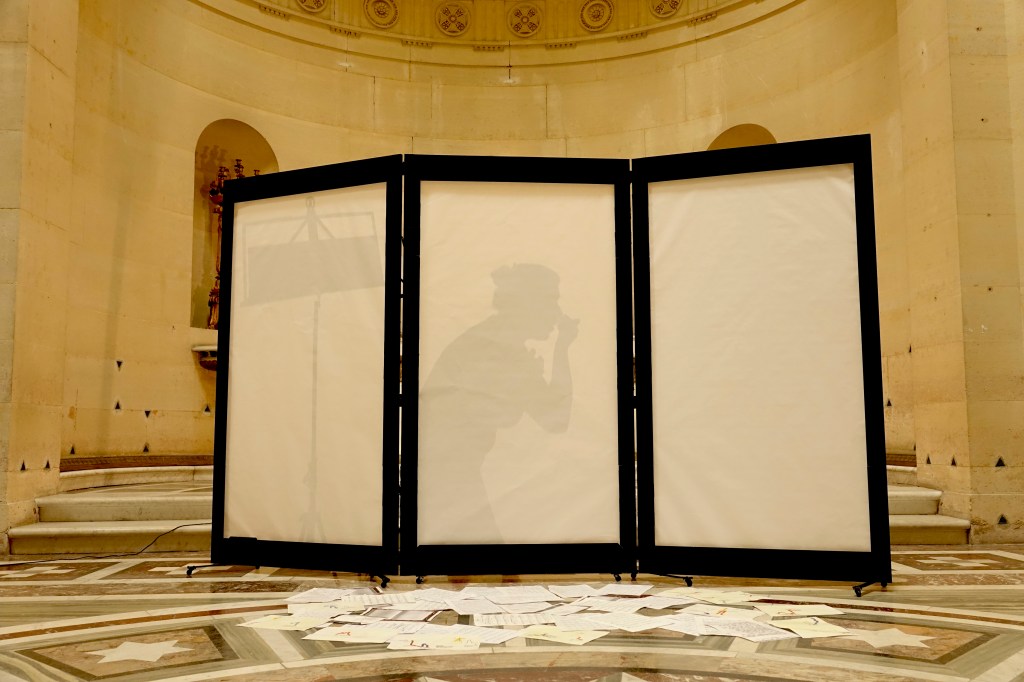
Here the theatre is born entirely from the physical act of performing Berio’s score. Ideally we would first listen to the sound and then I would show you how we interpreted it. Of course you can imagine all sorts of images over this music, in the same way in the Regieoper practice you have images added to the music performed by the invisible orchestra in the pit, but we are looking for something distinctly different here: when the music is not treated as a sound track, but the act of performing it becomes a source of theatre, we see the intermedia circulation unfold before our eyes as self-estrangement.
(As a sidenote, I would remark that there is nothing wrong with soundtracks. They are also a wonderful example of form circulation: when you listen to a film’s soundtrack separately you realize you have an aural version of the film’s narrative form. A plot, or fabula, is of course a form, something that can circulate and be transformed. I did a show once which was the staging of the music Hans Werner Henze wrote for a film adaptation of Heinrich Böll’s Die verlorene Ehre der Katharina Blum – without the dialogues and of course without the images, just some form of silent action. All you need is there in the music already. And the story could be told differently once you took that form out of its original biome of circulation to give it a new life.)
So these are examples of theatre’s agency in the circulation and development of forms. This requires the ability to distinguish between forms that are empty, limiting conventions and forms that can expand our theatrical possibilities. Let’s circle back to potpourri concerts, for instance. We already talked about Franz Liszt’s grievances. To these he had solutions of his own: he wrote programme music, and he performed concerts that have a form and a dramaturgy, for which he coined the now common word recital. So of course he borrowed forms, abundantly, from literature, from theatre, and in the case of the recital, from poetry readings. But what I find interesting for our purposes is that, while Liszt complained about this (inescapable) tendency of concerts to devolve into hit parade programmes without a backbone, he didn’t blame the heterogeneity. He didn’t solve the problem by playing only one work, or only monographic concerts, or concerts centered on simplistic keywords. He didn’t respond to the heterogeneous with homogeneity, but with rhapsody. The rhapsodic not only is rooted in musical tradition, it is one of the oldest ones: you borrow, you jam together, you piece things into something new, and the audience accepts this montage, as a strategy of production and form of reception.
This is quite interesting because other art forms, in the West, have only marginally taken montage seriously until the 20th century. Of course montage has existed on all sorts of levels as a technique – quotation is montage, metaphor, oxymoron is montage –, but in the same way that disciplines open and close up, when they close up they develop ideals of purity. This mirrors our deeper cultural problem with everything that is mixed and hybrid. In this sense I think it is interesting to turn our general assumption around – why wouldn’t classical concert forms be interesting precisely because they have this rhapsodic potential, not in spite of it? In a world that has been blessed with the work of Gertrude Stein and Heiner Müller, we should know how to value a dramaturgy of montage and not just judge it by the standard of linear storytelling. We owe the advent of these dramaturgies to the visual arts and collage, of course, but they also have a musical origin – not directly through the classical concert, but the popular formats of cabaret and revue, evenings that seek heterogeneity, reclaimed under the name of variety, variété.
(I will be making a purely conventional distinction here: the visual arts driven collage has a stronger connotation of ‘found object’ methodology of decontextualization, the more musically oriented montage organizes elements on the axis on time so as to create a larger form that is ultimately articulated into a unity. However, most uses of these words are metaphorical and don’t apply strictly, and a praxis may be described with a combination of both words. A revue is one show, usually personified by a master of ceremonies, but the element of heterogeneity can be extreme, taking the notion of objet trouvé to extremes of chance operation and, of course, alienation through the exploitative figure of the ‘monster.’)
At the turn of the 20th century, cabaret and variété evenings could be experimental or commercial, and usually they were a mixture of both, which is another symptom of their intrinsic lack of ontological purity. Their influence on the avant-garde is well-known: the experience of the heterogeneous Parisian cabarets, as a format and in their content, was a decisive impulse for Filippo Tommaso Marinetti in the development of Futurism7; the cabaret scene of Munich provided Hugo Ball and Emmy Hennings with a model to launch the Cabaret Voltaire and the Dada movement; it also gave Bertolt Brecht the key to a dramaturgy of heterogeneity.
The point I would like to underline is that genetically, the classical concert is related to these forms, although in that family it is usually perceived as the boring middle-class cousin – but the core idea that very different things are put together is there, and it is deeply exciting if you develop it into a theatrical experience, instead of accepting it as a convention.
COMPARATIVE STRATEGIES OF HETEROGENEIZATION.
In these examples we see how musical and theatrical practices can nourish each other to create heterogeneity. And this is where I think it is important to distinguish both between different forms of heterogeneity within a given work of performance, and by extension between different strategies of circulation between media and disciplines – all are not conducive to heterogeneity.
The classic paradigm for heterogeneous form-building within one given discipline is the rhapsodic, of which I will now talk beyond the modern musical meaning of the word earlier exemplified by Liszt. Rhapsodia, which grew into a metaphor of heterogeneous creation in other fields than spoken word, is also itself a metaphorical word, that refers literally to the sewing, the stitching together of songs. In the context of Greek epics, as in many oral traditions, this stitching was presumably happening during performance, and the same procedure was used in writing by the person, collective, or consecutive authors we call Homer, until the texts of the Iliad and the Odyssey were edited into a fixed version in the 6th century BC – a date after which they were still used as a material sampled and recombined in performance by rhapsodes. The stage before this moment when the corpus was closed into the definitive ‘classic’ is most interesting to us, the rhapsodic procedure as we can understand it from the frozen text itself, meaning the two elements that make the stitching possible: a frame narrative, and the meter (the rhapsode, unlike the ancient bard, was not accompanying himself with an instrument, and was only equipped with a staff, presumably used to keep a beat).
Thanks to the frame narrative, nested narratives and digressions could be inserted, and thanks to the hexameter, wild changes in tone, in language, in characters, could come in, and the epic could still hold together and move forward. We are not at all attuned to the dimension of pleasure that listeners and readers of Homer could derive from the epic poems not as perfect monolithic masterworks, but in the way they make heterogeneity hold together. The meter is not something that makes everything sound the same, but the underlying warp that allows for the weaving of multiple colors and motives. Of course, in this historical model, the unifying elements do hold a strong grip: one meter/warp, one voice, one loom. But it is useful to compare such rhapsodia to the paradigm of tragedy, the total, through-composed poem, which has been repeatedly revisited as the model for opera. In contrast with tragedy, the ultimate paradigm of integration and harmony that dramatizes the process of achieving integration and harmony, the rhapsodic poem is defined by its explicitly pieced-together form.
The rhapsodic is a spectrum that, in textile terms, moves somewhere between the weaving of an integrated tapestry (montage) and the stitching together of a patchwork quilt (collage). The patchwork being the extreme of heterogeneity, where the seams between heterogeneous materials remain visible – and it is a spectrum because of course this doesn’t mean there isn’t a method of composition involved in patchwork too, in some cases even repetitive geometrical patterns that are not intrinsically different from what weaving can produce. Within this spectrum, the tension between heterogeneity and integration remains alive and can be resolved (or left open) in a variety of unique ways.
As we have seen, there is a lengthy history of rhapsodic practices beyond Homeric poetry, some of which stretch the limits of unity. This is because there is also a lengthy history of appreciation of the stitching-together: it is an art of creating connections (the same thing
metaphors do on the syntactic level) that as a formal procedure has been given philosophical significance – the stitching together of myths in Ovid’s Metamorphoses is the most obvious example, radicalizing the rhapsodic montage method of epic poetry into a flamboyantly heterogeneous literary object that is a celebration of a multifaceted and ever-transforming world. But the cruder art of the patchwork, the aesthetic pleasure of variety, of heterogeneity itself, also has a sensual tradition. If you look at 18th-century pasticcio operas, pieced together from different opuses, sometimes different from composers and even in different languages, you are reminded of that special strand of pleasure, and it is no coincidence that the word pasticcio itself comes from a mixed culinary preparation, as the culinary has been a field where these kind of pleasures have been both refined and normalized. In the aesthetic realm, which we traditionally don’t like to extend to food, mixed forms always appear, but they are indefinitely suspicious. This is where the mechanism of normativity, of form consolidation, comes into play. The rhapsodic is solidified into the great epic poem treated as a sacred text, the collaboration of multiple artists and disciplines is solidified into the integrated model of the tragedy and the opera.
There can be good reasons to protest against the culinary pleasure, of course, precisely when the rhapsodic tension between heterogeneity and unity does not exist anymore – when we are only dealing with a best of that is not trying to satisfy anything else than our desire to be entertained by familiar things, if possible in the form of short numbers. For instance Brecht was inspired by the revue, but he also emphasized that he wanted to create a dramaturgy of tension that keeps the fragmentary structure together. Yet he couldn’t have come to this form without the revue, and he couldn’t have developed his method of writing, cutting, reassembling scenes without collage and montage. It is this active, lively dialectic between composition and fragmentation, individuation and self-estrangement, that is here called the rhapsodic. It leads to a wide range of possible forms that are unique to the specific work or performance that is being created.
This dialectic of the rhapsodic within one form, and its potential failure at preserving heterogeneity in the wake of form consolidation, is fully transposable to the formal problems that emerge in an interdisciplinary context. In an interdisciplinary performance, a rhapsodic approach can result in the juxtaposition and combination of elements from different disciplines and therefore the circulation of forms between them, but also in one medium annexing the others, integrating them aggressively to its own goals, feeding them to its own loom. This can be a musician or a visual artist treating elements from other disciplines only as fodder to which they apply their own methodologies, as a way of expanding their palette. It is also the uncomfortable element in the largest interdisciplinary integration machine our Western tradition has produced, opera as the composer’s Gesamtkunstwerk.
In Wagner’s writings, there is this nostalgic way of looking at the Greek tragedy as the lost Eden before the separation of media, when everything was one. That old dream, and all models that rely on such golden age mythology, is a dream of integration, favoring the melting pot over the salad bowl, if you will. The musical paradigm we call opera, starting from Monteverdi’s musical recitative – also based on an interpretation of Greek tragedy – is ultimately about restoring homogeneity. In that form, all components are woven into a musical form, and the chorus is a crowd, breaking into complexity only to express chaos that has to be coaxed into control. Its aesthetic ideal resides rather in the unison than in the rhapsodic equivalent: the complex polyphony that can be created around something as simple as a unifying meter or beat.
We have to think carefully about the consequences of media annexation, both on forms and on the meaning their produce. In the musical world, annexation can be opera seen as an integrated formula of music/theatre relationships, or it can be the complete composition of gesture, lighting, and video into a new music piece, often in avoidance of actual collaboration with other people. Conversely, from the perspective of the stage, annexation can be a form of Musiktheater in which sound is only experienced for its semantic value or as a theatrical gesture, and not as an autonomous artistic medium. Of course they can also be that, in the same way a poem can be treated by a composer simply as a series of sounds, but it should be given a chance to also exist on its own terms, follow its own logic, and provide its own kind of experience to the spectator. The rhapsodic applied to intermedia means to give space to different media in the artistic process, whichimplies actually giving space to different people who have their ways of feeling, opening that many more possible avenues for an audience that is itself heterogeneous, and making them face that much more positive estrangement.
The problem of a lot of opera in my eyes is how many layers of assumptions it contains musically about all the media involved. The theatrical conventions of the time (and this is true of any time) end up being deeply imprinted into the music itself. How the action is supposed to unfold and climax, when the dance number is due, the limitations of set changes, all things that every opera composer has ever complained about. It is not without reason that some of the most interesting works for us to stage today were specifically not written for the stage, which acted as a crucible, a melting potfor formal integration as much as social validation. Composers like Bizet and Mahler, who knew very well the limitations of opera in their time, invented forms that we only now have the theatrical tools to stage. Handel, who was a successful show business entrepreneur, was very aware of the additional artistic freedom he had when composing oratorios instead of operas – from the perspective of today’s standards, his oratorios are operas without the limitations of the scene on which he was operating.
And of course alternative forms have also historically been alternative spaces. I am now thinking of oratorio as a way for women to do opera when they were banned from the opera stages in Rome, of the chamber cantata as a way for women to compose opera in private spaces when they were not welcome to the big stages, and all the practices of music-making and storytelling that have developed in the margins, among oppressed groups. Recently I had a collaboration with the Noh performer Ryoko Aoki (together with composer Juha T. Koskinen), and she told this interesting fact: women were traditionally not allowed to perform Noh theatre, but they were allowed to learn the technique of Noh singing, utai, and to perform private recitals of it. So there is a parallel, hidden tradition of this music being performed outside of institutions, and Ryoko developed this tradition by having new utai music commissioned from living composers for recitals, and now a whole new repertoire and new ways of staging it are growing out of this tradition, that would be impossible within Noh theatre per se, which remains strictly codified and gate-kept.
Fundamentally, and this is maybe where the expression mise en espace takes its deeper meaning, what we need is to create different spaces in which a variety of experiences is possible. I do not mean only physical venues, although this obviously matters a lot, but the shared space that is created between the beginning and the ending of the performance, and maybe before and after as well. I have listed some of the ways in which music, I believe, has successfully created such spaces, that can serve as an inspiration to us today, as by contrast theatre is, and always has been since the word was created, the name of a certain type of venue, of a fixed (if historically evolving) organization of gazes. Music as a practice, on the opposite, creates experiential spaces proactively. When they interact, they can blend into the worst of both worlds, the stiffest form of convention, or they can on the opposite materialize as an ever-shifting architecture of shared experiences that welcomes different forms of expression and of reception, with strategies of montage, internal and intermedia polyphony or heterophony that allow for choral richness. Certainly it is about representation of stories and ways of seeing, but more importantly it is about being compellingly able to let audiences experience them, and experience circulation between them. That is the famous motto from Audre Lorde: “There are no new ideas. There are only new ways of making them felt.8”
RECONTEXTUALIZATIONS.
In way of conclusion, I would like to illustrate my interest for staging concert pieces with two recent examples.
First here is something from a show called The King is Dead!, in 2024. The show is constructed around a famous piece by Peter Maxwell Davies called Eight Songs for a Mad King (1969), which is based on the words of the titular ‘mad king’ George III, and you can interpret the singing character as the king himself or as a person who believes they are the king. Like Berio’s Sequenza which I mentioned earlier, it is kind of a showcase piece for extended vocal techniques, in this case of the vocalist Roy Hart, who was a pioneer not only of new vocal techniques but also of psychotherapeutic uses of the voice. Hart’s work has been influential to people like Grotowski and Brook, and the piece is in itself pure vocal theatre. It has been staged multiple times, but I myself always found it too short and fast, it’s under half-an-hour of what easily just feels like one manic crisis after another, which is also not what the experience of psychosis is. So I decided to rhapsodically combine the piece with Quartet for the End of Time, an instrumental work that Olivier Messiaen composed and premiered in the camp of Görlitz as a prisoner of war in 1941. Both pieces are cast in eight movements, that work surprisingly well when you alternate them, which I would call off-the-rails concert logic, because you wouldn’t do that to a musical score in normal circumstances. However the instrumentation and instrumental idioms are oddly similar, and many motives travel from one work to another, including the singing of birds like an apparition in the middle of darkness. Although you could think instrumental additions can only diminish the theatricality of the whole, in this case I finally felt like the story of a man losing himself, committed to some kind of institution or camp, could be told genuinely, because that is how those mental and physical places are – time passes slowly and you have no control over it.
[Excerpt from The King is Dead! (2024)
featuring Holger Falk and Olli Leppäniemi]
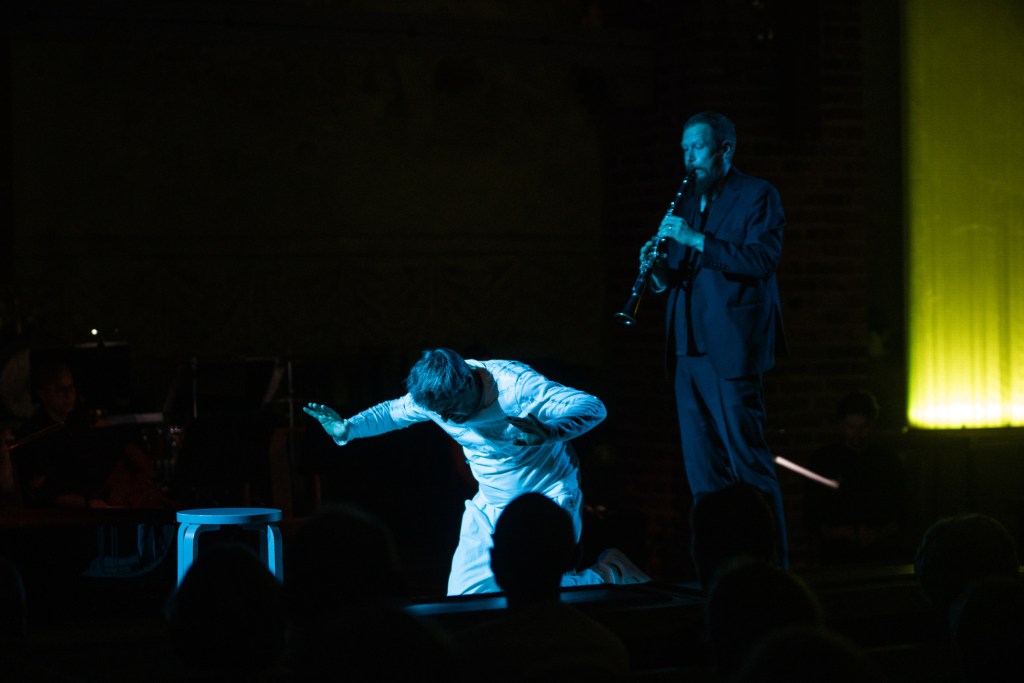
In the excerpt you see the transition from Davies to Messiaen, with the physicalization of the clarinet solo “Abîme des oiseaux.” The idea was again that we don’t use the instrumental music as a soundtrack to action, but build from the act of performing it. The pattern on the singer’s shirt is actually the clarinet solo’s score, and the clarinetist plays from him – all his physical actions, that seem like a brutal inspection of the ‘mad king’ character, are simply developed from the act of transforming him into a human score. It felt like a compelling way to ground in a concrete situation of music-making the dark vulnerability of the music, and was inspired by an anecdote about the first sight-reading of the score: while in transit to Görlitz, Messiaen and the clarinetist Henri Akoka were standing in a windy field, and you must imagine Messiaen, for lack of a music stand, holding the score for Akoka, and this music being played for the first time ever in this fragile moment. I think we are then at the core of “Abîme des oiseaux.” The work has been recontextualized in the richer sense of the word: not put back into its historical context nor strictly speaking updated, but given a context that allows for the coexistence of different contexts and readings.
One last example I would like to share is from a peculiar piece I created, that is trying to dramatize the friction between music and theatre itself. It was born from a request from violinist Peter Herresthal, who wanted to physicalize Kaija Saariaho’s violin concerto Graal Théâtre (1994), which in its title already bares this tension between the musical/spiritual and the material conditions of production of the concert. I tried different solutions, which were in the continuity of the work I had done with Kaija for the premiere of her clarinet concerto
D’OM LE VRAI SENS in 2010 – back then, we had developed the idea that the soloist had multiple stations in the hall and on stage, associated with evolving treatments of lights, with an element of theatricality that is inherent to all of her concertos but that had then culminated in this example, because she had herself imagined that the protagonist’s journey should be physicalized. But with Graal Théâtre, I realized that making the violinist himself act was counterproductive, and that the core tension was best expressed on his side through the playing itself. I could however maximize this tension by adding a component: a speaking part.
I happen to have a special interest for melodrama (another heterogeneous form, with rhapsodic pedigree, that repeatedly reappeared in history, but didn’t resist normative homogenization), the combination of spoken voice with instrumental music, which I have implemented in a variety of projects – it is such a distinctive way for text to coexist with music as equal while retaining a character that is not filtered by musicalization. Our actor in this new version would be like the knight’s buffoon, a painted illumination in the margin of the manuscript, who comments on his musical adventure, from his position of not belonging to the very situation of a violin concerto, and of being reduced to the mundane expression of words. I singled out from the score the spaces where I felt like a new voice could fit and suggested the composer to add fermatas and repeats that wouldn’t alter the piece’s musical logic. Maybe out of morbid curiosity, she accepted, and was pleasantly surprised by the result, which she decided to make an authorized new version of the piece. Sometimes people even ask us what might have been there in the original version in those spaces occupied by the spoken voice.
What I find interesting about this form is that it really sits at an unusual place, where the usual hierarchies between media are on the edge. This is crucial first of all in terms of artistic creation, because if you want to montage heterogeneity in a way where one medium is not ruling over the others, be it text or music, you have to look for multiple articulations, interfaces, points of passage, that will allow diverse strategies of circulation. Secondly, on the audience side, this diversity will force us to constantly recalibrate our way of listening to it. In the case of our Graal Théâtre (Not a Knight), the words can sometimes accompany the music the way music often shadows words and images in other settings. The text colors the music, orientating our audition, hopefully without suffocating the music’s semantic ambiguity. My model was the way Kaija used words in her titles, to suggest moods rather than restricting meaning.
You will see also a treatment of space through lighting and video which is rather typical of my work with Étienne Exbrayat, which whom we design the spaces for many shows, which is the work on transparence as a tool for spatial ambivalence. The space is a naked space, structured only by fabrics, and the directions, intensity, and colors of lighting/video constantly transform the feeling of the space, its material presence, its size and intensity. That for me is the legacy of the musical treatment of space by Appia, that allows us to fragment space into a variety of very different spaces. Tools from visual arts and architecture, musical forms, semantic ambiguity and expressivity. All this I believe falls under the general notion of recontextualization.
[Excerpt from Between (2022)
featuring Peter Herresthal and Thomas Kellner]
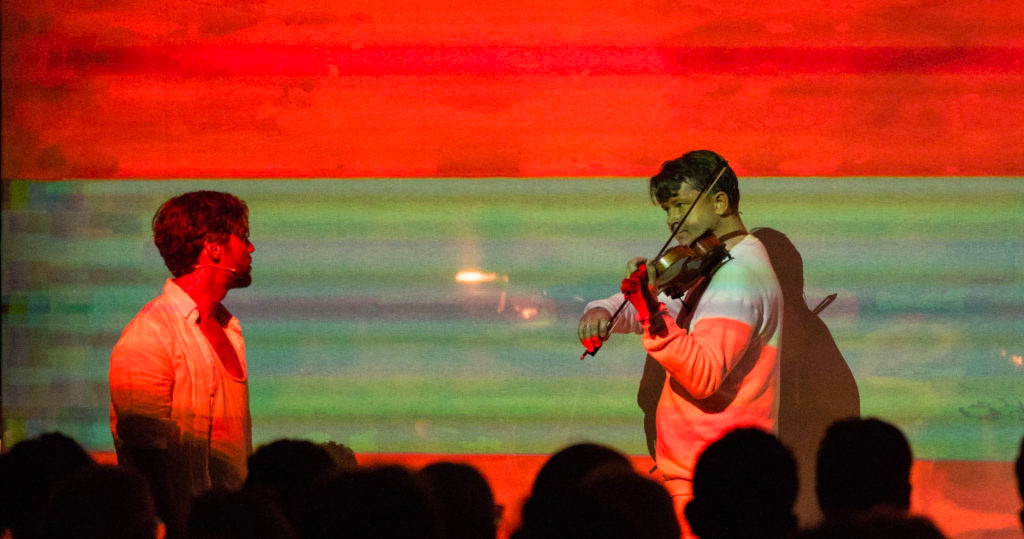
This was part of another show called Between, composed from a montage of pieces from different authors and composers, that some commentators thought was built too much like a concert. I find this an interesting piece of criticism, because there are so many assumptions of aesthetic hierarchies in such categories – which I hope to have shown are extremely unhelpful when it comes to providing a rich artistic experience, except for the fact that you do need to map out audience expectations to be able to subvert them. Of course, if you lose all known coordinates, the listener-spectator will have difficulties orientating and constructing meaning. You see that I am working a lot with unifying elements that can be one work, one performer, one space – that can act like the rhapsode’s frame narrative and meter. In an intermedia context, the element that plays that role can be each time different and even vary within one work, as long as it keeps the dialectic of heterogeneity active, meaning perceptually effective.
But there is a grey space that I find infinitely fruitful, in which music’s capacity to hold together fragmentation in montage and chorality in polyphony, as well as to cultivate semantic ambiguity that allows for free associations without eliciting indifference, prove to be exciting tools for a heterogeneous theatre of emancipated forms. It requires for us to study circulations, find shared interfaces where we can meet and montage and translate. Such a non-disciplinary theatre, I believe, is a safer space to explore ideas and emotions, and to experience the lively dialectics of individuation and self-estrangement without which we are doomed to hegemonic homogeneity.
1 G.E. Lessing, Laokoön oder Über die Grenzen der Malerei und Poesie, 1767.
2 T.W. Adorno, “Über einige Relationen zwischen Musik und Malerei” (1965) and “Die Kunst und die Künste” (1966).
3 F. Nietzsche, Die Geburt der Tragödie aus dem Geiste der Musik, 1872.
4 A. Artaud, “La mise en scène et la métaphysique”, in Le Théâtre et son double, 1938.
5 F. Liszt, “De la situation des artistes et de leur condition dans la société”, Gazette musicale de Paris, May 3, 1835.
6 I owe a deeper insight into Pierre Audi’s work to my conversations with Willem Bruls.
7 See in particular F.T. Marinetti, Il Teatro di varietà, 1913.
8 A. Lorde, “Poetry Is Not a Luxury”, 1977.


