The following notes have been developed in the aftermath of a session of Kirill Gerstein’s online seminar with the Kronberg Academy, for which I had suggested as a starting point the topic ‘Music & Dramaturgy in a Multilingual World’.
It has become increasingly simple, and indeed common, to create performances and films that use multiple languages, as the use of subtitles and surtitles is normalized and social change (along with more nefarious forces of market expansion) also allows for increased participation and representation of foreign cultures and languages.
There is something complex to navigate about the fact that a lot of my work as a writer/director involves the use of multiple languages, when ‘multilingual dramaturgy’ is a formal device rather than a unified genre or category into which those works might be lumped. I will try to unfold the history and implications of multilingualism as a formal trait in a work of art and explicate some of on my own experiences, in order to map out the ways in which it can be used and convey meaning. In this process, a broader goal comes to light: the challenging of an alienating Monolingual reality.
The Humanistic Legacy of a Dramaturgy of Quotation
In the following I shall focus on the inclusion of languages perceived as foreign relatively to the work’s main linguistic framework(s), meaning I will not address multilingual texts created within a multilingual context, such as multilingual lyrics (so-called ‘macaronic verse’) in areas and times where multiple languages are in close contact: for instance, the mixing of Latin and vernacular languages in the Middle Ages, Rumi’s combination of Arabic and Persian, Dante’s trilingual canzone, Yiddish-Slavic and English-Gaelic songs, or ‘Frenglish’ Canadian rap. Such cases are beautiful examples of the ways in which the written and sung word can crystallize multilingual realities. Not that they are devoid of questions about the relationship to the Other that will be examined here: all multilingual environments are structured by a relative social and symbolic hierarchy of the languages involved, and works representing them necessarily deal with those specific internal tensions and with foreignness, which is not a binary but a spectrum. But the inclusion of material that is not only internally foreignized but actually foreign begs different questions, starting with intelligibility, which is why I will here concentrate my efforts on that form of inclusion.
The very idea of including ‘foreign’ languages in an otherwise monolingual text comes from the literary practice of quotation. From the Bible to Montaigne’s Essays, quoting an original in its own language, within the limits of the reader’s assumed literacy, has been a common part of a writer’s palette. The range of these quotations’ functions would be a discussion of its own, from attaching conceptual importance to the linguistic specifics of the original, to local color, to erudition-signaling. This range is bound to inform any further use of multilingualism. What the following examples help pointing out, however, is a value system historically shared by most quotational dramaturgies, that can broadly be termed as humanistic.
Quotation was the matrix of the more profusely multilingual texts that became a staple of a certain avant-garde in the 20th century. The way Ezra Pound included foreign languages into his Cantos (or T.S. Eliot under his influence in The Waste Land) was chiefly under the form of quotation, liberated from the constraints of scholarly practice but not different in intent: creating text that weaves in multicultural content to suggest a broader narrative of continued literary and philosophical process, enacting the continuum of what Pound reclaimed through Goethe’s idea of a World-Literature. This happened to take the form of a mainly quotational use of multilingualism (rather than authoring original text in multiple languages), therefore unifying the practice of collage –a key technique in 20th-century avant-gardes– with the older tradition of scholarly intertextuality. In this we witness the first fully coherent and integrated dramaturgy of multilingualism, relying on an intuitively obvious equivalence between ‘foreign language’ and ‘foreign material’. It has, of course, been much derided as the crowning symptom of an art that relishes in pedantic obscurity. What was taken issue with was perhaps first and foremost Pound’s reliance on quotation, doing so in multiple languages being merely a maximization of the obstacle to broad reception. Pound himself was playful about this notion, however, and his texts present a quest rather than an exposé: “I shall have to learn a little greek to keep up with this / but so will you, drratt you.” (Canto 105) Multilingualism does not only make the many colors of a multicultural world visible, it forces upon the reader its challenges and the difficulty of embracing it, an endeavor in which we are together. As we face the existence of concepts and thoughts from other languages that are not easily translatable, our monolingual world is challenged and we also face Ludwig Wittgenstein’s anxious assessment that “the limits of my language mean the limits of my world” (the first Cantos and the Tractatus Logico-Philosophicus happen to be contemporaneous byproducts of the civilizational collapse that was World War One and the end of Eurocentric empires). Pound’s threefold understanding of poetry as possessing visual, musical as well as intellectual dimensions, implies that an ideal experience of poetry would combine the specific ways in which each language explores these three dimensions, leading to a widened experience of reality. It may not be useless to remember how truly controversial the use of foreign languages (both linguistic and artistic) was in a time of heightened patriotic propaganda –leading for instance to the demise of the Russian director Vsevolod Meyerhold who was accused of making ‘foreign theatre’ because he integrated East Asian influences– and indeed remains revolutionary for the same reason in our age.
The Avant-Garde from Quotation to Collage
Pound’s example had a lasting influence on the use of multilingualism in poetry, and in post-War Europe was emulated in particular in the field of music, re-uniting in a new formal crucible multilingual quotational poetry and the aesthetics of collage.
Musical technique is perhaps best suited to sophisticated manipulation of multilingualism, because it allows both expanded expressive possibilities on the individual level and the weaving of multiple levels into a unified whole in the form of polyphony, which is why musical examples will be central to the present analysis. The relationship to the intelligibility of text is also widely different in a musical context, especially in the Renaissance madrigal tradition which was at the core of historical humanism and, when rediscovered by Italian composers in the 20th century, served as a valuable model of formal freedom and complexity. In a musical setting, the text is traditionally divided into two simultaneous forms of reception: the printed out (possibly translated) version and the composed one which, not being under pressure of being immediately understood, might as well be in any language, or in multiple languages –a cue that was eagerly taken in particular in Italy, where rediscovered Renaissance tradition and the avant-garde formed a peculiar creative combination.
The convergence of practices of quotation and collage is best embodied by Luciano Berio’s collaborations with Edoardo Sanguineti, himself a neo-modernist heir of Pound and Eliot, whom he incidentally included in his multilingual collage libretto for Berio’s Laborintus II (1965). In this piece, as in Passaggio (1963) and A-Ronne (1974) that were crafted by the same pair, a dense texture of quotations is woven to highly colorful effect due to the use of original languages, based on the formal model of Sanguineti’s inaugural poem/collection Laborintus (1956): a monolingual backbone into which other languages are inserted, typically seamlessly mid-sentence, and usually in the form of quotations or at least references and nods. In the course of the Sanguineti/Berio collaboration, the libretti have tended to become less narrational as they also became more multilingual and quotational, and more choral in form: Passaggio is still centered on a protagonist, a woman going through a form of via crucis under the scathing attacks of a multilingual audience-choir, whereas Laborintus II derives from the linear narration of Dante’s first-person writings into a more proliferating and complex critique of consumer capitalism, and finally A-Ronne is thoroughly madrigalistic (musically) and even more (textually) structured by free associations, organizing modern mythologies according to the alphabetical order typical of the humanistic totem object, the encyclopedia (‘from A to Ronne’ being the ancient form of ‘from A to Z’).
Apart from the dramaturgical possibilities offered by intertextuality and his fascination for another Pound-influenced collagist, James Joyce, Berio himself had also come to mixing materials and juxtaposing languages separately, from a musical standpoint, and he explored the potential of quotational multilingualism also in pieces created without Saguineti such as his Folk Songs (1964) and Coro (1976), that juxtapose larger blocks of text in different languages (Coro also includes texts from non-European sources, but in translation rather than in original form). Berio’s taste for new sounds found in (linguistically or musically) foreign sources allowed him to offer some of the most cohesive solutions in creating a new whole from heterogeneous parts through compositional process –and he took the material seriously too, calling works such as Laborintus II and A-Ronne or his quotational Sinfonia (1968) ‘documentaries’, and concretely contributing to the discovery of cultures and authors, coalesced into a new World-Music. Other enactments of a similar humanistic ethos of quotational multilingualism include Bruno Maderna’s opera Satyricon (1974) which is one big quotation-machine, and Luigi Nono’s collage works of music theatre such as Intolleranza 1960 (1961), Al gran sole carico d’amore (1975) and Prometeo (1984, on a libretto by Massimo Cacciari). In Nono’s pieces in particular, the author’s internationalist communist stance finds a direct translation in the choice of source material that deals with the historical and intellectual legacy of the Left, and musical embracing of a multicultural world. They illustrate not only a functional advantage of multilingualism, namely the fact that quoting a text in its original foreign language also serves an immediate purpose which cannot be satisfyingly met within a monolingual text: immediately signaling that one is hearing a quotation –they also offer multilingualism, and its polyphonic potential, as a broader political paradigm, rooted in the humanistic tradition.
Toppling the Tower of Babel
The specific cultural context that allowed for such an Italian blossom of multilingual dramaturgies in music didn’t last –with notable exceptions, for instance Clay McMillan’s multilingual chamber cantata Siste Viator (2011) which deals directly with Pound’s legacy, with nods to the Sanguineti/Berio collaboration. Quotational multilingualism has been widely dismissed for a variety reasons, including again being elitist or being dated artistically and ideologically, in the wake of the purported death of ideologies that supposedly calls for a more postmodern use of quotation, where emphasis leans more heavily towards the aesthetics of collage than in the implications of multilingualism (on the coattails of Bernard Parmegiani). This doesn’t mean, however, that other paradigms of multilingualism didn’t develop next to and after this peak of the 1960s, paradigms that in contrast were not defined by their quotational origin.
The most common trope concerning multilingualism is that it is a state of division and separation between men, a curse and a punishment, because very much like we were chased out of the idle abundant paradise of Eden, when we became city-builders in Babel “the Lord confounded the [formerly single] language of all the earth, and from thence scattered [us] abroad upon the face of the earth” (Genesis 11:9). Although linguistics do describe the history of languages as one of continuous and inescapable drifting apart leading to mutual unintelligibility, the tragic mythological narrative of Babel entails a broader golden age fantasy that has its own history and implications: the loss of the unique original language has been equated to humankind’s separation from nature, and been understood as concomitant with the separation of speech from music. This fantasy leaves us with a more-or-less well-founded nostalgia for something we don’t remember, an aspiration to making what is divided one again, to rediscovering the Orphic key to a form of melodious communication not only within humankind, but also between humankind and nature itself –and the city-walls will crumble and the world will be our garden again. All forms of this fantasy don’t of course relish in such kitsch, but from the reinvention of opera under the guidance of Orpheus to talks of music as a universal language (including in the all but universal form of the tonal system) to every mystical attempt at returning to being part of a Whole, or simply like Rilke to listening to the ‘melody of things’, the Golden Age myth of language has pervaded even our modern mythology, and inevitably, our dramaturgies of music and multilingualism. In this second form of dramaturgy, sentimental nostalgia trumps erudite humanism.
The dysphoric version of this is the use of multilingualism to create an impression of chaos, of confusing multitude, a sensorial embodiment of our existential state of separation. One particularly articulate example is Karlheinz Stockhausen’s Hymnen, a version of which was first premiered in 1967. The piece is centered on a tape constructed from sampled national anthems from various countries and other multilingual material (for instance the word red in different languages), languages being in this instance explicitly assigned to national entities. As the languages/anthems are set against each other, they map a world of borders riddled with the antagonisms of Cold War –but in a narrative of redemption, the work gradually weaves them together into a recomposed whole, and leads to a utopian imaginary unified anthem of ‘Harmondie’ (Stockhausen had his own syncretic mythology based on the Bible-influenced Urantia Book and embraced its teleological consequences).
Deconstructed Babelism
Very different is the variation of the Golden Age fantasy to be found in the work of John Cage; neither tragic nor utopian, it is informed by his interest in Zen Buddhism as he came to study it through the teachings of Daisetz Suzuki. Because Cage fought out of principle the separation between the acts of music-making and of listening to the sounds of the world, in his view the Golden Age of belonging to the Greater Music was neither lost nor to be reconquered, but available anytime to anyone who’d care to listen, much like Rilke’s Orphic ‘melody of things’. Hence his piece for a cappella voice Aria (1958), composed from text in five languages, embraces a Babelesque condition of humankind but without antagonisms.
I happened to stage Aria within a one-woman vocal performance by singer Marianne Seleskovitch titled Give Me A Few Words (Paris, 2017) in which Cage’s piece was placed between other works that question the fragmentation of spoken languages into a more physical, pre-linguistic form of expression: Luciano Berio’s Sequenza III, which breaks a poem into sounds that reconstruct the content of the poem in the very effort of uttering it, next to Clément Mao-Takacs’s new work Ophelia: Songs & Sequences, which does pretty much the same thing in monodrama proportions with Shakespeare’s Ophelia’s ‘mad scenes’; the Lettrist poem Larmes de jeune fille by Isidore Isou, a rhymed piece in regular verse, however built only from non-semantic sounds; and Giacinto Scelsi’s Hô, a series of textless vocalizations reminiscent of Hindu mantras. In this context that emphasized the quest of a personal voice through foreign material, Aria exemplified the purest form of a certain fragmented multilingualism: the singer is meant to perform fragments of texts in several languages, in different vocal styles left to the performer’s choice but marked in different colors (that don’t match the languages) with only rough indications of relative pitch and duration. The outcome sparks a Babelesque impression in the listener, and the fact that the fragments don’t coalesce into a unified text even if you understand or translate them indicates that this impression is its own purpose, that the work is not about conveying meaning but about the fragmentation of our means to convey it. My solution in staging this piece was to have the singer Marianne Seleskovitch interact with a radio (in the spirit of other works by Cage that utilize the radio as a sound-emitting object) and the first part of Aria presented a recording of Marianne’s own voice as a session of channel-hopping between radio stations, inspiring her character to perform the rest of the score as an imitation of that versatility –ending up in a competition of the human and the technological, and a display of expressive range that is beyond language, since in its incomprehensible multiplicity language has become indifferent. This interpretation of Cage’s work’s substance stemmed from an understanding of his use of multilingualism as a means to not communicate something through languages but stage language itself and move beyond it, the radio helping to create dialectics between the multiple voices of the outside and the way they inhabit and haunt the individual. As such, Aria is perhaps the most elegantly executed attempt at a Zen multilingual dramaturgy.
One other deconstructed variation on the Babel paradigm that I would like to mention is embedded in Diana Syrse’s monodrama Connected Identities (2017), on which I consulted as a dramaturge/librettist and which I staged in Paris in 2021. Diana conceived the piece as an autobiographical manifesto of her own experience of multiculturality (both as a Mexican mestiza and as an immigrant in the United States and in Europe) and wrote it for her own soprano voice, with the intent of putting her own body on stage as an exhibit. The piece is structured in concentric, widening circles of identity: the first movement, focused on Diana’s Mayan heritage, introduces the mythological hybrid creature nahual as a model, through a collage of ancient and modern poetry in Mayan languages that actually already are mutually unintelligible in their diversity (Lacandón, Tzotzil and Yucatec); the second movement, aptly titled ‘The Tower of Babel’, presents the confrontation with the world’s many cultures first in the form of a sampled multilingual tape (exhibiting the classic Babel trope), then of an English-language testimony by Diana herself that turns upside-down the expected estrangement and separation, replacing it with multiple identification: “in each world, my heart had learned to beat at a different tempo and my tongue dances a different rhythm / while I start to see these broken parts of myself in every one of you” –before breaking herself into multilingual expression. In this original reading of the Babel myth, the fragmentation of humankind into different languages is not understood as an alienating curse, but on the contrary as something that allows to account for the intrinsic fragmentation of the self, blending the individual and collective human experiences into one same proliferating multiplicity that becomes an experience of unity or rather interconnectedness. The work’s last movement –a song to which I wrote the text– offers a culmination that is not the expected redemption from the multiplicity of Babel, but instead finds its model in Jorge Luis Borges’s short story El Aleph, a contemplation on the possibility of watching the entirety of humankind in the same glimpse. The stake is then not the return to some primal undifferentiated whole, but a permanent dance with limitless alterity within which the self is negotiating its identity. The ending of this work led naturally to a sequel piece Diana created on texts I wrote under the title The Invention of Sex, that explored that negotiation in the form of the evolutionary development of sexual reproduction and its emotional stakes.
Furthermore, the latest piece composed by Diana Syrse on a text I wrote, Circe (premiered in 2021 in Erfurt) revolves more explicitly around the subject of language, again in the form of a multilingual monodrama (dubbed a ‘minidrama’ because of its miniature-like concision). The titular (purported) witch is presented as struggling with her ideal of being the solitary queen of her own metaphorical island, while being stuck between “the language of the Empire that rules over the seas” (English) and the language of her alienating relationship with a warrior, intimacy and violence being entangled in one dialect (German). In the course of the piece, the character explores the whole spectrum of language from primal, instinctual animal sounds to switching between monolingual spaces, to combining her languages into a mixed sabir. The open ending, that leaves her to her solitude without clarifying whether it is entirely emancipatory or a new form of alienation, is set in an improvised personal language. In this case the reference to code-switching and to the many layers of power through which we navigate when we navigate languages, struggles that perhaps do not have any redeeming resolution, simply bypasses the Babel paradigm.
Expanding Quotational Dramaturgy
In general I have come to find the Babel trope extremely unhelpful, because of its Biblical understanding of anything that is manifold, mixed or hybrid as cursed, and of course because of the implied nostalgia of a Golden Age and its mirror-fantasy of a utopian reunification, all of which are not without political consequence –this is the reason I have only ever approached it through works that undermine it fundamentally, such as Aria and Connected Identities. This has also led me to frustration with the commonplace limiting of multilingualism to this trope and to its consequences, commonplace to the point of ‘Babel’ often being an automatic phrase to describe anything multilingual. I have therefore found the quotational tradition to be a much more valuable point of reference and a potent counter-paradigm to conceive multilingual dramaturgies, although it does need to be expanded beyond cautious sprinkling of languages and references in order to really decenter us from the Monolingual reality. The legacy of European humanism needs to be reassessed critically, too.
The first experiences I had myself with mildly multilingual dramaturgies were instances that emerged organically from collage dramaturgies. Within the music theatre ensemble La Chambre aux échos, born from my collaboration with conductor Clément Mao-Takacs starting from 2010, we have consistently worked on dramaturgies (including some elaborate ones that were never actually taken to the stage) created from the combination of pre-existing heterogeneous musical and textual works, set to contextualize and illuminate each other. One example was the performance La Guerre, très loin (Paris, 2015) that wove together the French fragmentary play Enfonçures by Didier-Georges Gabily, written during the onset of the Persian Gulf War and dealing in particular with the French foreignizing of Muslim citizens (and also with the helpless silence of Friedrich Hölderlin’s later life in the wake of his perceived failure at changing the world), and a series of cantatas composed by Hanns Eisler (a Communist in exile from Nazi Germany) on German translations of Italian texts by Ignazio Silone (a Communist in exile from Fascist Italy). These interpenetrated works deal separately with the way moments in history echo each other, and switching from one to another in performance allowed for the uncanny repetitions of history to play out with full effect. The evening was unified by musical material created by Clément based on Eisler’s cantatas (performed by a tenor, Johan Viau) for the spoken scenes (performed by an actress, Laurence Cordier). The difference between speech and song of course were sufficient to identify the intertwined material, but an even more striking effect was created by the dialogue between French text (addressing among others a German poet and his work) and German text (addressing the Italian situation), in terms of mere clarification of vantage points but also of the extension of their content. This was furthered by surtitled translation of German into French, and already contained in the translation from Italian into German. For instance, Silone writes about the followers of Fascism: “Essi credono, o fingono di credere, nell’Uomo della Provvidenza.” This had been translated and condensed in Eisler’s version as: “Sie glauben an ihn und nennen ihn Führer.” The transformation of the ‘providential man’ into a ‘Führer’ is both linguistically valid and a chilling comment on the transcultural potency of charismatic leaders appearing under different names in different contexts, and we were prompted to surtitle this sentence not monolingually but by including the many other possible translations: Duce / Führer / Caudillo / Líder Máximo / Leader / Great Helmsman / etc.
Such experiences with the expansion of quotational multilingual dramaturgy to larger fragments made me think this could be used to more extensive effect. Apart from the intrinsic value of examining the same subject under different angles culturally and linguistically, keeping source material in its original language was a means –as in previous examples of quotational dramaturgy mentioned above– to identify sources immediately in performance. I have tended to be frustrated by monolingual collage dramaturgies that do not allow for this and usually deal with it (at best) only by including a list of sources in the program notes, leaving the spectator with a stream of words without providing tools to set them against each other as heterogenous and potentially conflicting.
This proved crucial to the creation of the music theatre piece Ophelia/Tiefsee with composer Juha T. Koskinen and La Chambre aux échos (Paris, 2017). The work, of which I was librettist and stage director, was a cross-cultural examination of multiple (male) rewritings of the character of Ophelia, constructed with the idea that all roles (quantitative emphasis being put on the titular one) would be performed by a single male actor, inside a dramaturgical machinery unified by the music –the actor/orchestra combination being an experimental revival of the 19th-century ‘melologue’ form. The talents of trilingual actor Thomas Kellner allowed for us to include each source material in its original language: scenes from Shakespeare’s Hamlet in English and from Heiner Müller’s Die Hamletmaschine in German, and in French excerpts from Jules Laforgue’s Hamlet ou les suites de la piété filiale and from a French 19th-century review of a performance of Hamlet, very similar in tone to the latter, although embracing unironically the cultural and sexist clichés derided by Laforgue. As stylistically different as these texts are, it undoubtedly added a level of immediate clarity to the shifts of perspective to make them unequivocally identifiable through language, in addition to the immense artistic value of hearing them in their full original literary force and benefitting from the contrasts of the many colors and rhythms offered by three different languages. Each tableau had its language that was given space to unfold, within an overall kaleidoscopic form, and languages were only mixed up –as one might expect– in the ‘mad scene’, an amalgamation of Shakespeare and Müller performed with very quick and confusing linguistic shifts reminiscent of xenoglossy, a symptom as good as any other for a context of identity loss. This, very much like Ophelia’s purported madness itself, also allowed for unexpected connections and hidden truths to emerge, elaborating from the French and English words already contained in Müller’s text, or playing with interlinguistic ambiguities: when “there is pansies, that’s for thoughts” becomes “there is pansies, en guise de pensées”, the double meaning of the French word “pensée” (which means both pansy and thought) becomes more interesting than in a monolingual context. When the monologue ends in a recovered monolingual declaration of being finally “einig / mit meinem ungeteilten Selbst” (at one / with my undivided self), this newfound undividedness is given a concrete expression that would not be achievable, were it not in contrast with the previous multilingual confusion.
In contrast with this example, I have found it increasingly difficult to deal with collage dramaturgy without the help of multilingualism. For instance a show I devised and directed for Chicago’s Trap Door Theatre in 2018, called Letter of Love (The Fundamentals of Judo), intertwined two sources, namely an autobiographical play by Fernando Arrabal and the autobiographical writings of Yves Klein, both performed by an ensemble of four actors into which first-person selves were dissolved. Although the entire performance was structured around creating contrast in the parallel between sources and authors, including different body languages that involved choreographed fights, I do wonder how different it might have been if the source materials had been presented in the original Spanish and French instead of being leveled into shared English through translation. The English language felt like a necessary part of bringing the material to the actors and to the audience –all the more so because I was involved in the translation process, which hence became part of my overall process with the piece–, but in theory one could think the performance would have gained in clarity and in strength with linguistic shifts emphasizing the other shifts between the interwoven threads. This would be an example of how multilingualism in quotational dramaturgy needs to be a constant negotiation between the respective advantages of monolingualism and multilingualism: in this case, the content that attempted to both give concrete bearing to art theory and also play out highly emotional and sensual situations most certainly would have had much less direct impact on a mostly monolingual English-speaking audience, had the text been comprehended through text projections only.
An Aside: Liturgical Multilingualism as a Matrix
A particular subset of multilingual quotational dramaturgy that I think is worth mentioning, because it pre-dates its artistic utilization and has been imitated by a number of contemporary composers, is liturgical multilingualism. In various religious contexts, it is common to deal with the juxtaposition of a quoted text presented in its original language or languages (because it is sacralized) and elaboration and commentary in the language of the audience (because it needs to be understood, and sometimes discussed in terms otherwise not available). This dramaturgy was cleverly imitated by Igor Stravinsky and Jean Cocteau in their Oedipus Rex (1927), an opera-oratorio that features sung dialogue in Latin (a ‘fake original’ constructed for combined effects of antiquity and sacredness) and a spoken narration in the language of the audience.
Composer Djuro Zivkovic developed a more layered solution in his own oratorio Bogoluchie (which I staged for its premiere in 2018, conducted by Christian Karlsen): the source material was the Hymns of Divine Love by the 11th-century Byzantine monk Symeon the New Theologian, an immense collection of poems that form a first person account of his own spiritual journey, written in exile. Djuro carefully edited excerpts of it into a libretto that follows the steps of this journey, and gave the bulk of the text to the solo contralto (Carina Vinke) who became a protagonist of sorts. His interesting choice was to compose most of the text in the original Greek, and gradually shift to ever larger parts in English, giving the process of elucidation a linguistic form, and acknowledging that the ‘accessibility’ role as a vehicular language that once was Koine Greek’s is now bestowed upon English. Importantly, this transformation was paralleled by the gradual introduction of an actual Serbian Orthodox choir singing pieces of their repertoire in Greek and in Church Slavonic, two languages that are only partly foreign since they are a living part of liturgy and hold the imprint of Orthodox liturgy’s history, in its uninterrupted transmission from the age of Symeon to ours. The intricate solutions developed by Djuro regarding his oratorio’s trilingualism, its subtle shades of foreignizing and domesticating, are owed to the particularism of liturgical multilingualism, transformed by him into an original means of artistic expression.
Liturgical multilingualism is an interesting and potent case that can be explored in many enlightening ways. For instance Juha T. Koskinen, already mentioned above, interweaves in his choir piece Earth Treasury (2018) a Sanskrit mantra into a Japanese waka poem by the Buddhist monk Myoe Shonin, with full awareness that one of the interesting aspects of Japanese Buddhism precisely is its multicultural and multilingual dimension, nourished by inspiration from and intellectual exchange with India, China and Korea. This also happens to be a dimension Juha and myself are currently exploring on a larger scale, in a work-in-progress of which I am librettist, combining various forms of multilingual dramaturgy that are explored in the present text.
Its many versions and particular beauties set aside, the main limitation of quotational multilingual dramaturgy is intrinsic to its definition: it manipulates pre-existing material, even if creatively –and the closer to the liturgical model, the more restricted the corpus of quotations. For this reason, I shall now examine a third multilingual paradigm which, as obvious as it may now seem to us, became commonplace only very recently.
Naturalistic Multilingualism and the Polyphony of a Multilingual World
Multilingualism has become increasingly common and widely accepted in mainstream media, even though it retains a certain flavor of edginess; it is usually introduced in the name of naturalism, for instance in historical films aiming at accuracy or in movies depicting multiple locations or culturally mixed environments, such as Alejandro González Iñárritu’s Babel and Biutiful (to quote well executed, if somewhat ostentatious, examples, the ostentatiousness being best illustrated by the very reference to Babel). However, under the guise of objective truth, the attitude to language is then in tension between purported realism and the seduction of foreignization, which is also to be found in the separate but not unrelated case of works that are monolingual in rare languages, eluding general naturalism but implementing a form of ‘linguistic naturalism’, be it Mel Gibson’s films The Passion of the Christ (Aramaic and others) and Apocalypto (Yucatec Maya), or Philip Glass’s operas Satyagraha (Sanskrit) and Akhnaten (Ancient Egyptian and others). Such ventures obviously fall into a different category than monolingual (or multilingual) works in ‘rare languages’ created within cultures in which the language in question is spoken, for reasons either practical or also indebted to naturalistic aesthetics. In the case of purported naturalistic multilingualism or reconstructed monolingualism, what can potentially be taken issue with is a use of languages that leans towards exoticism, and that incidentally raises all sorts of other cultural and linguistic questions (including actual accuracy, to start with). There is a strong line –albeit it has been easily crossed in the past– between including a language for its sheer effect of foreignness or local color, and actually striving to add to the perception and representation of a culture, material or character through the use of languages. Anything that becomes mainstream is at risk of being used with questionable intents (including decoratively) and of being poorly executed. And the quality of execution often depends directly on the intent.
More interestingly for our purposes, mainstream naturalistic multilingualism has an origin that allows for many solutions that are more convincing than the cosmetic inclusion of foreign languages. This origin is the increased amount of cultural exchanges allowed by movements of population and international collaboration, challenging the status of English as the universal communication language of a globalized world, and making multilingual forms a way of accounting for the actual situations in which cultural objects are being made, not because of (dominant) naturalistic aesthetics, but because it is more truthful to the process and the life experience of its participants, as an alternative to globalized Monolingualism.
One out of many such experiences that constantly take place in the 21st century is the one I had with the project Das Floß at the Hamburgische Staatsoper in 2018. I was, alongside Franziska Kronfoth, the co-stage director of this experimental opera, and co-author of the texts with the rest of the team, which included among others three composers (Alexander Chernyshkov, Andreas Eduardo Frank and Anastasija Kadiša), two dramaturgs (Isabelle Kranabetter and Elise Schobeß) and performers from various backgrounds including Iceland, Russia, Portugal and Korea. These international backgrounds of the team and the unusual size of the group prompted us to pick as a subject two mirror-narratives that could be understood on a meta-level: the survival of the (equally international) crew of the frigate Méduse on the infamous raft in 1816, and the (equally international) pirate utopian colony Libertalia founded in 17th-century Madagascar. Although German was the natural vehicular working language, and unifying language of the piece, it was just as natural to include all the languages spoken in the group into the libretto, not because they were the languages that the stories called for (they were not, apart from French) but because they were our actual languages, and allowed for a concrete problematization of intercultural and interlinguistic cooperation, which was not only talked about but enacted. The composers, especially Alexander and Andreas, extensively used the musical and phonetic possibilities of the contrasting and combining of languages, and a great amount of playfulness and problematization was allowed by the fact of borrowing each others’ languages (hence playing with the spectrum of foreignization) and dreaming up the enactment both of a multilingual society and of a fantasized universal language. One would of course need to think of a more unified form in order for such efforts to coalesce into a more integrated whole, but the experiment bore many surprising fruits.
Multilingualism in Opera and the Example of Innocence
A more integrated example is the opera Innocence (2021), composed by Kaija Saariaho on a libretto by Sofi Oksanen, in which I was involved as a dramaturge in the writing process and as the curator of the (composed) multilingual libretto, translated from Sofi’s Finnish original. Before I go into the specifics of this project, an aside about the history of multilingualism in opera might provide important context.
Much like film, opera, as a former mainstream mass media, has a strong history of monolingualism, due to Italian hegemony over the genre. And much like theatre, it always also had its odd isolated sentences in foreign languages, inserted for the sake of coloration, thanks to a foreign character, a crowd cacophony, a prayer, or a mass. (Incidentally, it is interesting that one of the consistently multilingual operas of the era of ‘linguistic naturalism’, Peter Eötvös’s Love and Other Demons (2008), elaborates both on that tradition and on the formal possibilities of the kind of liturgical multilingualism discussed earlier, using English and Spanish to render a bilingual colonial context, and Latin and Yoruba to account for intracommunity activities.) But this largely monolingual history has been constantly challenged and as such has been one of the battlegrounds of the many questions of life in a multilingual world: for one, in the Baroque era, the problems in accessibility caused by Italian operas have led to bilingual solutions akin to the aforementioned Oedipus Rex, meaning arias were sung in Italian, and recitatives, that were closer to natural speech, were performed in the language of the audience, which is an interesting way to negotiate the tension between text and music in a multilingual context, and that incidentally is close to quotational practices. Second, as we established, the aesthetics of music and of opera in particular have been widely influenced by the Babel paradigm, leading to repeated debates about how to transcend the limitations of verbal language through music –Jean-Jacques Rousseau, a fervent proponent of the musical origin of languages corrupted by linguistic evolution and more generally of the Golden Age narrative, argued during the ‘Querelle des Bouffons’ controversy in 1753 that the French language was simply not suited for the opera or singing in general, compared to the melodic qualities of Italian, deemed closer to the fantasized primal musical tongue. There has hence been a dominant aesthetic standard that, for a couple of centuries, declared it impossible to write operas in any other language than Italian (a problem Mozart, among others, had to face in his project of creating music theatre that utilized the resources of his native tongue), in the name of the Babel narrative. That debate was speedily erased when, during the national awakenings of the 19th century, the concept of the Nation-State was forged on the premise of the coextensivity of territory, people and language, leading simultaneously to emancipatory reclamation of ‘national’ languages both in practice and in works of culture, and destructive suppression of minority and vehicular languages. Fortunately, this allowed for operas to be written in new languages (sometimes having languages influence musical content in revolutionary ways as in the case of Leoš Janáček, and sometimes with primitively folkish nationalistic approaches), and unfortunately, performing opera in the local languages became common practice, in constrained translations that separated the music from its linguistic matrix –a practice since then made obsolete in most places by surtitling.
This entire history informs the creation of a new, multilingual opera such as Innocence. Even when the problem of understandability subsides, dramaturgical and musical questions of how to convincingly write for multiple languages and integrate the speech/music dichotomy remain. In 2012, Kaija Saariaho set out to create, in her own words, an operatic ‘fresco’ in which a broad range of roles, characterized by separate languages, would deal with a shared situation. Kaija already had experience with quotational dramaturgies, having crafted versions of it in small-scale works, and used fragments in foreign languages in some of her operas created with librettist Amin Maalouf: in L’Amour de loin (2000), elements of Occitan (a song by Jaufré Rudel) and Arabic (a few words) offer a suggestive linguistic reconstruction of the world around the 12th-century Mediterranean, while in Émilie (2010) a few quotations in foreign languages give flesh to Émilie du Châtelet’s humanistic upbringing. But such a dramaturgical device is complex and tedious to extend to an entire libretto that has narrational ambitions (which is not exactly the case of the quotational operas of the 20th-century Italian school) –unless the subject matter really lends itself to a proliferation of quotations, such as Louis Andriessen’s Theatre of the World (2016, on a septalingual libretto by Helmut Krausser), which is centered on the 17th-century scholar Athanasius Kircher. On the other hand, ‘linguistic naturalism’ is difficult to apply fully to an opera, which is a non-naturalistic medium that seldom integrates successfully naturalistic speech forms, these being bound to become comical when set to music. As for the Babel paradigm, it is by nature averse to developing the possibilities of multilingualism since it aspires to transcend it: it is incapable of conceptualizing a multilingual situation as anything else than a transitory state of chaos that needs to be brought to unifying, typically monolingual or purely musical, resolution (even though playful pleasure can be derived from this chaos, as much as of any dissonance) –as in the ‘World Parliament’ section of Stockhausen’s Mittwoch aus Licht (1995). So what would a dramaturgy be that could embrace multilingualism, without being quotational, naturalistic or constricted to limiting it to a transitory phase?
In order to solve this problem, Kaija introduced it to two collaborators: Sofi Oksanen, to create a story that could make the best use of the idea of continued multilingualism, and explore through plot and dialogized character development its implicit potential (multiple points of view in a collective arena, language as something that simultaneously separates and binds); and myself, to help develop the form with the knowledge of the dramaturgical possibilities of music theatre (Sofi being a novelist writing her first libretto) and execute the multilingual aspect when it would be defined (Sofi’s writing language being Finnish; the final libretto would be only 4% Finnish). Sofi’s talent for storytelling inspired her to create a storyline that would integrate Kaija’s abstract idea of a multilingual fresco by problematizing questions of cultural bias through two settings of present-day Finland that allowed for a certain amount of linguistic naturalism: an international wedding and an international school. But our trick was to stylize this apparent naturalism by fragmenting the dramaturgical structure: the wedding plot, although built like a dramatic thriller with a series of revelations and characters having a naturalistic relationship to language (using English as a vehicular language and switching to shared languages depending on situations), is riddled with non-naturalistic monologues of the aria-type, and interrupted by scenes located in an abstract psychological space in which another set of characters –whose connection to the wedding plot is only gradually revealed– deliver internal monologues / confessions to the audience, each in their own language, connected to each other by collage rather than by situational dramatic interaction (apart from a couple climactic scenes where separate levels bleed into each other). This interwoven structure allows for the piece to be simultaneously kaleidoscopic and narrational, giving language alternate roles of isolating and of connecting characters –all thirteen of which could also be characterized with extreme contrast thanks to their specific languages and the specific musical material these inspired.
The second part of my task, the translating, took place in the summer of 2016, and consisted not only in transforming the Finnish text (which was not yet final, as it kept evolving as it was coming to life with the linguistic input) into text in eight other languages (always in collaboration with native speakers, the level of collaboration depending on my own fluency in each language) but also in recording readings of the result, that Kaija notated and analyzed electronically in order to directly derive compositional material from the languages. Multilingualism was hence truly embraced as a musical matrix, each language possessing specific expressive and musical qualities that could be exalted, rather than being considered degraded versions of a lost ideal speech as in the Babel narrative. It also had a concrete effect on the ways in which to realize the musical project, since it was deemed preferable to cast performers who were themselves native speakers of their characters’ languages, in a movement symmetrical to the process of Das Floß: not a work built on a team’s languages, but a work that incentivizes the building of a multicultural team each time it is brought to life. On a side note, the premiere’s cast proved crucial in amending and perfecting the libretto’s multilingual aspect during rehearsals, through their own translational abilities that turned out to be a defining creative input.
One interesting way in which Innocence advances an anti-Babel stand is also one aspect in which it simultaneously proved non-naturalistic. I have been asked why we, as the creating trio of this dramaturgy, didn’t use the opportunity to stage linguistic miscommunication between characters who speak different languages, and often rely on English to talk to each other. On the contrary, I found it an interesting stand to make it so that in a situation so utterly riddled with miscommunications, none of these could be blamed on language. It was all the more striking that the forces of denial, self-delusion and, more often than not, selfishness were to blame. The challenges of inhabiting a multilingual and multicultural world don’t maybe lie in the most dramatically emphasized differences, but in non-linguistic dimensions of communication and of collective processing of the kind of trauma, guilt and grief that are the true thematic core of Innocence, as its title indicates. However, the embracing of multilingualism gives us both concrete and metaphorical tools to approach this, in art as in life.
Kaija Saariaho and myself continued exploring this aspect of multilingualism in our following collaboration, the ‘science-fiction madrigal’ Reconnaissance (premiered in Venice in 2021 by the Accentus choir). The piece’s backbone is as rather dystopian narrative of the colonization of Mars as a form of capitalist evasion in the wake of civilizational collapse, told in English. But this monolingual narrative is embroidered with three numbers that resort to the quotational type of multilingual dramaturgy –with a twist, as I will clarify below.
The piece’s second movement, ‘Count Down’, is a chorus of humankind’s acceleration, structured as a rocket launch countdown in which choral polyphonic writing allows for a complex play of layers that stylize the tribal and oppositional dynamics of group psychology. While the rhythmical arc is provided by the numbers of the countdown (sung in the languages of economic powers that currently have a space program: English, French, Russian, Standard Arabic and Mandarin Chinese), the listeners are overwhelmed by a continuous stream of quotational fragments in various other languages that constitute humanity’s rumble, in the form of advertisement (“All You Can Eat”, “Buy It Because It’s A Better Car”), opposing protests (“El Pueblo Unido”, “Refugees Welcome”, “Charity Begins At Home”) and glimpses into national or racial narratives, all of which create together an aural tableau of a species divided into various types of factions but globally swept away in a state of (mass) consumption and on the brink of collapse. Only one solo emerges from this mad race, as an alto voice sings what could be called a double quote: Nelson Mandela’s mantra “It always seems impossible until it is done”, but in Swedish, as Greta Thunberg displayed it on a cardboard sign during her inaugural climate protest. Beyond the referential power of quotation, another force emerges: translation.
The other two multilingual numbers in Reconnaissance are both quotational, but revolve around translation. The ‘Interlude’ at the center of the piece presents, in the original Russian, a monologue from Andrei Tarkovsky’s Solaris, critiquing the blindness of the space race to existential contemplation of our craving for conquest. Communicated by what could be understood as Tarkovsky’s character, played by a deep bass, the statement is also translated sentence for sentence by a soprano performing the role of the interpreter. Later in the piece, in the fourth part titled ‘Desert People’, fragments of Hopi legends transcribed by Ekkehart Malotki are uttered by the choir both in the original Hopi language and in English, oscillating between the original nature of what Malotki calls ‘verbal art’ within the community, and the gravity of the alarming testimonies that same community has repeatedly made in front of the United Nations to warn us, as a civilization, against the chaotic state of koyaanisqatsi into which we are collectively being engulfed.
In this context, quotational dramaturgy was given a specific function: introducing foreign voices, presenting alternate perspective on the English-speaking Monolingual reality that poetry and fiction also try to bend in the rest of the libretto, corrupted as it is by its very monolingualism and the limitations of its vocabulary and conceptual world. In both cases translation is embedded in the quotational dramaturgy as transmission, the parliaments of choir and audience becoming, like Mars and Earth, two ‘mirrors face to face’. Including the English translation of these sources of course had a function of making the quotational aesthetics functional on the basic level of monolingual intelligibility, in the sense that even without separate notes an English-speaking listener or reader finds all the relevant information in the sung text itself. But more importantly to dramaturgical stakes, the material is virtually ‘staged’ as being quoted, as coming from the outside, the point being to introduce foreign, alternate perspectives within the monolingual narrative –and to disrupt the linguistic homogeneity of the English text with the very phonetic reality of other languages that are bound to weave in a different kind of music. There is no make-believe of being Russian or Hopi, but a transmission, and indeed a translation.
Translation is not a form of multilingual dramaturgy distinct from the aforementioned three types, rather it is an ethos through which these are to be manipulated. From the point of view of the audience, quotational practice without translational ethos is, in truth, only a subset of the Babel paradigm, an embrace of obscurity and of the curse of incommunicability. Not that translation is meant to remove any hint of an obstacle or, to put it in Walter Benjamin’s words, to “cover the original” (verdecken), to pretend that original and translation are exactly the same thing, thus leveling the unknown into the known, the other into myself, and negating alterity and the difficulties of dialogue. Translational ethos is a constant negotiation and calibration, a tension that allows for creative dialogue and dialectics. But the perpetuation of such an ethos requires for us to persist in making the process of translation visible, in de-automating it, as opposed to common practice that makes it an invisible activity that can easily be carried out by algorithms or by underpaid anonymized workers. Staging it, making it a part of the narrative, is part of such a process.
This emphasis of translation is also key to Ezra Pound’s understanding of the possibilities of a World-Literature. Pound was for a while a promoter of Charles Kay Ogden’s ‘Basic English’, a simplified version of the language that if generalized would serve as a lingua franca and allow efficient universal communication and eventually world peace, through mutually profitable commercial and cultural exchanges. Ogden, and Pound after him, called this debabelization. But Pound, like many others, soon realized there is nothing universal about English, and that debabelizing the world would really be an enormous loss in sheer terms of the range of what can be communicated, and the world that would be built on those bases. This doesn’t mean, however, that vehicular languages are not necessary (or indeed inevitable as they shadow geopolitical evolutions), that languages shouldn’t mix into creoles and pidgins as they naturally do, or that constructed languages that follow similar utopian ideals, such as Esperanto, have nothing to contribute to the challenges of a multilingual world. But the only conscious act in which cultures nourish each other without taking anything from each other, and on the contrary create new substance in the process, is the act of translation. Its key role needs to be championed proportionally to its immense material and paradigmatic value.
The Translator and the Hybrid, and the Many Delights to Come
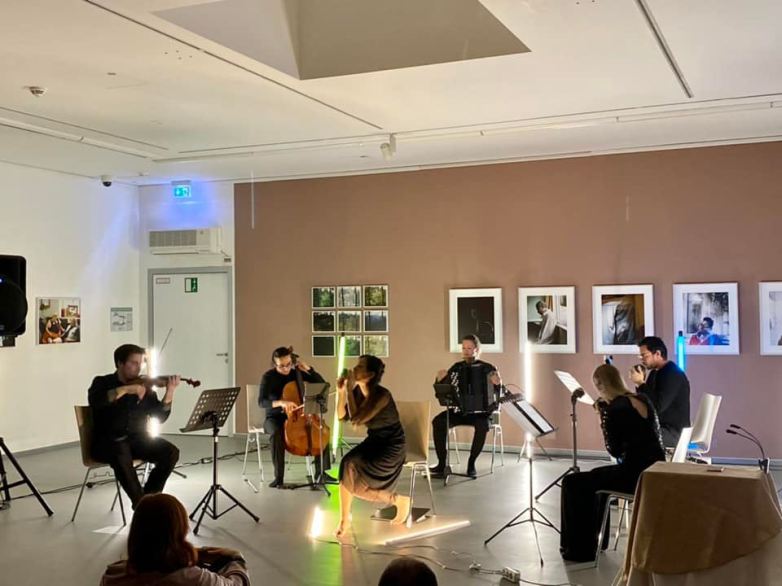
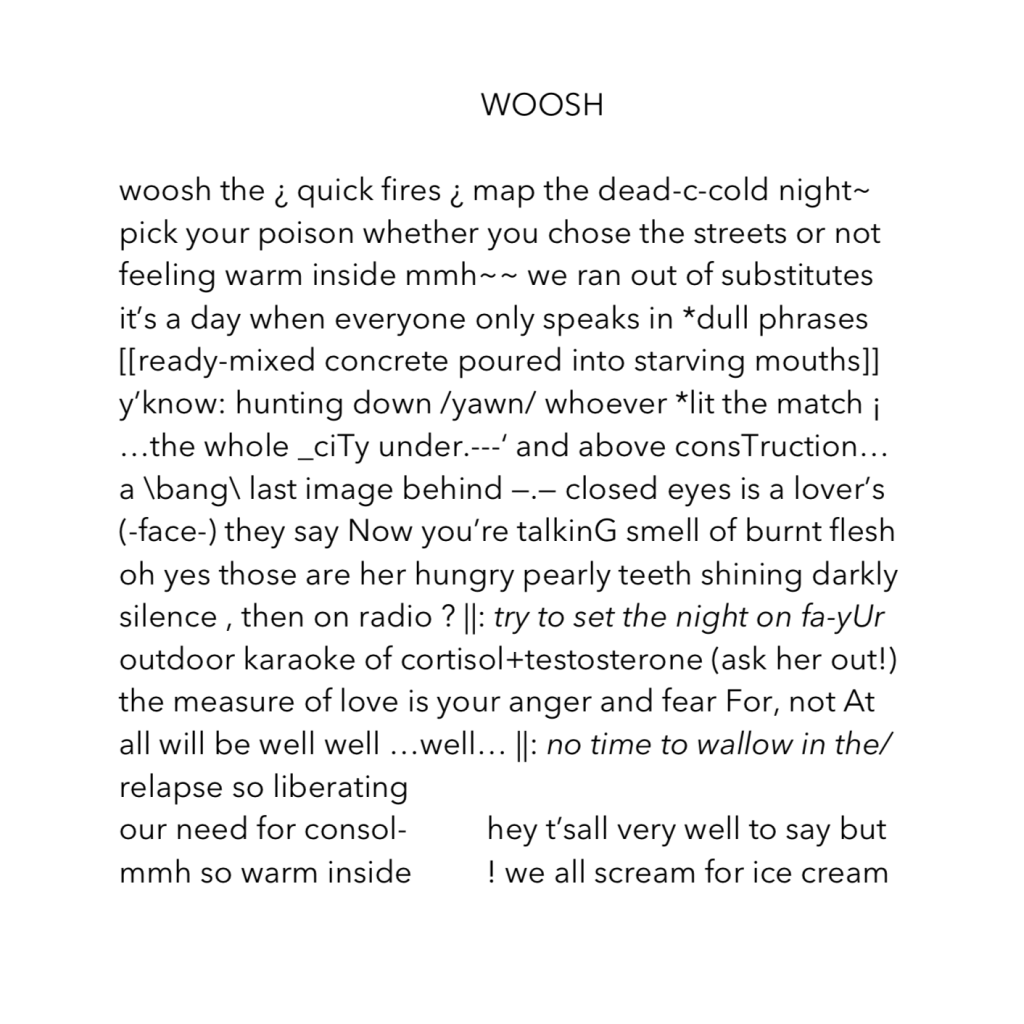
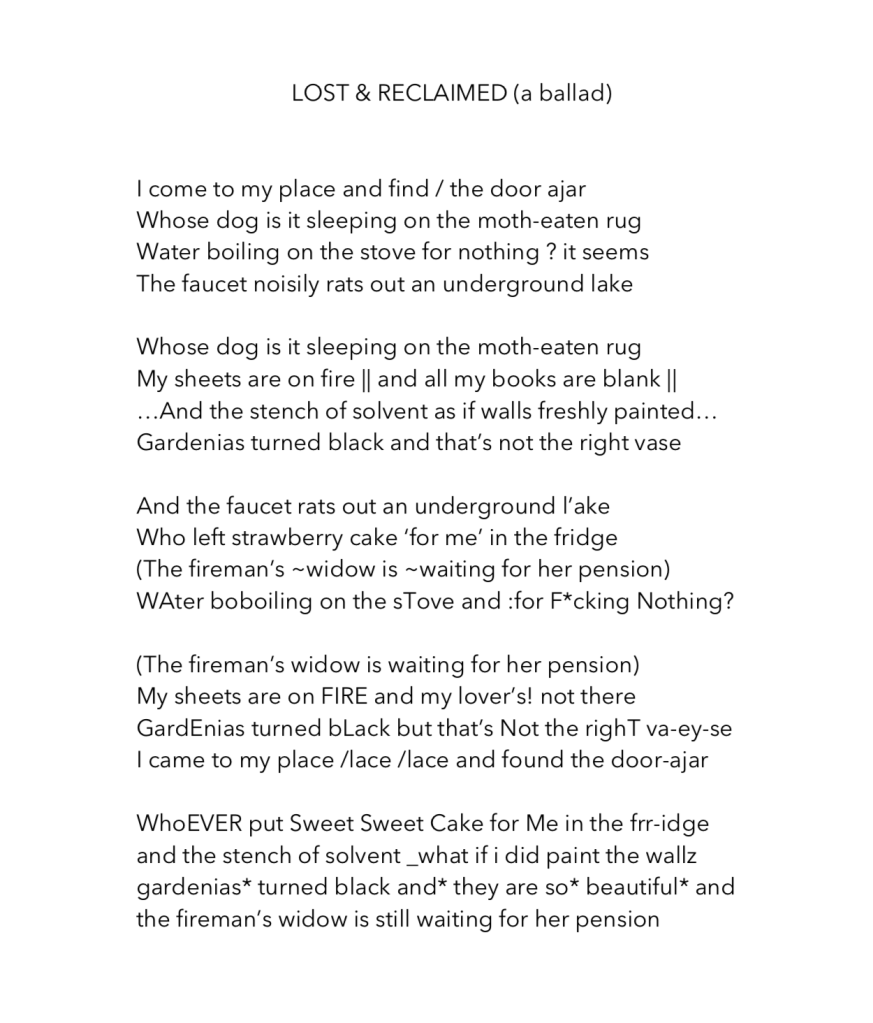
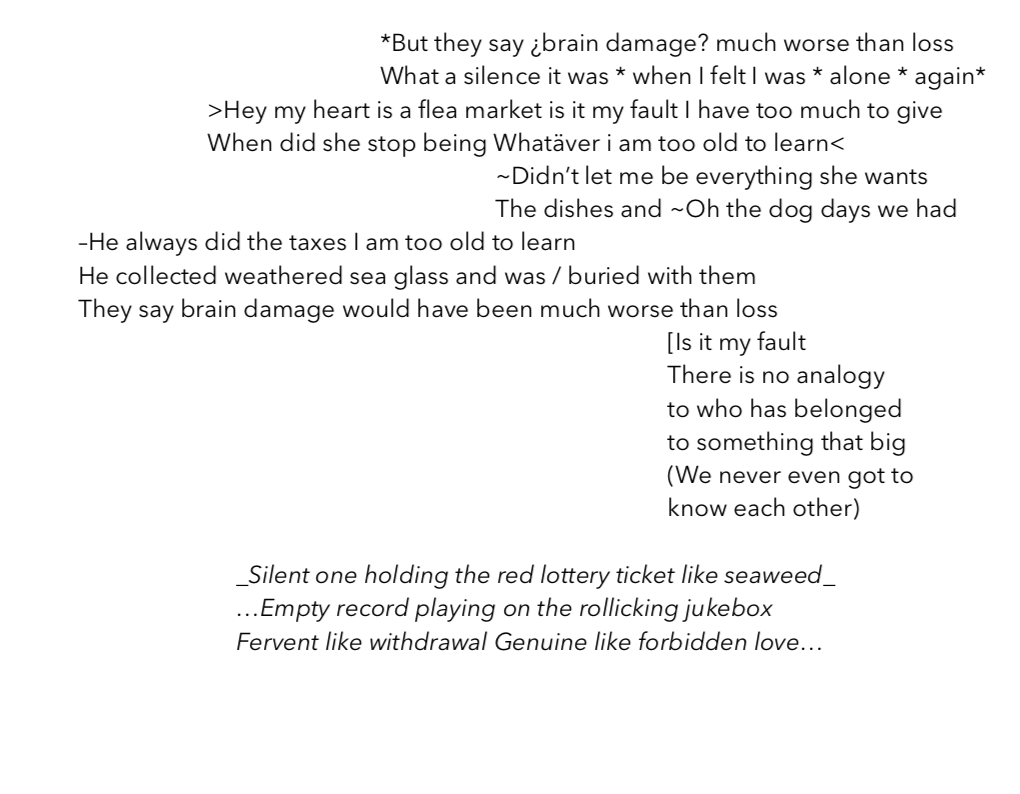
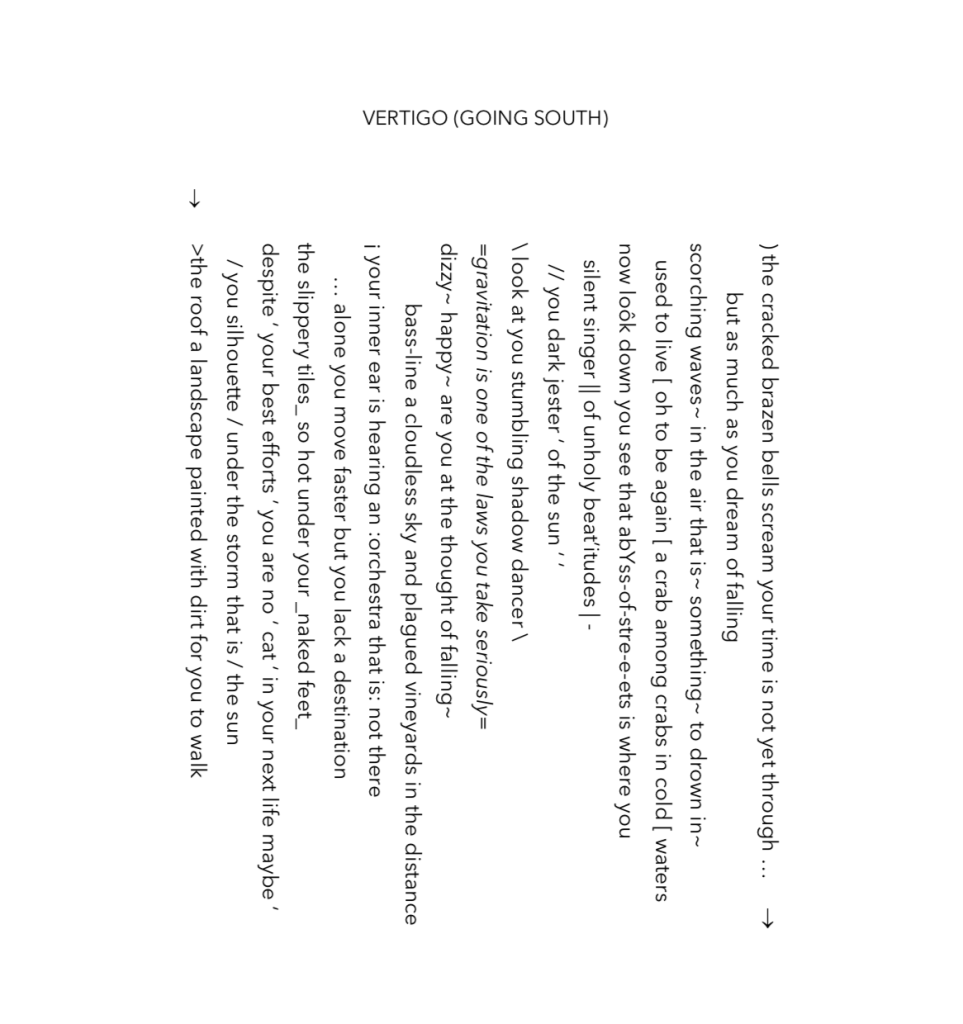
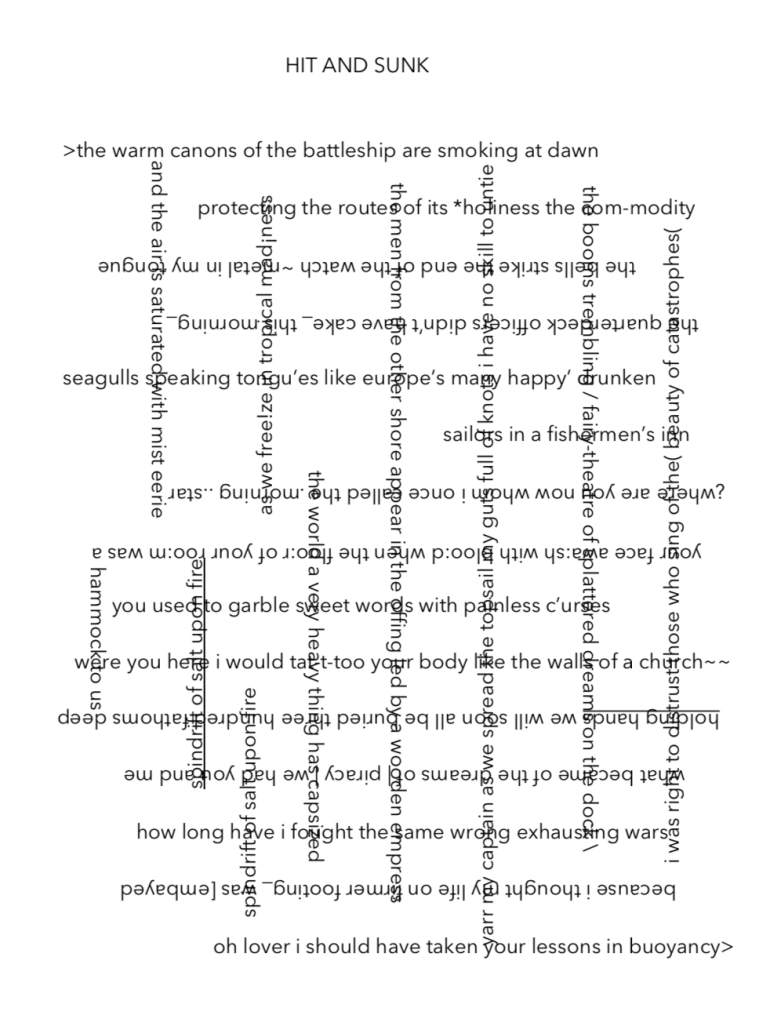
I will conclude this already extensive survey of multilingual dramaturgies with the example of a text of mine that was indirectly derived from the process of creating Innocence. The Minotaurus trilogy of poems (2020-2021) is a series of miniatures that deal directly with the substance of the multilinguistic opera which, though fundamental, is never explicitly addressed in it, unlike for instance what happens in Diana Syrse’s Circe which I discussed earlier. In both Minotaurus and Circe (which happen to be based on related mythological figures) multilingualism is taken as both medium and subject to explore the fragmentation of the self, and the mythology of the hybrid monster is used as an alternative paradigm to counter the Babel trope, in the same way Diana had resorted to the Mayan figure of the nahual. The first text, Minotaurus-Lamento, uses all nine languages from Innocence, but manipulates entirely unrelated material. Ironically the similarity of the multilingual form constructed as a labyrinth to Sanguineti/Berio’s Laborintus II had to be brought to my attention, as I had entirely suppressed the association –but the comparison is enlightening as to the main difference, which is that Minotaurus-Lamento is in no way quotational (unless a few common phrases should be understood as such). It is, on the contrary, an attempt to truly write an original multilingual text that falls into none of the above-mentioned types of multilingual dramaturgy. The pitfall of such an endeavor is of course that the text can be deemed basically undecipherable to anyone but an imaginary erudite reader who would happen to understand all nine languages. This is however not the spirit in which it was conceived; rather, the poem acknowledges the many combinations of fluencies that exist in a multilingual world, and will unfold differently to each reader depending on the languages they know. The syntactic overlaps in language switches are such that, in what is basically one long sentence, key points can be understood very differently depending on the languages that are being read. Accepting this fact allows for both the creation of very different layers and the shameless relishing in each language’s specific grammatical and musical possibilities –all while unveiling interlinguistic connections and associations through juxtaposition and wordplay. These themes are explored throughout the series, although the second and third poems have a more traditionally monolingual English trunk, and the second text even introduces multilingualism only through (musical) quotation. It was indeed necessary to contextualize the meaning of multilingualism beyond the mere linguistic level (and the very concrete experience of a polyglot’s code-switching), to address the fragmentation of the self in other dimensions.
In these last examples, the Hybrid and the Translator emerge as fundamental figures in the challenging of Monolingual reality and of borders. Bilingual forms of code-switching, creoles, pidgins and translations are the places where the conditions of existence in a multilingual world are negotiated, both at their most concrete and at their most existential. They also offer us metaphors and paradigms to understand everything that is exchanged, combined and transformed: in the arts on the interdisciplinary level, and in society on the intercultural level. It is the lack of conceptual tools provided by the multilingual experience, and a broader understanding of the ecology of forms between media (which I have discussed elsewhere) that limit our experiences to an art and a society that are monolingual both in the literal and in the metaphorical sense, and all too exposed to the sirens of chauvinistic Golden Age myths.
I hope to have demonstrated how three distinct forms of multilingual dramaturgy (the humanistic quotational paradigm, the nostalgic Babel paradigm, and the naturalistic paradigm) have developed and interacted in a history that mirrors a broader relationship to language and hence to the Other, and how we can learn from this history in order to create new works in the 21st century without perpetuating inadequate models, but instead be guided by translational ethos and the dialectics of creolization. Undoubtedly mixed media, and in particular music theatre, as an art of hybridization, translation and articulation, has the most convincing tools to integrate multiple languages in a way that challenges Monolingualism and its implications, through its ability to create complex, interdisciplinary objects. Most of it still remains to be explored.







 >marginalia*