NOTES ON MULTILINGUAL DRAMATURGY

The following notes have been developed in the aftermath of a session of Kirill Gerstein’s online seminar with the Kronberg Academy, for which I had suggested as a starting point the topic ‘Music & Dramaturgy in a Multilingual World’.


It has become increasingly simple, and indeed common, to create performances and films that use multiple languages, as the use of subtitles and surtitles is normalized and social change (along with more nefarious forces of market expansion) also allows for increased participation and representation of foreign cultures and languages.

There is something complex to navigate about the fact that a lot of my work as a writer/director involves the use of multiple languages, when ‘multilingual dramaturgy’ is a formal device rather than a unified genre or category into which those works might be lumped. I will try to unfold the history and implications of multilingualism as a formal trait in a work of art and explicate some of on my own experiences, in order to map out the ways in which it can be used and convey meaning. In this process, a broader goal comes to light: the challenging of an alienating Monolingual reality.

The Humanistic Legacy of a Dramaturgy of Quotation

In the following I shall focus on the inclusion of languages perceived as foreign relatively to the work’s main linguistic framework(s), meaning I will not address multilingual texts created within a multilingual context, such as multilingual lyrics (so-called ‘macaronic verse’) in areas and times where multiple languages are in close contact: for instance, the mixing of Latin and vernacular languages in the Middle Ages, Rumi’s combination of Arabic and Persian, Dante’s trilingual canzone, Yiddish-Slavic and English-Gaelic songs, or ‘Frenglish’ Canadian rap. Such cases are beautiful examples of the ways in which the written and sung word can crystallize multilingual realities. Not that they are devoid of questions about the relationship to the Other that will be examined here: all multilingual environments are structured by a relative social and symbolic hierarchy of the languages involved, and works representing them necessarily deal with those specific internal tensions and with foreignness, which is not a binary but a spectrum. But the inclusion of material that is not only internally foreignized but actually foreign begs different questions, starting with intelligibility, which is why I will here concentrate my efforts on that form of inclusion.

The very idea of including ‘foreign’ languages in an otherwise monolingual text comes from the literary practice of quotation. From the Bible to Montaigne’s Essays, quoting an original in its own language, within the limits of the reader’s assumed literacy, has been a common part of a writer’s palette. The range of these quotations’ functions would be a discussion of its own, from attaching conceptual importance to the linguistic specifics of the original, to local color, to erudition-signaling. This range is bound to inform any further use of multilingualism. What the following examples help pointing out, however, is a value system historically shared by most quotational dramaturgies, that can broadly be termed as humanistic.

Quotation was the matrix of the more profusely multilingual texts that became a staple of a certain avant-garde in the 20th century. The way Ezra Pound included foreign languages into his Cantos (or T.S. Eliot under his influence in The Waste Land) was chiefly under the form of quotation, liberated from the constraints of scholarly practice but not different in intent: creating text that weaves in multicultural content to suggest a broader narrative of continued literary and philosophical process, enacting the continuum of what Pound reclaimed through Goethe’s idea of a World-Literature. This happened to take the form of a mainly quotational use of multilingualism (rather than authoring original text in multiple languages), therefore unifying the practice of collage –a key technique in 20th-century avant-gardes– with the older tradition of scholarly intertextuality. In this we witness the first fully coherent and integrated dramaturgy of multilingualism, relying on an intuitively obvious equivalence between ‘foreign language’ and ‘foreign material’. It has, of course, been much derided as the crowning symptom of an art that relishes in pedantic obscurity. What was taken issue with was perhaps first and foremost Pound’s reliance on quotation, doing so in multiple languages being merely a maximization of the obstacle to broad reception. Pound himself was playful about this notion, however, and his texts present a quest rather than an exposé: “I shall have to learn a little greek to keep up with this / but so will you, drratt you.” (Canto 105) Multilingualism does not only make the many colors of a multicultural world visible, it forces upon the reader its challenges and the difficulty of embracing it, an endeavor in which we are together. As we face the existence of concepts and thoughts from other languages that are not easily translatable, our monolingual world is challenged and we also face Ludwig Wittgenstein’s anxious assessment that “the limits of my language mean the limits of my world” (the first Cantos and the Tractatus Logico-Philosophicus happen to be contemporaneous byproducts of the civilizational collapse that was World War One and the end of Eurocentric empires). Pound’s threefold understanding of poetry as possessing visual, musical as well as intellectual dimensions, implies that an ideal experience of poetry would combine the specific ways in which each language explores these three dimensions, leading to a widened experience of reality. It may not be useless to remember how truly controversial the use of foreign languages (both linguistic and artistic) was in a time of heightened patriotic propaganda –leading for instance to the demise of the Russian director Vsevolod Meyerhold who was accused of making ‘foreign theatre’ because he integrated East Asian influences– and indeed remains revolutionary for the same reason in our age.

The Avant-Garde from Quotation to Collage

Pound’s example had a lasting influence on the use of multilingualism in poetry, and in post-War Europe was emulated in particular in the field of music, re-uniting in a new formal crucible multilingual quotational poetry and the aesthetics of collage.

Musical technique is perhaps best suited to sophisticated manipulation of multilingualism, because it allows both expanded expressive possibilities on the individual level and the weaving of multiple levels into a unified whole in the form of polyphony, which is why musical examples will be central to the present analysis. The relationship to the intelligibility of text is also widely different in a musical context, especially in the Renaissance madrigal tradition which was at the core of historical humanism and, when rediscovered by Italian composers in the 20th century, served as a valuable model of formal freedom and complexity. In a musical setting, the text is traditionally divided into two simultaneous forms of reception: the printed out (possibly translated) version and the composed one which, not being under pressure of being immediately understood, might as well be in any language, or in multiple languages –a cue that was eagerly taken in particular in Italy, where rediscovered Renaissance tradition and the avant-garde formed a peculiar creative combination.

The convergence of practices of quotation and collage is best embodied by Luciano Berio’s collaborations with Edoardo Sanguineti, himself a neo-modernist heir of Pound and Eliot, whom he incidentally included in his multilingual collage libretto for Berio’s Laborintus II (1965). In this piece, as in Passaggio (1963) and A-Ronne (1974) that were crafted by the same pair, a dense texture of quotations is woven to highly colorful effect due to the use of original languages, based on the formal model of Sanguineti’s inaugural poem/collection Laborintus (1956): a monolingual backbone into which other languages are inserted, typically seamlessly mid-sentence, and usually in the form of quotations or at least references and nods. In the course of the Sanguineti/Berio collaboration, the libretti have tended to become less narrational as they also became more multilingual and quotational, and more choral in form: Passaggio is still centered on a protagonist, a woman going through a form of via crucis under the scathing attacks of a multilingual audience-choir, whereas Laborintus II derives from the linear narration of Dante’s first-person writings into a more proliferating and complex critique of consumer capitalism, and finally A-Ronne is thoroughly madrigalistic (musically) and even more (textually) structured by free associations, organizing modern mythologies according to the alphabetical order typical of the humanistic totem object, the encyclopedia (‘from A to Ronne’ being the ancient form of ‘from A to Z’).

Apart from the dramaturgical possibilities offered by intertextuality and his fascination for another Pound-influenced collagist, James Joyce, Berio himself had also come to mixing materials and juxtaposing languages separately, from a musical standpoint, and he explored the potential of quotational multilingualism also in pieces created without Saguineti such as his Folk Songs (1964) and Coro (1976), that juxtapose larger blocks of text in different languages (Coro also includes texts from non-European sources, but in translation rather than in original form). Berio’s taste for new sounds found in (linguistically or musically) foreign sources allowed him to offer some of the most cohesive solutions in creating a new whole from heterogeneous parts through compositional process –and he took the material seriously too, calling works such as Laborintus II and A-Ronne or his quotational Sinfonia (1968) ‘documentaries’, and concretely contributing to the discovery of cultures and authors, coalesced into a new World-Music. Other enactments of a similar humanistic ethos of quotational multilingualism include Bruno Maderna’s opera Satyricon (1974) which is one big quotation-machine, and Luigi Nono’s collage works of music theatre such as Intolleranza 1960 (1961), Al gran sole carico d’amore (1975) and Prometeo (1984, on a libretto by Massimo Cacciari). In Nono’s pieces in particular, the author’s internationalist communist stance finds a direct translation in the choice of source material that deals with the historical and intellectual legacy of the Left, and musical embracing of a multicultural world. They illustrate not only a functional advantage of multilingualism, namely the fact that quoting a text in its original foreign language also serves an immediate purpose which cannot be satisfyingly met within a monolingual text: immediately signaling that one is hearing a quotation –they also offer multilingualism, and its polyphonic potential, as a broader political paradigm, rooted in the humanistic tradition.

Toppling the Tower of Babel

The specific cultural context that allowed for such an Italian blossom of multilingual dramaturgies in music didn’t last –with notable exceptions, for instance Clay McMillan’s multilingual chamber cantata Siste Viator (2011) which deals directly with Pound’s legacy, with nods to the Sanguineti/Berio collaboration. Quotational multilingualism has been widely dismissed for a variety reasons, including again being elitist or being dated artistically and ideologically, in the wake of the purported death of ideologies that supposedly calls for a more postmodern use of quotation, where emphasis leans more heavily towards the aesthetics of collage than in the implications of multilingualism (on the coattails of Bernard Parmegiani). This doesn’t mean, however, that other paradigms of multilingualism didn’t develop next to and after this peak of the 1960s, paradigms that in contrast were not defined by their quotational origin.

The most common trope concerning multilingualism is that it is a state of division and separation between men, a curse and a punishment, because very much like we were chased out of the idle abundant paradise of Eden, when we became city-builders in Babel “the Lord confounded the [formerly single] language of all the earth, and from thence scattered [us] abroad upon the face of the earth” (Genesis 11:9). Although linguistics do describe the history of languages as one of continuous and inescapable drifting apart leading to mutual unintelligibility, the tragic mythological narrative of Babel entails a broader golden age fantasy that has its own history and implications: the loss of the unique original language has been equated to humankind’s separation from nature, and been understood as concomitant with the separation of speech from music. This fantasy leaves us with a more-or-less well-founded nostalgia for something we don’t remember, an aspiration to making what is divided one again, to rediscovering the Orphic key to a form of melodious communication not only within humankind, but also between humankind and nature itself –and the city-walls will crumble and the world will be our garden again. All forms of this fantasy don’t of course relish in such kitsch, but from the reinvention of opera under the guidance of Orpheus to talks of music as a universal language (including in the all but universal form of the tonal system) to every mystical attempt at returning to being part of a Whole, or simply like Rilke to listening to the ‘melody of things’, the Golden Age myth of language has pervaded even our modern mythology, and inevitably, our dramaturgies of music and multilingualism. In this second form of dramaturgy, sentimental nostalgia trumps erudite humanism.

The dysphoric version of this is the use of multilingualism to create an impression of chaos, of confusing multitude, a sensorial embodiment of our existential state of separation. One particularly articulate example is Karlheinz Stockhausen’s Hymnen, a version of which was first premiered in 1967. The piece is centered on a tape constructed from sampled national anthems from various countries and other multilingual material (for instance the word red in different languages), languages being in this instance explicitly assigned to national entities. As the languages/anthems are set against each other, they map a world of borders riddled with the antagonisms of Cold War –but in a narrative of redemption, the work gradually weaves them together into a recomposed whole, and leads to a utopian imaginary unified anthem of ‘Harmondie’ (Stockhausen had his own syncretic mythology based on the Bible-influenced Urantia Book and embraced its teleological consequences).

Deconstructed Babelism

Very different is the variation of the Golden Age fantasy to be found in the work of John Cage; neither tragic nor utopian, it is informed by his interest in Zen Buddhism as he came to study it through the teachings of Daisetz Suzuki. Because Cage fought out of principle the separation between the acts of music-making and of listening to the sounds of the world, in his view the Golden Age of belonging to the Greater Music was neither lost nor to be reconquered, but available anytime to anyone who’d care to listen, much like Rilke’s Orphic ‘melody of things’. Hence his piece for a cappella voice Aria (1958), composed from text in five languages, embraces a Babelesque condition of humankind but without antagonisms.

I happened to stage Aria within a one-woman vocal performance by singer Marianne Seleskovitch titled Give Me A Few Words (Paris, 2017) in which Cage’s piece was placed between other works that question the fragmentation of spoken languages into a more physical, pre-linguistic form of expression: Luciano Berio’s Sequenza III, which breaks a poem into sounds that reconstruct the content of the poem in the very effort of uttering it, next to Clément Mao-Takacs’s new work Ophelia: Songs & Sequences, which does pretty much the same thing in monodrama proportions with Shakespeare’s Ophelia’s ‘mad scenes’; the Lettrist poem Larmes de jeune fille by Isidore Isou, a rhymed piece in regular verse, however built only from non-semantic sounds; and Giacinto Scelsi’s , a series of textless vocalizations reminiscent of Hindu mantras. In this context that emphasized the quest of a personal voice through foreign material, Aria exemplified the purest form of a certain fragmented multilingualism: the singer is meant to perform fragments of texts in several languages, in different vocal styles left to the performer’s choice but marked in different colors (that don’t match the languages) with only rough indications of relative pitch and duration. The outcome sparks a Babelesque impression in the listener, and the fact that the fragments don’t coalesce into a unified text even if you understand or translate them indicates that this impression is its own purpose, that the work is not about conveying meaning but about the fragmentation of our means to convey it. My solution in staging this piece was to have the singer Marianne Seleskovitch interact with a radio (in the spirit of other works by Cage that utilize the radio as a sound-emitting object) and the first part of Aria presented a recording of Marianne’s own voice as a session of channel-hopping between radio stations, inspiring her character to perform the rest of the score as an imitation of that versatility –ending up in a competition of the human and the technological, and a display of expressive range that is beyond language, since in its incomprehensible multiplicity language has become indifferent. This interpretation of Cage’s work’s substance stemmed from an understanding of his use of multilingualism as a means to not communicate something through languages but stage language itself and move beyond it, the radio helping to create dialectics between the multiple voices of the outside and the way they inhabit and haunt the individual. As such, Aria is perhaps the most elegantly executed attempt at a Zen multilingual dramaturgy.

One other deconstructed variation on the Babel paradigm that I would like to mention is embedded in Diana Syrse’s monodrama Connected Identities (2017), on which I consulted as a dramaturge/librettist and which I staged in Paris in 2021. Diana conceived the piece as an autobiographical manifesto of her own experience of multiculturality (both as a Mexican mestiza and as an immigrant in the United States and in Europe) and wrote it for her own soprano voice, with the intent of putting her own body on stage as an exhibit. The piece is structured in concentric, widening circles of identity: the first movement, focused on Diana’s Mayan heritage, introduces the mythological hybrid creature nahual as a model, through a collage of ancient and modern poetry in Mayan languages that actually already are mutually unintelligible in their diversity (Lacandón, Tzotzil and Yucatec); the second movement, aptly titled ‘The Tower of Babel’, presents the confrontation with the world’s many cultures first in the form of a sampled multilingual tape (exhibiting the classic Babel trope), then of an English-language testimony by Diana herself that turns upside-down the expected estrangement and separation, replacing it with multiple identification: “in each world, my heart had learned to beat at a different tempo and my tongue dances a different rhythm / while I start to see these broken parts of myself in every one of you” –before breaking herself into multilingual expression. In this original reading of the Babel myth, the fragmentation of humankind into different languages is not understood as an alienating curse, but on the contrary as something that allows to account for the intrinsic fragmentation of the self, blending the individual and collective human experiences into one same proliferating multiplicity that becomes an experience of unity or rather interconnectedness. The work’s last movement –a song to which I wrote the text– offers a culmination that is not the expected redemption from the multiplicity of Babel, but instead finds its model in Jorge Luis Borges’s short story El Aleph, a contemplation on the possibility of watching the entirety of humankind in the same glimpse. The stake is then not the return to some primal undifferentiated whole, but a permanent dance with limitless alterity within which the self is negotiating its identity. The ending of this work led naturally to a sequel piece Diana created on texts I wrote under the title The Invention of Sex, that explored that negotiation in the form of the evolutionary development of sexual reproduction and its emotional stakes.

Furthermore, the latest piece composed by Diana Syrse on a text I wrote, Circe (premiered in 2021 in Erfurt) revolves more explicitly around the subject of language, again in the form of a multilingual monodrama (dubbed a ‘minidrama’ because of its miniature-like concision). The titular (purported) witch is presented as struggling with her ideal of being the solitary queen of her own metaphorical island, while being stuck between “the language of the Empire that rules over the seas” (English) and the language of her alienating relationship with a warrior, intimacy and violence being entangled in one dialect (German). In the course of the piece, the character explores the whole spectrum of language from primal, instinctual animal sounds to switching between monolingual spaces, to combining her languages into a mixed sabir. The open ending, that leaves her to her solitude without clarifying whether it is entirely emancipatory or a new form of alienation, is set in an improvised personal language. In this case the reference to code-switching and to the many layers of power through which we navigate when we navigate languages, struggles that perhaps do not have any redeeming resolution, simply bypasses the Babel paradigm.

Expanding Quotational Dramaturgy

In general I have come to find the Babel trope extremely unhelpful, because of its Biblical understanding of anything that is manifold, mixed or hybrid as cursed, and of course because of the implied nostalgia of a Golden Age and its mirror-fantasy of a utopian reunification, all of which are not without political consequence –this is the reason I have only ever approached it through works that undermine it fundamentally, such as Aria and Connected Identities. This has also led me to frustration with the commonplace limiting of multilingualism to this trope and to its consequences, commonplace to the point of ‘Babel’ often being an automatic phrase to describe anything multilingual. I have therefore found the quotational tradition to be a much more valuable point of reference and a potent counter-paradigm to conceive multilingual dramaturgies, although it does need to be expanded beyond cautious sprinkling of languages and references in order to really decenter us from the Monolingual reality. The legacy of European humanism needs to be reassessed critically, too.

The first experiences I had myself with mildly multilingual dramaturgies were instances that emerged organically from collage dramaturgies. Within the music theatre ensemble La Chambre aux échos, born from my collaboration with conductor Clément Mao-Takacs starting from 2010, we have consistently worked on dramaturgies (including some elaborate ones that were never actually taken to the stage) created from the combination of pre-existing heterogeneous musical and textual works, set to contextualize and illuminate each other. One example was the performance La Guerre, très loin (Paris, 2015) that wove together the French fragmentary play Enfonçures by Didier-Georges Gabily, written during the onset of the Persian Gulf War and dealing in particular with the French foreignizing of Muslim citizens (and also with the helpless silence of Friedrich Hölderlin’s later life in the wake of his perceived failure at changing the world), and a series of cantatas composed by Hanns Eisler (a Communist in exile from Nazi Germany) on German translations of Italian texts by Ignazio Silone (a Communist in exile from Fascist Italy). These interpenetrated works deal separately with the way moments in history echo each other, and switching from one to another in performance allowed for the uncanny repetitions of history to play out with full effect. The evening was unified by musical material created by Clément based on Eisler’s cantatas (performed by a tenor, Johan Viau) for the spoken scenes (performed by an actress, Laurence Cordier). The difference between speech and song of course were sufficient to identify the intertwined material, but an even more striking effect was created by the dialogue between French text (addressing among others a German poet and his work) and German text (addressing the Italian situation), in terms of mere clarification of vantage points but also of the extension of their content. This was furthered by surtitled translation of German into French, and already contained in the translation from Italian into German. For instance, Silone writes about the followers of Fascism: “Essi credono, o fingono di credere, nell’Uomo della Provvidenza. This had been translated and condensed in Eisler’s version as: “Sie glauben an ihn und nennen ihn Führer.” The transformation of the ‘providential man’ into a ‘Führer’ is both linguistically valid and a chilling comment on the transcultural potency of charismatic leaders appearing under different names in different contexts, and we were prompted to surtitle this sentence not monolingually but by including the many other possible translations: Duce / Führer / Caudillo / Líder Máximo / Leader / Great Helmsman / etc.

Such experiences with the expansion of quotational multilingual dramaturgy to larger fragments made me think this could be used to more extensive effect. Apart from the intrinsic value of examining the same subject under different angles culturally and linguistically, keeping source material in its original language was a means –as in previous examples of quotational dramaturgy mentioned above– to identify sources immediately in performance. I have tended to be frustrated by monolingual collage dramaturgies that do not allow for this and usually deal with it (at best) only by including a list of sources in the program notes, leaving the spectator with a stream of words without providing tools to set them against each other as heterogenous and potentially conflicting.

This proved crucial to the creation of the music theatre piece Ophelia/Tiefsee with composer Juha T. Koskinen and La Chambre aux échos (Paris, 2017). The work, of which I was librettist and stage director, was a cross-cultural examination of multiple (male) rewritings of the character of Ophelia, constructed with the idea that all roles (quantitative emphasis being put on the titular one) would be performed by a single male actor, inside a dramaturgical machinery unified by the music –the actor/orchestra combination being an experimental revival of the 19th-century ‘melologue’ form. The talents of trilingual actor Thomas Kellner allowed for us to include each source material in its original language: scenes from Shakespeare’s Hamlet in English and from Heiner Müller’s Die Hamletmaschine in German, and in French excerpts from Jules Laforgue’s Hamlet ou les suites de la piété filiale and from a French 19th-century review of a performance of Hamlet, very similar in tone to the latter, although embracing unironically the cultural and sexist clichés derided by Laforgue. As stylistically different as these texts are, it undoubtedly added a level of immediate clarity to the shifts of perspective to make them unequivocally identifiable through language, in addition to the immense artistic value of hearing them in their full original literary force and benefitting from the contrasts of the many colors and rhythms offered by three different languages. Each tableau had its language that was given space to unfold, within an overall kaleidoscopic form, and languages were only mixed up –as one might expect– in the ‘mad scene’, an amalgamation of Shakespeare and Müller performed with very quick and confusing linguistic shifts reminiscent of xenoglossy, a symptom as good as any other for a context of identity loss. This, very much like Ophelia’s purported madness itself, also allowed for unexpected connections and hidden truths to emerge, elaborating from the French and English words already contained in Müller’s text, or playing with interlinguistic ambiguities: when “there is pansies, that’s for thoughts” becomes “there is pansies, en guise de pensées”, the double meaning of the French word “pensée” (which means both pansy and thought) becomes more interesting than in a monolingual context. When the monologue ends in a recovered monolingual declaration of being finally “einig / mit meinem ungeteilten Selbst” (at one / with my undivided self), this newfound undividedness is given a concrete expression that would not be achievable, were it not in contrast with the previous multilingual confusion.

In contrast with this example, I have found it increasingly difficult to deal with collage dramaturgy without the help of multilingualism. For instance a show I devised and directed for Chicago’s Trap Door Theatre in 2018, called Letter of Love (The Fundamentals of Judo), intertwined two sources, namely an autobiographical play by Fernando Arrabal and the autobiographical writings of Yves Klein, both performed by an ensemble of four actors into which first-person selves were dissolved. Although the entire performance was structured around creating contrast in the parallel between sources and authors, including different body languages that involved choreographed fights, I do wonder how different it might have been if the source materials had been presented in the original Spanish and French instead of being leveled into shared English through translation. The English language felt like a necessary part of bringing the material to the actors and to the audience –all the more so because I was involved in the translation process, which hence became part of my overall process with the piece–, but in theory one could think the performance would have gained in clarity and in strength with linguistic shifts emphasizing the other shifts between the interwoven threads. This would be an example of how multilingualism in quotational dramaturgy needs to be a constant negotiation between the respective advantages of monolingualism and multilingualism: in this case, the content that attempted to both give concrete bearing to art theory and also play out highly emotional and sensual situations most certainly would have had much less direct impact on a mostly monolingual English-speaking audience, had the text been comprehended through text projections only.

An Aside: Liturgical Multilingualism as a Matrix

A particular subset of multilingual quotational dramaturgy that I think is worth mentioning, because it pre-dates its artistic utilization and has been imitated by a number of contemporary composers, is liturgical multilingualism. In various religious contexts, it is common to deal with the juxtaposition of a quoted text presented in its original language or languages (because it is sacralized) and elaboration and commentary in the language of the audience (because it needs to be understood, and sometimes discussed in terms otherwise not available). This dramaturgy was cleverly imitated by Igor Stravinsky and Jean Cocteau in their Oedipus Rex (1927), an opera-oratorio that features sung dialogue in Latin (a ‘fake original’ constructed for combined effects of antiquity and sacredness) and a spoken narration in the language of the audience.

Composer Djuro Zivkovic developed a more layered solution in his own oratorio Bogoluchie (which I staged for its premiere in 2018, conducted by Christian Karlsen): the source material was the Hymns of Divine Love by the 11th-century Byzantine monk Symeon the New Theologian, an immense collection of poems that form a first person account of his own spiritual journey, written in exile. Djuro carefully edited excerpts of it into a libretto that follows the steps of this journey, and gave the bulk of the text to the solo contralto (Carina Vinke) who became a protagonist of sorts. His interesting choice was to compose most of the text in the original Greek, and gradually shift to ever larger parts in English, giving the process of elucidation a linguistic form, and acknowledging that the ‘accessibility’ role as a vehicular language that once was Koine Greek’s is now bestowed upon English. Importantly, this transformation was paralleled by the gradual introduction of an actual Serbian Orthodox choir singing pieces of their repertoire in Greek and in Church Slavonic, two languages that are only partly foreign since they are a living part of liturgy and hold the imprint of Orthodox liturgy’s history, in its uninterrupted transmission from the age of Symeon to ours. The intricate solutions developed by Djuro regarding his oratorio’s trilingualism, its subtle shades of foreignizing and domesticating, are owed to the particularism of liturgical multilingualism, transformed by him into an original means of artistic expression.

Liturgical multilingualism is an interesting and potent case that can be explored in many enlightening ways. For instance Juha T. Koskinen, already mentioned above, interweaves in his choir piece Earth Treasury (2018) a Sanskrit mantra into a Japanese waka poem by the Buddhist monk Myoe Shonin, with full awareness that one of the interesting aspects of Japanese Buddhism precisely is its multicultural and multilingual dimension, nourished by inspiration from and intellectual exchange with India, China and Korea. This also happens to be a dimension Juha and myself are currently exploring on a larger scale, in a work-in-progress of which I am librettist, combining various forms of multilingual dramaturgy that are explored in the present text.

Its many versions and particular beauties set aside, the main limitation of quotational multilingual dramaturgy is intrinsic to its definition: it manipulates pre-existing material, even if creatively –and the closer to the liturgical model, the more restricted the corpus of quotations. For this reason, I shall now examine a third multilingual paradigm which, as obvious as it may now seem to us, became commonplace only very recently.

Naturalistic Multilingualism and the Polyphony of a Multilingual World

Multilingualism has become increasingly common and widely accepted in mainstream media, even though it retains a certain flavor of edginess; it is usually introduced in the name of naturalism, for instance in historical films aiming at accuracy or in movies depicting multiple locations or culturally mixed environments, such as Alejandro González Iñárritu’s Babel and Biutiful (to quote well executed, if somewhat ostentatious, examples, the ostentatiousness being best illustrated by the very reference to Babel). However, under the guise of objective truth, the attitude to language is then in tension between purported realism and the seduction of foreignization, which is also to be found in the separate but not unrelated case of works that are monolingual in rare languages, eluding general naturalism but implementing a form of ‘linguistic naturalism’, be it Mel Gibson’s films The Passion of the Christ (Aramaic and others) and Apocalypto (Yucatec Maya), or Philip Glass’s operas Satyagraha (Sanskrit) and Akhnaten (Ancient Egyptian and others). Such ventures obviously fall into a different category than monolingual (or multilingual) works in ‘rare languages’ created within cultures in which the language in question is spoken, for reasons either practical or also indebted to naturalistic aesthetics. In the case of purported naturalistic multilingualism or reconstructed monolingualism, what can potentially be taken issue with is a use of languages that leans towards exoticism, and that incidentally raises all sorts of other cultural and linguistic questions (including actual accuracy, to start with). There is a strong line –albeit it has been easily crossed in the past– between including a language for its sheer effect of foreignness or local color, and actually striving to add to the perception and representation of a culture, material or character through the use of languages. Anything that becomes mainstream is at risk of being used with questionable intents (including decoratively) and of being poorly executed. And the quality of execution often depends directly on the intent.

More interestingly for our purposes, mainstream naturalistic multilingualism has an origin that allows for many solutions that are more convincing than the cosmetic inclusion of foreign languages. This origin is the increased amount of cultural exchanges allowed by movements of population and international collaboration, challenging the status of English as the universal communication language of a globalized world, and making multilingual forms a way of accounting for the actual situations in which cultural objects are being made, not because of (dominant) naturalistic aesthetics, but because it is more truthful to the process and the life experience of its participants, as an alternative to globalized Monolingualism.

One out of many such experiences that constantly take place in the 21st century is the one I had with the project Das Floß at the Hamburgische Staatsoper in 2018. I was, alongside Franziska Kronfoth, the co-stage director of this experimental opera, and co-author of the texts with the rest of the team, which included among others three composers (Alexander Chernyshkov, Andreas Eduardo Frank and Anastasija Kadiša), two dramaturgs (Isabelle Kranabetter and Elise Schobeß) and performers from various backgrounds including Iceland, Russia, Portugal and Korea. These international backgrounds of the team and the unusual size of the group prompted us to pick as a subject two mirror-narratives that could be understood on a meta-level: the survival of the (equally international) crew of the frigate Méduse on the infamous raft in 1816, and the (equally international) pirate utopian colony Libertalia founded in 17th-century Madagascar. Although German was the natural vehicular working language, and unifying language of the piece, it was just as natural to include all the languages spoken in the group into the libretto, not because they were the languages that the stories called for (they were not, apart from French) but because they were our actual languages, and allowed for a concrete problematization of intercultural and interlinguistic cooperation, which was not only talked about but enacted. The composers, especially Alexander and Andreas, extensively used the musical and phonetic possibilities of the contrasting and combining of languages, and a great amount of playfulness and problematization was allowed by the fact of borrowing each others’ languages (hence playing with the spectrum of foreignization) and dreaming up the enactment both of a multilingual society and of a fantasized universal language. One would of course need to think of a more unified form in order for such efforts to coalesce into a more integrated whole, but the experiment bore many surprising fruits.

Multilingualism in Opera and the Example of Innocence

A more integrated example is the opera Innocence (2021), composed by Kaija Saariaho on a libretto by Sofi Oksanen, in which I was involved as a dramaturge in the writing process and as the curator of the (composed) multilingual libretto, translated from Sofi’s Finnish original. Before I go into the specifics of this project, an aside about the history of multilingualism in opera might provide important context.

Much like film, opera, as a former mainstream mass media, has a strong history of monolingualism, due to Italian hegemony over the genre. And much like theatre, it always also had its odd isolated sentences in foreign languages, inserted for the sake of coloration, thanks to a foreign character, a crowd cacophony, a prayer, or a mass. (Incidentally, it is interesting that one of the consistently multilingual operas of the era of ‘linguistic naturalism’, Peter Eötvös’s Love and Other Demons (2008), elaborates both on that tradition and on the formal possibilities of the kind of liturgical multilingualism discussed earlier, using English and Spanish to render a bilingual colonial context, and Latin and Yoruba to account for intracommunity activities.) But this largely monolingual history has been constantly challenged and as such has been one of the battlegrounds of the many questions of life in a multilingual world: for one, in the Baroque era, the problems in accessibility caused by Italian operas have led to bilingual solutions akin to the aforementioned Oedipus Rex, meaning arias were sung in Italian, and recitatives, that were closer to natural speech, were performed in the language of the audience, which is an interesting way to negotiate the tension between text and music in a multilingual context, and that incidentally is close to quotational practices. Second, as we established, the aesthetics of music and of opera in particular have been widely influenced by the Babel paradigm, leading to repeated debates about how to transcend the limitations of verbal language through music –Jean-Jacques Rousseau, a fervent proponent of the musical origin of languages corrupted by linguistic evolution and more generally of the Golden Age narrative, argued during the ‘Querelle des Bouffons’ controversy in 1753 that the French language was simply not suited for the opera or singing in general, compared to the melodic qualities of Italian, deemed closer to the fantasized primal musical tongue. There has hence been a dominant aesthetic standard that, for a couple of centuries, declared it impossible to write operas in any other language than Italian (a problem Mozart, among others, had to face in his project of creating music theatre that utilized the resources of his native tongue), in the name of the Babel narrative. That debate was speedily erased when, during the national awakenings of the 19th century, the concept of the Nation-State was forged on the premise of the coextensivity of territory, people and language, leading simultaneously to emancipatory reclamation of ‘national’ languages both in practice and in works of culture, and destructive suppression of minority and vehicular languages. Fortunately, this allowed for operas to be written in new languages (sometimes having languages influence musical content in revolutionary ways as in the case of Leoš Janáček, and sometimes with primitively folkish nationalistic approaches), and unfortunately, performing opera in the local languages became common practice, in constrained translations that separated the music from its linguistic matrix –a practice since then made obsolete in most places by surtitling.

This entire history informs the creation of a new, multilingual opera such as Innocence. Even when the problem of understandability subsides, dramaturgical and musical questions of how to convincingly write for multiple languages and integrate the speech/music dichotomy remain. In 2012, Kaija Saariaho set out to create, in her own words, an operatic ‘fresco’ in which a broad range of roles, characterized by separate languages, would deal with a shared situation. Kaija already had experience with quotational dramaturgies, having crafted versions of it in small-scale works, and used fragments in foreign languages in some of her operas created with librettist Amin Maalouf: in L’Amour de loin (2000), elements of Occitan (a song by Jaufré Rudel) and Arabic (a few words) offer a suggestive linguistic reconstruction of the world around the 12th-century Mediterranean, while in Émilie (2010) a few quotations in foreign languages give flesh to Émilie du Châtelet’s humanistic upbringing. But such a dramaturgical device is complex and tedious to extend to an entire libretto that has narrational ambitions (which is not exactly the case of the quotational operas of the 20th-century Italian school) –unless the subject matter really lends itself to a proliferation of quotations, such as Louis Andriessen’s Theatre of the World (2016, on a septalingual libretto by Helmut Krausser), which is centered on the 17th-century scholar Athanasius Kircher. On the other hand, ‘linguistic naturalism’ is difficult to apply fully to an opera, which is a non-naturalistic medium that seldom integrates successfully naturalistic speech forms, these being bound to become comical when set to music. As for the Babel paradigm, it is by nature averse to developing the possibilities of multilingualism since it aspires to transcend it: it is incapable of conceptualizing a multilingual situation as anything else than a transitory state of chaos that needs to be brought to unifying, typically monolingual or purely musical, resolution (even though playful pleasure can be derived from this chaos, as much as of any dissonance) –as in the ‘World Parliament’ section of Stockhausen’s Mittwoch aus Licht (1995). So what would a dramaturgy be that could embrace multilingualism, without being quotational, naturalistic or constricted to limiting it to a transitory phase?

In order to solve this problem, Kaija introduced it to two collaborators: Sofi Oksanen, to create a story that could make the best use of the idea of continued multilingualism, and explore through plot and dialogized character development its implicit potential (multiple points of view in a collective arena, language as something that simultaneously separates and binds); and myself, to help develop the form with the knowledge of the dramaturgical possibilities of music theatre (Sofi being a novelist writing her first libretto) and execute the multilingual aspect when it would be defined (Sofi’s writing language being Finnish; the final libretto would be only 4% Finnish). Sofi’s talent for storytelling inspired her to create a storyline that would integrate Kaija’s abstract idea of a multilingual fresco by problematizing questions of cultural bias through two settings of present-day Finland that allowed for a certain amount of linguistic naturalism: an international wedding and an international school. But our trick was to stylize this apparent naturalism by fragmenting the dramaturgical structure: the wedding plot, although built like a dramatic thriller with a series of revelations and characters having a naturalistic relationship to language (using English as a vehicular language and switching to shared languages depending on situations), is riddled with non-naturalistic monologues of the aria-type, and interrupted by scenes located in an abstract psychological space in which another set of characters –whose connection to the wedding plot is only gradually revealed– deliver internal monologues / confessions to the audience, each in their own language, connected to each other by collage rather than by situational dramatic interaction (apart from a couple climactic scenes where separate levels bleed into each other). This interwoven structure allows for the piece to be simultaneously kaleidoscopic and narrational, giving language alternate roles of isolating and of connecting characters –all thirteen of which could also be characterized with extreme contrast thanks to their specific languages and the specific musical material these inspired.

The second part of my task, the translating, took place in the summer of 2016, and consisted not only in transforming the Finnish text (which was not yet final, as it kept evolving as it was coming to life with the linguistic input) into text in eight other languages (always in collaboration with native speakers, the level of collaboration depending on my own fluency in each language) but also in recording readings of the result, that Kaija notated and analyzed electronically in order to directly derive compositional material from the languages. Multilingualism was hence truly embraced as a musical matrix, each language possessing specific expressive and musical qualities that could be exalted, rather than being considered degraded versions of a lost ideal speech as in the Babel narrative. It also had a concrete effect on the ways in which to realize the musical project, since it was deemed preferable to cast performers who were themselves native speakers of their characters’ languages, in a movement symmetrical to the process of Das Floß: not a work built on a team’s languages, but a work that incentivizes the building of a multicultural team each time it is brought to life. On a side note, the premiere’s cast proved crucial in amending and perfecting the libretto’s multilingual aspect during rehearsals, through their own translational abilities that turned out to be a defining creative input.

One interesting way in which Innocence advances an anti-Babel stand is also one aspect in which it simultaneously proved non-naturalistic. I have been asked why we, as the creating trio of this dramaturgy, didn’t use the opportunity to stage linguistic miscommunication between characters who speak different languages, and often rely on English to talk to each other. On the contrary, I found it an interesting stand to make it so that in a situation so utterly riddled with miscommunications, none of these could be blamed on language. It was all the more striking that the forces of denial, self-delusion and, more often than not, selfishness were to blame. The challenges of inhabiting a multilingual and multicultural world don’t maybe lie in the most dramatically emphasized differences, but in non-linguistic dimensions of communication and of collective processing of the kind of trauma, guilt and grief that are the true thematic core of Innocence, as its title indicates. However, the embracing of multilingualism gives us both concrete and metaphorical tools to approach this, in art as in life.

Multilingual Form and Translational Ethos

Kaija Saariaho and myself continued exploring this aspect of multilingualism in our following collaboration, the ‘science-fiction madrigal’ Reconnaissance (premiered in Venice in 2021 by the Accentus choir). The piece’s backbone is as rather dystopian narrative of the colonization of Mars as a form of capitalist evasion in the wake of civilizational collapse, told in English. But this monolingual narrative is embroidered with three numbers that resort to the quotational type of multilingual dramaturgy –with a twist, as I will clarify below.

The piece’s second movement, ‘Count Down’, is a chorus of humankind’s acceleration, structured as a rocket launch countdown in which choral polyphonic writing allows for a complex play of layers that stylize the tribal and oppositional dynamics of group psychology. While the rhythmical arc is provided by the numbers of the countdown (sung in the languages of economic powers that currently have a space program: English, French, Russian, Standard Arabic and Mandarin Chinese), the listeners are overwhelmed by a continuous stream of quotational fragments in various other languages that constitute humanity’s rumble, in the form of advertisement (“All You Can Eat”, “Buy It Because It’s A Better Car”), opposing protests (“El Pueblo Unido”, “Refugees Welcome”, “Charity Begins At Home”) and glimpses into national or racial narratives, all of which create together an aural tableau of a species divided into various types of factions but globally swept away in a state of (mass) consumption and on the brink of collapse. Only one solo emerges from this mad race, as an alto voice sings what could be called a double quote: Nelson Mandela’s mantra “It always seems impossible until it is done”, but in Swedish, as Greta Thunberg displayed it on a cardboard sign during her inaugural climate protest. Beyond the referential power of quotation, another force emerges: translation.

The other two multilingual numbers in Reconnaissance are both quotational, but revolve around translation. The ‘Interlude’ at the center of the piece presents, in the original Russian, a monologue from Andrei Tarkovsky’s Solaris, critiquing the blindness of the space race to existential contemplation of our craving for conquest. Communicated by what could be understood as Tarkovsky’s character, played by a deep bass, the statement is also translated sentence for sentence by a soprano performing the role of the interpreter. Later in the piece, in the fourth part titled ‘Desert People’, fragments of Hopi legends transcribed by Ekkehart Malotki are uttered by the choir both in the original Hopi language and in English, oscillating between the original nature of what Malotki calls ‘verbal art’ within the community, and the gravity of the alarming testimonies that same community has repeatedly made in front of the United Nations to warn us, as a civilization, against the chaotic state of koyaanisqatsi into which we are collectively being engulfed.

In this context, quotational dramaturgy was given a specific function: introducing foreign voices, presenting alternate perspective on the English-speaking Monolingual reality that poetry and fiction also try to bend in the rest of the libretto, corrupted as it is by its very monolingualism and the limitations of its vocabulary and conceptual world. In both cases translation is embedded in the quotational dramaturgy as transmission, the parliaments of choir and audience becoming, like Mars and Earth, two ‘mirrors face to face’. Including the English translation of these sources of course had a function of making the quotational aesthetics functional on the basic level of monolingual intelligibility, in the sense that even without separate notes an English-speaking listener or reader finds all the relevant information in the sung text itself. But more importantly to dramaturgical stakes, the material is virtually ‘staged’ as being quoted, as coming from the outside, the point being to introduce foreign, alternate perspectives within the monolingual narrative –and to disrupt the linguistic homogeneity of the English text with the very phonetic reality of other languages that are bound to weave in a different kind of music. There is no make-believe of being Russian or Hopi, but a transmission, and indeed a translation.

Translation is not a form of multilingual dramaturgy distinct from the aforementioned three types, rather it is an ethos through which these are to be manipulated. From the point of view of the audience, quotational practice without translational ethos is, in truth, only a subset of the Babel paradigm, an embrace of obscurity and of the curse of incommunicability. Not that translation is meant to remove any hint of an obstacle or, to put it in Walter Benjamin’s words, to “cover the original” (verdecken), to pretend that original and translation are exactly the same thing, thus leveling the unknown into the known, the other into myself, and negating alterity and the difficulties of dialogue. Translational ethos is a constant negotiation and calibration, a tension that allows for creative dialogue and dialectics. But the perpetuation of such an ethos requires for us to persist in making the process of translation visible, in de-automating it, as opposed to common practice that makes it an invisible activity that can easily be carried out by algorithms or by underpaid anonymized workers. Staging it, making it a part of the narrative, is part of such a process.

This emphasis of translation is also key to Ezra Pound’s understanding of the possibilities of a World-Literature. Pound was for a while a promoter of Charles Kay Ogden’s ‘Basic English’, a simplified version of the language that if generalized would serve as a lingua franca and allow efficient universal communication and eventually world peace, through mutually profitable commercial and cultural exchanges. Ogden, and Pound after him, called this debabelization. But Pound, like many others, soon realized there is nothing universal about English, and that debabelizing the world would really be an enormous loss in sheer terms of the range of what can be communicated, and the world that would be built on those bases. This doesn’t mean, however, that vehicular languages are not necessary (or indeed inevitable as they shadow geopolitical evolutions), that languages shouldn’t mix into creoles and pidgins as they naturally do, or that constructed languages that follow similar utopian ideals, such as Esperanto, have nothing to contribute to the challenges of a multilingual world. But the only conscious act in which cultures nourish each other without taking anything from each other, and on the contrary create new substance in the process, is the act of translation. Its key role needs to be championed proportionally to its immense material and paradigmatic value.

The Translator and the Hybrid, and the Many Delights to Come

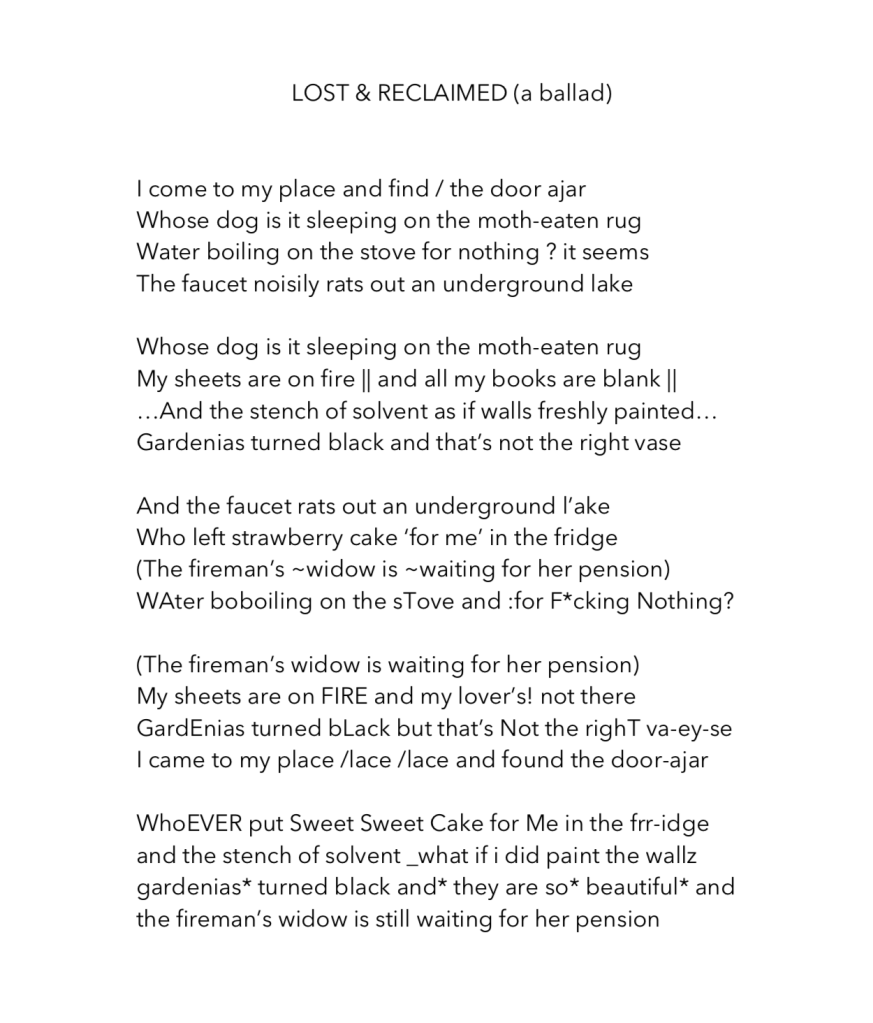
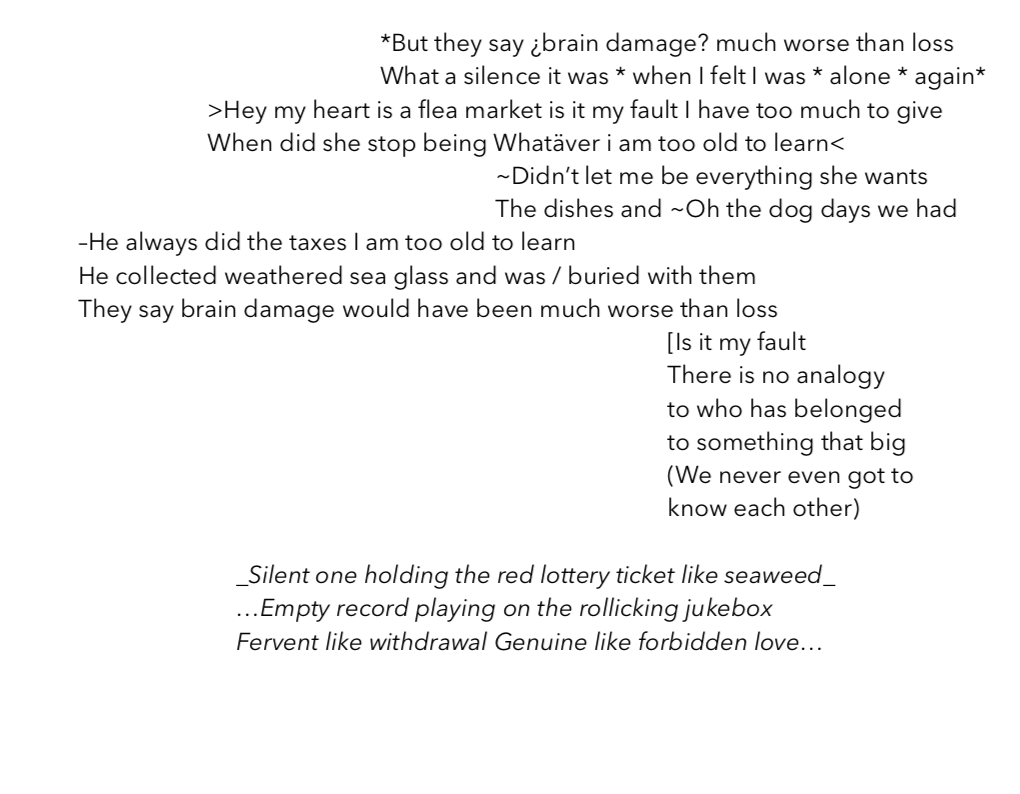
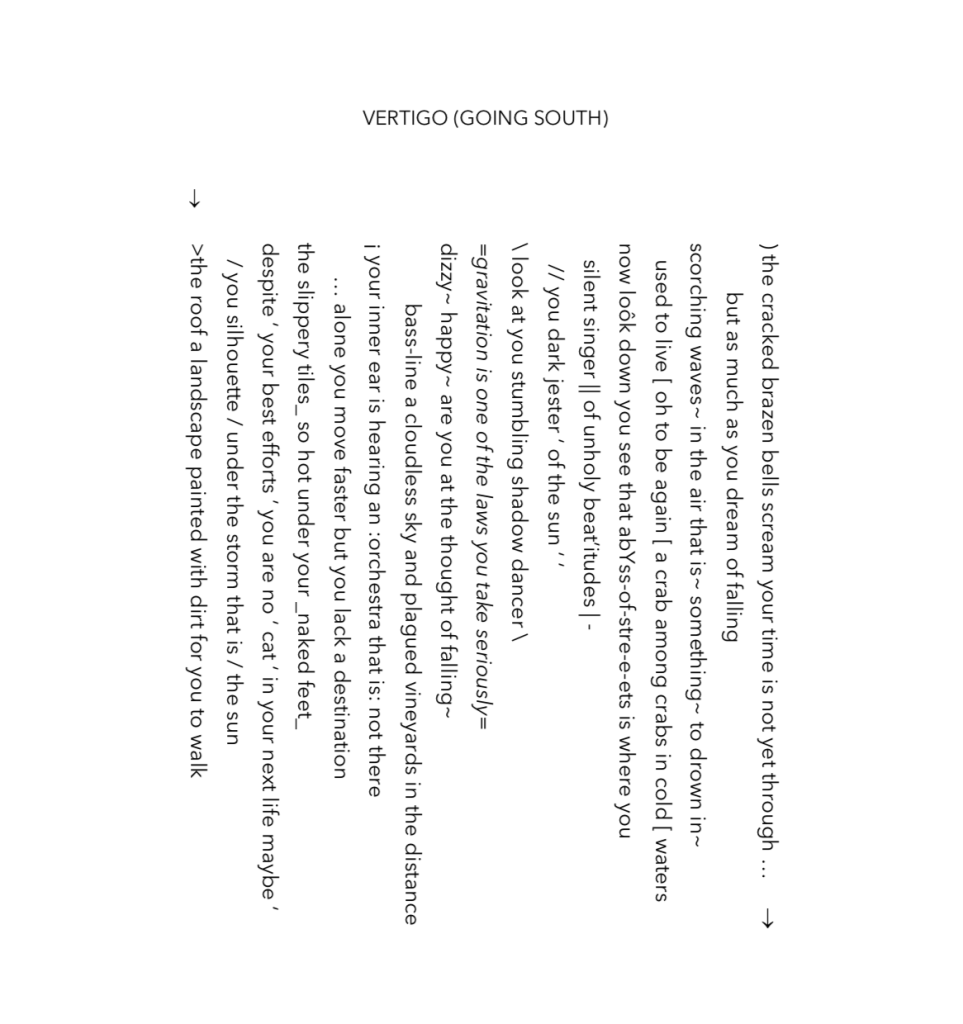
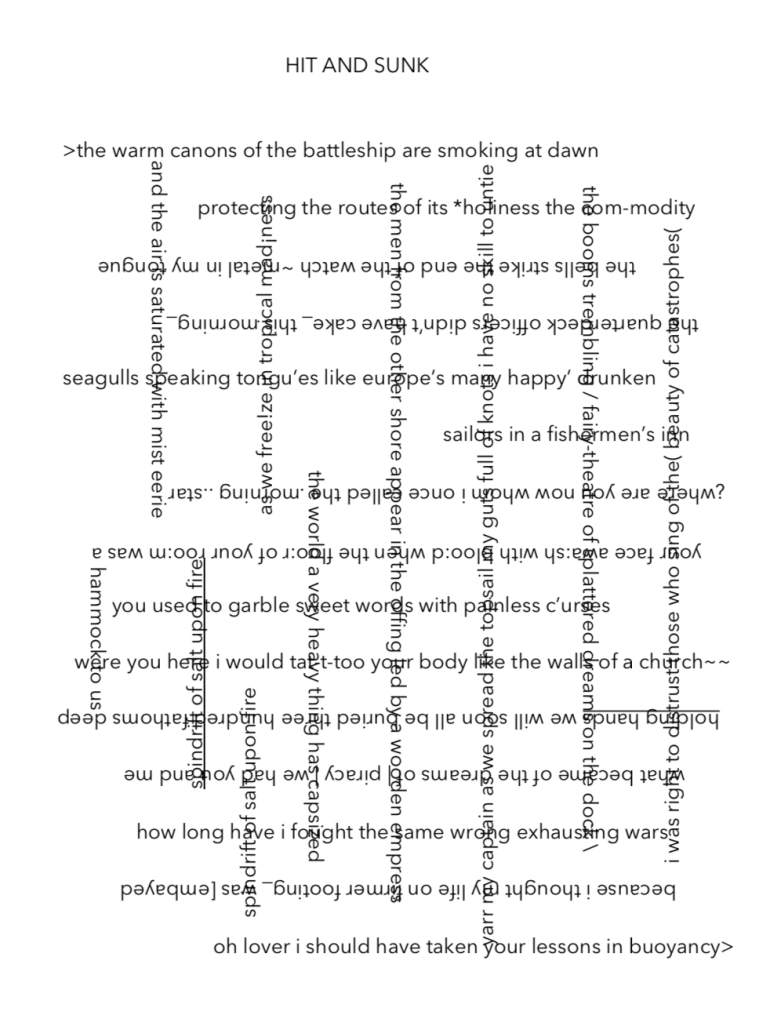
I will conclude this already extensive survey of multilingual dramaturgies with the example of a text of mine that was indirectly derived from the process of creating Innocence. The Minotaurus trilogy of poems (2020-2021) is a series of miniatures that deal directly with the substance of the multilinguistic opera which, though fundamental, is never explicitly addressed in it, unlike for instance what happens in Diana Syrse’s Circe which I discussed earlier. In both Minotaurus and Circe (which happen to be based on related mythological figures) multilingualism is taken as both medium and subject to explore the fragmentation of the self, and the mythology of the hybrid monster is used as an alternative paradigm to counter the Babel trope, in the same way Diana had resorted to the Mayan figure of the nahual. The first text, Minotaurus-Lamento, uses all nine languages from Innocence, but manipulates entirely unrelated material. Ironically the similarity of the multilingual form constructed as a labyrinth to Sanguineti/Berio’s Laborintus II had to be brought to my attention, as I had entirely suppressed the association –but the comparison is enlightening as to the main difference, which is that Minotaurus-Lamento is in no way quotational (unless a few common phrases should be understood as such). It is, on the contrary, an attempt to truly write an original multilingual text that falls into none of the above-mentioned types of multilingual dramaturgy. The pitfall of such an endeavor is of course that the text can be deemed basically undecipherable to anyone but an imaginary erudite reader who would happen to understand all nine languages. This is however not the spirit in which it was conceived; rather, the poem acknowledges the many combinations of fluencies that exist in a multilingual world, and will unfold differently to each reader depending on the languages they know. The syntactic overlaps in language switches are such that, in what is basically one long sentence, key points can be understood very differently depending on the languages that are being read. Accepting this fact allows for both the creation of very different layers and the shameless relishing in each language’s specific grammatical and musical possibilities –all while unveiling interlinguistic connections and associations through juxtaposition and wordplay. These themes are explored throughout the series, although the second and third poems have a more traditionally monolingual English trunk, and the second text even introduces multilingualism only through (musical) quotation. It was indeed necessary to contextualize the meaning of multilingualism beyond the mere linguistic level (and the very concrete experience of a polyglot’s code-switching), to address the fragmentation of the self in other dimensions.

In these last examples, the Hybrid and the Translator emerge as fundamental figures in the challenging of Monolingual reality and of borders. Bilingual forms of code-switching, creoles, pidgins and translations are the places where the conditions of existence in a multilingual world are negotiated, both at their most concrete and at their most existential. They also offer us metaphors and paradigms to understand everything that is exchanged, combined and transformed: in the arts on the interdisciplinary level, and in society on the intercultural level. It is the lack of conceptual tools provided by the multilingual experience, and a broader understanding of the ecology of forms between media (which I have discussed elsewhere) that limit our experiences to an art and a society that are monolingual both in the literal and in the metaphorical sense, and all too exposed to the sirens of chauvinistic Golden Age myths.

I hope to have demonstrated how three distinct forms of multilingual dramaturgy (the humanistic quotational paradigm, the nostalgic Babel paradigm, and the naturalistic paradigm) have developed and interacted in a history that mirrors a broader relationship to language and hence to the Other, and how we can learn from this history in order to create new works in the 21st century without perpetuating inadequate models, but instead be guided by translational ethos and the dialectics of creolization. Undoubtedly mixed media, and in particular music theatre, as an art of hybridization, translation and articulation, has the most convincing tools to integrate multiple languages in a way that challenges Monolingualism and its implications, through its ability to create complex, interdisciplinary objects. Most of it still remains to be explored.
CIRCE bird of prey

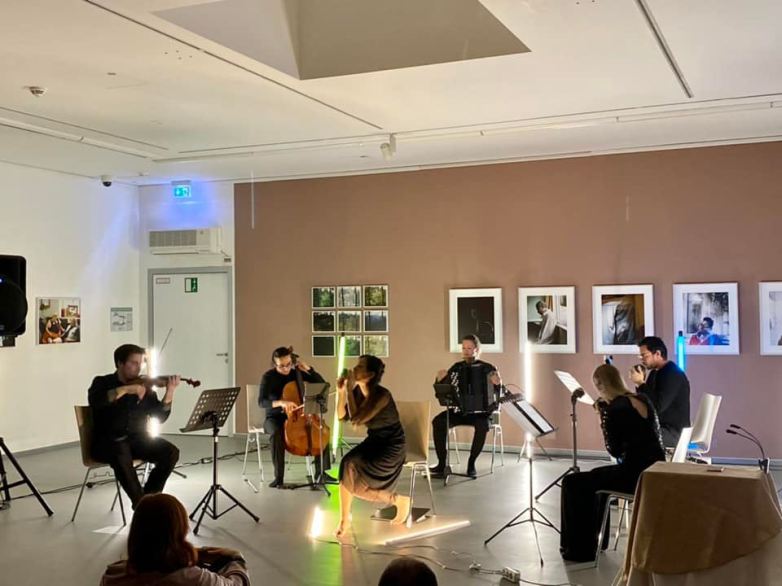
A musical minidrama for purported witch, five animal-instruments and an absent man.

Music by Diana Syrse
Text by Aleksi Barrière

World premiere on November 19th, 2021, at the Kunsthalle Erfurt, performed by Diana Syrse (voice) and Ensemble Via Nova.

Note

“By transforming these men into animals, I have revealed their proper forms. In the future I will be blamed for this, and reckless men will call good Circe evil.”

– Giordano Bruno, Cantus Circaeus, 1582

There was a witch on a lonely island covered with a wild forest. Her name was Bird-of-Prey – Κίρκη in the language of the culture that ruled the waves at the time. Maybe that is because men found it incomprehensible that this woman would rather live alone in a kingdom of her making than be subjected to their laws; and because it was easier for these men to think she transformed her suitors into beasts through witchcraft than to take the blame for really being beasts under their human skins. Is the name self-given or acquired by reputation? In any case it was reclaimed by her. And like Sylvia Plath, she ‘ate men like air’.

The archetypes of the femme fatale and of the sorceress have a history, and it is ambivalent. Circe is related to a lineage of dark femininity, placed as she is by the canon in the close family of Medea the witch and Pasiphae the mother of the Minotaur – sometimes of Hecate, the goddess of witchcraft herself. Many have sought to expand on this lineage to reclaim (under the names of these enchantresses and crones and of the ancient goddesses of which they are iterations) an empowering secret tradition of female knowledge and craft, and this now belongs to the subtext of Circe’s legend. This tradition, however, has little to do with burning sage and healing crystals, with the essentialist, sexist trope of feminine intuition versus male rationality: rather, it acknowledges that no one social or cultural group has a monopoly on science and power. Although The Odyssey is told from the perspective of the male civilized ‘hero’, it does recognize the potency of Circe’s knowledge, and her epithet πολυφάρμακος (of many poisons/medicines) makes her a match to Odysseus πολύτροπος (of many ways/turns).

Nevertheless, inside The Odyssey itself, the story of Circe is a most welcome rebuttal of the monolingual male epic, meaning both of the idea of a master language or culture or gender, and of every conception we have about how to tell a story. Circe doesn’t only offer an alternative to the paradigm of the conquering hero’s return by being a queen of herself only: she suggests a form of theatre based not on epic recitation, on the journey to Hell and back, but on νέκυια, the invitation for the dead to visit us, the making of ourselves into receptacles for suppressed voices and images. Circe the necromancer inaugurates a theatre of the oppressed. She is not a role-model or a cautionary tale, but as in the writings of Giordano Bruno, the teacher of a method to make the invisible visible there where we can see it: within ourselves, in the theatres of our minds and bodies.

In this highly condensed version of the story – a possession rather than an epic –, Circe is surrounded by the presence of the human animals she has tamed, and by the absence of her warrior-lover Nobody. She dissociates between her identities, created within different linguistic realms, until she invents her own language beyond them, closer to her own body and voice. Her controversial choice of embracing a solitary life on her own island and according to her own rules is open-ended: whether terminating her toxic power-play of a romance will result in life-long loneliness or in new, more empowered relationships is left for the audience to explore in their own lives – since that is the place where ancient mythologies continue to play out.

© Ensemble Via Nova

Libretto

Ga-Ga-Ga       Tööt     Pa-Pa-Pa         Coin-Coin-Cua?        
OINK  Hoo-Hoo        Guau-Guau Hee-Haw            Knor-Knor      Béééééh          Νιάου             Coc’orico        Moooo            Ii-Ha-Ha                     -Ha      Boo-Boo

ANIMALS all these men
barging in from their wars
they blame my sp-ells for their transformation

i was born from the moon and the sun / my s-cries
only shed light on what was already there
there is nothing they hate more these men who never take off their ar-mours
then when i see them naked
there is nothing you hate more

*

ich sehe dich nackt und ich lache und du schlägst mich ins gesicht und ich lache lauter und du schlägst mich fester ins gesicht und ich schaue dir in die augen mit lächelnden augen und du schreist schau mich nicht so an und du hasst mich wie einen feind und du drückst meinen kopf ins kissen und ich verhöhne dich was für ein mann und du drückst und drückst um meine lachen und gesicht zum schweigen zu bringen und so weiter und weiter und später als wir im bett liegen streichelst du meine blaue flecke und küsst meine brüste wie ein kind und flüsterst ich kann mir mein leben ohne dich nicht vorstellen

*

…arañas arañas en todos lados en mi cuerpo… ¿Por qué debería hablar tu idioma?
Seulement parce que je n’ai plus de langue personnelle ?
I make potions only to cleanse my mouth from your filthy language the language
of the Empire that rules over the seas.
Aqui en mi isla verkünde ich Gesetze que personne ne reconnaît.
Et ma peau est mon unique journal intime, wide open for everyone to write in.

*

>dance of Circe with the lustful animals>
>>female testosterone and male estrogen>>

*

[in an imaginary improvised language, translated as the following:]

You asked me to open the gates of hell for you
To show you the futures that laid ahead
Me the daughter of the sun and the moon
Me whose sister mated with a bull and gave birth to a labyrinth

I painted my eyes black and my lips red and I said things
You had never heard before larger than your traveler’s imagination
(Like painfully climbing a mountain you only knew as a distant landscape)
Your nails into my skin into your skin to the blood
You heard your dead mother’s voice and your wife’s and your daughter’s in mine
You cried and begged me to stop but I kept talking
Your fever gave me fever and I was a queen again
And you said leave me here in hell where I belong
And I said this hell belongs to me fare you well soldier
And before you left we looked at the black sky together
And the sky and the sea went silent and I felt alive

TAIDE ON DEMOKRATIAN PERUSTARVE [mielipidejuttu]

Kirjoitin tämän tekstin jo alkukeväällä 2020, ja jätin sen julkaisematta koronakriisin alkaessa, koska kulttuurin esteettömyys ja rahoittaminen tuntuivat toissijaisilta suhteessa tapahtumiin. Pandemia ja tapa, jolla julkiset tahot ovat sitä käsitelleet, ovat kuitenkin katkerasti muistuttaneet, kuinka taiteen ja kulttuurin arvoa ja roolia ollaan jatkuvasti väärinarvioitu. Suomen valtioneuvosto on yhtä kyvytön kuin ennenkin ymmärtämään elävän kulttuurin moninaisuuden tärkeyttä kriisitilanteessa ja pelastamaan toimintansa järkevillä tuilla ja säännöillä, ja taidelaitoksille on yhtä vaikeata todistaa, että kuuluvat jokaisen arkeen ja yhteiskunnan tapoihin käsitellä traumaa kollektiivisesti ja luomaan tärkeitä yhteiskunnallisia kokemuksia.

Massiivinen graniittilohkare: Eduskuntatalo, Suomen tasavallan temppeli, valloittamaton ja siksi myös hermeettinen. Sata vuotta yhden ajan edistyneimmän demokratian perustamisen jälkeen sitä vastapäätä seisoo neljä tärkeää rakennusta: Sanomatalo, Nykytaiteen Museo Kiasma, Musiikkitalo ja Keskustakirjasto Oodi. Se, että rakennuksia yhdistää lasiin pohjautuva arkkitehtuuri, niiden lävitse voi nähdä ja kävellä, ja niiden väliin on asetettu kutsuva aukio, osoittaa muuta kuin ajalle ominaisia muoteja.

Kaupunkisuunnittelun kannalta avoimuus ja läpinäkyvyys toimivat symboleina: terveen demokratian vakaata ja pysyvää voimaa peilaavat kansan esteetön oikeus lehdistöön, taiteeseen, tieteeseen, koulutukseen, luovuuteen, keskusteluun. Siis kulttuuriin, joka on orgaaninen osa kaupunkia, yhteiskunnallista elämää. Henkinen Kansalaistori. Demokratian “sykkivä sydän”, johon on puukotettu kylmä asfalttihaava: urbaani nelikaistainen väylä, jonka kautta autot ja bussit kuljettavat väkeä keskustasta esikaupunkialueille, pääkaupungista maakuntiin. Tähän meluisaan todellisuuteen upea symboliikka haaksirikkoutuu, ja ohikulkijoille hienot temppelit ovat yhtä abstrakteja nähtävyyksiä kuin pronssinen K. J. Ståhlbergin patsas Eduskuntatalon edessä. Rakennusten läpi kävellään, ja niihin pysähdytään useimmiten vaan kahville.

Niin sanottu “korkeakulttuuri” koetaan kaukaiseksi monesta syystä. Ainakin yksi syistä on oikeutettu: kulttuuri on keskitetty kaupunkien keskustaan, ja tämä on vain oire koodeista, jotka osoittavat, että se kuuluu eliitille. Siitä syntyy perinteinen polemiikki: miksi vähemmistön harrastuksia pitäisi rahoittaa valtion rahoilla?

Keskusteluun ovat puuttuneet aikamme molemmat suuret populismit: nationalistinen populismi, tyyliin “kansa haluaa omaa ja tuttua” ja liberaalinen populismi, jonka mukaan kuuluisi antaa markkinoiden paljastaa lipunmyyntien kautta, mistä ihmiset oikeasti tykkäävät, jolloin “hyödyttömät” tuotteet katoavat luonnollisesti. Populismi tarkoittaa aina tietyn yhteiskuntaluokan edustamista, ja kulttuuritukien väheksyminen kuuluu perinteeseen. On helppoa ehdottaa julkisen terveydenhoidon lakkauttamista henkilölle, joka on terve, tai jolla on varaa yksityiseen klinikkaan.

Mutta näitä päätöksiä tehdessä täytyy palata poliittisiin peruskysymyksiin: keitä valtio ja markkinat palvelevat, ja miten ne suhtautuvat toisiinsa. Valtion velvollisuuksien siirtäminen yksityisille tahoille on yhä siedettävämpää ja normaalimpaa ja siksi yhä huolestuttavampaa, koska se osoittaa populistisen strategian normalisoitumista.

Kulttuurikysymys on kansanterveyden kysymys. Tämä on unohdettu, vaikka Opetus- ja kulttuuriministeriön nimi muistuttaakin hämärästi, että asialla on jotakin yhteistä esimerkiksi urheilun ja opetuksen kanssa. Taideteokset kertovat toisista ihmisistä, ajoista, kulttuureista, ne käsittelevät kokemuksia ja faktoja, kyseenalaistavat ennakkoluuloja, herättävät monipuolisesti uteliaisuutta. Taide yllättää, ilahduttaa, ärsyttää. Taidekokemuksilla on suora vaikutus stressin vähenemiseen ja aivojen välittäjäaineiden säätelyyn; harjoitellaan kuuntelemista, keskittymistä, muistia ja empatiaa. Taide luo turvallisen tilan omille tunteille ja ajatuksille. Tilan, joka kuuluu kokonaan minulle, joka samanaikaisesti on omistettu toisille: opin siinä ymmärtämään toista näkökulmaa samalla kun avaan omaa assosiaatiomaailmaani.

Kun arjesta syrjäytyy väliaikaisesti, kaikkea, jolle ei arjen rutiinin kaaoksessa oikeasti ole tilaa, voi syöksyä vastaan: lapsuudenmuisto, uni, puolison hyvinvointi, läheisen sairaus. Ja vielä pelottavampia kysymyksiä: Miksi tämä on minusta niin liikuttavaa? Eikö tuskaa voi välttää? Miksi kaikki eivät saa ansaitsemaansa? Miksi ihmisten välinen kommunikaatio on niin hankalaa? Osaanko itse huomioida toisten kärsimystä? Mitä muutoksia uskallan tehdä omassa elämässäni? Miksi en kysy näitä kysymyksiä itseltäni enemmän?

Kysymykset ovat vaarallisia, sekä henkilökohtaisella että poliittisella tasolla. Ne tarkoittavat, että maailma voisi olla erilainen ja että minullakin voi olla vaikutus siihen. Ne herättävät keskustelua.

Kulttuuri on osa sekä tervettä ihmistä että tervettä demokratiaa. Ja niin kuin demokratia itse tai mikä tahansa terve dieetti, se vaatii säännöllisyyttä ja monipuolisuutta, mahdollisuutta kokeilla kaikkea, kokea monenlaisia ääniä, näkökulmia ja muotoja. Kirjasta elokuvaan, konsertista näyttelyyn, nykysirkuksesta oopperaan – kaikki provosoivat aisteja ja älyä eri tavoin.

Kulttuurissa ei ole kyse siitä, että kokisimme kaikki samat asiat samalla tavalla (identiteetti, jota nationalistit hellivät, tai viihde, joka on markkinatalouden esteettinen ideaali), vaan siitä, että osaamme ja saamme kokea samat asiat eri tavoin, ja kokemuksesta voi keskustella ja oppia. Yhteiskuntamme ei kärsi faktojen ja puheiden puutteesta, vaan kyvyttömyydestämme käydä rakentavaa keskustelua. Sukupuoleen perustuva väkivalta, ilmastonmuutos, maahanmuutto, riippuvuudet… monista aiheista puhumme vain vihaisesti ja säädämme pelkästään kriisinhallintastrategioita.

Terveyden ja tasa-arvon vaaliminen kuuluvat valtion velvollisuuksiin. Niiden siirtäminen yksityisille tahoille, esimerkiksi säätiöille, tarkoittaa demokraattisen vallan siirtymistä julkiselta taholta yhden yhteiskuntaluokan käsiin. Monipuolinen taide vaatii rahoitusta, joka ei tule pelkästään yhdeltä yhteiskuntaluokalta; se vaatii myös taiteilijoita, jotka tulevat kaikenlaisista taustoista.

Se, että saa koulutuksen taiteen nauttimiseen ja harrastamiseen, ja että myöhemmin elämässä taiteen tekemisen kustannukset eivät muutu ylittämättömän kalliiksi yleisölle, ei voi riippua siitä, onko syntynyt varakkaaseen perheeseen tai saanut varakkaalta säätiöltä tukea. Taiteilijoiden apurahat takaavat osittain sekä monipuolisuuden että esteettömyyden. Mutta se ei nykyisellään, sellaisenaan riitä kumpaankaan.

Taidekoulutus, kulttuurin tuominen suurkaupunkien ja -laitosten ulkopuolelle, kulttuuripalvelujen alennettu arvonlisävero (ala, jossa Suomi on joskus osannut olla esimerkillinen!) ja valtion myöntämät kulttuurisetelit ovat konkreettisia keinoja kynnysten alentamiseksi. Rahoituksella on sekä taloudellinen että symbolinen merkitys. Suomalainen erikoisuus, veikkausvoittorahojen käyttäminen taiteen avustamisessa, tulee kuihtumaan samalla kun huomaamme, että kulttuuritukimallimme perustuu osin tuhoisaan rahapeliriippuvuuteen. Tämä riippuvuus koskee kasvavaa osaa väestöstä, erityisesti sellaista, jolla ei ole varaa korkeakulttuuriin.

Vero, variksenpelätin, jota populistit niin innokkaasti liputtavat, on oikeudenmukaisin tapa rahoittaa yhteiskunnallisia palveluja, kahdella ehdolla:

1. Oikeudenmukainen verotus: koskien tuloveroa, mutta etenkin varallisuusveroa, yhteisöveroa, pääomatulojen verotusta. Jos varakkaammat oikeasti haluavat tukea kulttuuria, se tulee tehdä demokraattisin keinoin.

2. Demokraattinen prosessi, jonka kautta jokainen omaksuu kulttuurin olennaiseksi osaksi elämäänsä. Osallistuva budjetointi, jota tehdään osittain jo monessa Suomen kaupungissa. Asiantuntijoiden lisäksi itse yleisön osallistuminen apurahojen johtokuntiin (tekemällä yleisön jäsenistä paitsi osallistuvia, myös osaavia) ovat konkreettisia keinoja, joilla on paljon enemmän merkitystä kuin lipunmyynneillä.

Toteutuessaan nämä keinot avaisivat suuremman tilan riskinotolle, joka on monipuolisuuden ehdoton edellytys. Vertaamalla länsimaisia demokratioita opimme myös, että mitä enemmän vaaleja järjestetään, kaikilla tasoilla, sitä enemmän ihmiset äänestävät ja omaksuvat julkisen keskustelun. Vuonna 2019 kolmasosa äänioikeutetuista ei äänestänyt edes Suomen eduskuntavaaleissa.

Taiteilijoilla on paljon pohdittavaa koskien taiteen roolia yhteiskunnassa: kenelle he tekevät taidetta, ja millaista taidetta maailma tarvitsee – eikä näin suuri kysymys tarkoita, etteikö vastaukseen voisi myös kuulua keveyttä, johon kaikki taidelajit kykenevät, suurten ja hienovaraisten eleiden rinnalla. Kysymys on ennen kaikkea poliittinen: olemmeko moderni demokratia muutenkin kuin pinnallisesti, ja uskallammeko vahvistaa kulttuuria yhteiskuntamme peruspalveluna, monikulttuurisessa maassa, jossa yhteiskunta- ja ikäluokat erottuvat yhä vahvemmin toisistaan. Näin poliittinen ongelma vaatii poliittista ratkaisua: syvällistä reformia taiteen rahoituksen struktuureissa, lähteistä kohteisiin.

Tällä hetkellä systeemi suosii yksittäisiä taiteilijoita ja isoja taidelaitoksia. Se ei ruoki monipuolista vapaata kenttää, pienempiä ryhmiä, festivaaleja, orkestereita ja gallerioita, jotka nyt taistelevat jokaisen projektinsa puolesta. Projekteja, joiden tärkeyttä ei mitata lipunmyynneillä, yhdenmuotoisuudella tuttuihin ja menestyneisiin kulttuurituotteisiin, vaikuttavan teknologian käytöllä tai kuuluisuuksien osallistumisella.

Vapaan kentän tukeminen on tehokas keino luoda taloudellisesti ja maantieteellisesti tasa-arvoisempaa tarjontaa ja myös tukea pysyvämmin niitä taiteilijoita, jotka elävät tilauksista ja tekijänoikeuksista.Tarvitsemme kulttuuripolitiikkaa, joka ottaa kantaa ja antaa monipuoliselle yhteiskunnallemme moniäänisyytensä. Julkista tilaa, joka ei kuulu markkinavoimille. Kansalaistoria, joka ei ole pelkästään kauppatori sijoittajille ja turisteille. Jossa saa olla muutakin kuin työläinen ja kuluttaja: tasavallan kansalainen.

Tämän tekstin alkuperäinen versio on julkaistu Rondo Classic -lehteen lokakuussa 2021.

Lue myös: Myöhemmin kirjoitettuja Rondo-kolumneja.

TROIS CHŒURS DE NELLY SACHS (et les psaumes de Celan et Bachmann)

Les treize « Chœurs d’après minuit » de Nelly Sachs, publiés en 1946 dans son recueil In den Wohnungen des Todes (Dans les demeures de la mort), font partie des premiers textes qui ont su reprendre la langue allemande à la barbarie dont elle était devenue l’instrument, en portant de front à la fois le témoignage, le deuil et l’accusation, élargie et prolongée à tous les indifférents. Paul Celan a su y reconnaître l’expression de « l’héritage de la solitude » sur lequel lui-même essayait de mettre des mots. Le souffle lyrique de ces chœurs, que n’osera plus imiter la poésie d’après-guerre dans son corps à corps avec le silence, puise sa force autant dans la tragédie grecque que dans le chant du psalmiste. Il n’est donc pas inutile de les lire ensemble avec les deux tentatives de psaumes de Paul Celan et d’Ingeborg Bachmann, hantées respectivement par l’athéisme du survivant et la culpabilité de la fille de bourreau : ils ont dessiné ensemble dans les ruines de la vieille Europe une constellation qui ne se laisse pas réduire aux relations personnelles qui ont relié ces trois poètes dans les années 1950. Cette reconquête d’une langue par la poésie, qu’obligent bien des fantômes, impose à la traduction une tâche contagieuse, impossible mais salvatrice, où se dosent sans recettes la rudesse et la délicatesse, la gouache et le crayon : ces poètes n’ont pas constitué d’école, mais ce redoutable calibrage-là en est une.


CHOR DER WANDERNDEN

Wir Wandernde
Unsere Wege ziehen wir als Gepäck hinter uns her –
Mit einem Fetzen des Landes darin wir Rast hielten
Sind wir bekleidet –
Aus dem Kochtopf der Sprache, die wir unter Tränen erlernten,
ernähren wir uns. 

Wir Wandernde,
an jeder Wegkreuzung erwartet uns eine Tür
dahinter das Reh, der waisenäugige Israel der Tiere
in seine rauschende Wälder verschwindet
Und die Lerche über den goldenen Äckern jauchzt.
Ein Meer von Einsamkeit steht mit uns still
Wo wir anklopfen.
O ihr Hüter mit flammenden Schwertern ausgerüstet,
Die Staubkörner unter unseren Wanderfüßen,
Beginnen schon das Blut in unseren Enkeln zu treiben –

O Wir wandernde vor den Türen der Erde,
vom Grüßen in die Ferne
Haben unsere Hüte schon Sterne angesteckt.
Wie Zollstöcke liegen unsere Leiber auf der Erde
Und messen den Horizont aus –

O wir Wandernde,
kriechende Würmer für kommende Schuhe,
unser Tod wird wie eine Schwelle liegen
vor euren verschlossenen Türen!

CHŒUR DES ERRANTS

Nous les errants,
Nous traînons derrière nous nos routes comme un bagage –
D’un lambeau du pays où nous avons fait halte
Nous sommes vêtus –
De la marmite de la langue que nous avons apprise à travers les larmes
Nous tirons notre nourriture.

Nous les errants,
À chaque croisement nous attend une porte
Derrière laquelle le faon, Israël aux yeux orphelins du règne animal,
Disparaît dans ses forêts bruissantes
Et l’alouette par-dessus les champs dorés exulte.
Une mer de solitude se tient auprès de nous, étale,
Partout où nous frappons aux portes.
Ô vous les gardiens armés d’épées flamboyantes,
Les grains de poussière sous nos pieds errants
Commencent déjà à tirer le sang de nos petits-enfants –

Oh nous les errants aux portes de la terre,
À force de saluer les lointains
Nos chapeaux ont déjà allumé des étoiles.
Comme des mètres pliants nos corps gisent sur la terre
Et mesurent l’horizon —

Oh nous les errants,
Asticots grouillants pour les souliers à venir,
Notre mort s’étendra comme un seuil
Devant vos portes fermées à double tour !


CHOR DER TOTEN

Wir von der schwarzen Sonne der Angst
Wie Siebe Zerstochenen –
Abgeronnene sind wir vom Schweiß der Todesminute.
Abgewelkt an unserem Leibe sind die uns angetanen Tode
Wie Feldblumen abgewelkt an einem Hügel Sand.
O ihr, die ihr noch den Staub grüßt als einen Freund
Die ihr, redender Sand zum Sande sprecht:
Ich liebe dich.

Wir sagen euch:
Zerrissen sind die Mäntel der Staubgeheimnisse
Die Lüfte, die man in uns erstickte,
Die Feuer, darin man uns brannte,
Die Erde, darin man unseren Abhub warf.
Das Wasser, das mit unserem Angstschweiß dahinperlte
Ist mit uns aufgebrochen und beginnt zu glänzen.
Wir Toten Israels sagen euch:
Wir reichen schon einen Stern weiter
In unseren verborgenen Gott hinein.

CHŒUR DES MORTS

Nous que le soleil noir de la peur
A percés comme des passoires –
Égouttée de nous la sueur de la minute de mort.
Effeuillées de nos corps les morts qui nous ont été faites
Comme des fleurs des champs sur une dune de sable.
Ô vous qui saluez encore la poussière comme une amie
Vous sable parlant qui dites au sable :
Je t’aime.

Nous vous disons :
Déchirés sont les manteaux des mystères de la poussière
Les airs qui en nous ont été étouffés,
Les feux où nous avons été brûlés,
La terre où nos restes ont été jetés.
L’eau qui perlait de la sueur de notre peur
Avec nous s’est déversée et commence à scintiller.
Nous les morts d’Israël nous vous disons :
Nous avançons déjà d’une étoile
Dans les entrailles de notre Dieu caché.


CHOR DER TRÖSTER

Gärtner sind wir, blumenlos gewordene
Kein Heilkraut läßt sich pflanzen
Von Gestern nach morgen.
Der Salbei hat abgeblüht in den wiegen –
Rosmarin seinen Duft im Angesicht der neuen Toten verloren –

Selbst der Wermut war bitter nur für gestern.
Die Blüten des Trostes sind zu kurz entsprossen
Reichen nicht für die Qual einer Kinderträne.

Neuer Same wird velleicht
Im Herzen eines nächtlichen Sängers gezogen.
Wer von uns darf trösten?
In der Tiefe des Hohlwegs
Zwischen Gestern und Morgen
Steht der Cherub
Mahlt mit seinen Flügeln die Blitze der Trauer
Seine Hände aber halten die Felsen auseinander
Von Gestern und Morgen
Wie die Ränder einer Wunde
Die offenbleiben soll
Die noch nicht heilen darf.

Nicht einschlafen lassen die Blitze der Trauer
Das Feld der Vegessens.
Wer von uns darf trösten?

Gärtner sind wir, blumenlos gewordene
Und stehn auf einem Stern, der strahlt
Und weinen.

CHŒUR DES CONSOLATEURS

Jardiniers nous sommes, devenus sans-fleurs
Aucune herbe médicinale ne se laisse transplanter
D’hier à demain.
La sauge s’est fanée dans les berceaux –
Le romarin face aux morts nouvelles a perdu son parfum –

L’absinthe même était amère jusqu’à hier seulement.
Les floraisons du réconfort sont trop fraîchement écloses
Et ne suffisent pas aux tourments d’une larme d’enfant.

Une nouvelle graine peut-être
Sera tirée du cœur d’un chanteur nocturne.
Qui parmi nous a le droit de consoler ?
Tout au fond de la gorge
Entre hier et demain
Se tient le Kerub
Du choc de ses ailes jaillissent les éclairs du deuil
Mais ses mains écartent les deux rochers
D’hier et de demain
Comme les bords d’une plaie
Qui doit rester ouverte
Qui n’a pas encore le droit de guérir.

Les éclairs du deuil ne permettent pas
Au champ de l’oubli de s’endormir.
Qui parmi nous a le droit de consoler ?

Jardiniers nous sommes, devenus sans-fleurs
Debout sur une étoile qui rayonne
Et nous pleurons.


PSALM

Niemand knetet uns wieder aus Erde und Lehm,
niemand bespricht unsern Staub.
Niemand. 

Gelobt seist du, Niemand.
Dir zulieb wollen
wir blühn.
Dir
entgegen. 

Ein Nichts
waren wir, sind wir, werden
wir bleiben, blühend:
die Nichts-, die
Niemandsrose. 

Mit
dem Griffel seelenhell,
dem Staubfaden himmelswüst,
der Krone rot
vom Purpurwort, das wir sangen
über, o über
dem Dorn.

Paul Celan, Die Niemandsrose, 1963

PSAUME de Paul Celan

Personne à nouveau ne nous pétrira hors de la terre et de l’argile,
personne ne conférera la parole à notre poussière.
Personne.

Personne à nouveau nous pétrira hors de la terre et de l’argile,
personne conférera la parole à notre poussière.
Personne.

Loué sois-tu, Personne.
Par amour de toi nous voulons
fleurir.
Au-devant
de toi.

Un Rien,
C’est ce que nous étions, sommes, serons
ce que nous resterons, en fleurissant :
la rose de Rien, la
rose de Personne.

Avec
le pistil-stylet brillant de son âme,
l’étamine poudreuse ruine du ciel,
la couronne rouge
du mot pourpre que nous chantions,
par-dessus, oh, par-dessus
l’épine.


PSALM

1

Schweigt mit mir, wie alle Glocken schweigen!

In der Nachgeburt der Schrecken
sucht das Geschmeiß nach neuer Nahrung.
Zur Ansicht hängt karfreitags eine Hand
am Firmament, zwei Finger fehlen ihr,
sie kann nicht schwören, daß alles,
alles nicht gewesen sei und nichts
sein wird. Sie taucht ins Wolkenrot,
entrückt die neuen Mörder
und geht frei.

Nachts auf dieser Erde
in Fenster greifen, die Linnen zurückschlagen,
daß der Kranken Heimlichkeit bloßliegt,
ein Geschwür voll Nahrung, unendliche Schmerzen
für jeden Geschmack.

Die Metzger halten, behandschuht,
den Atem der Entblößten an,
der Mond in der Tür fällt zu Boden,
laß die Scherben liegen, den Henkel …

Alles war gerichtet für die letzte Ölung.
(Das Sakrament kann nicht vollzogen werden.)

2

Wie eitel alles ist.
Wälze eine Stadt heran,
erhebe dich aus dem Staub dieser Stadt,
übernimm ein Amt
und verstelle dich,
um der Bloßstellung zu entgehen.

Löse die Versprechen ein
vor einem blinden Spiegel in der Luft,
vor einer verschlossenen Tür im Wind.

Unbegangen sind die Wege auf der Steilwand des Himmels.

3

O Augen, an dem Sonnenspeicher Erde verbrannt,
mit der Regenlast aller Augen beladen,
und jetzt versponnen, verwebt
von den tragischen Spinnen
der Gegenwart…

4

In die Mulde meiner Stummheit
leg ein Wort
und zieh Wälder groß zu beiden Seiten,
daß mein Mund
ganz im Schatten liegt.

Ingeborg Bachmann, Die gestundete Zeit, 1953

PSAUME d’Ingeborg Bachmann

1

Taisez-vous avec moi, comme les cloches se taisent !
Au moment où la terreur expulse son placenta
la vermine vient chercher une nouvelle pitance.
Pour tâter le terrain, les vendredis saints, une main descend
du firmament, il lui manque deux doigts,
elle ne peut pas jurer que tout,
que tout n’a pas été et ne sera
rien. Elle plonge dans le rouge des nuages,
délivre les nouveaux assassins
et s’en va libre.

De nuit sur cette terre
ils s’accrochent aux fenêtres, ils écartent les draps,
pour que se dénude l’intimité des malades,
un ulcère plein de pitance, des douleurs interminables,
il y en a pour tous les goûts.

Les bouchers suspendent, de leurs mains gantées,
le souffle des dénudés,
la lune dans le cadre de la porte tombe par terre,
répand au sol les éclats, l’anse…

Tout était dressé pour l’extrême onction.
(Le sacrement ne peut pas être administré.)

2

Tout est vraiment vanité.
Ramène une ville par ici,
élève-toi de la poussière de cette ville,
déguise-toi d’un emploi
et travestis-toi,
pour échapper à la honte nue.

Acquitte-toi des promesses
devant un miroir aveugle dans les airs,
devant une porte fermée dans le vent.

Encore sauvages sont les sentes du versant abrupt du ciel.

3

Ô yeux, brûlés en ce grenier du soleil la terre,
chargés du fardeau de pluie de tous les yeux,
et maintenant emmêlés, pris dans les fils
des araignées tragiques
du présent…

4

Dans le creux de mon mutisme
dépose un mot
et étire des forêts de chaque côté,
que ma bouche
tout entière dans l’ombre repose.

NOTES ON LIGHT with Jakob Kullberg

Liner notes for the CD Remembering – Cello Concertos (BIS records) by cellist Jakob Kullberg, featuring Kaija Saariaho’s cello concerto Notes on Light and two concerti by Per Nørgård. These notes were intervowen with a text by Jørgen I. Jensen about Nørgård’s works.

The Concerto as Method

As a performer, arranger, composer and curator, Jakob Kullberg incorporates a broad range of unusual extended techniques, borrows from other bowed instruments or the guitar and sometimes even sings. In his hands the cello is an instrument devoted to the creation of new music, but gorged with the awareness of its own lengthy history, and its versatility and broad range are put to good use to collaborate and, when needed, steal. It is therefore only partly surprising that Kullberg’s work, a highly personal process relying on his own arrangements, skills and friendships, finds its centre of gravity in the concerto, a most classical form (to the point that in recent times composers have often approached it with reluctance) but also the most collaborative. Concertare does mean ‘to play together’, and a concerto is a musical dramatization of the encounter of an individual soloist with the sound world of a composer. This happens to be precisely what Kullberg is so eager to explore: the point where the instrumentalist enters into a dialogue with a living composer’s musical language, weaves himself into it without renouncing his personal artistry, playing with the idea of becoming a transparent vehicle for it, but ultimately transforming it into something personal by treating it as something that needs to be expanded. Music begets music, in what is a personal journey and adventure. On this record Kullberg continues his work on the concertos of two composers with whom he has collaborated extensively, and although his personal readings of these works are to be found in his performances, some background information may be useful to the listener.

Notes on Light

Like Per Nørgård, Kaija Saariaho came only gradually to the concerto form. Her distinctive voice as a composer emerged in the development of subtly woven sound textures in which, thanks to live electronics, individualities blend rather than enter dialogues. For that very reason, she herself dismisses the idea that works such as … à la fumée (1990) or Amers (1992), both including a cello next to the orchestra, are anything like concertos. It was only in her forties, starting with the violin concerto Graal Théâtre (1994), that Saariaho started tackling how the classical soloist/orchestra relationship could be integrated into her own language, a process that paved the way to the kind of musical dramatization of individual voices that allowed her to write operas in the 2000s.

As such Notes on Light (2006) not only functions as a kind of musical drama, but also recapitulates the development of her musical language until that point. The first movement (Translucent, secret) starts where Saariaho’s previous work for cello and orchestra, Amers, left us: in an aquatic world that possesses both the weight of water and its ability to carry and diffract light. As the concerto begins, descending cello lines suggestive of gravity are broken into glissandi and harmonics, like diffracted spectral chords that shine in the darkness. But unlike in Amers, the cello is immediately established as an individual character, one that tiptoes into cold water. The solo part starts with a series of tentative scales descending from an F sharp on the A string, meaning in physical terms that the player’s fingers begin their timid exploration of the instrument’s neck from the uppermost (and outermost) string. As listeners, we are treated to a close-up of the tactile adventure of a player taking possession of his instrument and then trying to find his place in the complex and extremely reactive environment of the orchestra. This is the beginning of a conversation.

The second movement is called On Fire, which can of course describe the state of burning, but should also be understood as the subject of a debate. The cello and the orchestra undergo a ‘heated’ conversation and refuse to share the space. But the writing, at first reminiscent of the dialogic character of Saariaho’s violin concerto, morphs thanks to the orchestral textures into something more elaborate during the transition to the third movement (Awakening), borrowing musical material from the work she composed just before creating this concerto: the opera-oratorio La Passion de Simone. Here the cello writing is both bellicose and integrated with the orchestra, in fact reminiscent of the position of a singer in an opera, and in its low register the cello does happen to sound like a human voice singing underwater. In the most dramatic way: the climax unfolds in the only clearly ascending line of the movement, which with its alternation between the highest and lowest notes of the instrument’s range feels like the toilsome gasping of drowning lungs. In this recording, Jakob Kullberg completes the resolution of the climactic line with a two-minute cadenza he has composed himself. Here, at the exact centre of the piece, he creates an expressive space, freed from the constraints of the orchestra and of the sheet music itself, playing in a personal way with the musical ideas at hand. But this cadenza is a swan song, and when the orchestra re-enters the cello melts into harmonics and the high register; when the orchestra recedes like an ebb tide, the soloist too has disappeared, seemingly washed away by it.

This feels like the end of the piece. The conflict has been solved, something like a traditional three-part arch (albeit inverted compared to a classical concerto: slow-quick-slow) has been completed. But the journey is not over. In the fourth movement (Eclipse) the orchestral sea flows back in heavily, without the soloist. The cymbal shimmers may evoke images of an actual solar eclipse, but it is really the invisible influence of the moon on the tides that we are witnessing over the course of several minutes. Besides, this majestic build-up doesn’t make for an epic re-entry of the soloist: when the cello returns at the beginning of the final movement (Heart of Light), like a bird rustling its wings as it emerges from an oil spill, it speaks not of the sun-hero’s return from the dead, but of transformation, shadows and memories, after a lost battle against the fatal entropy of the universe.

The cello’s utterances are not triumphant, but now more than ever made of descending lines, crushed sounds and a frail upper register. They do shine, but with the gentle dimness of a constellation amongst constellations. They are for us to contemplate, ‘looking into the heart of light, the silence’ as in the lines from T. S. Eliot’s The Waste Land quoted by Saariaho on the final page of her score, alluding to the moment when love and music live only in our recollections. Carefully re-constructed, re-membered as Per Nørgård would say, ready to live another life within ourselves as material for something else. The self-centred individual has dissolved into the greater cosmos and is now at home, ready to become once again what it always aspired to be: new music.

Jakob Kullberg performing Notes on Light (first movement)
Lighting Design by Aleksi Barrière / I Djurs og Mols Festival, Denmark, July 2021
Picture by Mats Iversen Vangen

Graham Vick OUT OF THE GATES OF HISTORY

I am shocked to read that Graham Vick, the pioneering opera director, has passed, at the young age of 67, from Covid-related complications.

Since the creation of the Birmingham Opera Company in 1987, he was an inspiration to all of us who think that the ‘Gesamtkunstwerk’ must not choose between bold artistic stands and outreach beyond the educated and wealthy audiences of the opera world; all of us who, in fact, think the total medium is all about creating new work for new audiences, and starting conversations.

This was a man who knew how to use the big stage like a master and had an international career – but as he told me when we met in Paris in 2015, he really was only excited to be challenged by the next show he was preparing for his audience in a warehouse in Birmingham, and mainly saw the glitz and glitter of the big houses as a way to keep the project that mattered most to him going in his home town.

His eager, erudite knowledge, his British tongue-in-cheek humour, and his commitment to the entangled forces of music and theatre will all be sorely missed.

When I wrote the program note for his production of Ernest Chausson’s take on the Arthurian legend (he hated the notion of the program note, and said the show was the only actual director’s note, but somehow he didn’t make me feel like an idiot for writing one), he insisted I end with the following image rather than all the ideas about politics, mythology, Wagner and Tolstoy we had been discussing; and if you didn’t know the man, please be informed this is what his grumpy idealistic genre-bending soul sounded like, and as a last tribute it fits him like a glove:

Arthur rises to the sky. It is not my mission to interpret this ascent for the audience, and I think it should remain open, although it is cyclical, and the end always goes back to the beginning. When we enter into the realm of mysticism – as is the case when a man, who was destroyed by his ideal, is himself transformed into an ideal for other men –, it really becomes a matter of each and everyone projecting his preferred answer anyway. But again, one must remember this is an opera about idealism. So the earth will be separated from the sky. And that is how a legend is born, which is, again, what this is all about. Like Charlton Heston leaving on horseback at the end of Anthony Mann’s El Cid: “… he rode out of the gates of history – into legend”!

LE TRADUCTEUR, ÉTERNEL INCOMPÉTENT [la tare du traducteur]

Version longue d’une communication prononcée dans le cadre du séminaire « Traduire les sciences humaines » organisé par Julie Loison-Charles et Ronald Jenn à l’Université de Lille en ligne le 9 avril 2021.


Bonjour à toutes et à tous. C’est un plaisir de parler parmi vous aujourd’hui, et je remercie d’abord chaleureusement Julie Charles de m’y avoir convié. C’est un plaisir mais un plaisir intimidant, parce que la traduction n’est pas le premier de mes métiers, que je le pratique en pointillés dans des domaines souvent éloignés de la recherche universitaire, et que par ailleurs je ne suis pas traductologue. Est-ce une raison suffisante de prendre pour sujet l’incompétence du traducteur ? Cette incompétence, du moins, est un sujet sur lequel je peux me prévaloir d’une certaine compétence.

Transparence et incompétence

Je précise, parce que c’est aussi une question de traduction, que pour parler des personnes qui exercent le métier de traduire, j’aurais tendance à employer le féminin de majorité (c’est un métier pratiqué pour deux tiers par des femmes), mais vraiment, venir discourir ici sur « la traductrice, éternelle incompétente », ça aurait fait mauvais genre. On me pardonnera donc de parler par commodité du traducteur, également parce que ma communication est motivée en partie par une phrase de Walter Benjamin dans son essai La Tâche du traducteur (1923). On ne présente plus ce texte classique et iconoclaste, qui reste pourtant étrangement silencieux sur la question de la compétence, qu’on pourrait croire présupposée par l’idée d’une tâche, et qui est structurante dans tout le débat sur la traduction : être « sourcier » ou « cibliste », « littéraliste » ou « annexant », linguiste ou spécialiste, c’est donner la priorité à certaines compétences plutôt qu’à d’autres, puisqu’il est entendu que n’existe pas le Traducteur Idéal – quelqu’un donc qui aurait accès à toutes les strates de signification d’un texte et à toutes les ressources des langues en jeu. La phrase de Benjamin qui m’intéresse est une remarque faite en passant et sur laquelle il ne revient pas :

« les œuvres importantes, qui ne trouvent jamais leur traducteur prédestiné au temps de leur naissance… »

Ihre erwählten Übersetzer. C’est Maurice de Gandillac qui traduit « leur traducteur prédestiné » – on peut traduire « le traducteur élu », ce n’est pas moins intimidant pour nous qui nous posons la question de traduire. C’est une idée à la fois belle et un peu romantique : il y aurait des textes que nous sommes les mieux placés pour traduire, qui nous attendent et qui se languissent de nous. On peut repousser la formule pour son mysticisme mais c’est renoncer à penser la question qu’elle pose : si l’on reformulait cette idée de prédestination en disant « tel traducteur a le plus de compétences pour traduire tel texte dans telle langue », elle paraîtrait assez consensuelle. Mais ce qu’on appelle une compétence de traducteur ne cesse d’être source de litiges, et récemment ce fait a même donné lieu à débat dans une sphère publique qui généralement s’intéresse très peu à la traduction et tend à en faire un processus invisible et automatique. Je veux bien sûr parler de la polémique sur les traducteurs de la poétesse Amanda Gorman. En somme, partager quelque chose de l’expérience de vie de l’autrice était érigé en compétence, à côté par exemple du fait de connaître sa langue ou d’être capable de poésie dans la langue cible. « Connaître sa langue », c’est d’ailleurs un peu la même question que celle de l’expérience de vie, puisque la langue est informée par un milieu social et un contexte culturel dont la connaissance fait partie de celle de la langue, qui ne se réduit pas à ce qu’on peut trouver dans les livres. Cette polémique a au moins remis au goût du jour deux constats : d’une part, que la compétence du traducteur importe, et qu’il y a un choix idéologique à faire dans la hiérarchie des compétences recherchées ; d’autre part et en creux, que le traducteur est nécessairement incompétent, puisqu’il n’est pas l’auteur en personne et ne le sera jamais ; et s’il l’est, il fait une nouvelle œuvre originale et non une traduction.

Le fait de l’incompétence est généralement éludé par le biais de deux stratégies opposées : soit en disant que toutes les compétences manquantes peuvent s’acquérir par le travail et la recherche ; soit en disant que l’incompétence est tellement intrinsèque à tout traducteur qui n’est pas l’auteur que tant qu’à faire, n’importe qui peut traduire, sans regarder à la compétence. Parce qu’après tout, une traduction n’est jamais qu’une approximation qui se heurte à l’Intraduisible, au fait qu’aucune langue n’est entièrement soluble dans une autre. Mais peut-être avons-nous tendance à confondre ces deux derniers constats. Dans la littérature sur le sujet, l’impossibilité de la traduction est une question noble, ontologique, et l’incompétence du traducteur est une question bassement pratique, presque vulgaire, qui a à voir avec les connaissances individuelles et avec le marché de l’emploi, et contre laquelle se dressent les exemples de grandes traductions réalisées sans connaissance de la langue originale – ouvrages qui en fait posent plutôt la question de l’écrivain que celle du traducteur. Et qui donc contribuent à nier l’intérêt de la traduction comme domaine propre et à en faire une pratique mineure : à la recherche universitaire la pensée et l’érudition, à la littérature le mystère et le style… la traduction se contentera de la superficie fonctionnelle de la communication.

Je ne m’intéresse pas ici aux stratégies par lesquelles le traducteur réel est amené, en vendant ses services ou en faisant la promotion de son travail, à masquer la question de sa nécessaire incompétence (à dissimuler son inévitable statut de faussaire). Mais je voudrais poser que de la même manière que la conscience de l’impossibilité de traduire nourrit l’art de la traduction (ne serait-ce qu’en faisant proposer des traductions qui ne cachent pas l’original en prétendant s’y substituer parfaitement, comme le dénonce Benjamin, ce qui est finalement l’ultime trahison), la conscientisation de l’incompétence du traducteur est un mouvement fertile. Ceci non pour faire l’éloge de l’incompétent total, dilettante égotiste, qui se dédouane de toute éthique traductionnelle ; mais pour mesurer ce à quoi se mesure le traducteur.

J’ai moi-même approché la traduction sous plusieurs angles. Je résume rapidement pour clarifier d’où je parle : je suis né dans une famille bilingue franco-finlandaise (où donc la traduction était constamment une question pratique, voire administrative), j’ai étudié la traduction littéraire en classe préparatoire, la traduction de textes philosophiques en licence de philosophie, j’ai traduit dans le cadre de ma recherche universitaire en études théâtrales, et j’ai écrit et traduit des textes littéraires, pour l’imprimé et pour des spectacles, notamment ceux que je montais moi-même en tant que metteur en scène. J’ai toujours cherché à avoir une approche informée et critique de la traduction. Mais je reste fasciné par cette incompétence fondamentale, parce que la pragmatique du traducteur ne peut pas se contenter de se réfugier derrière l’Intraduisible.

Benjamin donne sa propre solution à l’Intraduisible : la transparence de la traduction. Benjamin en propose une forme concrète : la littéralité de la traduction, et la juxtaposition de l’original et de la traduction. Dans le milieu de la recherche, nous avons de surcroît tous les autres outils de l’édition critique : l’exégèse, la note de bas de page, l’apostille, etc. L’Intraduisible est intégré au dispositif – ce qui ne l’est pas, c’est l’incompétence. S’il existe des « traducteurs prédestinés », c’est pourtant par le faisceau de leurs compétences et incompétences qu’ils se définissent comme tels.

Je voudrais explorer ce point à travers deux exemples personnels qui se trouvent être des traductions réalisées en binôme. Et pour cela faire un détour par le théâtre, qui est mon champ de pratique et de recherche, même si comme on va le voir la recherche en sciences humaines ne sera jamais bien loin de nous, chemin faisant.

L’épreuve du surtitrage

En 2011 j’ai fait un travail de traduction singulier avec Laurent Prost – à l’époque nous étions tous les deux à la fois dramaturges et chercheurs en théâtre – sur le texte du cycle d’opéras de Richard Wagner L’Anneau du Nibelung, pour le surtitrage et le programme de salle d’une mise en scène de cette œuvre[1]. Nous avions la compréhension dramaturgique du projet esthétique de Wagner et un désir de faire une traduction qui ne soit pas uniquement utilitaire, mais qui rende la richesse littéraire du texte chanté. Notre incompétence se situait au niveau de la langue : bien que bons connaisseurs de l’allemand (je crois), nous étions confrontés à un texte d’une rare densité, rempli d’archaïsmes, illisible avec les seuls outils de l’allemand contemporain. C’est cette incompétence qui a suscité une méthode : nous sommes allés chercher le dictionnaire des frères Grimm, contemporain de Wagner, un dictionnaire historique de la langue allemande qui contient toutes les strates littéraires dont Wagner lui-même était imprégné. L’écriture allitérative de Wagner est gorgée de jeux étymologiques. Ce qui est précieux dans le dictionnaire des Grimm, c’est aussi qu’il cite pour chaque mot allemand la racine latine équivalente, qu’il dessine une double carte de l’Europe irriguée par des racines germaniques et romanes qui suivent des croissances parallèles, et restituer cela, c’est nécessairement toute l’entreprise de traduire Wagner, poète et mythologue : faire correspondre un projet lexicologique à un travail artistique, donc traduire (une définition possible de traduire). En quelque sorte, Wagner appelait Grimm. Ce à quoi je veux en venir, c’est que l’incompétence appelle au développement de méthodologies. Dans le théâtre historique de Wagner, à Bayreuth, ses opéras non seulement ne sont pas traduits, mais sont joués sans surtitrage allemand. Le public est supposé compétent, et n’est donc pas conduit à entrer dans un travail du texte que ne permet que la conscience de l’incompétence – ce travail est pourtant particulièrement important pour prendre la mesure du projet de Wagner dans sa dualité entre le nationalisme et l’européanisme notamment. Cette déconstruction est le premier rempart contre la récupération, dont on sait qu’elle a été particulièrement importante dans le cas (de) Wagner.

Une remarque en passant sur le surtitrage : le fameux texte de Benjamin s’achève sur un éloge de la littéralité en traduction, sur le rêve d’une traduction qui ne masque pas l’original, et sur cette formule magnifiquement provocatrice : « La version interlinéaire du texte sacré est l’archétype ou l’idéal de toute traduction. » Dans l’idéal de transparence, cela se rapproche d’ailleurs d’une autre formule célèbre, celle de Chateaubriand à propos de sa traduction du Paradis perdude Milton (1836) : « J’ai calqué le poëme de Milton à la vitre ».[2] Cet idéal de transparence, d’une présence de l’original à travers la traduction m’a longtemps paru une posture impossible, jusqu’à ce que je perçoive que c’est exactement ce que réalise un sous-titrage de cinéma ou un surtitrage de théâtre. (Mon ordinateur persiste d’ailleurs depuis des années à corriger automatiquement « surtitrage » en « survitrage », sans doute devrait-on parler ici d’incompétence fertile de la machine.) C’est précisément cela que nous avons vécu en surtitrant Wagner – et j’ai creusé cette question dans mes propres spectacles en intégrant différentes formes de surtitrages –, dans la coexistence de l’œuvre et de sa traduction, sous deux formes différentes : une traduction interlinguistique et une mise en scène. Ces questions de traduction sont d’ailleurs très précieuses dans la pensée de ce qu’est l’acte de mise en scène d’une œuvre préexistante. La mise en scène peut se comprendre par exemple dans la tension entre la reconduction d’un original sacralisé et une traduction qui la rapproche de l’univers de ses spectateurs, et qui est l’esprit de la traduction de la Bible par Luther et de toutes les traductions protestantes qui ont irrigué les langues européennes avec tant de fertilité dans son sillage. Nous gagnons beaucoup à joindre les deux approches, à éloigner et rapprocher le texte dans un mouvement constant de mesure.

Dans le vocabulaire contemporain de la mise en scène, ce que fait Luther s’appelle un updating, ou une actualisation : par exemple le désormais classique Don Giovanni mis en scène par Peter Sellars (1989), où le personnage éponyme ne porte pas un pourpoint mais un blouson en cuir, ne se bat pas avec une épée mais avec un couteau à cran, et où d’ailleurs toute l’action est resituée à Harlem. La matrice culturelle de Peter Sellars, c’est le protestantisme américain : ce qu’il fait en transposant/actualisant ne paraît pas très différent de ce que fait Luther quand il fait parler à la Bible la langue de tout le monde (l’allemand de « la mère dans la maison et de l’homme du commun »), et d’ailleurs on a réservé à Sellars à peu près les mêmes insultes pour son traitement de Mozart que celles qu’avait pu recevoir Luther en son temps. Mais Sellars est plus fin que cela : tout en « transposant » l’action scénique pour la rapprocher de nous (en traduction on parle de domesticating), il choisit de travailler avec des musiciens dits « baroqueux », qui jouent Mozart en essayant de reconstituer les techniques de jeu de son époque, qui sonnent étrangères à nos oreilles (ce qu’on appelle foreignizing). Il propose par ailleurs l’œuvre in extenso, dans son Urtext, sans les coupes qui étaient et sont encore souvent opérées pour rendre les opéras soi-disant plus digestes pour notre époque calibrée sur les durées standard d’un film commercial ou d’un événement sportif. La transposition est donc superposée à une couche d’archaïsme, et l’écart est saillant. De surcroît la traduction du livret par Sellars est projetée en surtitres, et marque son écart par rapport au texte original qui est chanté : la traduction donne le signe et la poétique de ce qui se passe par ailleurs dans le spectacle. C’est une version possible du fantasme interlinéaire de Benjamin.

Mais ce n’est pas une approche herméneutique, dans le sens où Sellars ne prétend pas pour autant donner la vérité des « intentions » de l’original, mais seulement mettre en œuvre tous les outils disponibles pour s’approcher du texte. Ce n’est pas histoire de dire : voici d’une part l’œuvre et de l’autre son interprétation. C’est affirmer : je ne suis pas compétent à dire ce que les auteurs ont voulu dire. Ce que je peux, c’est tenter de mesurer l’écart, c’est-à-dire traduire.

L’épreuve de l’édition critique

Une autre traduction à deux qui m’a occupé plus récemment est celle des écrits du compositeur et metteur en scène allemand Heiner Goebbels, que j’ai réalisée avec Isabelle Kranabetter[3]. Ici encore les deux traducteurs du binôme se ressemblent : deux dramaturges qui travaillent sur la forme de théâtre musical qui intéresse Goebbels, et qui connaissent donc bien ce dont parlent les textes à la fois dans leur théorie historique et dans la pratique. La différence c’était qu’il y avait une Allemande et un Français, et à cet égard nous pouvions nous compléter assez idéalement : Isabelle corrigeait mes contre-sens en allemand, je corrigeais son français, et à nous deux nous avions un réservoir de références culturelles qui couvraient l’explicite et l’implicite des textes. Cela va des choses que l’on ne peut connaître qu’en ayant grandi en Allemagne aux mots de jargon technique qu’on ne trouverait dans aucun dictionnaire généraliste mais qui font partie du quotidien de la pratique théâtrale et musicale dans chaque pays. C’est un cas qui plaide pour la traduction à deux, dont vous aurez compris que je la trouve judicieuse, même si je traduis beaucoup « tout seul » aussi[4]. Pas simplement pour compenser l’inexistence du Traducteur Idéal, total, qui aurait tout lu, tout vu, tout vécu. Mais parce qu’il y a des béances qui ne sont réfléchies que lorsqu’elles sont vécues comme béances. Je peux prendre un exemple chez Goebbels avec un mot pour le moins important quand on parle de spectacle, celui de Darsteller, qui désigne n’importe quel artiste sur une scène, un acteur ou un musicien par exemple.

Or Goebbels a un problème avec cette notion de Darsteller, qui est un problème classique de la mise en crise de la notion même de représentation. Il veut un théâtre où l’on se passe de quelqu’un qui représente des émotions à notre place sur scène, où l’on cherche plutôt à susciter des conditions où c’est au membre du public de vivre ses propres émotions sans passer par ce dispositif. L’idée est limpide en allemand, le Darsteller est celui qui produit une Darstellung, donc une représentation. Si le vocabulaire était cohérent en français, on dirait de l’acteur d’une représentation qu’il est un « représentant », mais ce n’est pas le cas, et même si les connotations de commerce ou de députation que cette traduction forcée pourrait fournir sont intéressantes, ce ne sont pas les connotations du mot allemand, qui est parfaitement transparent.

(Le même problème se pose au demeurant quand on veut traduire par exemple le verbe anglais to act. On éclaire différemment le travail de l’acteur en mobilisant le champ lexical de l’action plutôt que celui du jeu comme en français. Ces frottements-là sont intéressants, et les pratiques théâtrales se sont toujours nourries de la traduction, en ce que celle-ci force la réflexion sur des métaphores devenues impensées en entrant dans le langage courant par l’usage et par catachrèse.)

Fort heureusement la connotation d’une médiation existe dans un équivalent français courant de Darsteller, un équivalent qui est spécialement intéressant pour le traducteur puisqu’il le met en scène : c’est le mot interprète. C’est une traduction que je trouve opérante, parce que revendiquer « un théâtre sans interprète » en soulignant le mot nous fait réfléchir au rôle traditionnel de l’acteur comme médiateur de l’expérience à laquelle le spectateur est convié. La traduction fait réfléchir le français, réactive le sens fort du mot interprète dont la métaphore a été diluée par l’usage. L’acteur comme interprète. Mais tout en trouvant la traduction heureuse, on ne peut pas se dispenser ici d’une note de bas de page. J’ai eu en cours de langues des leçons sur la version où l’on affirmait que la note de bas de page est un aveu d’échec du traducteur, une marque d’incompétence, du moins en littérature. Je ne vois pas personnellement pourquoi il faudrait réserver ce plaisir coupable aux travaux scientifiques, sinon au nom d’un escamotage qui est de faire croire au lecteur qu’il lit le texte original plutôt qu’une traduction. Il me semble beaucoup plus fertile pour le traducteur et le lecteur d’assumer ensemble leurs incompétences et de dialoguer à partir d’elles.

La compétence est une question de définition du cahier des charges du traducteur, que ce soit en littérature ou dans la recherche. Dans bien des cas le traducteur produit ce qu’Henri Meschonnic appelle une « annexion » (et Nietzsche la conquête, Berman la traduction ethnocentrique, dans des métaphores cohérentes entre elles), c’est-à-dire qu’il produit un texte qui fonctionne selon les logiques de la langue cible, un texte qui « se lit bien », qui s’inscrit dans les termes du débat de son public et ne « décentre » pas celui-ci. Selon le point de vue dominant (en tout cas en dehors des cercles de la traduction de poésie, plus éclairés mais aussi plus radicalisés) l’annexion est la marque d’une traduction réussie, le produit d’une compétence. Un traducteur compétent traduit sans état d’âme to act par jouer, et Darsteller selon les contextes par acteurmusicienexécutant, sans forcément imposer le même mot pour chaque occurrence (une autre technique qu’on nous apprend quand on étudie la traduction), et donc sans ériger Darsteller en concept puisqu’il ne fait pas l’objet d’un développement spécifique dans la source (et pour cause : il relève du langage courant)… J’appelle alors traducteur incompétent celui chez qui ça coince : il ne fait pas une « bonne traduction », qui coule comme l’original coule. Il choisit le plus souvent la surtraduction, et pas toujours à bon escient, mais toujours en révélant quelque chose. On peut jouer sur les mots, et dire que le traducteur compétent est celui qui sait que les langues ne se traduisent pas terme à terme et qui en tient compte. Mais dire cela c’est masquer l’échec nécessaire des choix qui sont faits (on tranche en faveur d’une solution qui n’est jamais que la « moins pire »), qui reflètent les biais du traducteur et donc ses incompétences. Ainsi le traducteur incompétent au sens propre se heurte à ses impossibilités. Il est à la peine. Sa compétence la plus désirable est de s’en rendre compte, et de chercher à suppléer à ses faiblesses, en inventant des outils ou en demandant de l’aide, donc en créant à la fois de la discussion et de la connaissance. Il y a alors plus que communication d’un message contenu dans le texte original, il y a enrichissement.

L’incompétence du traducteur, qui est constamment à éprouver à la fois en la combattant et en l’affirmant, est ce qui nous permet de mesurer notre distance par rapport à l’Intraduisible d’un texte mais surtout à sa part éternellement incompréhensible. Les exemples que je donne, je crois, ne sont pas dus seulement à la déformation professionnelle qui me conduit à penser à partir du théâtre. Le théâtre est à la fois un lieu des traductions dites « bonnes » (conçues pour être audibles, intelligibles, adaptées à l’oreille du public) et le lieu des pires traductions, qui amputent tout ce qui est difficile et littéraire ou qui réclame des notes de bas de page, au nom du primat de l’intelligibilité. J’ai eu de fort mauvaises heures en tant que traducteur de théâtre, lorsqu’il n’y avait pas un projet scénique complet derrière qui prenait en compte cette dimension ; où il s’agissait par exemple simplement de jouer en français une pièce écrite dans une autre langue. Pourtant, en jouant l’interdisciplinarité, la multiplication des strates, la distance par rapport au matériau, le théâtre est le lieu idéal pour éprouverla traduction, un lieu de traduction in vivoqui complète la traduction in vitrotout aussi précieuse de l’édition critique.

Calibrages

L’incompétence du traducteur, qui est constamment à éprouver à la fois en la combattant et en l’affirmant, est ce qui nous permet de mesurer notre distance par rapport à l’Intraduisible d’un texte mais surtout à sa part éternellement incompréhensible. Les exemples que je donne, je crois, ne sont pas dus seulement à la déformation professionnelle qui me conduit à penser à partir du théâtre. Le théâtre est à la fois un lieu des traductions dites « bonnes » (conçues pour être audibles, intelligibles, adaptées à l’oreille du public) et le lieu des pires traductions, qui amputent tout ce qui est difficile et littéraire ou qui réclame des notes de bas de page, au nom du primat de l’intelligibilité. J’ai eu de fort mauvaises heures en tant que traducteur de théâtre, lorsqu’il n’y avait pas un projet scénique complet derrière qui prenait en compte cette dimension ; où il s’agissait par exemple simplement de jouer en français une pièce écrite dans une autre langue, en une annexion qui ne dit pas son nom. Pourtant, en jouant l’interdisciplinarité, la multiplication des strates, la distance par rapport au matériau, le théâtre est le lieu idéal pour éprouver la traduction, un lieu de traduction in vivo qui complète la traduction in vitro tout aussi précieuse de l’édition critique.

Antoine Vitez, grand metteur en scène et grand traducteur, le dit dans les termes suivants :

« C’est justement cela qui caractérise la traduction : le fait qu’elle est perpétuellement à refaire. Je le ressens comme une image de l’art lui-même, de l’art théâtral qui est l’art de la variation infinie. Il faut rejouer, toujours tout rejouer, reprendre et tout retraduire. »[5]

Je joue avec le mot incompétence, mais je suis bien conscient qu’il est bêtement managérial. Plutôt que de la tâche du traducteur et de ses incompétences, il faudrait parler de la tare du traducteur. Cette tare peut bien sûr s’entendre comme étant la somme de ses défauts fondamentaux (ce qui lui manque pour être l’impossible Traducteur Idéal) mais c’est aussi et dans le même moment l’acte par lequel le traducteur se mesure. Je le dis ici au sens où l’on « fait la tare » d’une balance en la réglant pour soustraire le poids du récipient par exemple[6]– on calibre le plateau, pour parler comme les épiciers et les gens de théâtre, qui ont beaucoup de choses en commun. À notre époque de traduction efficace, on pèse en utilisant des étalons qui sont le dictionnaire ou des normes de beau style, voire on automatise entièrement l’opération. Faire la tare, cela veut dire que l’on ne cesse jamais de calibrer, qu’on règle constamment la balance par rapport à soi-même. J’en passe par cette métaphore un peu obscure pour dire que nous devons absolument par la traduction nous mesurer aux textes, nous peser par rapport à eux par le mouvement même où nous cherchons à en prendre la mesure, et que l’étalon de cette mesure est notre propre incompétence. Voilà le point auquel je voulais en venir : n’hésitons pas à traduire. Sans attendre que vienne le « traducteur prédestiné ». Seul·e·s dans la solitude du texte ou à plusieurs, de préférence en alternant ces deux approches. Dans la littérature comme dans les sciences humaines, les traductions imparfaites permettent bien plus que de faire circuler des idées, elles permettent d’en inventer. Nous avons tous immensément de compétences à faire valoir, mais aussi beaucoup de discussions à susciter dans toutes les langues par nos incompétences assumées. Et surtout notre incompétence première : de ne pas être l’Autre, et donc de devoir aller à sa rencontre pour le comprendre et nous comprendre nous-mêmes, aussi difficile et douloureux que cela puisse être.


[1]Celle d’Antoine Gindt avec la compagnie T&M-Paris.

[2]Solange Arber explore cette image de la transparence dans son article « Traduire “sous verre” ou “à la vitre” : l’imaginaire de la transparence en traduction », Itinéraires, 2018-2 et 3 | 2019.

[3]À paraître aux éditions de la Philharmonie de Paris. Je cite ci-après le texte de Heiner Goebbels « Ce que nous ne voyons pas nous attire » (2007), paru dans son anthologie Ästhetik der Abwesenheit (Theater der Zeit, 2012).

[4]Les guillemets s’imposent, dans la mesure où cette solitude est accompagnée par tant et tant de lexicographes, par des personnes consultées pour leurs compétences, et bien sûr par l’auteur lui-même, fût-il décédé ou injoignable.

[5]Dans un entretien repris dans l’ouvrage collectif Antoine Vitez, le devoir de traduire, Actes Sud, 2017, p. 24. 

[6]Je dois l’image de la tare à une conversation avec Sarah Clauzet et Laurent Prost.

THE TIME IS OUT OF JOINT

De la même manière qu’on aime en français traduire la dürftige Zeit de Hölderlin (où l’on se demande à quoi bon des poètes) par des “temps de détresse” plutôt que plus directement par des “temps de besoin”, on prête à Hamlet s’exclamant The time is out of joint des images de chaos (un “temps hors de ses gonds”, un “temps détraqué”, etc.) en traduisant ce qui peut se comprendre comme une métaphore sèche et médicale qui a trait à une articulation déboîtée.

Même quand ils sont élégie et tragédie, la poésie et le théâtre sont pourtant autre chose que complaisance élégiaque et tragique. Ce sont des pragmatiques du désespoir, qui cherchent la chose, le piège, la machine, et ce qui sauve au plus près de la maladie et de la dislocation. Il s’agit, dans une démarche qui n’est justement pas sans affinité avec celle de la traduction, de coller aux choses par les mots, de diagnostiquer. Dans la crise, armons-nous en traducteurs, qu’ont été Shakespeare et Hölderlin – c’est là le style qui n’est pas que littérature.

The time is out of joint. O cursèd spite,
That ever I was born to set it right!


L’époque est luxée. Amère disgrâce
Que d’être né pour la remettre en place !

Traduire-inventer INNOCENCE

Texte de la conférence donnée à l’invitation des Amis du Festival d’Aix le 17 mars 2021 en amont de la création de l’opéra Innocence (musique : Kaija Saariaho, livret original : Sofi Oksanen, dramaturgie et livret multilingue : Aleksi Barrière).


Je me réjouis de vous parler un peu ce soir d’Innocence, et remercie avant toute chose l’Association des Amis du Festival pour cette invitation, ainsi que Timothée Picard, dramaturge du Festival d’Aix, qui l’a suggérée. 

Innocence, donc, qu’est-ce que c’est ? C’est un nouvel opéra composé par Kaija Saariaho qui aura sa première en juillet au Festival. Pour le dire autrement, c’est 100 minutes de musique qui racontent une histoire. Mais c’est aussi un processus de création qui a commencé en 2012, il y a plus de huit ans donc, et que j’ai accompagné, et c’est cette histoire-là que je voudrais vous raconter, plutôt que celle qu’Innocence raconte : on n’a pas l’occasion de découvrir un nouvel opéra aussi souvent qu’un nouveau film, et je voudrais faire attention à ne pas trop vous gâcher la surprise, et la joie que nous aurons bientôt de vivre à nouveau l’art vivant. Comme dit l’écrivain Philippe Delerm, « La première gorgée de bière… C’est la seule qui compte. Les autres, de plus en plus longues, de plus en plus anodines, ne donnent qu’un empâtement tiédasse, une abondance gâcheuse. » Ceci étant dit sans animosité aucune vis-à-vis du plaisir qu’on a à retrouver à chaque saison des œuvres familières du répertoire – Delerm néglige le charme particulier mais réel de la bière tiède. Mais cette intervention sera consacrée au charme de la première gorgée de bière, à cette découverte d’une œuvre nouvelle. Pour rester dans cet esprit je vais, plutôt que vous raconter cette œuvre, vous raconter comment nous-mêmes l’avons découverte, en l’inventant. En latin c’est le même mot pour dire les deux choses.

Tout commence en 2012 avec une commande du Royal Opera House de Covent Garden. Cette maison lançait alors un vaste programme de commandes, consistant à proposer à plusieurs compositeurs de répondre par un opéra à une série de questions très générales qui étaient : « Qu’est-ce qui nous préoccupe aujourd’hui ? Comment nous mettons-nous en représentation sur la scène ? Quels sont les mythes collectifs de notre présent et de notre futur ? » Kaija Saariaho a vu dans ces questions une opportunité de faire quelque chose dont elle n’était pas coutumière : montrer dans sa musique une réalité proche et contemporaine. Le projet s’est d’autant plus radicalisé dans cette direction parce que Kaija était alors en train de préparer un autre opéra, qui allait devenir Only the Sound Remains (créé en 2016). C’est là une œuvre qui est inspirée des traductions de deux pièces de théâtre nô, ce qui se traduit dans un dispositif très resserré : deux personnages, un orchestre de chambre et un chœur de chambre. Kaija, au moment où on lui propose en 2012 d’imaginer un autre opéra en plus de celui sur lequel elle a déjà commencé à travailler, imagine en quelque sorte un projet complémentaire. Only the Sound Remains a une origine ancienne et lointaine, le théâtre japonais du 15e siècle ; il faudra donc au contraire aller au plus contemporain et au plus proche. Only the Sound Remains présente, comme tous les opéras précédents de Kaija, une concentration de l’action sur une poignée de personnages ; il faudra donc au contraire explorer une multiplication du nombre de personnages, de leurs caractères musicaux et même de leurs langues d’expression. Voici un document qui illustre très bien comment ces deux projets se sont développés en miroir l’un de l’autre : c’est une double page du carnet de notes de Kaija qui date de cette époque.

Carnet de Kaija Saariaho, reproduction interdite

À droite vous voyez des pistes de réflexion sur le titre à donner à un « Noh opera » qui sera Only the Sound Remains, et à gauche des idées pour le projet marqué « ROH », c’est-à-dire Royal Opera House. On y voit plusieurs idées dont la compositrice s’éloignera, mais aussi les idées principales qu’elle a choisi d’explorer, notamment celle d’une fresque(fresco) et celle d’une œuvre en plusieurs langues (monia kieliä) dans laquelle se diffractent plusieurs versions d’une même histoire (tarinan eri versiot).

Ce sont des idées assez claires – mais ça ne résout pas la question de l’histoire qu’il va s’agir de raconter.

C’est pour cela que Kaija a eu l’idée de solliciter la romancière Sofi Oksanen pour écrire un texte. Si vous ne connaissez pas son travail, je vous recommande chaleureusement ses romans, dont la plupart sont disponibles en français dans les traductions de Sébastien Cagnoli. Un peu comme Amin Maalouf, également romancier et qui a également écrit des livrets d’opéra pour Kaija Saariaho, Sofi Oksanen a un certain art de raconter des situations collectives à travers des personnages individuels. Elle s’est beaucoup attachée notamment à l’histoire récente et contemporaine de la Finlande et du pays de sa mère, l’Estonie. On voit donc l’idée : Sofi Oksanen était la personne idéale pour raconter une histoire proche. De plus, Kaija et Sofi avaient la langue finnoise en partage, et comme point de départ, travailler dans sa langue maternelle c’est effectivement à peu près le contraire de travailler sur des traductions en anglais de pièces japonaises du 15e siècle.

Mais ça ce n’était qu’une partie des idées, et dans la discussion entre Kaija et Sofi restait ouverte la question suivante : comment introduire formellement cette idée de fresque et de multilinguisme ? Sofi souhaitait écrire en finnois seulement, et par ailleurs n’avait jamais écrit de livret d’opéra, même si deux de ses romans ont par ailleurs été adaptés en opéras par d’autres – de son propre aveu elle ne connaissait pas les possibilités formelles d’une œuvre de ce type. Et c’est à ce point que modestement, j’interviens. J’avais écrit en tant que librettiste des textes pour des pièces pour chœur de Kaija ; en tant que metteur en scène je travaillais justement sur des formes de théâtre musical contemporaines qui sont encore le cœur de mon activité aujourd’hui ; et j’étais par ailleurs traducteur de plusieurs langues, dont le finnois. Kaija a donc proposé à Sofi de m’inclure dans le processus de création en tant que dramaturge et traducteur, et c’est ainsi que le travail a commencé.

Nous sommes donc, à ce stade, début 2013. La commande supposait une création de l’opéra en 2020. On avait donc du temps, et chacune et chacun, d’autres projets à mener en parallèle. Mais nous avons commencé à nous retrouver régulièrement toutes les trois (ici le féminin l’emporte) pour développer ce projet dont le titre de travail était toujours Fresco

Source : Wikimedia Commons

En suivant cette première intuition, nous avons commencé notre réflexion à partir de la fresque de La Cène de Léonard de Vinci1, pas pour son sujet (car je ne parle pas l’araméen), mais pour cette idée de plusieurs personnages qui sont réunis au même endroit, qui ont chacun l’air un peu de vivre leur vie, c’est un peu chaotique, mais on sait qu’ils sont réunis par une histoire. Pour être plus précis, par un drame qui est sur le point de se produire ; ou pour être plus précis encore, un drame qui est sur le point de se révéler, puisqu’il a déjà commencé. La trahison de Judas a eu lieu, ses conséquences vont se dérouler de manière implacable et imminente.

Tout ce que je vous raconte là peut donner l’impression que nous n’avions aucune idée de ce que nous étions en train de faire. Ce n’est pas très loin de la réalité. C’était un peu le but d’ailleurs. Kaija Saariaho voulait expérimenter une dramaturgie chorale qu’elle n’avait jamais déployée à cette échelle, et Sofi Oksanen était intéressée par l’idée de plusieurs personnages présents simultanément, parce que, disait-elle, c’est quelque chose qui est impossible à réaliser dans un roman – de même que le multilinguisme d’ailleurs. Pour ma part j’étais en tant que dramaturge mis dans la position du sachant, de celui qui donne des conseils sur les possibilités du théâtre musical, mais j’étais aussi paumé que les autres : j’avais vingt-trois ans et dans mon coin je préparais avec le chef d’orchestre Clément Mao-Takacs une mise en scène qui mettait en relation les Kindertotenlieder de Gustav Mahler, la fusillade de l’école primaire Sandy Hook, et le travail du deuil dans le théâtre nô. Cependant, à notre décharge, nous cherchions certes la bonne histoire à raconter, il serait excessif de dire que nous n’avions pas notre sujet. La forme choisie elle-même reflétait un désir de montrer une chose précise, à savoir comment un groupe de personnes surmonte un drame collectif. Et les langues différentes permettraient de mettre en scène à la fois leurs difficultés de communication et la manière dont chacun est isolé dans son expérience individuelle. Nous avions donc le sujet, mais pas l’histoire qui lui donnerait corps.

C’est ici que les conversations à trois ont été précieuses. Sofi me demandait des pistes d’histoires qui n’auraient jamais auparavant été racontées sous la forme d’un opéra. Et par ailleurs elle se posait des questions qui ont trait à son éthique d’écrivaine : d’abord, le sujet devait être lié à la société finlandaise contemporaine, parce que Sofi jugeait et juge toujours qu’il faut écrire sur ce que l’on connaît ; mais dans le même temps il fallait aussi que l’intrigue permette d’introduire les différentes langues d’une manière qui ne soit pas artificielle. Et puis bien sûr il fallait trouver le prétexte de réunir autant de personnages au même endroit au même moment, pris dans une situation partagée. Et puisqu’il y aurait beaucoup de personnages il fallait que les rôles des personnages les uns par rapport aux autres soient assez faciles à faire comprendre, sachant que de par leur nombre il n’y aurait pas beaucoup de temps pour les présenter chacun en détail.

Une des premières idées était de centrer l’intrigue sur une scène de procès. Un procès, c’est clair, on comprend tout de suite qui fait quoi, et cela se déploie dans un ordre ritualisé. Mais la fresque de La Cène a donné à Sofi une autre idée, en lui évoquant les photos de mariage. Un mariage c’est beaucoup moins prévisible : comme dans un procès on comprend aussi tout de suite les rôles de chacun par rapport à l’événement, mais les vieilles photos de famille figées en sourires crispés nous laissent toujours deviner qu’il y a des tensions, des secrets qui sont prêts à refaire surface. Et puis cela permet des choses beaucoup plus dramatiques. Dans un procès, on sait d’emblée qu’il s’est passé quelque chose de terrible, alors que dans un mariage, quelque chose de beau doit se produire, mais le passé rattrape les protagonistes, et c’est « l’avenir qui est remis en cause par le passé » (cette formule est de Sofi dans nos échanges de mails).

À partir de ces différentes idées, Sofi a écrit en 2015, après deux ans de discussions à trois, le synopsis, puis le texte d’une œuvre qu’elle a appelée Kuokkavieras, titre que j’ai traduit en anglais par The Uninvited Guest. J’ai une raison personnelle d’être assez content qu’on n’ait pas gardé ce nouveau titre provisoire : c’est qu’il est intraduisible en français. L’Invitée non invitée ce n’est pas très heureux ; L’Intruse, c’est une pièce de Maurice Maeterlinck (qui ferait un très bel opéra d’ailleurs) ; et L’Incruste, ce serait plutôt un titre pour Francis Veber que pour Sofi Oksanen, et ces deux maîtres dans leurs domaines respectifs sont difficilement interchangeables. 

En 2015, dans nos échanges pendant l’écriture de The Uninvited Guest, nous avons essayé de développer une forme qui tienne compte des contraintes que nous nous étions données. Sofi a imaginé cette scène du mariage, qui se construit comme un drame classique structuré par une unité de temps et de lieu – mais que viendraient interrompre d’autres voix venues du passé, les voix des personnes mêlées à une tragédie qui s’est produite dix ans plus tôt, et dont le souvenir va venir hanter le mariage. Vous devez vous demander quelle est cette tragédie. Je ne vais évidemment pas vous le dire maintenant, il va falloir attendre de découvrir le spectacle. Mais l’important est que Sofi a trouvé le moyen dramaturgique de relier ces deux niveaux de l’histoire et de les rendre tous les deux multilingues : le mariage réunit des personnages de plusieurs nationalités, et la « Tragédie » (c’est ainsi que les personnages aussi la désignent) a eu lieu dans un lycée international à Helsinki, où donc chaque élève est étranger ou binational.

Notre première question était formelle : comment distinguer clairement ces deux niveaux de l’action, et comment permettre aux personnages des élèves et de leur enseignante d’avoir chacun suffisamment de texte pour être intéressant, sachant qu’un texte composé pour être chanté prend beaucoup de temps à se déployer – or nous voulions une œuvre courte, qui se joue sans entracte, en une seule coulée, comme le Wozzeck d’Alban Berg. J’ai alors proposé une solution inhabituelle dans un opéra, qui était de dire que le mariage serait en quelque sorte un opéra au sens classique, interprété par des chanteurs lyriques, et que les scènes des lycéens feraient appel à d’autres solutions, réunissant des interprètes qui utilisent leurs voix différemment. Certains parleraient comme des comédiens, d’autres utiliseraient un mélange de parole et de chant, d’autres encore utiliseraient des techniques de chant qui ne sont pas traditionnellement celles de l’opéra. Cette solution nous a permis d’inventer une esthétique différente pour les deux niveaux de l’histoire ; elle a par ailleurs permis à Sofi d’écrire plus de texte qu’elle n’aurait pu dans un livret classique, et à Kaija d’inventer des caractères musicaux très différents pour chacun des personnages, sans se limiter au chant lyrique.

Esquisse de Kaija Saariaho / reproduction interdite

Une autre composante intéressante dans le travail sur ce texte appelé The Uninvited Guest, était que Sofi avait donc écrit son texte entièrement en finnois, comme une base de travail. Non seulement cela nous laissait toute latitude de décider plus tard quelles langues nous voulions introduire, mais de surcroît le finnois se trouve être une langue non-genrée, où il n’y a pas de « il » ou de « elle » : beaucoup de personnages étaient donc de sexe indéterminé. Nous avons donc pu discuter chaque personnage ensemble au cas par cas, dans un chantier longtemps resté ouvert, jusqu’à amener le livret à sa forme finale.

C’est ici qu’intervient la question de la traduction. Puisque c’était à moi de faire les traductions, j’ai naturellement suggéré l’emploi de langues dont je pouvais dire que je les parlais suffisamment bien, ou que j’étais en mesure de discuter avec quelqu’un qui traduirait le texte avec moi. L’idée était de se passer au maximum d’intermédiaires supplémentaires, donc d’utiliser au mieux les langues que je connaissais le mieux. Pour ma part ce livret est donc, de manière anecdotique mais amusante, linguistiquement autobiographique. Je suis né d’un père français et d’une mère finlandaise, et assez naturellement le personnage du Marié s’est retrouvé bilingue avec une mère française et un père finlandais. J’ai fait une partie de mes études en République tchèque, et s’il fallait une langue étrangère principale pour certains personnages nous penchions donc vers le tchèque. Bien sûr la langue de communication principale est l’anglais, et pour les langues des autres personnages nous avons choisi le suédois, l’allemand, l’espagnol, le grec et le roumain. Donc un total de neuf langues.

La dramaturgie se devait bien sûr d’aller plus loin que l’autobiographie. C’est par de nombreux allers-retours avec Sofi et Kaija que nous avons décidé quelle langue éclairerait de manière intéressante quel personnage, et s’il semblait plus naturel que ce personnage soit masculin ou féminin. Plus intéressant encore : Sofi était inspirée par les essais de traductions que je lui montrais, et elle a réécrit et précisé ses personnages à partir de l’identité qui se définissait dans les langues étrangères par ce travail de traduction.

Tout cela nous emmène déjà à l’été 2016, où je traduis le livret et en même temps le livret continue de s’écrire à partir de la traduction. On touche un peu à la limite de la signification du mot traduction d’ailleurs, puisqu’il ne s’agissait pas dans ce travail de donner accès à un texte dans une autre langue : l’original allait disparaître pour toujours, et être remplacé par un livret multilingue qui serait le nouvel original (à retraduire à son tour pour le surtitrage). En réalité, du texte en finnois de Sofi Oksanen il allait rester seulement 4% – le texte que Kaija allait mettre en musique serait le texte traduit. C’est dans ce texte-là qu’il fallait inscrire tout le potentiel musical des mots, et les choix à partir desquels les personnages prendraient vie. Et il va sans dire que ces nuances-là sont très différentes dans chaque langue. L’anglais était le plus facile, ce n’est la langue maternelle que d’un seul personnage, pour le reste il est cet idiome international qu’il est aujourd’hui – il fallait simplement calibrer le fait que chacun parle un anglais plus ou moins sophistiqué selon son niveau d’éducation supposé. Pour les autres langues il a fallu être plus précis, et j’ai donc contacté des collaborateurs dont c’étaient les langues maternelles (donc de manière importante pour cette œuvre, pour qui c’était la langue de l’enfance), et qui de surcroît seraient en bonne position pour comprendre les enjeux de cette traduction. Ils sont eux-mêmes traducteurs, dramaturges, acteurs, compositeurs, c’est-à-dire qu’ils comprenaient la difficulté de dire ou chanter une phrase. Et par ailleurs j’ai choisi des personnes de ma propre génération, donc ayant l’âge des personnages des élèves, pour trouver le bon niveau de langue et le bon vocabulaire. D’ailleurs ce travail s’est poursuivi jusqu’aux répétitions de l’été dernier où j’ai continué à corriger le texte avec les interprètes du spectacle, qui eux aussi ont un rapport intime à chaque langue et sont de cette même génération. C’est un des effets de bord intéressants de cette forme multilingue. Quand on fait une traduction de théâtre, il est normal de continuer à corriger en voyant sur scène comment ça se passe, ensemble avec les interprètes – mais on a rarement ce luxe à l’opéra. Ici pour une fois nous avons pu procéder de la même manière (surtout avec les textes qui ne sont pas du chant au sens classique) et donc garder cette dimension collective que la création au plateau et la traduction ont en partage, et qui insuffle tellement de vie à une œuvre, et la fait exister par-delà ses auteurs.

C’est aussi à ce moment-là que le titre est venu. The Uninvited Guest concentrait l’opéra sur un seul personnage, et c’était bien normal puisque c’était le personnage le plus développé dans le premier état du texte : cette intruse par qui la fête du mariage dégénère. Mais à travers les différentes langues, tous les autres personnages commençaient à prendre vie, et il n’y avait plus de personnage principal, mais véritablement une forme chorale. Ainsi, parce que chacun de ces personnages est prisonnier de sa propre relation à cet événement du passé, « la tragédie », et reste enfermé dans sa culpabilité, j’ai proposé le titre Innocence (incidemment une solution qui marche en anglais et en français !). D’ailleurs, c’est bien le sujet de La Cène de Léonard, qui nous montre le moment où le Christ proclame : « En vérité, je vous le dis, l’un de vous me livrera »– et tous les apôtres se confondent en gestes de dénégation, protestant de leur innocence, surpris, choqués, en déni, en colère. C’est d’ailleurs une des originalités de Léonard dans sa manière de peindre ce sujet que de ne pas isoler Judas, de ne pas le montrer comme dans d’autres peintures de la même époque en bout de table ou dos à nous : il est assis parmi les apôtres, ça pourrait être n’importe lequel d’entre eux tant qu’on ne l’a pas déniché. Le spectateur est invité à faire le détective, à essayer de repérer le coupable, et on peut chercher longtemps, avant de voir ce mouvement de la main gauche, et cette main droite qui serre nerveusement la bourse aux trente deniers. Si Léonard a pu faire un thriller sur le mur du réfectoire d’un courant dominicain, pourquoi ne pouvions-nous pas en faire un dans un opéra ?

Ce détail d’histoire de l’art mis à part, la question du titre est vraiment intéressante parce qu’elle reflète le processus de création de manière très claire, l’ontogenèse de l’œuvre : d’abord Fresco, l’idée formelle de la compositrice, qui pourrait être un titre d’œuvre musicale ; ensuite The Uninvited Guest, l’idée narrative de l’écrivaine, qui pourrait être un titre de pièce de théâtre ; et enfin Innocence, la synthèse du dramaturge-traducteur, quand ça devient du théâtre musical.

C’est donc sous le titre d’Innocence que Kaija Saariaho a pu commencer à composer la musique en 2016, un travail qui s’est terminé en 2019. Je passe sur le détail de ces trois ans, parce que bien sûr le dialogue à trois a continué pendant toute cette période : Kaija a fait des suggestions de modification du texte selon ses impératifs musicaux, ou selon la manière dont la musique lui faisait sentir ces personnages avec qui elle a passé trois ans. Elle posait ses questions à Sofi ou à moi-même selon si cela concernait l’intrigue ou le texte chanté. Mais ce qui est intéressant à observer c’est comment Kaija a développé l’univers de son opéra à partir de son idée originelle d’un texte multilingue, maintenant que ce texte existait. Nous avons vu que la décision de différents types de chanteurs et acteurs lui permettait de caractériser chaque personnage. Ce travail s’est poursuivi à partir de la langue. Ce que recherchait dès l’origine Kaija, c’était le fait que chaque langue contient une musicalité différente, et donc suggère une musique différente. En travaillant à la traduction, j’ai fait lire à haute voix et enregistrer le résultat par mes collaborateurs, de manière à ce que Kaija dispose d’une base sonore pour approcher le nouveau texte. Elle a ensuite procédé de différentes manières : en faisant ce qu’on appelle des dictées de ces enregistrements, donc en notant sur du papier à musique ces « mélodies » de la parole, et en les analysant avec des outils informatiques.

Esquisse de Kaija Saariaho / reproduction interdite

On voit par exemple ici du texte en tchèque. Kaija Saariaho, qui donc ne parle pas un mot de tchèque, a noté ce qu’elle entendait dans l’enregistrement, et étudié à quoi correspond chaque mot, pour en tirer une musique qui est spécifique à la fois à la langue tchèque et au personnage qui l’utilise (l’emploi du tchèque était d’ailleurs entre nous un hommage rendu au compositeur Leoš Janáček qui procédait de la même manière). Vous verrez que cette même méthode a été appliquée à chaque personnage – il y a treize personnages dans l’opéra, ce qui est au passage le seul détail formel que nous avons gardé de la fresque de Léonard de Vinci. Enfin ce matériau musical, Kaija l’a utilisé comme base pour l’ensemble de la musique de l’opéra : vous entendrez donc que chaque personnage est très reconnaissable, et que parfois sa présence se fait sentir dans la musique de l’orchestre même lorsqu’il est absent. On peut dire que l’ensemble du processus de composition d’Innocence a consisté à inventer un univers musical dans lequel ces différentes langues coexistent et collaborent, et forment un tissu coloré au maillage subtil. Tout se traduit dans tous les sens, c’est un opéra né de la traduction comme mouvement, transposition infinie, recherche d’une voix dans le texte, de moi à l’autre à moi, mot à mot et note à note. C’est là son affinité secrète avec Only the Sound Remains, l’opéra faux-jumeau, né de la tentative de traduire le japonais en anglais (dans une chaîne de transmission singulière que j’évoque ailleurs). Sauf que là où Only the Sound Remains parle de la difficulté de traduire pour opérer la rencontre des cultures et des individus, Innocence donne à voir un monde déjà mélangé tout entier fait de traduction.

En relisant mes échanges avec Kaija et Sofi pour préparer cette intervention j’ai pu constater que nous avons eu notre première réunion à trois en mai 2013, il y a huit ans. Cela paraît très loin, bien sûr d’abord parce que le temps a filé, et de violents événements que nous avons tous collectivement vécus nous ont rappelé que cet opéra est tristement contemporain et que nous manquons de manières de représenter notre expérience collective du mode autrement que dans la surenchère spectaculaire. Que la manière dont en société nous vivons le deuil et la culpabilité, dont nous gérons la guérison des traumas, est un sujet brûlant et forcément actuel. Dans sa recherche de forme et de narration que j’ai ici brossée à grands traits, Innocence est un opéra qui refuse la complaisance avec laquelle la plupart des formes artistiques et culturelles cultivent la fascination morbide pour les monstres et pour la violence. C’est un opéra qui a treize coupables et treize victimes. Qui parle de ce qui se passe normalement après le dernier acte : le choc post-traumatique, le travail du deuil, le statut des victimes, les survivants qui s’accablent eux-mêmes et qui se déchirent entre eux, la difficulté à dire que la vie continue – mais aussi, devons-nous dire aujourd’hui, le courage d’affirmer qu’il n’y aura pas de monde d’après. Il n’y aura pas de retour à la normale après la catastrophe, d’abord parce qu’il y a des séquelles, mais aussi parce qu’il n’y avait rien de normal à quoi revenir dans le monde qui a pu produire la catastrophe. On fait le deuil d’une innocence qui était un rêve.

En l’an 2 d’une pandémie, l’expérience de cela nous regarde chacun intimement mais elle est surtout collective. « Il se moque des cicatrices, celui qui n’a jamais senti en lui une plaie ouverte », nous rappelle, chez Shakespeare, un autre adolescent blessé, Roméo. Placer la traduction au cœur d’un projet artistique, c’est aussi se souvenir que traduire c’est écouter, et réparer.

Dans le dialogue qui s’est ouvert dans la création de cette œuvre, d’abord entre trois personnes, puis entre plusieurs traducteurs partout en Europe, et maintenant avec une vaste équipe internationale d’artistes, d’artisans et de techniciens formidables, j’ai pu la voir devenir, toute bruissante qu’elle est des langues qu’on peut entendre se mélanger aujourd’hui dans nos métropoles et dans nos régions, un projet collectif qui déborde ses créateurs, c’est-à-dire une œuvre vivante, et c’est là sa destination profonde. Depuis le début, c’est sa forme et c’est son sujet. Je me réjouis d’enfin pouvoir la partager avec vous cet été, et qu’on en parle ensemble, pour mettre fin à l’ère des œuvres créés et consommées en isolement, une ère qui a commencé bien avant le Covid.

En cette période où les théâtres sont occupés par des militants porteurs d’importantes revendications, occupons ensemble les théâtres. Longue vie au spectacle vivant, à ses artistes et à ses spectateurs.

Sur la création d’Innocence, en anglais :
“On the Other Side of Violence”,
note de programme d’Aleksi Barrière

  1. Nous avons également discuté d’autres fresques telles que celle de Michel-Ange pour la Chapelle Sistine et celle de Zimri-Lim au Louvre. ↩︎