FORM ECOLOGY: A TOOL FOR INTERDISCIPLINARY RESEARCH AND CREATION [essay]

Presentation at the Theater and Performance Studies workshop of the University of Chicago, on February 19th, 2018.

When poetry mimics musical forms, when literature imitates pictorial composition, when visual arts turn into performance, we witness transfers, or translations, of paradigms from one medium to another. Are these transpositions purely metaphorical? On what terms do they occur, and why? How do they affect the target medium and the way it defined itself previously? And, on a broader scale, what do they tell us about the relationship between ‘art and the arts’? To start answering these questions we offer to discuss a theoretical model, ‘form ecology’, understood as the translation of parameters from a given medium into the framework of another medium. 

Drawing from the translation analogy, let us quote Ezra Pound, for whom translation was, in theory and in practice, a key paradigm: he asserts that since the end of the age of The Seafarer, Beowulf and other examples of early Anglo-Saxon poetry, ‘English literature lives on translation, it is fed by translation; every new exuberance, every new heave is stimulated by translation, every allegedly great age is an age of translations, beginning with Geoffrey Chaucer, Le Grand Translateur’[1]. Pound’s case is not simply one for translations of literature as a means to access a broader range of writings[2], and he illustrated himself the extent of his paradigm as a poet by offering his own versions of texts written in Latin, Greek, Chinese, Japanese and many others, his motivation being not only erudite knowledge of other cultures but also transformation, rekindling of his own thanks to alien material, by which he obviously didn’t simply mean ‘subject matters’ or ‘content’ that could have been paraphrased, but a deeper process of fertilization.

Hence, rather than simply as an analogy to the previous, but rather expanding Pound’s already broad understanding of translation and its function, we shall argue in the following that: Every artistic medium lives on form ecology, it is fed by form ecology. Emboldened by Pound’s peremptoriness, we might even dare to postulate: Every allegedly great age of a given medium is an age of form ecology. Whether this is a sustainable postulate will be the subject of the following inquiry. After trying to orientate within the available lexical tools to offer a better definition of form ecology, we will put it to test in the analysis of three contrasted examples where it has appeared to be relevant.

For the sake of method we will focus here on seemingly linear cases of form ecology, i.e. pertaining to translation from medium A to medium B, although one of our further goals, being rooted in theatre and performance studies, would be to have tools to study the action of form within complex art objects that involve multiple media such as opera and cinema, where form ecology operates in a layered and intricate way. As we shall see, in the understanding of media in play here, theatre and performance have a specific status, since they have been formalized fairly recently and have repeatedly been used as tools to aggregate or articulate media, or even defy the definition of ‘medium’ itself.

Why ecology? ‘Form fluidity’ for instance could seemingly appear as a strong enough description, but what we are looking at here is not simply movements between media, or the general possibility of such a movement, but rather the pattern that emerges from its observation: the understanding of a given ‘artworld’ as an ecosystem that needs to be comprehended in a more holistic way. If the old vocabulary that creates categories within art can still be of any use, it is by helping us name the phases of the inner workings of something that is actually organic. Even the existence of categories, or in the case of media of disciplines and genres, needs not to be negated, but understood as part of a process of its own that belongs to this broader ecology of the arts.

This text, that presents an on-going research, operates through forays and questions. We hope it will be answered with suggestions of examples and references that can broaden it, since by its ‘very nature’ the study of form ecology is an object that requires broad inter- and transdisciplinarity, and since by his own ‘very nature’ the author will be hindered by his own limitations while facing the challenge. 

1. Lexical Toolbox

Given the layered meanings of the vocabulary at use here, let us first make sure we are aware of them in order to operate them correctly.

Medium. This highly problematic old world has often been criticized for being confused and inducing confusion. Back to its most narrowed down meaning, it refers to the concrete material out of which an artwork is made, such as ‘written words’ or ‘oil on canvas’. The word’s theoretical use has then been widened, because the material usually comes with a way it is presented to its audience, a technique, a history and a set of conventions (called a discipline), that will then be considered as intrinsic to any given medium, to the point that the word medium comes to designate these other aspects of it, too. Just how much of the discipline-medium (e.g. painting, music) is considered to be embedded into the material-medium (e.g. paint, sounds) reflects on the state of art criticism at a given time: no definition of that notion can by any means be used as universal and anhistoric.

We shall not, for now at least, enter the lasting debate about the ‘purity of media’, this idea that they are media that speak to one of the five senses only and that this is their chief characteristic (painting to vision, music to audition), putting other media in the awkward position of being ‘mixed’ and ‘impure’. Let us rather recognize such an idea as a historical construct valid in some of the theoretical frameworks that have crystallized on media, namely disciplines. We need to understand media only through proper contextualization of these disciplines.[3] From here on we can work from the broad definition offered by W.J.T. Mitchell (see note 3), expanding Raymond Williams’s comment on language, of a medium as ‘a material social practice’.

In What Do Pictures Want?, W.J.T. Mitchell establishes a picture-based model of articulation (a metapicture in his vocabulary) in which a medium is the technique that allows the binding of an image (an immaterial figure) to a material object, thus producing a picture. Within this broad description of medium that is close to what we previously called discipline-medium (as opposed to material-medium), let us isolate a more specific tool, which is form.

Form. This word that also has a lengthy history in art theory has the advantage of having a very concrete, straightforward meaning in everyday language: it describes the shape of any given thing, and its use in the context of art can seem self-evident. Nevertheless the word also comes with a history and conventions, which we should try to narrow down. We shall not use the noun ‘art form’, which appears to be too blurry and, depending on the occurrences, refer to discipline, medium, genre or form as we will define it below.

(Let us also dismiss an opposition that is considered common sense but is of no help to describe artistic objects or artistic creation: the opposition between form and content. This theoretical straw man had already little intellectual bearing before the writings of Marshall McLuhan, and we mention it only to clarify that by no means is the word form used here as the opposite to contentdiscourse or message. Form is not a kind of mold into which content is cast. It is assumed that the many components of a work of art are closely entangled and that none of them can be isolated as ‘the content’, other than by interpretation and paraphrase.)

Form could be defined as the bridge between the previously mentioned concept of shape and the more specific concepts of design or composition, in the sense of a pattern pre-existing to a work of art, and that also informs our reception of it in a more or less conscious level. It is useful here to refer to the German word for this denotation of form, Gestalt. It is fitting to describe the double-ended understanding of form that we are trying to formulate, which is not concerned only with the working process of the creator but also with the reception of the resulting work by the spectator, insofar that form is not only the way in which the creator organizes his material for himself but also the way in which he organizes its reception. Gestalt psychology as a school has precisely been interested in studying the mechanisms of how we perceive forms (organized, coherent percepts) instead of random non-related stimuli. We shall not delve deeper here into the background of Gestalt psychology and its situation in the agitated debate about perception in cognitive science in general[4], but let us borrow its description of form as that perceptual pattern, that allows us not just to organize our perception of reality but also, in the case of art, to make sense for instance of a hierarchy of figures in a painting, or to recognize a tune transposed into a different key: the notes are different but the pattern is detectable.

A form is a pattern in which material is organized and perceived. Or to put it differently, it is the method according to which material is structured in order to condition its reception. Therefore a broad range of means can and must be used to comment on it, tools that enable us to perceive the workings and implications of forms from perspectives of both emission and reception but also context, which has historically been the task of aesthetics and has been explored for instance by Hans Robert Jauss or Stuart Hall in the context of reception theory.

Form/medium ecology. If we are to articulate these two concepts, it appears that by definition this organization of material that is a form occurs and develops in a context of traditions, techniques and theories, an environment, corresponding to what we call a medium, sometimes organized into a set of forms-conventions called a genre. Our hypotheses based on these definitions are the following:

1) In the ecological metaphor, all media are interconnected ecosystems belonging to a larger whole that is an artworld, meaning a cultural entity sharing equivalent aesthetics values.[5]

2) A form is typically formalized within a specific medium that informs its parameters and the way we talk about it –let us call this process form individuation.

3) Due to the conceptual bonds that seal the unity of any given artworld, and the bridges existing between its various media, a form has the possibility to circulate from one medium to another –let us call this circulation form ecology.

The use of the concept of ecology here intends to translate the assumption that all cultural practices in a given historical framework can be described as belonging to one dynamical system, however strong the way in which conceptual and pragmatic divides between various media have been organized, and that the circulation of those patterns called forms within that system are an inevitable and complex part of its organic life. The conditions of such an ecology are what we still need to determine.

It is inherent to this observation of the “life of forms” that a condition for their circulation (at least in a recognizable way) is their previous development within one specific medium. We borrow the useful concept of individuation from the writings of Gilbert Simondon[6]: it helps him describe the process of how ‘living organisms’ (both biological individuals and social groups) are produced rather than given or preformed, a process that is ever-continued as the organism conserves ‘a permanent activity of individuation’. In this perspective, there is no ‘substance’ of an individual that had been waiting to realize itself, and really no individual per se, but only processes of individuation. Moreover, individuation is always only ‘relative to the milieu associated with its existence’, and one aspect of it is interaction, meaning that individuation is also how the others come to perceive an organism as an individual –it has much to do with the theory of form perception of Gestalt theory we were referring to earlier. Such a model, built not only to describe various types of organic processes (namely, biological, psychological, social), but to demonstrate their interconnectedness on a deeper level, seems to be more than fitting to describe artistic phenomena as we have set out to.

This is especially crucial to the relationships between forms and media, too: it is this medium-borne nature of form individuation that has led to the conceptual blurring of form and media and led to exaggerate identification of both, and hence also to the whole Western ‘system of the arts’ based on a strong compartmentalization, and even hierarchy, of disciplines. Only by highlighting the tensions between individuation and circulation within a global form ecology can we begin to understand in a dynamic fashion the history of ‘the arts’.

Open questions. This set of tools leaves us with even more questions than previously. In which context does form circulation occur? Does a specific set of conditions have to present themselves? Can it be willed by an individual artist? What would be his impetus to do so? Mere exposure to other forms beyond his medium, or a more formalized assessment of the limitations of the forms available to him within his medium? And when proceeding to circulating a form, what tools are at his disposal to select parameters of this form to import it? What are the ‘translatable’ parameters? Is this translation really successful, or consistent? A lot of form translations we will describe operate on the level of what can only be termed as ‘metaphor’, meaning a selective and imperfect transposition that relies sometimes on imperfect analogies, a necessary liberty in approaching the areas objectively shared by two media and then the areas beyond, to which the transposition also needs to be expanded to be complete. Let us see this not as an imperfection but as a necessary condition to circulation.

This model also is an invitation to consider parameters/forms that do not intuitively belong to the scope of an artworld, or rather to expand our understanding of the artworld to the more global cultural framework that of course also informs our perception of art as art and our decoding of it. There seems to be no reason not to consider that a form cannot be found in the medium of philosophical, scientific or political speech, and imported into an artistic medium[7]. Theatre dialogue, naturalistic or not, is the translation into the medium of dramatic writing of ‘conversation’, a form found in the medium of speech, and the history of Greek drama shows it has been a slow development, a conscious artistic choice requiring a process of formalization to implement it within a medium that was ritual, lyrical and choreographic, rather than a self-evident imitation of life. The dodecaphonic and serial systems of musical composition, that rely on the idea that all tones of the chromatic scale (and later all other musical parameters), rather than being hierarchized by the previously dominant laws of harmony and tonality, are of equal value and should be treated as such, can be understood in historical context as the importation of the political form of ‘democracy’ or ‘egalitarianism’ into the musical medium, which is also how for instance Karlheinz Stockhausen describes them[8]. The opposite circulation, from the artistic field to the political field, is then also logically possible, and serves its own purposes: for instance, the form of unison choir singing (or limited to a division into only a small number of parts) has been repeatedly used by churches, parties and regimes as a tool to create a sense of internal cohesion and, by staging the expression of uniform consense of the masses, staged effective consense and tried to implement it. Such an example demonstrates how useful it would actually be to consider critically the ecology of form in the entire cultural realm, in order to understand the mechanisms of the ‘aestheticization of politics’ analyzed by Walter Benjamin. Our area of study would then be the entirety of what W.J.T. Mitchell calls in his field ‘visual culture’, or generally speaking what Jacques Rancière has termed the ‘division/distribution of the sensible’, which works on the assumption that political space is being organized aesthetically and that there indeed is no separation between politics and aesthetics, that they belong to the same realm[9] –he also explores how in the age of aesthetics arts can be a laboratory of political forms, which would be an example of global form ecology, open to later discussion.

2. Example 1: Text/Music interplay

The most common occurrences of form circulation are also those, like mainstream translations (see note 2), that are forcefully made invisible. The example of book-to-film adaptation is the most typical: when one sees printed on the cover of a novel the ritual words “Now a Major Motion Picture”, often adorned with pictures of the film’s actors, one could think it is a feat of prestidigitation one is treated to –as if that very object, the book, had magically been trans-formed into another object belonging to an entirely different medium, a film, and as if this metamorphosis had not required extensive processing from (probably numerous) screenwriters and other makers, of course filtered by intricate theories or prejudices about the target medium and what ‘translates’ best into it.[10] That process is so unreflected that one is commonly able to simultaneously speak of it as if the novel itself had been entirely transformed into a film, and unconsciously assume that what really has been transposed is simply the synopsis or plot, i.e. the elements of the storyline that are easiest to isolate and name. What the Russian formalists and other narratologists call the ‘fabula’ (the organization of the storyline) is of course a form in the present meaning and subject to transmedia circulation, but so are other components such as dialogism, viewpoints and other semiotic elements. At any rate each case ought to be assessed with the awareness of the problematic dimensions of form individuation and circulation, which would also include the long-term in-formation of cinema by literature, and its feedback.

Similar points could be made about another common case of circulation, so common that it has a specific expression in the English language: the ‘setting’ of text to music (in German it even has its own word, Vertonung; literally, transformation into notes). In terms of common vocabulary, no process could possibly be described as more im-mediate and uncomplicated than that of ‘setting’ something (an object on another, or a table, or an alarm, or a fire). And this specific type of setting does indeed have the particularity of leaving the source material (the text) intact, in the sense that nothing seems to be removed from it, as in the adaptation of a novel into a film. But this appearance clouds the fact that many things have then been transported from one medium to another, with immense implications for the target medium. This transition into music is facilitated by the aural components of words as codified by their pronunciation, and depending on the type of setting by the already melodic components of phrasing inherent to their use in spoken language, in other words, elements that are already adjusted to music as a medium –but it also carries along forms that belong to its original medium, text, and which may enter in conflict with the forms indigenous to the medium of music.

The musical quality of language –more specifically, correlation between emotional effect and the sound and rhythm of speech– is one of the chief devices of poetry according to Ezra Pound, who named it melopoeia.[11] Pound’s history of it in Western poetry is worth quoting, as a narrative of the relationships between music and poetry whose outline has come to be consensual. Like all narratives of decadence, it starts with a golden age of unity: in the Ancient Greek language, quantitative meter and the complex patterns it allows are the height of the possibilities of interplay of sound and meaning, but in general languages have tended to lose this quality, a very Rousseauist but linguistically correct assessment. And then in the Provence of the troubadours –which Pound had extensively studied and written about–, within a broad linguistic and cultural continuum that covered the entire European continent, the chanson/canzone illustrates the perfect unity of a medium whose authors were simultaneously poets and composers, and they created forms that were intrinsically both literary and musical, based on complex rime and rhythm patterns, such as the sestina and the villanelle, but also patterns of equal complexity created by the author specifically for the purposes of his creation. Such forms culminated in the Renaissance in such works as the complex compositions of Clément Janequin and the genre of the madrigal, whose “words were not published apart from the music in their own day”. Another telling point: “In Provence it was considered plagiarism to take a man’s form, just as it is now considered plagiarism to take his subject matter or plot.” But gradually the parameters of music and of poetry were cultivated separately, for their intrinsic refinements –sounds and rhetorics respectively– and lost touch of each other, in other words became entirely separate media into which separate forms individuated. This moment is called classicism and for Pound it belongs to a history linear enough: “European civilization or, to use an abominated word, ‘culture’ can be perhaps best understood as a mediaeval trunk with wash after wash of classicism going over it.” In the realm of poetry: “In all this matter the sonnet is the devil. Already by 1300 the Italian sonnet was becoming, indeed had become, declamatory, first because of its having all its lines the same length, which was itself a result of divorce from song. (…) The sonnet was next used for letter writing, used for anything not needing a new tune performance for every new poem.” On the long run: “French verse went soggy and leaden, and (…) tumefied when some literary lump was too dull to finger the lute.” And on the side of music, “you get to the last deliquescence, where the musician, despairing, possibly, of finding an intelligent author, abandons the words altogether, and uses inarticulate sound” –and rigidifies modal compositional tools into stiff tonality, one might add. Let us quote out of ‘pure literary’ pleasure the dark view Pound paints of the world of medium separation in which this history leaves us:

In an age of musical imbecility we find the aspiring poet in his garret, he never goes to a concert either from lack of curiosity, or because he can’t afford to buy concert tickets, that being the fault of a carious and wholly filthy system of economics, but in any case the level of general culture is so low that the poet’s impecunious friends are not musicians, or are accustomed only to an agglutinous or banal substitute for good melody.

For Pound it is a matter of principle: “Music rots when it gets too far from the dance. Poetry atrophies when it gets too far from music.” While one might not share the somewhat dramatic understanding Pound has of this history and its programmatic implications, the evolution and drifting of poetic and musical forms is indeed observable. In French verse the lengthening of verse can be followed over the span of a millennium: multiple internal rimes, then octosyllables, then decasyllables, then alexandrines, then even longer verses and free verses. Both less repetitive rime schemes (seen in any given era as liberation from models that are perceived as too restrictive for purely literary creativity) and longer verses make poetry ostensibly drift away from the chanson forms, and closer to prose, discourse and rhetoric. ‘Rondeau’, a chanson form emanating from a dance song, which derived into both a written poetical form and a purely instrumental form, could be a textbook case –if such textbooks were written– of form individuation, bearing the geological trace of the individuation of discipline-media.

It is however also necessary to put this linear reading into the context of a more complex ecology. The individuation of the sonnet, which allowed its developed free from a certain restrictive understanding of musical forms and of text/music relationships, then returned to music for instance in the Petrarch settings of Adrian Willaert’s landmark collection Musica Nova (1559), inspiring the renewal –of course not purely literary in its sources, but also indebted to the importation of new literary patterns– of madrigal in Italy, its new formal possibilities, and enabling the development of the new more discursive form that came to be known as opera. For Pound the difficulties of musical setting merely reflect the disastrous consequences of the divorce of poetry and music, and could only theoretically be achieved beyond what could be called form dissonance or on the contrary unsatisfactory submission of one medium’s forms to the other’s (what is usually termed dismissively ‘illustration’), if both disciplines were to return to a mutual understanding in line with his model of lost unity. But in a form ecology model, separate form individuation and subsequent circulation attempts such as musical setting offer the possibility to challenge a medium with new possibilities and leads to innovative forays. Musical setting being of course only one possible combination: Bach, by writing, as instrumental music, dance movements that were not meant to be danced, and ‘arias’ that were not meant to be sung, offered paradigmatic illustrations of the fact that music has the ability to gorge on extra-musical forms. In many ways multiple circulations short-circuit any linear understanding of form history: in search of musicality in the name of modernity, Verlaine and Rimbaud came back to short verses and repetitive rime schemes precisely inspired by chanson, which belonged to their preferred set of references, while Mallarmé by exploring pure literary forms later suggested yet unheard solutions to Debussy and Boulez when they set his poetry into music, and both Baudelaire and Ravel could draw on the Malaysian verse form of ‘pantoum’. Pound’s understanding of what at a given time can be understood as a poet’s lack of ‘musicality’ could, in many cases, more aptly be described as this poet’s secession from the field of the music of his time, within a process of individuation.

His comment on classicism, which can be defined as strong form individuation within appropriate media, is nevertheless important to the understanding of the history of Western artistic media. The separation and hierarchization of discipline-media, the need to develop a discourse to implement and justify it, and the consequences of the resulting ‘system of the arts’ in further art practices, is perhaps the single most defining moment in the development and theoretical discussion of art in modern Europe and belongs to its defining traits (the Greeks had nine Muses, but none of them was devoted to visual arts for instance). By correlation, attempts to challenge these separations have all been defined by the prior ‘classical’ worldview –attempts that are not new, as is testified by the classical genre of the ‘comparison between arts’ that tend in particular to explore the grey areas shared by poetry and painting, and the nature of the discussion of aesthetics (a field of studies born from this history) by Lessing, Kant and Hegel.

The separation of music and poetry, or in the same time period of architecture and sculpture to which it could be compared in many ways, obviously exceeds the boundaries of form individuation: in them we witness the birth of the very idea of artistic medium in the modern sense, which is the focus of a discipline on a certain type of material and the assignment of one of the five senses. But a more thorough study of this process through the lens of the individuation and circulation of forms could help us understand it better, the aspiration towards form individuation/development appearing to be a defining matrix of the drifting apart of media in artistic theory and practice.

3. Example 2: Perspective as a Form

Kant’s Critique of pure reason opens with a ‘transcendental aesthetic’ that examines the conditions of the process of perception, assessing that it operates within a predefined framework: our senses only ever perceive objects and the qualities they attribute to them through the grid of two fix hard-wired parameters, space and time, i.e. extension in area and duration. They exist a priori, and are described as the ‘pure forms of sensibility/sensation’ (reine Formen der Sinnlichkeit). Kant’s method in isolating these two ‘pure forms’ relies on his observation of the very possibility of existence of mathematics and geometry, that appear to be the consummate abstract formalizations of the framework of human perception existing outside from experience. We can easily imagine any mathematically described three-dimensional figure and its movement in time, but cannot imagine an object existing outside of space and time, in the same way that we cannot imagine a process that doesn’t submit to the principle of causality, which Kant later establishes in his ‘transcendental logic’, his study of the a priori conditions of understanding that complements his study of the a priori conditions of sensibility/sensation, as a pure ‘form of the intellect’ (Form des Verstandes).

This influential view has been challenged in subsequent research, both as a matter of principle by empiricists arguing that there is no such thing as the a priori, and on the scientific level by psychologists and neurologists studying the functioning of cognitive processes, arguing that there may be more than two fundamental ‘forms of sensibility’ and that their development in the individual (and in history) may be more complex.[12] Let us however take Kant’s view for what it is: the proposition of a model, grounded in the context of its time. Paraphrased in our vocabulary, this model consists in the idea that there are two a priori forms that in-form all the other forms that we perceive, that indeed everything we call forms is not just patterns in which material is organized and perceived, but necessarily the organization of such patterns along coordinates of space and time. Space and time are, then, the meta-forms that condition and define all other forms.

It follows that all forms dealing with space in one way or another are bound to be limited by the space-meta-form, or to be interpretations of it. One interesting case in this respect is the technique of perspective in Western art. This ‘technique’ could actually, in our context, be described as a form. Let us remember that one of the appeals of the concept of form as a tool is that it doesn’t operate only on specific scales or dimensions, that it puts in correlation –and therefore binds in a holistic manner– microforms (e.g. rime patterns) and macroforms (e.g. the grid layout of a city, the fabula of a novel).

Within the tradition of Western graphic arts, perspective does truly function like a form: it operates like a pattern, actually in its most literal sense: when it is made visible in the sketching or analytical breakdown, it appears as a grid that converges towards a vanishing point, and to which everything that is depicted is ‘set’, to the point that draftsmen had grid-tools that facilitated the translation of any real-life view into this grid form. This is how it was formalized already in Leon Battista Alberti’s 1435 treatise De pictura, the first scientific study on the subject, grounded in optics and geometry, and displaying the famous grid model. It is therefore firmly drawn from the understanding of space as a perceptual meta-form, what would then become Kant’s a priori form of sensibility, also based on the paradigm of geometry as formalization of pure space. Interestingly, the study of this meta-form is both inspired by artistic practice –Alberti, an architect, also credits Brunelleschi for the first formalization of geometrical perspective in his work– and intended as artistically programmatic, since it offers guidelines for the making of new works in the medium of painting. The bond between the inception of the meta-form and the individuation of the artistic form could not be clearer.

Apart from this connection to the meta-form, perspective as a form also bears the trace of its relationship to architecture from which it originated. Mantegna’s illusionistic frescoes for the Camera degli Sposi of the Ducal Palace in Mantua (1465-1474), a work born in the moment of highest virtuoso perspective work of Renaissance Italy within the generation that followed Alberti’s, are a masterful blending and interplay of actual architecture and perspective painting. It relies entirely on the continuity between the space-meta-form and perspective-as-a-form.

The growing taste for illusionistic perspective and the development of such a genre as trompe-l’œil are testimonies of strong form individuation within the medium of painting, they are very much akin to the sonnet as described in the previous case study. And in this case too, form individuation appears to have set the objective of the medium of which it was considered to be the most technically meaningful example, leading to the trend of growing ‘realism’ in Western painting, ever more sophisticated, stopped only by the invention of photography in the 19th century. It is not only, as is commonly asserted, that ‘realism’ (a very vague aesthetic value) had been overtaken and had become obsolete: one could simply observe that technology had finally allowed to transcribe directly the image of the camera obscura, which is only a variation of the perspective-grid device, and hence left useless perspective-as-a-form in its original purpose.

In the meantime, perspective had a productive career as a circulating form. First as a driving force of baroque aesthetics, which shouldn’t be obscured by the taste for ornamentation, ornamentation being always structured by grids of strongly emphasized perspective plays. To take even the most pared-down example, the paintings of Caravaggio are based on exaggerated perspectives, amplified by his dramatic use of lighting. The model for Italian baroque theatres, the Teatro Olimpico in Vicenza, makes pompous use of the architectural paradigm that was later stylized in the aesthetics of theatre wings, painted flats and periaktos (two competing techniques), and stage machinery that prospered in the following centuries. Thus perspective-as-a-form became the main tool of theatrical design, and also of staging of the actors and singers, until the slow rise of naturalism. As a generic tool to create relief, it also became an increasingly important device of musical composition, as dynamic nuance (from pianissimo to fortissimo) entered the classical instrumental and vocal palette in the baroque era as a means for layering and contrast.

One crucial moment in the circulation history of perspective-as-a-form was the 19th century, due to the interest of Romantic artists for landscape as a genre, for the first time extended beyond the limits of painting and architecture. This interest grew probably organically from the golden age of landscape drawing and landscape gardens that the late 18th century had been, and it was fueled by a rising fascination for the dark forces of nature that had maybe not be entirely tamed by man after all. Goethe, typically, was an amateur artist and left thousands of landscape drawings, as was the convention at the time technically very scrupulous in their use of perspective (to the point of seeming to be exercises in that technique), and he believed this granted him contact not just with the meta-form, but with the medium of nature itself[13]. His novel The Sorrows of Young Werther (1774), which already on the macro-level uses the epistolary form in order to place emphasis on direct subjectivity, makes also significant and creative use of landscape as a genre, and perspective as a form. Ekphrasis is a typical attempt to transform a visual form into a literary form, but such transformation doesn’t always retain distinct formal characteristics from the original, which one could argue is the case in the transposition of perspective-as-a-form in literature through the imitation of the structure of perspective itself. The description of the peacefully designed garden and of the large canvases of the landscapes that Werther as a character describes first-hand (at first harmonious, then threatening), are beautiful examples of the translation into the literary medium of the plays of perspective and organization of perception around the observer, with the intent of mirroring the latter’s mental state. Similar use of the form can be found in large poems by Hölderlin structured like landscapes, such as “The Ister” (1803), where the view on the eponymous river becomes, like in ancient perspective maps, a glimpse into the continent and its limits, matching the author’s wider civilizational project. Later in his life, Hölderlin kept on resorting to the form of perspective in shorter poems describing a view, some of them actually titled “Perspective” (Aussicht). In the same years, perspective-as-a-form makes its way in a similar fashion into the medium of music beyond the previous associations with genre (e.g. baroque pastorale) or singular illustrative tropes (e.g. music suggesting a tempest), with the concomitant rise of larger orchestral textures, longer symphonic forms and the taste for program music. Some famous examples are Beethoven’s Symphony No. 6 (1808) that draws from conventional precedents in a highly unconventional way, or Mendelssohn’s The Hebrides (1830) based on the composer’s visit to Scotland, both of which can be said to formally construct perspectives, by creating an interplay between a background and motives to convey the feeling of a layered, structured landscape[14]. Mendelssohn was, like Goethe, a keen landscape artist.

It is interesting that the circulation of perspective-as-a-form became wider in the arts in the 19th century, in a moment when there was wide interest in depicting precisely the ‘play of perspectives’ between individual humans and huge landscapes, in the fashion of C.D. Friedrich’s programmatically Romantic paintings. The matter of man’s place in nature from a critical point of view –literally, the putting of his previously assumed dominant position ‘in perspective’– became an important theme, and this is precisely when the formal technique of perspective became widespread in many different media. The timing, coherent with both the preoccupations of that generation and the newly established predominance of the aesthetic paradigm of Kant’s theory of perception and judgment within objectivated meta-forms, is telling both about the slow temporality of form circulation in general, and about the history of Western arts in particular, as we are able to analyze it with the tools of form ecology.

4. Example 3: 20th century: Medium over Form vs. Form as Medium

The model of form and medium we are trying out on the previous examples could make us doubt whether it really has any validity beyond the artworld we named as our starting point, namely classical aesthetics based on a rigid ‘system of the arts’ with fix and fairly compartmentalized discipline-media, that culminated in the Kantian model. Already the evolution of art in the 20th century seems to make our concepts obsolete, because the articulation of both medium and form moved into a distinctly different direction. One of the most radical views is Yves Klein’s claim that not only artistic forms, but even meta-forms that organize perception, are alienating, and should give way to a pure experience of sensitivity/sensation, best exemplified according to him in the total enjoyment of one color’s vibration:

… in front of any painting, figurative or non-figurative, I felt more and more that the lines and all their consequences, the contours, the forms, the perspectives, the compositions, became exactly like the bars on the window of a prison. Far away, amidst color, dwelt life and liberty. And in front of the picture I felt imprisoned, and I believe it is because of that same feeling of imprisonment that van Gogh exclaimed, ‘I long to be freed from I know not what horrible cage!’[15]

It is worth noting that Klein, rejecting in passing both figurative and abstract painting, aims at no less than rejecting the entire artworld he is supposedly operating in as a painter, taking the common trope, which we previously found in Pound, of dismissing the categories created by classicism to an entirely new level. In the world Klein is calling for, it appears the very concepts of medium and form are altogether useless, as they belong to an antiquated past, to art history.

Let us put Klein back into the context of the more general debate on which the 20th century art discussion has been centered (starting in the visual arts but ultimately propagated throughout all discipline-media), a discussion in which he undoubtedly belongs, although he is here subtly diverting our attention onto the abstract/figurative question. This discussion gave birth to two distinct trends or sides that have come to construct themselves in opposition to each other, and we shall argue that their relationships to form and form individuation are actually pivotal to the debate and the understanding of recent art history.

The first trend, which we will call modernism, is art practice that constructed for itself a narrative in which new art is the realization of a process where media have ceased to be used as means for reproduction of reality and now explore themselves, a turn presented either as the result of a long-term evolution of art or as a sudden revolution. Its mythical founding father in painting is Kandinsky (as Schönberg is in music), both as a painter and a theorist, and interestingly his advocacy for a liberation of all discipline-media stems from his advice to look into music for a paradigm, an inclination common in the Symbolist circles: “In manipulation of form music can achieve results which are beyond the reach of painting.”[16] He develops a method of painting described as ‘composition’, divided into ‘melodic’ and ‘symphonic’ styles, clearly described as form circulations but also largely metaphorical. But although he wishes that, based on this model, all disciplines emancipate themselves from imitation to become more ‘abstract’ and fulfill their role in a ‘spiritual revolution’, Kandinsky does remind that they are ‘peculiar languages’, and in his belief in a possible combination of the arts in a Wagnerian total ‘art of the future’, permitted by their shared parameters, he is not oblivious of their unsolvable differences. Much of the modernist trend that followed Kandinsky, even though coming from vastly different theoretical backgrounds, has agreed to this status quo of disciplines united in their aim under the umbrella of an unique ‘Art’, open to collaboration with each other, but firmly autonomous. “Equitable and friendly neighbors” that should respect each other’s privacies, as Lessing put it in his study of painting/poetry relationships[17]. Two generations later Clement Greenberg has come to be considered the foremost theorist of this paradigm: he too lauds music as a paragon for all disciplines, showing them the method of concentrating on their own medium. The underlying idea of the exploration of media by themselves is ‘the purity of media’, a topos we have already shortly mentioned in the first part of this essay, along with W.J.T. Mitchell’s argument against this purity, if understood as the identification of discipline-medium with material-medium and one of the five senses. Greenberg is one of the champions of this idea. “It is by virtue of its medium, he writes in a famous Lessingesquely titled paper, that each art is unique and strictly itself. To restore the identity of an art the opacity of its medium must be emphasized.”[18] We already see here a firmer tone compared to Kandinsky: the discipline-media have not only to protect themselves from the danger of the old paradigm of representation, but also from the intrusion of each other. This has become an increasingly important issue, as the Wagnerian influence has faded and the second trend we will now speak about has gained momentum.

This other trend, which we will call anti-artworld, is illustrated by avant-gardes as defined by Peter Bürger who himself opposed them to ‘modernists’[19]: artists and movements who refuse the existing system of the arts and the institution that embodies it, in short the dominant artworld, seen as a realm that has artificially separated itself from the other dimensions of life. Its most distinctive model is Dada, and it commonly advocates not for the Kandinskian spiritual mission of art, but for the ‘blurring of art and life’ and of the borders between disciplines. It creates ‘experiences’, is a resistance against society and in favor of freedom, but “signifies nothing” in the words of Tristan Tzara in the 1918 Dada Manifesto. Its favorite paradigm is not music, but collage, which brings together into one continuum (possibly also randomly) heterogeneous material, and performance, which is the unifying factor of everything that can happen between an artist and an audience member through the mediation of artistic creation, resulting in something like an artwork or not. In the second half of the 20th century, this trend has most importantly been illustrated by the Fluxus group, that had an international and interdisciplinary scope and claimed Dada and John Cage as forerunners, other examples including Viennese Actionism, Joseph Beuys, Allan Kaprow, and many others that came to be associated to the lineage of ‘performance art’, although the importance of visual arts in this history shouldn’t hide the fact that the paradigms in play here have also been more specifically transposed into the fields of music, literature and theatre itself. In light of such a description, Yves Klein, whose point of view we quoted earlier, clearly belongs to this trend. Minimal art and conceptual art are derivations from its main concepts, although these movements, that have come to a dominant position in the institutions and the art market in the postmodern age and crystallized into something like a discipline, do not really fit the values of this hardcore avant-garde. In any case, the anti-artworld trend is by definition in a relationship of antagonism with the modernist trend, which for them belongs to the artworld that they are set to destroy, or simply disregard. And for a defender of the modernist cause, such as Adorno, these makers of happenings and advocates of the “erosion” of arts that “eat each other” as they blend are relishing “ostentatious meaninglessness” and the destruction of the spiritual and utopian mission of art, an act that is nothing less than “sabotage” as, because of these creators’ fascination for everything “extra-aesthetic”, art loses its special status and “becomes virtually a thing among things”, ironically fulfilling the culture industry’s plan of destroying “high art” and creating a world without aim and values.[20] In the same years, ‘formalist’ critic Michael Fried also sides with the modernists against the other trend, which he sees as obsessed with ‘events’ and with objects taken at their “literal” face value that threaten the concept of the artwork, in an attitude that is “corrupted or perverted by theatre”, which becomes the designated foe, “the negation of art”[21]. Not only “art degenerates as it approaches the condition of theatre”, but this degeneration is creating the impression that the “crumbling” of the “barriers between the arts” is both close and desirable, “whereas in fact the individual arts have never been more explicitly concerned with the conventions that constitute their respective essences”.

Although the terms of this lasting feud are consistent and increasingly polarized and radical over time, this divide between two trends could of course be debated at length. Movements like Bauhaus and Russian constructivism had a strongly ‘modernist’ conceptual basis (especially in their functionalist inspiration in the field of architecture), but also gave birth to strong interdisciplinarity and emphasis on performance as the uniting medium, and advocated for proactive intervention of art in life and conversely. A finer observation of their history and dynamics would show that such movements were no unified blocks, and that they were actually made up of individuals both more inclined towards the modernist direction or the anti-artworld direction, their collaboration resulting in interesting intermediate solutions, even when the movements themselves were only short-lived (if decisive) moments in the career of these artists –in many instances, it is not only a question of programmatic tools, but also of analytical ones, and both say Hemingway or Updike and Nouveau Roman novelists could be understood as concentrating on the medium of novel in itself, although they understood it differently. Finally, most artists themselves do not belong to a singular ‘family’, and when they do they may simply define it differently, such as a mix-media artist who would simply consider that her classical discipline-medium has extended, rather than questioning its validity. The trends we describe are ideas and directions, geographical poles in between which the artist navigates according to the immediate and the general contexts and multiple other factors.

In order to navigate by ourselves the issues at hand, it would be necessary to have a closer look at the components of these various discourses that operate with concepts that are not as foreign to those analyzed in previous time periods, as both appear to result from an original awareness of form ecology. One way to rephrase the claims of the modernist trend would be to say that form has been recognized as a possibly transmedia component of art in its new abstract and unifying understanding (all ‘external’ forms related to representational or illusionistic art having been singled out), and therefore has no more reason to be a defining feature in categorization of art; instead, precedence is taken by each individual medium that can devote itself to its specificity, by exploring its own intrinsic possibilities. It should be emphasized that the logic in question is not a creation of the intellectual framework of modernism. Rather, it must be understood within the context of a much broader tradition of advocacy of the ‘separation of the arts’, that can be witnessed in the classical comparisons between the arts, in the ‘art pour l’art’ fashion and in the intensive debates that followed the trend of Wagnerism all over Europe. Let us not, either, be confused by the name ‘formalists’ that Greenberg and his followers gave themselves: the work of Jackson Pollock, championed by Greenberg, is precisely an eloquent illustration of form being negated by the medium, the texture and physical behavior of paint becoming the designing parameter, in place of an organizational pattern or structure. On the other end, the anti-artworld trend can be described as striving towards the abolition of media, according to the idea that no limits of disciplines, or materials for that matter, should anymore be recognized. Fluxus artist Dick Higgins’s use of the word ‘intermedia’, that encompasses also so-called extra-artistic media, is rather than a recognition of the persistence of said media, a farewell to them. Forms, on the other hand, are all over this trend: the one material trace of happenings is their scripts, usually consisting in simple patterns, and all objects produced by this form of avant-garde are saturated with formal organization and use of forms, in some cases in a ‘found object’ spirit. Even the most extreme example, the use of chance, is the use of form: aleatory form, here form being precisely the set of parameters that are to be defined by chance.

Hence, form being understood as the structure of reception of art by the viewer, one could argue that, in the same way that modernism is the negation of form in favor of pure exploration of the medium, in the artistic movements where performance is the paradigm, form is not rejected but on the contrary becomes the very medium that is being operated. This becomes particularly salient in any Fluxus happening where elements of text, visual arts and music are blended: the structuring and driving force is the way in which the art presents itself to the viewer, anticipating reactions it is trying to provoke, in a close interplay of emission and reception. There is then only one total medium, which is form itself.

The idea that form is the actual medium of performance in general would open multiple possibilities that are yet to be explored. Beyond this specific paradigm, the reading we are offering of the discussion on the opposed directions that polarize the many diverse contemporary art practices can offer bridges to create communications between seemingly scattered attempts to solve the problems of medium and form, always at threat of either rejecting these concepts because their association with the ancient artworld has bestowed a taboo upon them, or retreating into uprooted conservative paradigms.

(Temporary) Conclusion

Rather than an illusory demonstration that would claim to be holistic in any other way than in its intents, we have here attempted to offer explorations of typical examples and problems of the field of aesthetics with a tool to which we hope to give both analytical and synthetic value. We hope this model can be expanded with other theoretical tools from other fields of study to become ever more comprehensive, and closer to its goal of offering a coherent approach.

Form is of course not the ultimate entity through which art must be understood, and must not be mistaken for anything other than what it is: a structural element, fundamental to the workings of artistic creation and other cultural phenomena, but a means and not an end. Nevertheless it appears clearly upon careful study that it is not, either, antiquated, and that we do not live in a ‘post-form’ age. Rather, form seems to be the only tool that allows us to analyze as a coherent ecosystem various aesthetical practices, including extra-artistic, and both the products of the culture industry and those of artistic modernism and avant-garde, all of which can be understood in their relationship to form.

We have observed that there are strong ties between the concept of form and the field of ‘aesthetics’, a field that has endured severe criticism. Aesthetics is rooted in a specific socio-cultural context: the study of the relationship between individual and collective ‘judgment’ in the 18th century. It needs to be contextualized as such, i.e. as belonging to a moment when a theory was required for the rising ruling class, the bourgeoisie, to create an intellectual framework for its own artistic production and reception, based on the notion of ‘taste’ as defined within a class as Bourdieu analyzed it. This is the cradle from which the modern ‘artworld’ was born. We have incidentally seen that it has been challenged, and we need to acknowledge that aesthetics is not the science of form in general, but the science of form within the Western art world of the classical and bourgeois eras. What we now need is a clear secession: either enlarge tremendously the scope and tools of what has until now been called aesthetics, which as a field has been put to trial by art history, sociology, cultural studies and visual studies in particular; or recognize that aesthetics can only be the limited version of the ‘studies of form ecology’ of an era that has, in the face of its failure to describe the entirety of artistic and cultural practices in a satisfactory way i.e. offer a satisfactory paradigm of artistic creation and discourse, come to an end. 

Back to where art is being made, the awareness of form ecology, the study of it, bears the promise of a creative fertility akin to that of those key moments we have started to explore in the limited scope of this paper. It is, we may now be bold enough to offer it as statement, in moments when the gateways to transmedia circulation have been understood to be ajar that artists have most profoundly renewed or indeed redefined their own fields. On a more global level, in the same way that scientific ecology has led to awareness to environment translated into political action, thus blurring the lines between objective research and moral stands, the study of form ecology, too, must be seen as a matrix for values, principles and action. It is therefore to be hoped that a more systematic deepening of form ecology as a field of study will not only provide interesting models for research, but also be an incentive for bold creation in the arts, whether those making it operate within a field and discipline or not.


[1]Quoted from E. Pound, “How To Read”, essay for The New York Herald Tribune Books 5/17 (13 January 1929).

[2]About the method: the tradition of translation theory referred to in our analogy is not the one about which, according to Walter Benjamin, we commonly “say that it reads as if it had originally been written in that language” (“Die Aufgabe des Übersetzers”, 1923) and which thus artificially fakes the comfort of reading a text without the help of a third party, but the one, illustrated despite their differences by Benjamin and Pound, where the process of the translation is critically aware of itself and made visible in the final product, and where both original and target languages shed light and broaden each other. 

[3]For a discussion of the purity of media, see W.J.T. Mitchell (“There Are No Visual Media”, in Image Science, University of Chicago Press, 2015), where it is argued that for instance both modernist and classical Western painting are more than purely optical: they contain words (in the sense of allegory or discourse), and the insistence on the visibility or invisibility of the painter’s brushstroke speaks to our understanding of touch, its sensations and its connotations: “seeing painting is seeing touching”. From the conclusion that “all media are mixed media” we must infer that the senses they speak to or the use of a specific material are not what define them, and they must be understood as more complex constructs.

[4]For a general introduction and exposition, see the 1938 classic by Willis D. Ellis, A source book of Gestalt psychology.

[5]We operate here within the framework of an ‘institutional theory of art’. The concept of artworld was further developed by Arthur Danto (“The Artworld”, 1964) and George Dickie (“Defining Art”, 1969). 

[6]G. Simondon, L’individuation psychique et collective, Aubier, 1989.

[7]Such were for instance the attempts in the 1960s to transpose kinetic theory of gazes and mathematical models into musical composition.

[8]“Use all the components of any given number of elements, don’t leave out individual elements, use them all with equal importance and try to find an equidistant scale so that certain steps are no larger than others. It’s a spiritual and democratic attitude toward the world.” J. Cott, Stockhausen: Conversations with the Composer. Simon & Schuster, 1973, p. 101.

[9]J. Rancière, Le Partage du sensible : esthétique et politique, La Fabrique, 2000. Rancière highlights in particular how in The Laws, Plato refers to artistic forms as political paradigms and offers as the ultimate positive model ‘the choreographic form’, based on unity and synchronization.

[10]‘Adaptation studies’ have however developed recently into a field of research, focusing on this specific type of circulation. See e.g. R. Stam, Literature through Film, Blackwell, 2005.

[11]Alongside two other ‘means’ of poetry that are the ‘casting of images upon the visual imagination’ (phanopoeia) and ‘the dance of the intellect among words’ (logopoeia). This divide, highly dependent on the intrinsic values of a given language, is also instrumental to his theory of translation mentioned in the opening of this text. These concepts and all following quotations are taken from Pound’s historical and programmatic essay ABC of Reading (1934). 

[12]Among the extensive literature stemming from this part of Kant’s legacy, see for instance Jean Piaget’s inaugural lecture at the Department of Philosophy of Science and Psychology of the Université de Neuchâtel, “Psychologie et critique de la connaissance” (1925), an invitation to put Kant’s paradigm into the context of the science of his time. This allows Piaget to present his ‘historico-critical method’, which is bound to replace Kant’s Transcendental idealism with proper contextualization and understanding of the variability of historically rooted systems of scientificity, what Kuhn would later call paradigms (The Structure of Scientific Revolutions, 1962) and Foucault epistemes (in Les Mots et les choses : Une archéologie des sciences humaines, 1966). As is probably clear by now, we also operate here on the assumption that artworlds are historical paradigms subject to change and replacement.

[13]“We talk too much. We ought to talk less and draw more. For my part, I should like to lose the habit of conversation and, like nature, express myself entirely in large drawings (Zeichnungen).” (Letter to J.D. Falk, 14 June 1809)

[14]A later version of this form could be said to be realized in a very literal fashion by Steve Reich in his piece City Life for small ensemble and digital samplers (1995), that creates planes out of musical cells and sampled sounds recorded in New York City to convey a composed urban soundscape with effects of perspective. Many other examples could be listed to illustrate the idea of the soundscape as a form that individuated itself within the medium of music in the Western tradition.

[15]Yves Klein, lecture at the Sorbonne, 1959.

[16]W. Kandinsky, Über die Geistige in der Kunst, inbesondere in der Malerei, 1912. Also: “Whatever truth there may be in [the comparison between Debussy and the Impressionists] merely accentuates the fact that the various arts of today learn from each other and often resemble each other.”

[17]G.E. Lessing, Laokoön oder Über die Grenzen der Malerei und Poesie, 1767.

[18]C. Greenberg, “Towards A Newer Laocoön”, Partisan Review, VII, no. 4, New York, July—August 1940, pp. 296-310. Referring to defined ‘identity’ rather than different ‘languages’ that can communicate is a shift that is also to be observed in political discourse in the 20th century. 

[19]Peter Bürger, Theorie der Avantgarde, 1974. We quote Bürger mainly as an example of how the anti-artworld trend defines itself as opposed to the modernist trend, not for his overall analysis of recent art history.

[20]T.W. Adorno, “Die Kunst und die Künste”, 1966. Thirty years after he started his crusade against ‘culture industry’ and its minions (such as jazz musicians), and up to his death, Adorno has maintained his purist stance against, among other things, hybridization, that has made him a somewhat overzealous theorist of an extreme subcurrent of the modernist trend, to which it would be difficult to associate any actual artist.  

[21]M. Fried, “Art and Objecthood”, 1967.
TRADUIRE EZRA POUND TRADUCTEUR

L’immense influence des pièces de théâtre Nô publiées en anglais par Ezra Pound à partir de 1916, remaniées à partir des notes de l’orientaliste Ernest Fenollosa, justifierait à elle seule d’en proposer une traduction complète : leur impact s’est fait sentir dans toute l’avant-garde théâtrale européenne du 20e siècle, qui ainsi s’ouvrait à une nouvelle pensée du temps scénique, du théâtre comme lieu de convention créatrice, et de la rencontre entre les arts mais aussi à de nouveaux dieux et fantômes. Ces traductions sont aussi un tournant crucial dans la carrière d’Ezra Pound comme poète, qui trouvera ici matière à donner les « grands poèmes imagistes » qu’il pensait impossibles, et comme historien de la culture, hanté jusqu’à la fin de sa vie par sa découverte de la littérature dramatique japonaise classique. Ces textes sont pourtant aujourd’hui difficilement trouvables, et encore moins en traduction – de fait, on ne peut que mesurer la difficulté de traduire des traductions (surtout quand elles sont un manifeste à la fois poétique et traductionnel), et mesurer aussi les écarts, comprendre ce qui s’est perdu et retrouvé des originaux dans la longue chaîne de transmission qui, des écoles de Nô séculaires, dépositaires des textes et menacées par la restauration Meiji, a couru par le maître Umewaka Minoru et l’universitaire Kiichi Hirata à Ernest Fenollosa qui les a consultés, et à travers lui jusqu’à Ezra Pound qui ne connaissait ni la langue japonaise ni le théâtre Nô. Gageons pourtant que cette transmission hasardeuse autant que fructueuse doit continuer à se poursuivre, dans l’attente de l’étudier, l’enrichir et continuer sa réinvention.

Voir le texte « Un Théâtre d’idéogrammes : Ezra Pound, Ernest Fenollosa et le Nô »


Tsunemasa

PRÊTRE
Je suis Giokei, gardien du temple de Ninna-ji. Le Gouverneur de Tajima, Tsunemasa, de la maison de Taïra, était aimé de l’Empereur quand il était un garçon, mais il fut tué jadis à la Bataille des Mers de l’Ouest. Et voici le Luth appelé Montagne Bleue que l’Empereur lui a donné avant ce combat. J’offre ce luth à son esprit en guise de libation. J’accomplis devant lui le rite qui convient.

(Rite.)

PRÊTRE
Quoi qu’il soit minuit je vois une forme humaine… Une forme trouble, là-bas dans la lumière. Si tu es un esprit, qui es-tu ?

SPECTRE
Je suis le spectre de Tsunemasa. Ton rite m’a amené ici.

PRÊTRE
Est-ce le spectre de Tsunemasa ? Je ne perçois pas de forme, rien qu’une voix.

SPECTRE
Un son… C’est un son trouble qui seul demeure.

PRÊTRE
Oh ! Mais j’ai vu une forme, vraiment, vraiment.

SPECTRE
Elle y est si tu l’y vois.

PRÊTRE
Je peux la voir. Je vois…

SPECTRE
Es-tu sûr de la voir, vraiment ?

PRÊTRE
Oh ! Te vois-je, ou ne te vois-je pas ?

CHŒUR
L’inconstant Tsunemasa, plein de l’universelle intranquillité, s’est retourné pour revoir le monde. Sa voix y a été entendue. Sa voix dépourvue de forme. Personne ne peut le voir, mais il a regardé à travers son fantôme. Un rêve qui contemplait notre monde.

PRÊTRE
C’est étrange ! Tsunemasa ! La forme était là et elle est a disparu. Seul un son infime demeure. La pellicule d’un rêve, peut-être ! C’était une récompense pour ce rite.

SPECTRE
Quand j’étais jeune je suis entré à la cour. J’ai vu la vie alors. J’étais très en faveur. J’ai reçu le luth de l’Empereur. C’est justement le luth que vous avez là. C’est le luth appelé Montagne Bleue. Je l’avais quand j’ai traversé le monde.

CHŒUR
C’est le luth qu’il avait dans ce monde, mais maintenant il va jouer la musique de Bouddha.

PRÊTRE
Sortez ce que vous avez de luths tendus de cordes, et suivez sa musique.

SPECTRE
Et je vous conduirai invisible.

(Le Spectre joue.)

PRÊTRE
Minuit est arrivé : nous allons célébrer les Fêtes de Minuit, Yabanraku.

SPECTRE
Le ciel limpide, le ciel s’est brouillé de nuages. La pluie marche les pieds alourdis.

PRÊTRE
Ils secouent l’herbe et les arbres.

PRÊTRE
Ce n’étaient pas les pieds de la pluie. Regarde là-haut.

CHŒUR
Une lune est suspendue, lumineuse, à la branche du pin. Le vent bruit comme s’il grouillait de pluie. Cette heure appartient à la magie.
Les cordes de basse sont quelque chose comme la pluie.
Les petites cordes conversent comme un soupir.
La corde grave est une voix de vent automnale.
Les troisièmes et quatrièmes cordes sont comme la cigogne qui crie dans sa cage quand elle pense à ses oisillons à la tombée de la nuit.
Que les coqs omettent leur cri.
Que personne n’annonce l’aube.

SPECTRE
La voix d’une flûte a dispersé les nuages du Shushinrei. Et les phénix ont surgi du nuage. Ils plongent au son du concert. Pitoyable, merveilleuse musique ! Je suis redescendu dans ce monde. J’ai recommencé à jouer comme jadis. Et j’ai été heureux ici. Tout cela sera bientôt terminé.

PRÊTRE
Voilà que je la revois, la forme que j’avais vue. Serait-ce Tsunemasa ?

SPECTRE
C’est une triste figure que j’affiche. Éteignez les lumières si vous me voyez.

CHŒUR
La tristesse du cœur est un incendie de feux furtifs. Les flammes sont changées en pluie épaisse. Il a tué par l’épée et fut tué. La flamme rouge du sang s’est élevée en feu, et maintenant il brûle de cette flamme. Il nous a priés d’éteindre les lumières,
il s’est envolé comme, l’été, un papillon de nuit.
Ses ailes nous ont frôlés comme une tempête.
Son esprit s’en est allé dans les ténèbres.

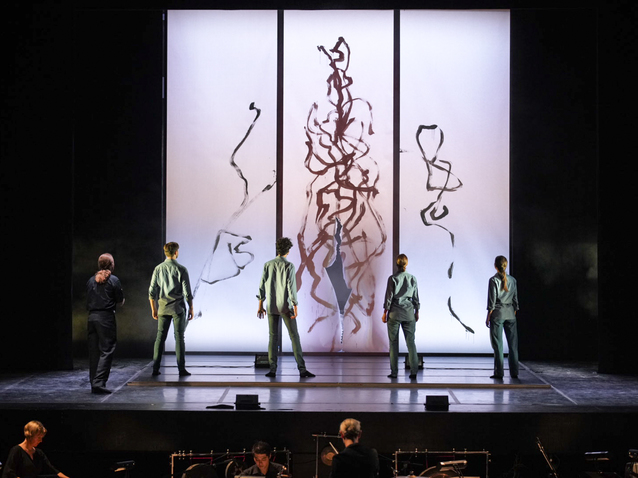
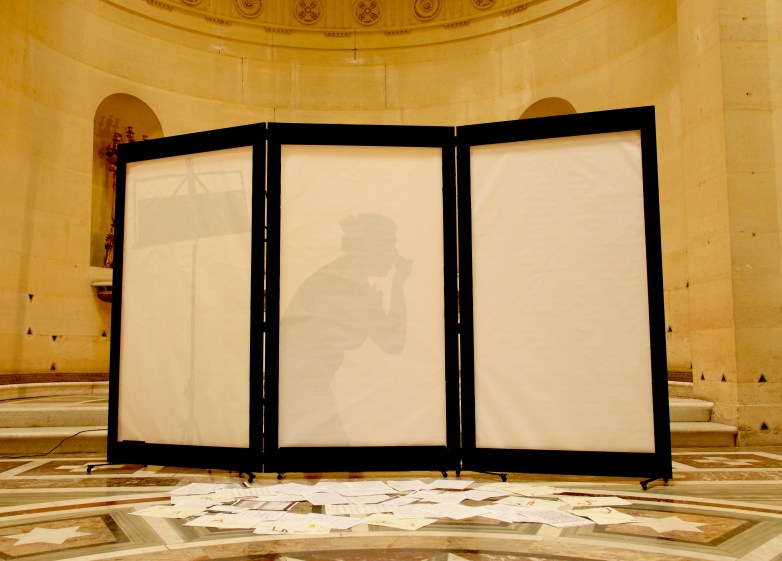
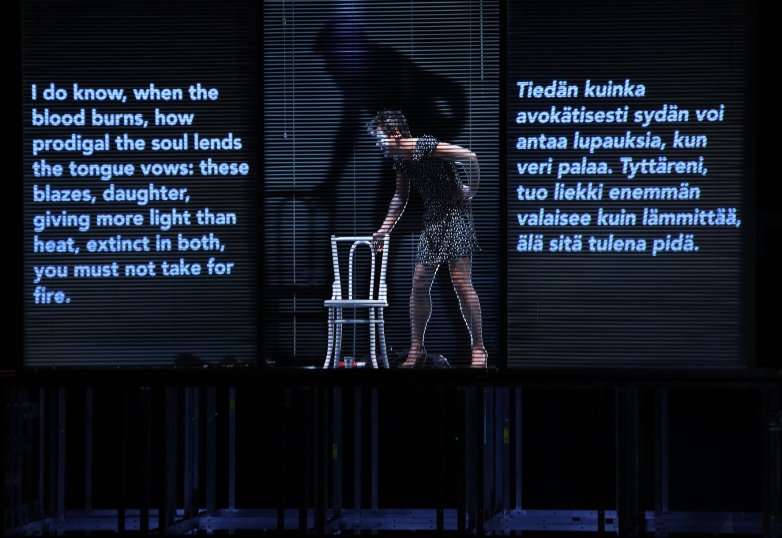
« Tsunemasa » dans l’opéra Only The Sound Remains de Kaija Saariaho
à la Biennale de musique de Venise en septembre 2021
Direction musicale Clément Mao-Takacs / Mise en scène Aleksi Barrière

UN THÉÂTRE D’IDÉOGRAMMES [Ezra Pound, Ernest Fenollosa et le Nô]

Version longue d’une étude sur les versions de textes de Nô réalisées par Ezra Pound, publiée dans le programme de salle de l’opéra de Kaija Saariaho Only the Sound Remains, à l’occasion de sa reprise dans la mise en scène de Peter Sellars à l’Opéra national de Paris, en janvier 2018.

British Museum, 1909. Ezra Pound a vingt-quatre ans et vient de quitter les États-Unis pour s’installer à Londres, et s’imprégner d’une tradition artistique qui selon lui fait si cruellement défaut à son pays. Il est le secrétaire du poète irlandais W.B. Yeats, de vingt ans son aîné. En Europe l’heure est au « japonisme », et ils viennent souvent ensemble visiter le département d’arts orientaux. Parmi les collections remarquables réunies par des officiers et banquiers de l’Empire britannique, Pound et Yeats admirent notamment la peinture chinoise – son renouveau permanent dans la tradition – et les estampes japonaises, qui stylisent avec élégance des scènes de théâtre, ou des scènes de vie théâtralisées. Un art qui, à la même époque, inspire de différentes manières Claude Debussy, Claude Monet, ou Edward Gordon Craig, qui avec la complicité de Yeats invente de nouveaux langages scéniques.

Pound commence à se faire un nom. On repère de loin, à ses habits chamarrés et à son sombrero, ce dandy provocant qui pourfend de son érudition encyclopédique et polyglotte l’ignorance et la médiocrité qu’il prête à ses contemporains – ce qui ne l’empêche pas de militer avec abnégation pour faire publier ceux qu’avec flair il estime, tels T.S. Eliot, William Carlos Williams, Robert Frost, James Joyce. Pound est intransigeant, selon lui le poète est le gardien de la langue, contre ceux qui la galvaudent, et sa mission est de première importance : « Lorsque les mots cessent de coller au plus près des choses, les royaumes s’effondrent et les empires périclitent ». Il faut prendre le parti de la poésie contre celui de la rhétorique, qui nivèle et dilue tout. Et écrire de la poésie, se souvient-il, en allemand se dit dichten : littéralement « condenser », « densifier ». Pound lance « l’imagisme », un mouvement poétique fondé sur la concentration de la forme et la puissance d’images évocatrices. Il s’inspire notamment des formes courtes de la poésie japonaise classique (tankas et haïkus) dont se multiplient alors les traductions.

Ce rapport un peu dilettante à l’Asie prend bientôt un tournant inattendu. En 1913, dans un salon londonien, Pound rencontre Mary McNeil Fenollosa – son mari Ernest Fenollosa, universitaire et orientaliste, décédé cinq ans plus tôt, avait préparé plusieurs manuscrits en vue d’une publication future, et elle cherche quelqu’un qui voudrait bien y mettre un peu d’ordre. Pound, quoique ne connaissant pas les langues asiatiques, accepte, et s’en trouve transformé.

Il avait déjà fantasmé une civilisation disparue, l’Europe des troubadours, celle d’une union désormais perdue de la poésie et de la musique et de cultures réunies dans un même continuum avant les rabougrissements nationalistes, et avant que l’on ne dévalorise l’art noble et crucial de la traduction. La traduction est pour Pound un sacerdoce – « la littérature, dit-il, vit de la traduction » qui seule permet son constant renouvellement – et grâce à Fenollosa un nouveau champ s’ouvre à lui. Il voit dans l’Asie ce qu’y verra aussi Roland Barthes : la possibilité de « connaître, réfractées positivement dans une langue nouvelle, les impossibilités de la nôtre ; apprendre la systématique de l’inconcevable ; défaire notre « réel » sous l’effet d’autres découpages, d’autres syntaxes » (Barthes, L’Empire des signes). Et Fenollosa ne propose pas seulement une matière mais aussi une méthode : un de ses manuscrits, L’idéogramme chinois comme médium poétique, est un véritable manifeste que Pound fait sien. Les idéogrammes chinois et japonais offrent selon lui l’exemple d’une langue idéalement souple dans sa syntaxe, expressive, et toujours immédiatement métaphorique, contrairement à nos langues indo-européennes « anémiques » où l’image se perd dans les méandres de l’étymologie : ainsi, l’Est 東 désigné par la surimpression des caractères qui signifient arbre 木 et soleil 日 – le soleil derrière un arbre au matin, le Levant. Un autre passeur, le poète et traducteur François Cheng, fera plus tard lui aussi l’éloge de la poésie du « langage pictural chinois ». Pound déjà trouve dans cette analyse linguistique un fondement à son propre projet « imagiste », et adopte le paradigme du poème-idéogramme, à atteindre par traduction et transposition du modèle oriental. Au même moment, Guillaume Apollinaire imagine lui aussi des poèmes aussi graphiques que ceux de la Chine – il les appelle idéogrammes lyriques, avant d’inventer le mot de calligrammes.

Outre son éloge de l’idéogramme, Fenollosa a laissé plusieurs ébauches de traductions et Pound, en les « arrangeant » (selon son propre terme), les transforme en démonstrations imagistes. Il y a d’abord en 1915 Cathay, un recueil de poètes classiques chinois qui fera dire de façon ambiguë à T.S. Eliot que « Pound est l’inventeur de la poésie chinoise à notre époque ». De fait ce recueil assoit la réputation de Pound comme poète, et marque aussi la pratique moderniste de la traduction poétique comme exercice de création littéraire.

En même temps paraissent progressivement les versions réécrites par Pound du grand chantier de Fenollosa : les traductions de quinze textes et canevas de théâtre nô. L’ambition est cette fois plus grande encore, car si Pound voit dans ces pièces écrites au tournant des 14e et 15e siècles la possibilité de réaliser ce qu’il croyait jusque là impossible, à savoir « de grands poèmes imagistes », d’immenses idéogrammes vivants, il a aussi conscience de contribuer à faire connaître en Occident plus que des textes, une forme théâtrale hautement sophistiquée, avec deux conséquences : établir qu’une civilisation non-européenne avait pu produire une forme d’art que l’on ne saurait rejeter comme simplement primitive et folklorique, un « drame lyrique » total dans lequel Pound décèle, à travers les textes et quelques démonstrations d’acteurs, une beauté hiératique supérieure – et donner l’impulsion d’une révolution théâtrale, donc esthétique, et donc politique.

La restauration Meiji de 1868, qui a démantelé le règne féodal des shoguns au profit de la centralisation impériale, a aussi mis en péril la tradition, ininterrompue depuis plus de quatre siècles, des compagnies de nô abritées jusque là par les cours seigneuriales. L’acteur Umewaka Minoru a alors créé un théâtre et une école pour en assurer la préservation. C’est auprès de lui que Fenollosa s’est initié aux textes et aux techniques de jeu du nô. Fenollosa, qui donc a prolongé l’œuvre de Minoru, a vécu longtemps au Japon, s’est converti au bouddhisme, et a contribué à la vie culturelle de l’Archipel et à la diffusion de son héritage à l’étranger, par des collections et des publications. Il a travaillé sur les textes avec un universitaire japonais qui comblait ses propres lacunes linguistiques – Kiichi Hirata, qu’il serait juste de citer comme le « troisième auteur » de ces traductions. Il y a quelque vraisemblance à l’affirmation de Pound selon laquelle Fenollosa était le meilleur connaisseur non-japonais du nô à ce moment-là.

Cette chaîne de transmission complexe, et forcément parfois hasardeuse, permet de nourrir d’une matière nouvelle le fécond fantasme que l’Europe se construit du théâtre oriental. Depuis Wagner une réforme bout : nombreux sont ceux qui souhaitent, sans savoir sur quel modèle, inventer un théâtre qui dépasse le naturalisme bourgeois et sa réduction de l’homme à sa dimension psychologique. On rêve d’un art total, à la démesure du monde qui nous traverse, et qui soit à la fois poétique, musical, gestuel et visuel. Les « théâtres d’ailleurs » offrent alors à chacun une surface de projection sur mesure. Yeats, avec qui Pound partage son travail, collabore avec un danseur japonais et écrit trois « nôs irlandais », puisque seul le nô peut montrer « la lutte d’un rêve avec le monde », et prêcher l’importance d’écouter les spectres, ce qui importe à l’occultiste qu’il est. Bientôt, en Russie, le constructiviste Meyerhold annonce « une alliance des techniques du théâtre européen et du théâtre chinois », à telle enseigne que la bureaucratie stalinienne lui reprochera avant de l’éliminer de faire « un théâtre étranger » et « formaliste ». En parallèle, Brecht s’inspire du nô et de l’opéra de Pékin pour créer un théâtre du signe, dont l’acteur est le narrateur et le commentateur. Antonin Artaud, découvrant le théâtre masqué balinais à l’Exposition coloniale de 1931, imagine un théâtre où toutes les formes d’art convergent à égalité, en mesure donc de révéler au-delà de la psychologie individuelle – plus encore que « l’homme social » de Brecht – « l’homme total » face au cosmos. L’acteur deviendrait alors sur scène, dit-il, « un hiéroglyphe », un idéogramme.

Cet attrait pour un « ailleurs », méconnu donc propice au fantasme, doit comme nous l’avons vu beaucoup aux empires coloniaux, qui sont alors à leur expansion maximale. Pur exotisme ? Rêver l’autre est une façon de ne pas lui donner la parole, et l’emprunt culturel peut servir de caution au pillage impérialiste. Mais ce pour quoi plaide l’humaniste Ernest Fenollosa, qu’Edward Saïd épargne dans sa charge contre l’orientalisme, est bien la rencontre de l’autre en tant qu’autre, le dialogue interculturel, et le bouleversement de nos préjugés les plus fondamentaux. Il nous invite notamment à brouiller, comme les Japonais, la frontière entre l’art et la vie, ce qui sera aussi la lutte de toutes les avant-gardes du 20e siècle. Elles auront trouvé un laboratoire historique dans la rencontre des théâtres d’Orient et d’Occident partout en Eurasie.

Ezra Pound, s’il s’est employé lui aussi à dessiner une culture-monde, s’est perdu en chemin, sans cesser d’être hanté par ses traductions de nô fondatrices. Loin des théâtres, celles-ci irriguent la création solitaire du poète. C’est au moment de les travailler qu’il entame le projet démesuré qui l’occupera plus de cinquante ans : les Cantos, ce cycle poétique et épique définitivement inachevé dans lequel, à chaque étape de sa vie, il déversera ses enquêtes et ses fulgurances, au fil de paraphrases érudites et d’idéogrammes. Un nouveau projet de traduction, également venu de Fenollosa, prend aussi une importance croissante : en Confucius, Pound trouve « l’invariable pivot » de sa pensée politique, conservatrice et autoritaire mais sociale. Fasciné par la figure et l’action de Mussolini, il s’en fait dès 1927 un ardent défenseur dans des pamphlets, puis à la radio officielle du régime fasciste. Après Pearl Harbour, n’en démordant pas, il affirme sans ironie que si les Américains avaient jadis pris la peine de lire les papiers de Fenollosa, jamais ils n’auraient sous-estimé la civilisation japonaise, ni ne se seraient permis de se croire les gendarmes du monde. Emprisonné en 1945, et longtemps mis à l’écart dans un hôpital psychiatrique, il réserve dans un manuscrit des vers amers à la conclusion toujours reportée de son poème infini : « J’ai perdu mon centre / dans mon combat contre le monde. (…) / J’ai tenté d’écrire Paradis (…) / Puissent ceux que j’aime tenter d’oublier / ce que j’ai fait. »

Ces vers font partie de ceux que Kaija Saariaho a choisi de mettre en musique dans son cycle pour baryton et ensemble Sombre en 2012, et c’est cette œuvre qui a fait naître entre elle et Peter Sellars le projet d’Only The Sound Remains, qui en est l’excroissance littéraire et musicale directe. De fait, Sellars fait partie de la lignée de réformateurs qui, de Meyerhold à Grotowoski et Brook, ont imaginé par la « connaissance de l’Est » un théâtre total et musical qui soit aussi un théâtre-monde, et par son travail sur le geste il transforme en effet bien ses acteurs en hiéroglyphes chantants, auxquels répondent les idéogrammes imaginaires de la plasticienne Julie Mehretu. Le texte même, à la fois joué et projeté en surtitres, réalise alors à sa manière l’ambition d’une poésie à la fois chant et idéogramme, horizontale et verticale : car Sellars est aussi un disciple revendiqué de l’éthique de la traduction créatrice de Pound et Fenollosa, qui donne à son théâtre sa méthode. Plus qu’une imitation d’une tradition lointaine, l’opéra né de la rencontre du tandem Sellars-Saariaho et de cette longue chaîne discontinue de voix qui se répondent à travers les siècles comme dans une pièce de nô, est le drame trop humain de la dangereuse quête d’Ezra Pound à la lisière entre l’intraduisible et l’innommable : notre aspiration partagée à une beauté qui nous réunisse, et qui dans un même ravissement nous révèle et nous élève.

Voir aussi : « Traduire Ezra Pound traducteur »

JEAN-BAPTISTE BARRIÈRE : UNE BRÈVE INTRODUCTION

Ce texte est la version éditée de la présentation donnée en ouverture d’un concert monographique des œuvres de Jean-Baptiste Barrière le 5 janvier 2018 au Reid Hall de Columbia University à Paris, à l’occasion du soixantième anniversaire du compositeur.

« Depuis toujours, l’une des tâches essentielles de l’art fut de susciter une demande en un temps qui n’était pas mûr pour qu’elle reçut une pleine satisfaction. (…) L’histoire de chaque forme d’art comporte des époques critiques, où elle tend à produire des effets qui ne pourront être librement obtenus qu’après modification technique, c’est-à-dire par une nouvelle forme d’art. »

Walter Benjamin, L’Œuvre d’art à l’ère de sa reproductibilité technique[1]

En guise d’introduction à ce concert, je ne ferai pas d’énumération biographique, que l’on pourra trouver ailleurs. Je ne ferai pas non plus une conférence sur le timbre, l’enveloppe spectrale, et leurs différents facteurs à l’ère du post-post. Je voudrais simplement restituer un peu, avec quelques cas concrets, un certain état d’esprit qui préside à la démarche de Jean-Baptiste, dont nous aurons quelques exemples récents dans ce concert[2]. Dans l’idée du titre de son installation audiovisuelle interactive Autoportrait en mouvement (1998), faire un « portrait en mouvement ». Certains connaissent Jean-Baptiste par un seul des aspects de sa personne ou de son travail, alors que c’est justement la cohérence globale de sa démarche qui le caractérise. Je resterai donc à un certain niveau de généralité, que les spécialistes m’en excusent.

Jean-Baptiste Barrière est né au même moment que l’informatique musicale[3]. Tant et si bien qu’ils sont tous les deux arrivés « à maturité » à peu près en même temps, à la fin des années 1970. Jean-Baptiste a précocement perçu le potentiel de cette brèche, et c’est ce qui l’a conduit à rejoindre en 1981 l’IRCAM[4] et à y conduire et diriger des projets pendant dix-sept ans. La possibilité de la synthèse de sons par ordinateur était selon lui une révolution copernicienne équivalente à celle de l’atonalité de Schönberg, ce moment de l’histoire de la musique où une note pouvait enfin être suivie de n’importe quelle autre, où cet enchaînement n’était plus codifié par les règles de l’harmonie tonale. L’ordinateur permet de franchir un palier supplémentaire : n’importe quel son audible par l’homme peut être synthétisé et enchaîné avec n’importe quel autre, sans aucune contrainte matérielle et notamment instrumentale. Un jeune compositeur ne pouvait que se sentir grisé (sans jeu de mots spectral…) d’avoir accès à ce domaine illimité à travers l’ordinateur, un outil que Jean-Baptiste décrit comme un « système ouvert », « façonnable à volonté par l’intentionnalité musicale en mouvement »[5].

Il ne s’agit pas de soudain laisser la technique envahir la musique. En fait elle y a toujours eu sa place, d’une part dans les traités qui façonnent la théorie et la pratique musicale au fil des siècles, d’autre part de façon implicite et impensée dans la facture des instruments et les techniques de jeu et d’écriture, et souvent c’est quand nous croyons être les plus « libres » et nous fier à ce que nous appelons « l’intuition » que ces impensés parlent à travers nous. Or toute technique est déjà porteuse d’un certain potentiel artistique inhérent. Les instruments eux-mêmes sont la cristallisation d’une théorie musicale. Le piano par exemple matérialise le système tempéré (la division de l’octave en douze intervalles chromatiques égaux), et il permet d’inventer de la musique à l’intérieur de ce système-là. Si donc on veut créer de la musique en dehors de ce cadre, il faut transformer l’instrument ou créer un nouvel instrument, ce qui revient au même. Ce sont notamment les compositeurs de l’IRCAM qui ont poussé Yamaha à réaliser le premier synthétiseur numérique commercial permettant de changer l’accord et de sortir du tempérament égal. La même chose vaut bien sûr aussi pour l’orchestration, et le fait de commander aux compositeurs des œuvres pour toujours le même type d’instrumentation standard vient avec ses conventions sur la manière de l’utiliser.

L’ordinateur, selon Jean-Baptiste, peut donc permettre de surmonter tout cela. D’abord en s’inscrivant dans une perspective de continuité avec l’histoire de la musique : le projet de la recherche en informatique musicale, c’est méthodologiquement d’abord de « rendre explicites toutes les manipulations conceptuelles en œuvre dans le travail compositionnel »[6].

Car il ne s’agit pas d’avoir un rapport à la technologie qui soit fétichiste ou technophobe (post-heideggérien), les deux tendances dominantes à l’époque, et singulièrement encore aujourd’hui. La technologie peut être l’instrument de la barbarie totalitaire et du consumérisme aliénant, mais aussi celui de la science, de la création et de la démocratisation des connaissances. Pour cela il faut une méthode, et si on est capable de comprendre de l’intérieur la technologie, les principes qui en permettent l’existence, elle peut justement nous fournir cette méthode elle-même, et permettre son propre dépassement. Vous le savez si vous avez déjà touché à la programmation : si vous voulez qu’un ordinateur fasse ce que vous voulez, vous devez être capable de dé-composer et d-écrire ce que vous voulez obtenir. C’est du reste déjà le problème qui se pose dans la notation musicale traditionnelle au compositeur qui veut transcrire ses idées et obtenir du musicien-lecteur le résultat qu’il s’imagine. Problème, et vertu : l’informatique musicale comme la notation en général obligent à formaliser une pensée musicale, c’est donc aussi l’occasion de la clarifier et de la développer, de la même manière que la notation est pour beaucoup dans l’évolution et le développement de la musique occidentale[7].

Mais développer pour faire quoi ? Face à l’infini des sons accessibles par synthèse, se profile justement le même danger qui s’est fait jour au moment de la libération atonale : le compositeur a besoin de se donner une méthode (étymologiquement, un « chemin au-delà ») pour construire des successions de sons, ce qui a conduit Schönberg lui-même à inventer la méthode dodécaphonique dont a émergé le sérialisme. Le sérialisme permettait de générer des séries de hauteurs qui soient différentes des gammes tonales, et quand ce système s’est épuisé on a pu appliquer le principe aux autres paramètres d’une note, comme les rythmes ou les durées, ce qu’on a appelé le sérialisme intégral. Au moment où Jean-Baptiste commence à composer, ce sérialisme intégral s’est un peu essoufflé, notamment selon lui parce qu’il peine à produire des tensions et donc un « discours musical ». Cependant il lui prête un rôle historique déterminant : celui d’avoir apporté « l’idée qu’on puisse décomposer la musique en paramètres » et traiter ces paramètres à égalité, en sortant de l’idée que tout repose sur un paramètre-roi, la hauteur, et sur la mélodie qui est la combinatoire des hauteurs. Mais en les séparant, le sérialisme a cloisonné ces différents paramètres, et a négligé les « ordres de perception conditionnés par le système complexe des relations qu’entretiennent [entre eux] les différents paramètres »[8]. Une science alors en plein essor, la psycho-acoustique, permet d’envisager comment les différents paramètres font système, c’est-à-dire qu’ils se modifient les uns les autres dans la perception. On peut créer des outils pour ne plus écrire à partir des sons comme abstractions formelles, mais dans la complexité de comment ils sont perçus.

Mais tout cela ne fait pas encore un chemin dans les sons. Les compositeurs sont à ce moment au désespoir de construire des formes à partir de la multitude de sons possibles. Ils cherchent partout des modèles formels, dans les probabilités, dans la théorie des jeux, dans la théorique cinétique des gaz en physique. Jean-Baptiste a la chance de faire ses études dans les années 1970 et de pouvoir se nourrir d’un terreau intellectuel autrement plus fécond que le simple formalisme mathématique, qui convient pour la combinatoire sérielle mais pas pour l’approche totale qui l’intéresse. Toutes les sciences sont alors en train de converger dans l’étude interdisciplinaire de ce qu’on appelle les systèmes complexes et dynamiques, à l’aide de nouveaux champs comme la systémique et la cybernétique, on formalise l’émergence, c’est-à-dire l’idée intuitive (mais peu compatible avec un certain réductionnisme) selon laquelle le tout produit quelque chose qui n’est pas dans la somme de ses parties. Deleuze et Guattari parlent de rhizomes, de corps sans organes – des modèles à la fois scientifiques, poétiques et politiques. La physique explore les systèmes ouverts à bifurcations. La théorie des catastrophes permet d’envisager l’unité de processus discontinus, des processus complètement inaccessibles aux sciences classiques mais aussi au sérialisme par exemple. C’est une période passionnée dans la recherche en épigénétique, c’est-à-dire la recherche sur les processus complexes par lesquels les organismes se forment, et des chercheurs comme le biologiste C.H. Waddington[9] dont la lecture est fondamentale pour Jean-Baptiste, envisagent que les modèles qui émanent de ses recherches peuvent s’appliquer en dehors de la biologie, à l’étude de l’univers en général et des sociétés humaines en particulier. C’est un moment extraordinaire où l’on défie l’hyperspécialisation scientifique, et où l’on découvre des structures complexes communes à toutes sortes de phénomènes et d’échelles, et Jean-Baptiste comprend qu’il ne s’agit pas simplement d’une approche formaliste, mais de faire émerger dans la musique des structures qui traversent l’ensemble de l’univers, ce que le cybernéticien Gregory Bateson appelait « les structures qui relient »[10], une expression que Jean-Baptiste cite à peu près dans tous ses textes avec une obsession faustienne.

Ce qu’il entreprend donc grâce à l’ordinateur, c’est en filant la métaphore biologique de construire une morphogenèse, une méthode de « genèse des formes », « une grammaire des processus formels ». Une méthode qui permette de gérer en compositeur tous les paramètres de la composition de façon organique. Par exemple, et c’est aussi un point de méthode important dans la musique dite spectrale qui se formalise à ce moment-là à l’IRCAM, analyser un matériau sonore permet de développer des façons de l’organiser qui en émanent directement, grâce au formalisme de l’ordinateur[11]. Donc littéralement de s’inspirer de la complexité organique des processus biologiques pour créer une musique complexe, mais émanant d’un développement organique, en phase avec la nature du son et de la perception, et ce en quoi cette nature-là nous relie au reste de comment la nature fonctionne, ce qu’il fait avec une référence directe à Waddington dès sa pièce pour bande Chréode I en 1983. Ces modèles ne se substituent évidemment pas au geste compositionnel, mais lui offrent des matériaux et des principes d’organisation, qui doivent pouvoir aussi être utilisés et, selon le terme de Jean-Baptiste, « court-circuités » : l’intéressant « ce n’est pas le modèle en tant qu’imitation, mais bien plutôt en tant que potentiel de dérivation »[12].

Sur cette organicité qui s’applique à tous les niveaux, je vais citer Jean-Baptiste un peu plus longuement : « L’hypothèse de continuité est sous-jacente à toute cette démarche : continuité de l’expérience vécue avec l’expérience culturelle sédimentée, continuité entre l’intuition musicale et les représentations mentales, continuité des systèmes de production et de perception, continuité des référents à travers des médiums différents, continuité entre synthèse, traitement, instruments, c’est-à-dire finalement continuité entre différentes catégories perpétuellement réévaluées sur l’axe qui mène du naturel à l’artificiel. »[13]

Et en effet il est révélateur que la clef empirique du modèle-phare du traitement électronique du son lui vienne de la pratique instrumentale acoustique, plus précisément de l’expérience suivante : quand un flûtiste chante dans son instrument tout en jouant dessus, l’instrument filtre la voix et la transforme, et donne lieu à un nouveau timbre. Le timbre, rappelons-le pour les non-connaisseurs, est cette propriété assez mystérieuse qui permet de reconnaître à l’oreille qu’une même note autrement identique est produite par tel instrument, ou par telle personne dont on connaît la voix. Le timbre, qui résulte de plusieurs variables indépendantes, est alors mal connu et s’avère riche à la fois en éléments compositionnels une fois qu’on est parvenu à les analyser, et en ce que Jean-Baptiste appelle des métaphores ou analogies, c’est-à-dire des transpositions parfois assez libres de concepts d’un champ à l’autre et qui ouvrent de nouvelles dimension[14]. Bref, pour revenir à notre flûte, le filtrage qu’elle produit, l’électronique permet de le reproduire à l’infini en filtrant et en perturbant n’importe quel son analysé informatiquement selon certains de ses paramètres avec un autre. Non seulement à l’inverse filtrer le jeu de la flûte dans du chant, ce qui est impossible acoustiquement, mais aussi bien n’utiliser que des modèles construits informatiquement et, ce qui est sa solution favorite, mélanger les niveaux acoustique et électronique, jouer sur leur continuité et construire des boucles de rétroaction. C’est le cas du filtrage qui conduit les équipes de l’IRCAM à formaliser les fameux modèles de résonance[15], donc à imiter ce que fait le corps d’un instrument, son résonateur, en réaction au son produit par son excitation par l’instrumentiste. On peut ainsi hybrider différents modèles de résonance et interpoler les timbres, hybrider les caractéristiques de différents instruments, créer des « chimères sonores ». Ici, la psycho-acoustique permet d’étudier quels paramètres sont pertinents dans la perception de l’auditeur, et de construire des modèles à partir d’eux. À l’IRCAM Jean-Baptiste défend en particulier cette interconnexion entre recherches scientifique et artistique, dans laquelle chercheurs comme artistes trouvent leur compte : mieux comprendre le son et sa perception, et en retour mieux écrire de la musique à partir de cette réalité.[16]

L’important est aussi que les instruments nouveaux apportés par l’ordinateur sont évolutifs : chaque nouvelle exploration peut rejoindre une bibliothèque d’outils disponibles, par soi-même et par les autres, selon un modèle humaniste. Se dessine aussi le rêve d’un instrument intelligent, qui soit réellement capable d’être le partenaire de l’instrumentiste, et d’apprendre. C’est aussi toute cette utopie, qui est en partie réalisée aujourd’hui avec la démocratisation de l’informatique, les progrès dans la vitesse des processeurs permettant le traitement en temps réel, et dans l’intelligence artificielle, toute cette utopie donc dont il faut se souvenir, pour se rappeler d’où vient Jean-Baptiste et ce qui a continué de nourrir sa démarche.

Car cette idée de développer de façon organique les différents paramètres compositionnels s’est poursuivie dans plusieurs directions, dans la continuité de la définition que Jean-Baptiste donne de l’activité du compositeur, à savoir « une constante modélisation pluridisciplinaire »[17]. Le geste de l’instrumentiste, l’espace dans lequel a lieu l’expérience de l’écoute, ce sont aussi des paramètres compositionnels, à développer en continuité, respectivement grâce à la transduction des gestes des musiciens avec des capteurs[18], et avec les ressources de la spatialisation sonore. L’image aussi, pourquoi pas, peut être un paramètre musical si elle est envisagée en continuité avec les autres, et Jean-Baptiste a beaucoup exploré la forme de ce qu’il appelle le « concert avec création visuelle » (vidéo), dont le rôle est selon lui d’« écrire l’image comme si celle-ci faisait partie de l’orchestration, prolonger les gestes instrumentaux, éclairer les situations harmoniques »[19], et cela en transposant à l’image les méthodes précédemment appliquées au son comme le filtrage et la perturbation, et encore une fois hybrider les modèles, cette fois entre son et image[20]. C’est aussi le sens de son exploration de la notion d’interactivité, à la fois en concert et dans des formes installations, dont nous n’aurons malheureusement pas le temps de décrire ici les spécificités[21]. Il faut souligner que dans l’écriture musicale étendue de Jean-Baptiste, même si l’horizon toujours repoussé qu’il se donne est le progrès technologique dont il suit avidement les avancées, c’est toujours à la fois le musicien-interprète et l’auditeur-spectateur qui sont au cœur du dispositif. C’est l’humain qui est inscrit au centre de ces vastes structures qui relient l’univers, et il y a quelque chose de pour ainsi dire matérialistement panthéiste dans ce que produit cet athée-là, ce hippie structuraliste qui a opéré, pour lui-même et pour les autres, la synthèse entre ses deux inspirations fondatrices, le rock progressif et la cybernétique.

Notons pour finir que peu de compositeurs ont travaillé autant, à la charnière de la création artistique et de la technique, avec d’autres compositeurs, peu d’artistes multimédia avec autant d’autres artistes multimédia. Il y a ici non simplement un souci de partager des compétences, mais une foi profonde dans le dialogue entre les artistes, dans ce qu’il peut avoir de fécond, mais aussi de nécessaire pour que la création conserve sa vitalité, et continue de s’irriguer de questionnements communs et d’idées contradictoires entre contemporains, ce qui est l’esprit du projet collaboratif qu’il réalise actuellement à la New School for Social Research à New York, The Art of Change.

Dans ses propres mots : « Nous avons la preuve à travers l’exemple de certains recherches contemporaines, notamment dans les sciences cognitives, que seules l’interdisciplinarité et la collaboration – qui sont inséparables et complémentaires – permettent de maîtriser la complexité. »[22]

C’est sur cette déclaration programmatique que je voudrais clore cette présentation, et ouvrir enfin un concert qui verra célébrer certaines créations récentes de Jean-Baptiste (de 2003 à 2018), mais aussi justement ce que sa démarche a compté de collaborations et d’amitiés, car il ne s’agit pas, loin s’en faut, de la quête d’un homme isolé, mais d’une recherche en effet placée sous le signe de « l’interdisciplinarité et de la collaboration », et elle est loin d’être terminée.


[1]Cité dans J.B. Barrière, Pour une esthétique de la musique avec ordinateur (thèse de doctorat soutenue en 1990, sous la direction d’Olivier Revault d’Allonnes, inédite).

[2]Furent représentées à ce concert plusieurs œuvres pour soliste, électronique et images : ViolanceCrossing The Blind ForestEkstasis, ainsi qu’un extrait de l’œuvre en cours d’écriture The 38th Parallel.

[3]L’informatique musicale est un domaine multiple qui a poursuivi plusieurs chantiers parallèles et conjoints mettant l’ordinateur au service de la création musicale, notamment : la synthèse sonore, l’analyse et traitement du son (en différé puis en direct), et les interfaces d’aide à la composition.

[4]Institut de Recherche et Coordination Acoustique/Musique, fondé par Pierre Boulez à Paris en 1970.

[5]J.B. Barrière, Pour une esthétique…, p. 206. Cette définition vaut particulièrement en comparaison et opposition avec le synthétiseur, « système fermé », conditionné pour la diffusion commerciale et l’utilisation normée dans les champs musicaux relevant de l’industrie culturelle.

[6]J.B. Barrière, Pour une esthétique…, p. 306.

[7]Le raisonnement évoqué plus haut sur les théories musicales, formant un cadre compositionnel parfois impensé, cristallisées dans les instruments de musique, vaut aussi pour la notation : « Le choix d’un système de représentation n’est en effet jamais innocent, jamais neutre. » (J.B. Barrière, « Timbre et processus formels », in S. McAdams & I. Deliège, La Musique et les sciences cognitives, éd. Pierre Mardaga, 1989, p. 197.)

[8]J.B. Barrière, Pour une esthétique…, p. 36. Par ailleurs, « on néglige la spécificité et l’idiosyncrasie d’un paramètre, par exemple le fait que l’espace des hauteurs ou des amplitudes ne soit pas linéaire » (op. cit., p. 35).

[9]C.H. Waddington, Tools for Thought, éd. Jonathan Cape, 1977.

[10]G. Bateson, A Sacred Unity: Further Steps to an Ecology of Mind, Harper Collins, 1991.

[11]« La gestion des structures de contrôle des [différents niveaux] est en continuité dans le travail avec ordinateur, et est éventuellement justiciable des mêmes structures de description. » (J.B. Barrière, « Timbre et processus formels », op. cit., p. 188)

[12]J.B. Barrière (dir.), Le Timbre, métaphore pour la composition, Christian Bourgois, 1991, p. 158.

[13]J.B. Barrière, « Timbre et processus formels », op. cit., p. 198.

[14]Parmi les « métaphores » à son sens les plus fécondes proposées par ses collaborateurs, citons notamment « l’espace des timbres » et « l’image auditive » – Jean-Baptiste donnera d’ailleurs pour nom à son association de création multimédia Image Auditive. Plus concrètement sur les métaphores tirées de la recherche scientifique : « Les instruments conceptuels issus de ces représentations pourraient permettre de déterminer des analogies sur les transitions, les modes de substitution, la production de complexité, l’équilibre et l’invariance, la régulation, la résilience, qui pourraient s’avérer particulièrement utiles dans la recherche sur les interpolations de timbre, particulièrement s’ils étaient mis en interaction avec les aspects perceptifs et cognitifs, dans un cadre d’investigation plus général. » (Pour une esthétique…, p. 284). Sur sa pensée de la métaphore, voir bien sûr Le Timbre, métaphore pour la composition,op. cit.

[15]Cf. P.F. Baisnée, Y. Potard & J.B. Barrière, « Méthodologies de synthèse du timbre : l’exemple des modèles de résonance », in Le Timbre…op. cit.

[16]Pour une appréciation rétrospective du climat bouillonnant dans lequel cette utopie s’est réalisée dans les années 80 et son étiolement, cf. J.B. Barrière, « Kaija Saariaho and Musical Research at IRCAM », Music & Literature, n° 5, 2014.

[17]J.B. Barrière, Pour une esthétique…, p. 237.

[18]Cette transduction est en continuité avec le matériau sonore, d’abord évidemment parce qu’il existe un rapport causal direct entre le geste de l’instrumentiste et le son qu’il provoque, mais aussi parce que les processus de captation du temps réel mis en interaction avec l’électronique font aussi déjà partie des procédés de la musique électro-acoustique au strict niveau sonore (pitch followingenvelope followingtimbre following), procédés qui sont donc ainsi étendus/transposés à la gestique.

[19]A. Bonardi & P. Birot, « L’opéra en version de concert avec création visuelle – Points de vue et entretien avec Jean-Baptiste Barrière », in La création lyrique en France depuis 1900, Presses Universitaires de Rennes, 2015, pp. 329-342.

[20]Pour la description de ces méthodes, et la façon dont elles se déploient notamment dans le cadre pluridisciplinaire de l’opéra, cf. A. Barrière & J.B. Barrière, « When Music Unfolds Into Image », in Y. Kaduri (dir.), The Oxford Handbook of Sound and Image in Western Art, Oxford University Press, 2016.

[21]Sur les enjeux et les perspectives de l’interactivité, cf. J.B. Barrière, « It is the nature of the society in which we want to live that is in question », conférence prononcée à l’University of California, San Diego, en 2001, accessible sur le site du compositeur et professeur Roger Reynolds, http://www.rogerreynolds.com.

[22]J.B. Barrière, Pour une esthétique…, p. 14.

L’ÉCRITURE IN-CLUSIVE, UN OUTIL POUR SORTIR DE LA PER-CLUSION DE LA LANGUE [billet d’humeur]

De tous les arguments possibles pour critiquer les différentes formes d’écritures inclusives (oui, il y en a plusieurs, et elles s’offrent comme des outils disponibles et non comme une prescription unifiée), celui qui m’étonne le plus ces jours-ci est celui consistant à dire que c’est un « massacre » de « notre belle langue française », de son esprit, voire de son esthétique immanente. On se drappe dans quelques dix siècles de littérature « française » pour nous expliquer qu’il faut caresser ce bon vieil idiome dans le sens supposé de ses poils, parce que bon, ce n’est pas sa faute s’il n’a que le masculin pour neutre, et il s’en est très bien sorti comme ça jusqu’ici, sans avoir à inventer des mots et des conventions typographiques à tout bout de champ. Puisque cette langue et ses limites sont mon outil et mon « lieu » principal de travail tous les jours, je me permets quand même quelques remarques là-dessus. Passons sur ce que l’on peut opposer à une certaine vision anhistorique du langage en montrant que la grammaire a été orientée à certains moments-clefs selon une vision sexiste, sur les liens complexes entre la langue et la société, tout cela a déjà été dit et bien dit, et je ne peux que renvoyer à des commentaires plus éclairés tirés de la lecture féministe de l’histoire et de la linguistique.[1] Précisons aussi que ne suis pas intéressé ici par un quelconque projet de « réforme » qu’il s’agirait de défendre, et que je ne parle de la langue qu’en termes de pensée vivante et de plaisir, voire de sensualité, disons en anarchiste. C’est à ce titre que je veux évoquer ce rapport charnel, largement subjectif, à la langue, de certaines critiques sentimentales qui se revendiquent de l’érudition et de la sensibilité littéraire, contre une « novlangue » qu’on voudrait nous imposer.

Il y a d’abord l’éternelle, complexe et passionnante dialectique du féminin et du masculin, qui comme cela a souvent été répété ne relève dans certains cas que de l’arbitraire de l’histoire des mots et de la formation des langues, et qui fait qu’en français, contrairement à ce qui se passe ailleurs, chaque mot a un sexe, sans que l’on ait de raison particulière de penser qu’une chaise est spécifiquement féminine et qu’un tabouret est quintessentiellement masculin. C’est un particularisme qui constitue le cadre grammatical dans lequel la langue française évolue, bénin (quoique pas moins bizarre pour autant) quand on parle d’objets, plus problématique quand on parle d’humains, quand par exemple, pour citer des cas qui s’expliquent toujours par l’étymologie mais suscitent des interrogations légitimes, un homme est une sentinelle, ou une femme un mannequin (pour dériver sur ces exemples, évidemment l’enseigne, la vigie ou l’estafette non plus ne doivent leur genre à autre chose que l’histoire des mots, qui de substantivations en métonymies forment ainsi les titres et les noms de fonctions, quoique en l’occurrence on puisse noter que ce ne sont jamais les grades les plus élevés de la hiérarchie militaire qui sont concernés ; et remarquons aussi que le mot mannequin vient d’un objet qui est, étymologiquement, un modèle artistique de la figure humaine, étant entendu que l’étymon anglo-saxon masculin « man », ici convoqué via le néerlandais, désigne le genre humain en général : même dans ces cas admis-là rien n’est tout à fait neutre dans le langage). Soit, cet arbitraire est un donné, et on ne peut pas remettre du sens là où il n’y en a pas, dans une certaine mesure c’est en effet une spécificité du français. D’ailleurs pour y remédier quand ça pique les yeux et les oreilles, dans d’autres langues, que ce soit l’espagnol ou le suédois, où le suffixe de certains mots marque forcément un genre, on a pu naturellement inventer un neutre, un troisième genre qui n’existait pas. En français, où le féminin se construit généralement par un suffixe ajouté à la forme masculine qui sert de neutre par défaut, le cas n’est pas aussi binaire : dans certains cas il faut inventer une nouvelle forme, dans d’autres on n’a pas besoin de chercher à féminiser certains mots alors que l’on ne songerait pas à en masculiniser d’autres. Et ce n’est pas grave d’ailleurs, on apprend à aimer le trouble délicieux qui oppose LE soprano et LA basse, qui pourtant traduisent musicalement le paroxysme non seulement d’un genre, mais aussi d’un sexe dans la réalité physiologique auquel il correspond, et c’est une tension féconde, un jeu de masques plaisamment trouble. Ici la question de l’écriture inclusive n’est pas de démanteler le fonctionnement de la langue, mais de faire prendre conscience de ses mécanismes en cessant de les invisibiliser. On peut faire vivre davantage cette sexualité trouble des mots, en ne la reléguant pas aux impensés mais en se demandant comment elle affecte, teinte chacun des termes que nous employons, pourquoi un arbre (ou un poisson) serait mâle et une fleur (ou une abeille) femelle, avec tout ce que cela charrie de représentations. Ensuite, en pratique pour les mots sur lesquels on peut agir, le litige concerne principalement les noms de métiers et de fonctions. Or dans ce cadre il n’est jamais inintéressant, par simple désir de comprendre notre société et notre histoire, de se demander pourquoi traditionnellement certains mots seraient censés se contenter de la forme masculine, y compris quand l’étymologie permet naturellement les deux genres : si même le latin a auctor et auctrix, il n’y a pas trop de raisons de ne pas avoir auteur et autrice, et d’ailleurs sur ces choses le français est étrangement conservateur par rapport aux autres langues indo-européennes. Il s’agit aussi de prendre conscience, dans le cas où le mot existe mais est employé dans un sens précis, que l’usage est dicté par un cadre socio-historique, et que le temps où ambassadrice ne pouvait pas désigner autre chose que l’épouse de l’ambassadeur est révolu. Est-ce pour autant qu’il faut tout sur-genrer ? Non, au contraire, et pour toute une série de mots, il ne faut pas oublier que c’est précisément la réflexion critique sur le genre dans la langue qui a remis au goût du jour un terme technique de grammairiens, celui d’ « épicène », désignant les mots où le genre n’est pas apparent, et qui sont en pratique réellement neutres, comme élève ou juge ou archéologue, ou des adjectifs comme rouge, agréable, difficile. Personne ne cherche à sexualiser ces mots-là, précisément il s’agit dans la réflexion sur le sexisme latent du langage d’inciter à leur usage quand il est possible. Tous ces rappels pour simplement m’étonner de voir des personnes qui prétendent « aimer la langue française » et ses beautés refuser que l’on fasse de la tension entre les genres grammaticaux, et entre les mots genrés et épicènes, les éléments d’un usage raisonné et conscient, sensible, pouvant conduire aussi à un choix méticuleux voire ludique de son lexique, au plaisir de « choisir ses mots » et d’en jouer. Ou qui n’imaginent pas inventer des nouveaux mots pour pallier l’absence de féminin là où le suffixe est clairement masculin, ou pour inventer de nouveaux pronoms. Pour moi en tout cas, la saveur de la langue, et de la langue française en particulier, réside dans ce genre de plis qui sont une richesse et une source de réflexion et de jeu.

Un autre cas qui montre que les usages émergeants dits « inclusifs » poussent à mieux réfléchir notre langue et son histoire, c’est cette fameuse règle du « masculin l’emporte », dont on rappelle beaucoup en ce moment l’origine sexiste, et que l’on oppose à bon droit à l’usage avec lequel il était en concurrence, celui de l’accord de proximité (dans une énumération, accorder en genre avec le dernier terme cité). Je n’ai toujours pas compris ce que l’on pouvait raisonnablement opposer à cette belle contamination du genre d’un mot à toute la phrase, qui vient bousculer et surprendre l’oreille, tout en s’imposant avec naturel dans le flux de l’énonciation. Que les arbres et les fleurs sont belles : on sent la phrase respirer et c’est merveilleux, et il faudrait en effet parler ainsi, ne serait-ce que parce que c’est plus beau.

Un autre procédé d’écriture inclusive mis en avant, et qui est en ce moment le plus vif objet de courroux des puristes, est la déclinaison des suffixes à l’écrit pour éviter que le masculin ne l’emporte au pluriel, à l’aide des points bas, ou tirets, ou points médians, qui heureusement sont venus remplacer l’usage bizarroïde des féminins mis entre parenthèses : les électeur·rice·s. D’abord grammaticalement : comme pour le jeu des étymologies, j’ai du mal à comprendre que quelqu’un qui aime les mots et leur histoire, qui aime les mines d’or que sont les dictionnaires n’aime pas cette pratique qui fait jouer devant nous les engrenages d’un mot, en fait ressortir et retentir le radical, le torréfie et l’ouvre à son origine cachée, à ses associations plus ou moins libres, nous le propose comme assemblage de strates. Ensuite purement typographiquement, quelqu’un qui aime l’écrit peut-il vraiment ne pas jouir de voir des signes typographiques s’immiscer au milieu des phrases plutôt que de les ponctuer, et d’enrichir le français, si misérablement pauvre en signes diacritiques qui embellissent tant d’autres écritures à travers le monde, de signes comme le point médian qui jusqu’ici était le privilège des langues occitano-romanes comme le catalan ? Rien que ce double plaisir, lexical et typographique, me semble infiniment libérateur dans l’usage de l’écrit, et il ne devrait pas être réservé aux poètes, ou à ceux qui réfléchissent sur l’articulation des mots à coups de tirets comme Lacan et Derrida : cela devrait être une possibilité donnée à tou·te·s de s’approprier ainsi le langage et la manière dont on l’écrit. Car c’est bien aussi de la spécificité de l’acte d’écrire qu’il s’agit. Il y a à ce sujet cet argument, celui de celleux qui objectent qu’on produit par ce type d’écriture (par exemple celles que je viens d’utiliser : tou·te·s et celleux) des formes qui ne sont pas traduisibles à l’oral : ces personnes (dont sont nos illustres Académicien·ne·s qui ont cru bon de se prononcer dans ce débat) se trompent non seulement sur la nature du langage comme réalité plastique, mais aussi sur celle de l’écrit, qui n’est pas d’être simplement du langage oral gelé, mais qui est une pratique distincte et autonome du langage. Depuis l’invention de l’imprimerie l’écrit ne cesse de s’enrichir de nouvelles dimensions comme langage à part, irréductible à l’usage oral : cela a commencé avec les divers usages de la différence majuscule/minuscule (d’abord une convention laissée à la discrétion des typographes, avant que Victor Hugo par exemple n’en fasse un usage maîtrisé, en considérant que ce sont des « effets » qu’il faut composer et doser comme les autres), et avec l’élargissement de la gamme disponible des signes de ponctuation que l’on s’est progressivement appropriés. Ne pas seulement transcrire des mots et une phraséologie de la Langue qui se manifesterait dans toute sa pureté dans la communication orale, mais inventer une langue de l’écrit, et même une langue de « l’imprimé », c’est un enjeu au moins depuis le « Coup de dés » de Mallarmé, et puis les calligrammes, Dada, les futuristes (Zaoum !), la poésie graphique, le lettrisme, la typographie expressive, etc. etc. L’écriture inclusive, qui a pour point de levier la question du genre, ouvre en réalité l’écrit à toutes les possibilités qui en font autre chose que de la parole durcie, au contraire à un élargissement de la parole par les moyens de l’écriture, dans un mouvement que l’on ne peut appeler autre chose que de la poésie, une poésie à l’usage de tou·te·s.

Ce qui est intéressant dans tout cela, ce n’est évidemment pas d’imposer de nouvelles conventions d’écriture, une nouvelle ortho-graphe obligée, dans le sens d’une ortho-doxie ou ortho-dontie de l’écrit. Ce n’est, de fait, l’intention de personne dans cette affaire, et la revendication inquiétante pour certain·e·s de ne pas « laisser tranquilles » les usages où le masculin passe pour du neutre ne doit pas masquer cette hauteur de vue qui n’est pas réductible à la lutte féministe, sinon par la conscience que l’émancipation désirée par le féminisme est celle de toutes les dimensions de la vie, bien au-delà de la polarité masculin/féminin qui n’est qu’une des nombreuses structures mal pensées de nos sociétés. L’enjeu est ici pour nous tou·te·s de donner vraiment « à lire » dans toutes ses strates la langue que l’on écrit, et avec laquelle on communique et pense, et cela n’est pas un appauvrissement mais un enrichissement, un ouvroir à possibilités nouvelles, pour dire plus et dire mieux. Par la sensibilité à l’accord en genre du reste de la phrase, par la tentative de greffer de nouveaux suffixes au radical qui est la seule part réellement « neutre » d’un mot, et au-delà de ces procédés, on donne à observer ce que fait le sexe aux mots, on le rend visible et audible. On fait réfléchir le langage que l’on utilise. Un langage très désagréable à réfléchir, évidemment, puisqu’il nous pénètre et nous structure. Cette confrontation avec l’impensé que constitue paradoxalement l’outil avec lequel on pense est certes pénible et fastidieuse, mais aussi salutaire. Elle nous invite à une très éprouvante introspection, individuelle et collective, qui n’est pas contraire à « l’usage » que l’on devrait avoir d’une langue, ni a fortiori de ce à quoi peut servir la littérature, mais qui au contraire touche au cœur de ce que ces choses-là – la langue et la littérature – peuvent vouloir dire, à quoi elles peuvent nous servir. Ne nous crispons donc pas sur les faux sujets, et ne prenons pas pour cela un soi-disant amour de la langue, et son patrimoine littéraire, en otage. Au contraire saisissons l’opportunité de faire du langage un lieu pour réfléchir, en acceptant la nécessité qu’il a pour être cela de se réfléchir toujours lui-même. Avec nos mots, soyons tou·te·s savant·e·s, poète·sse·s et philosophes, au-delà même de la question du masculin et du féminin qui sert ici de point de départ. Les champs qui s’ouvrent à nous sont infinis, et nous devons remercier la pensée féministe de nous les offrir à tou·te·s.


[1] Ceux notamment de l’historienne de la littérature Éliane Viennot dans cet entretien passionnant.

MACRON OU L’ÉTOURDERIE PRÉMÉDITÉE [billet d’humeur]

À l’occasion du « Grand Entretien » télévisé d’Emmanuel Macron le 15 octobre 2017.

« Vous voyez déjà le paradoxe… » Le corps du roi nous est enfin apparu, nous avons pu assister, pas simplement à des déclarations, mais à de la pensée complexe en construction. Trônant entre du street art décontextualisé et donc aseptisé, pour ne pas dire récupéré, et un Alechinsky déraciné du terreau insubordonné, joyeusement communiste et contestataire du mouvement CoBrA et devenu ainsi pur formalisme et décoration (a priori c’est le sémillant et dispendieux Aquilino Morelle qui a fait mettre là ce tableau lorsqu’il était conseiller de Hollande), entre des tables sur lesquelles s’empilent les livres fermés, il est là et il parle, tout à la jouissance de parler. « Vous voyez déjà le paradoxe… » Il commence une phrase, s’interrompt une fraction de seconde, trouve une formule ou un angle d’attaque, esquisse un sourire, reprend et déroule son raisonnement. C’est un concours d’éloquence qui se déguise en cours de philosophie – car oui, ses « réformes en profondeur » seraient appuyées sur « une philosophie profonde ». Un cours, à telle enseigne qu’il rabroue ses élèves, les trois journalistes qui l’interrogent et qui l’agacent : leurs choix de mots semblent toujours stupides, et ils sont traités comme s’ils ne comprenaient rien dès qu’ils essaient de recadrer les digressions. « Il faut toujours remettre les choses dans leur contexte », assène-t-il en prenant de la hauteur.

Qu’est-ce qui charpente cette pensée ? Comme tout philosophe depuis Platon, il veut atteindre « la vérité », au singulier, tout simplement. Ce serait beau si ce n’était pas ainsi qu’il justifiait trivialement jusqu’à ses sorties les plus commentées (« illettrées », « bordel »…) : c’est un « discours de vérité » (d’ailleurs, « parfois quand on s’approche de la vérité on s’y brûle », c’est la dure vie des prophètes !), « je nomme », il s’agit de « dire les choses », et puis finalement un modalisateur, enfin : « dire ce que je crois vrai ». Sans ça on l’aurait cru en contact direct avec les essences des choses. Blague à part, on sait bien ce que signifie ce classique du discours politique consistant à se revendiquer du réel, qui serait par définition dépourvu d’idéologie, et il le rappelle lui-même quand il est dit que les ordonnances doivent permettre de « s’adapter à LA RÉALITÉ de l’entreprise ». La prétention à parler sans le filtre de l’idéologie est une façon efficace d’en instiller.

La philosophie, c’est aussi raffiner les images. On a appris que le Président ne croit pas à la « théorie du ruissellement ». Heureusement, c’est pour la remplacer par une image autrement plus subtile, moins technique et économique et plutôt chargée d’une engageante connotation d’héroïsme et d’aventure : la cordée. Tel un fil rouge l’image se déroule au fil de l’entretien, et c’est bien ça : il y a des « premiers de cordée » (ceux qui réussissent, les riches), et ils tirent tous les autres vers le haut. La suite ? Il n’y en a pas. Ah, si, il y a des « activistes violents » et des agitateurs en mal d’indemnités de licenciement qui jettent des cailloux et mettent tout le monde en danger dans cette escalade. Bon, jetons un voile pudique.

Et puis, au moment où on ne l’attendait pas, Elle est revenue : « L’esprit de cette réforme c’est bien ce couple libérer/protéger. Et les garanties effectives, pour reprendre le beau mot de la philosophe Simone Weil, ce n’est pas d’aller expliquer aux gens qu’ils ont des droits, des droits de tirage, des droits dont ils ne verront la couleur, c’est de leur dire : la société change. » Nous avions déjà relevé à l’époque que le philosophe-roi prêtait à Simone, dans son discours au Congrès, des concepts qui ne lui appartenaient pas. Maintenant, grâce à ce nouvel effort de pédagogie, il y a des commentateurs pour penser qu’elle a parlé de « garanties effectives », qui est au mieux un terme juridique, généralement destiné à masquer le flou d’une entourloupe d’ailleurs. Et de fait c’est de droit qu’il s’agit. Oui, Simone Weil conteste les droits abstraits inapplicables. Mais ce qu’elle écrit dans L’Enracinement est plus fin : « l’accomplissement effectif d’un droit provient non pas de celui qui le possède, mais des autres hommes qui se reconnaissent obligés à quelque chose envers lui ». Si Simone Weil a pensé un monde, c’est un monde de respect mutuel et de solidarité, dans un cadre intellectuel, moral et institutionnel, pas un monde d’individualisation et de libéralisme économique, de ce que Macron appelle « la libération du travail ». Il est incompréhensible qu’il continue d’utiliser ainsi le nom de Simone Weil, en plus sous une forme aussi fragile qu’un mot cuisiné à toutes les sauces, pour légitimer la construction d’un monde qui l’aurait écœurée. Comment disait-il déjà, quelques minutes plus tôt, en se plaignant de la dictature « de l’info en continu et du tweet » ? Ah, oui : « Quand on sort le mot du discours, on peut tout faire dire. » En effet. Il en sait quelque chose.

Mais il n’en reste pas là, il n’est pas seulement dans la vérité et l’effectivité, il est aussi l’expression même d’un peuple incarné par ses institutions. Le motif revient beaucoup : sa façon de gouverner serait de laisser s’exprimer « l’ESPRIT de nos institutions », « le SENS de nos institutions » (notons la mystique de ces termes) – lequel serait que seul « le président a le mandat du peuple souverain » et qu’il se doit d’incarner et de centraliser. Il le répète comme pour s’en persuader : « le mandat qui m’a été donné par notre peuple », et tout est censé être légitimé par cela. Qui est ce peuple ? Peut-on encore au 21e siècle penser (comme le fait aussi Mélenchon d’ailleurs, qui lui n’a même pas l’excuse de ne pas appartenir à une tradition politique qui connaît la sociologie) qu’il existe une entité qui est le peuple, qui a un destin, ou autres attributs de cette rhétorique passéiste et essentialiste ? Et puis ce peuple, s’il existe, comment s’exprime-t-il d’une seule voix ? Est-il là en action, mandat a-t-il été donné par lui quand on a été élu par 4 électeurs inscrits sur 10, donc 3 Français sur 10, comprenant le vote non d’approbation mais anti-Le Pen – il ne s’agit pas ici de contester le résultat du scrutin, mais simplement de se demander qui est ce « peuple » homogène qui aurait donné mandat à cet homme pour réaliser son projet. Mais il insiste : « j’ai été élu par nos concitoyens, pas par une catégorie », « le peuple français a gagné parce que sa volonté est respectée ». Incroyable de pouvoir dire ces choses, de peut-être les croire.

Une allusion est utile pour comprendre tout cela, c’est quand il se félicite de la réforme constitutionnelle de 2008 (celle de Sarkozy, donc), permettant au Président de s’adresser au Congrès. Levant donc un obstacle juridique qu’il qualifie de « procédure chinoise », citant un peu de travers la formule « cérémonial chinois » d’Adolphe Thiers, pour qui cet obstacle avait été posé par une Assemblée qui lui était opposée. Thiers désirait la concentration des pouvoirs, et il a de ce trait d’esprit un tantinet raciste désigné les moyens détournés auxquels il était réduit pour que sa parole soit présente à l’Assemblée. L’esprit de nos institutions, donc, c’est l’esprit de Thiers ? Celui qui a fait émerger la IIIe République de la répression des communes et du désir politique qui venait d’en bas ? Oui, c’est l’ADN idéologique d’une certaine République française. Mais que Macron le dise enfin à mots découverts est le plus grand aveu de cette intervention télévisée.

On pense au commentaire de Victor Hugo, député de l’Assemblée, sur le rôle de Thiers, chef élu dans la panique du pouvoir exécutif qui allait se retrancher à Versailles, dans le déclenchement de la Commune de Paris : « Thiers, en voulant reprendre les canons de Belleville, a été fin là où il fallait être profond. Il a jeté l’étincelle sur la poudrière. Thiers, c’est l’étourderie préméditée. »

Aujourd’hui, nous avons de nouveau un président rhéteur qui concentre les pouvoirs, en se réfugiant derrière les raisonnements de haute voltige qui doivent tout pouvoir justifier par le jeu des concepts et des citations, et de petits bons mots. En somme, un président qui est fin là où il faut être profond. Un maître de l’étourderie préméditée. 

THE DRAMA OF THE ART OF PURE LIVING

A longer version of the essay published with the DVD/Blu-ray of Kaija Saariaho’s opera Only the sound remains, in the stage production by Peter Sellars (2016).

The opera Only The Sound Remains owes much of its uniqueness and essential concentration to the fact that it stands at the crossroads of many artistic paths. Its philosophical DNA should be traced back to the life-long project of the poet Ezra Pound (1885-1972) and his quest of the universal, through poetry viewed as a transformative force in mankind. Over half a century Pound worked on his ultimately unfinished epic poem The Cantos, an ambitious attempt to reach across genres and languages by interweaving elements borrowed from various cultures and timeframes, and exploring the tension between those forms of beauty that circulate throughout the world and those that are ‘untranslatable’. Fundamental to the beginnings of Pound’s project was his fascination for Asia and its culture, and his very erudite knowledge thereof, which found its most concrete form when he came into possession of the unpublished manuscripts of Ernest Fenollosa, a renowned American orientalist and art curator. Fenollosa’s widow had entrusted him with the task of editing her late husband’s works, which he did by completing and publishing a collection of Chinese poetry, and the anthology of Noh plays (1916) from which the two works at the core of Only The Sound Remains were picked. Fenollosa had a deep and first-hand understanding of Japanese language and arts, and of Noh theater in particular (he had studied it with the Noh master Umewaka Minoru for twenty years), providing Pound the material and tools to reinvent as a poet an art form he could otherwise only fantasize: in his own words, ‘my work has been that of a translator who had found all the heavy work done for him and who has had but the pleasure of arranging beauty into the words’.

Fenollosa was well aware that he participated in what he described as a thousand-year-old tradition of a stagnant Western culture being rekindled by inputs from the Asian continent, carried along by immigrants, Crusaders, Silk Road merchants, Jesuit missionaries, and most recently scholars whose translations and studies on Middle Eastern and Chinese literature had been instrumental to the birth of English and German Romanticism. The new wave of this cultural tide was now in motion: the poet and dramatist William Butler Yeats, who collaborated with Pound on the editing of the Fenollosa manuscripts, was deeply influenced by the discovery of Noh theatre, and helped spreading knowledge of it in Europe through his own theatrical experiments. Yeats belongs to the founding fathers of a long dynasty of Western theater makers who saw in the use of formal convention and ritualism of Asian theatre, and in its challenging of questions of morality, community and spirituality, an antidote to the stiff naturalism of European drama and its degeneration into meaningless entertainment. The focus always being, of course, on reinterpreting freely these foreign theatre forms, rather than simply imitating or mimicking them. 

As a director, Peter Sellars was bred and schooled within such a dynasty. He gorged on many forms of puppet traditions, including Japanese and Balinese, already during his training as a puppeteer in his teen years, and at Harvard University studied with the onnagata (male kabuki actor playing female roles) Onoe Kuoremon, before writing his final thesis on the work of the Russian avant-garde director Vsevolod Meyerhold, who drew his syncretic inspiration among others from traditional Chinese theatre. As he was creating his own blend of cosmopolitan music-driven theatre, like his predecessors he found in the Asian traditions insights into ‘what Western theater must have been like before the nineteenth century came along’. But most importantly, creating bridges between art forms from different continents has held for him and many others a broader meaning and agenda than simply reinvigorating one’s own artistic language: participating in the construction of an enlightened ‘world culture’ based on dialogue and mutual knowledge and influence, stressing common traits as well as singularities that make mankind more diverse and colorful, and dismantling anything stemming from isolationism, chauvinism, and the simplistic ideology of ‘the clash of civilizations’. Some famous examples of such a ‘Poundian’ endeavor in Sellars’s body of work include his commissioning of new Western-Eastern syncretic music from Chinese composer Tan Dun as a response to the classical Kunqu style opera The Peony Pavilion (1998), or his collaboration with John C. Adams on A Flowering Tree (2006), an opera based on a South Indian folk tale. It is no surprise that Sellars has been aware of and fascinated by the Pound/Fenollosa translations from early on, and had already staged their version of Tsunemasa in 1986, thirty years before its reinterpretation in Only The Sound Remains.

The art of Kaija Saariaho has drawn from Asian traditions in ways very similar to Sellars’s in their method and intents, for instance in her study of the Japanese shakuhachi flute, which has immensely inspired her work on breath and extended techniques applied to Western wind instruments. But the spark for Saariaho’s and Sellars’s latest collaboration was not their shared interest for Japanese culture, as one could have expected: it was the poetic work of Ezra Pound. When the prolific artistic pair first discussed of possibilities for a fourth joint operatic venture, in 2011, Saariaho happened to be working on a piece for baritone and small ensemble called Sombre (premiered in 2013), based on three poems chosen from the last drafts Pound wrote for The Cantos, heart-wrenching comments on the failures of his life’s quest for absolute beauty, that had led him to most tragically misguided ways, such as his emphatic support of Mussolini’s Fascist regime: ‘I have tried to write Paradise (…) Let those I love try to forgive / what I have made.’ Only The Sound Remains does not simply reflect Saariaho’s and Sellars’s shared fascination for Pound’s peculiar poetry, that blossoms in his Noh translations, especially those two they chose together to work on: it delves deeper into the crux that was at the center of Sombre, that of the human mind’s relentless yet helpless yearning for beauty in all its forms, including moral, hindered by our own weaknesses, and by the very fact of being part of this world as it is. This yearning, that can be expressed in both mystical and practical terms, is central to Pound’s life’s struggle, and was also beautifully expressed by French philosopher and activist Simone Weil, to whom Saariaho and Sellars had devoted their third collaboration La Passion de Simone (2006): ‘This world is the entrance. It’s a barrier. And at the same time it is the passage.’ ‘The beauty of the world is the gateway to the labyrinth.’

While this intuition had guided much of both co-creators’ achievements before this work of shared maturity, it finds a consummate expression in the language of Noh theatre, which always imbricates human drama into a broader cosmic frame. Pound, whose role-model in building his own coherent universal epic was none other than Dante Alighieri, found the qualities of the Italian master’s mystic and poetic quest of beauty in the Noh plays he translated, likening for instance the Tennin’s dance in Hagoromo, that mirrors the phases of the moon, to the heavenly smile of his love Beatrice when she contemplates the light of Christ in Paradise, in the final section of the Divine Comedy. And while natural elements have always been part of Saariaho’s operas, in Only The Sound Remains they seem for the first time to come together in a fashion that can only be compared to a music of the spheres enveloping the stage and the audience in its mystery —backing Sellars’s intuition that her musical language possesses the particular quality that the Japanese call yugen. Fenollosa writes that ‘the Japanese people have loved nature so passionately that they have interwoven her life and their own into one continuous drama of the art of pure living.’ Nature has been part of Saariaho’s musical world on all levels, from recorded forest and wind sounds to the influence of French Spectralism, that relies on the use of the very laws of sound to develop compositional parameters, both in sound-color harmonies and on the broader scale of musical architecture —so to speak, making music out of the very physicality of sound and matter.

This strand of Saariaho’s music is strongly present in Only The Sound Remains, as is her lasting interest in Asian musical traditions, that translates here in personal though perceptible ways in her writing for the flute, percussions, and the traditional Finnish plucked-string instrument, the kantele. Avoiding any form of orientalism or undue cultural appropriation was as important musically as on all levels of this peculiar ‘Noh project’, as is also to be witnessed in Sellars’s signature use of syncretic body language, and his invitation for Julie Mehretu to create the stage design: this Ethiopian-American visual artist’s often large canvases have been termed abstract, but could rather be described as exploring a space between purely expressive brush-strokes and drawing, graffiti, calligraphy and architecture —a space that seems to eerily exist in-between and beyond all pictorial traditions, while stemming from their shared origin.

The result of this collaboration that sums up the essence of the life’s work of a handful of artists from such diverse crafts and backgrounds, this performance that is as minimalistic and strikingly lush and intoxicating as the original Noh theatre itself though bearing so little resemblance with it in practice, does not offer itself to us as some sort of final monument. It is rather an invitation to partake in ever more celebrations of the unknown that is to be found among ourselves and each other, the stage being the place where such a feast can take place. By such means, Ezra Pound’s dangerous quest is perhaps redeemed, and continued.

GIVE ME A FEW WORDS avec Marianne Seleskovitch

Autour de Give Me A Few Words – théâtre musical par La Chambre aux échos
Créé le 21 juin 2017 dans le cadre du Festival Intervalles (Paris)

Voix : Marianne Seleskovitch
Mise en scène et scénographie : Aleksi Barrière

Ce spectacle, un seule-en-scène construit autour de la présence vocale de la chanteuse Marianne Seleskovitch et avec elle, présentait les matériaux suivants :

Luciano Berio, Sequenza III (1966)
Morton Feldman, Only (1946)
John Cage, Aria (1958)
Isidore Isou, Larmes de jeune fille, poème clos (1947)
Clément Mao-Takacs, Ophelia: Songs & Sequences (2012-2017, fragments)
Giacinto Scelsi,  (1960, fragment)

Un duel entre une chanteuse et sa voix

Une chanteuse lyrique nous invite sur son lieu de travail. Elle chante, c’est-à-dire qu’elle livre son corps entier à un exercice de souffle qui doit lui permettre d’atteindre le sommet de la justesse et de l’expressivité, celui du premier cri humain, de la mère qui berce son enfant, du premier insurgé ou de la tragédienne qui meurt sur une scène d’opéra. En elle-même, elle trouve une voix qui lui offre mille possibilités d’aller au-delà de ce que disent les mots, si elle réussit à l’apprivoiser. Mais pour cela elle devra affronter les autres voix qui l’habitent, celles de la société – un voyage qui risque de l’emmener jusqu’à la folie et au-delà.

« Sortir sa voix »

La voix humaine est cette chose étrange qui semble sortir des profondeurs les plus mystérieuses de notre être. Pour capturer cette énigme, le chanteur dispose pourtant de moyens techniques, voire médicaux, extrêmement précis, et qui font l’objet d’un artisanat, d’un entraînement athlétique très calibré. Cela ne veut pas dire que sa démarche est dépourvue de mystique : ainsi, le chanteur lyrique impétrant est-il invité à « sortir sa voix ». Une voix qui se trouverait nichée en lui ou en elle dans l’attente de son heure, et qu’il s’agirait d’apprendre à laisser prendre son envol. Cette étrange invocation, ce numéro de charmeur de serpent se déroulera, selon la formule, sous nos yeux ébahis. Est-ce un pur exercice virtuose ? Nous apprendrons au contraire que, comme la prouesse du funambule, elle n’est pas étrangère à notre condition partagée.

« Speech Is No/thing »

Le langage est un cloître : quand il ne nous dit pas quoi penser, il nous indique comment, sans nous offrir d’alternatives. Dans nos rêves nous allons parfois au-delà des mots, plus près peut-être de notre première enfance. La musique réalise ce rêve : elle nous demander d’aller chercher un mot plus loin que dans le cerveau, plus bas, dans les poumons, les muscles du thorax, du ventre et du dos, et plus bas encore au plus profond du bassin où sont les premiers organes avec lesquels on commence à penser. La Voix qui mène à ce lieu obscur nous conduit à une porte que l’on ne peut pas impunément pousser. Ce rêve-là est hanté par beaucoup de fantômes. « Le spectacle est le mauvais rêve de la société moderne enchaînée, qui n’exprime finalement que son désir de dormir. » (Guy Debord)

Les œuvres

Les œuvres de ce spectacle ont été écrites entre les années 1940 et aujourd’hui : ce sont des œuvres de notre temps, celui des avant-gardes, du grand spectacle et des moyens technologiques les plus avancés. Mais elles remettent cela même en jeu, en choisissant la forme la plus pure de la musique originelle, celle qui prend ses sources dans notre propre corps, et se tournent occasionnellement vers les origines populaires du chant, et à une tradition musicale qui, depuis le Moyen-Âge et la Renaissance, a travaillé cet instrument primal.

Dans leur hétérogénéité, qui fera la richesse de cette heure que nous passerons ensemble, ces œuvres explorent de par leur choix de dispositif la même question de la voix et du langage et de la solitude dans laquelle ils nous enferment. Elles ne le font pas abstraitement, mais dans le concret de l’origine musculaire, respiratoire, physique du son, et de manière révélatrice résultent de collaborations étroites entre des compositeurs et des interprètes qui leur ont ouvert leur atelier vocal : Berio et Cage avec Cathy Berberian, Scelsi avec Michiko Hirayama, et enfin Clément Mao-Takacs avec Marianne Seleskovitch qui joue ce spectacle. Le dialogue avec l’organique et le vivant de la voix est aussi un dialogue organique entre vivants, auquel nous sommes tous conviés.

Déroulé détaillé (notes de travail)

La Sequenza III s’inscrit dans une série de pièces de Luciano Berio conçues comme des « dialogues entre des musiciens et leur instrument ». Ici, c’est à un dialogue entre une chanteuse et sa voix que l’on assiste. Et ce dialogue est libérateur : durant ses échauffements et sa tentative de chanter, au sens lyrique du terme, la poésie mystérieuse de Markus Kutter, elle découvre toutes les possibilités expressives de son instrument organique, par-delà les limites des conventions verbales et musicales. Plus que la simple expérimentation formelle à laquelle on veut trop souvent réduire la musique d’aujourd’hui, c’est l’histoire d’une expérimentation, dans laquelle nous devons explorer/exploser le langage, en quête de l’expression originelle, totale.

Cette recherche se prolonge de différentes manières au long du récital, qui propose un parcours à travers cette thématique.

D’abord par une confrontation de la chanteuse à la concurrence de la technique, par le truchement de la partition de John Cage. Celui-ci, dans une période de fascination/répulsion pour la radio, a mis en jeu sa capacité à mixer instantanément des fréquences fragmentées aléatoires afin d’écrire une « aria » pour chanteuse moderne, au même moment où Beckett avançait l’idée d’écrire une pièce qui serait le duo d’un comédien et d’un magnétophone, La Dernière bande. Cage compose donc une Aria où dix voix s’entremêlent aléatoirement, au cours d’une période consacrée par ailleurs à l’écriture de pièces « pour radios » (Imaginary Landscape No 4, Radio Music…), et ses motivations sont claires quant à l’utilisation de ce média : « … ce que je pensais, c’est que je n’aimais pas la radio et que je pourrais l’aimer si je l’utilisais dans mon œuvre. C’est le même genre de pensée que nous prêtons aux hommes des cavernes qui dessinaient ces animaux terrifiants, en les dessinant ils pensaient se les concilier » (interview avec Richard Kostelanetz, 1984). C’est cette relation que nous mettons en scène dans une interprétation inédite d’Aria, sous la forme d’un duel entre une chanteuse et sa radio. La voix naturelle est la véritable héroïne, et c’est comme telle qu’elle tombera si elle échoue à relever le défi.

En introduction à ce combat, Only, « chanson » de Morton Feldman, éloge de la voix naturelle à travers les mots d’un sonnet de Rilke qui déjà refusait de voir dans les aéroplanes la réalisation du désir intemporel de voler, tout comme Cage niera que l’électronique puisse à elle seule constituer une révolution musicale. Le duel, pourtant, s’avère fructueux dans sa tension même.

Après que les agressives vociférations du monde extérieur amenées dans l’espace intime par la radio se sont tues, la chanteuse chasse la présence oppressante du politique, du monde extérieur dans toute sa violence. C’est en elle-même qu’elle doit aller combattre la société et son langage. D’abord dans Larmes de jeune fille, un poème d’Isidore Isou, inventeur du lettrisme, ce mouvement de destruction sonore des mots qui rejoint de manière inattendue les recherches de ses contemporains musiciens : c’est une poésie de sons, éminemment physique, qui se passe de syntaxe et de phonèmes.

La lutte se poursuit danss une création de Clément Mao – Takacs, qui réinvente l’expression de la folie par le personnage de l’Ophélie de Shakespeare ; cette folie est un acte de protestation contre le monde qui lui refuse l’usage du langage. La voix est ici encore toutes les voix – celle d’Ophélie comme celles des autres personnages qui la hantent – et délivre un message trouble et angoissant, traversé de chansons déconstruites qui déjà dans Hamlet constituaient une poésie débridée, si loin des canons de son époque.

Vient enfin le retour à une expression originelle réinventée par le compositeur mystique Giacinto Scelsi dans , dont les vocalises sont de véritables mantras, manière pour l’individu de « s’accorder » au sens musical avec lui-même et le monde, en dehors des langages et des idéologies, peut-être une victoire ou une réconciliation, du moins une résolution. Atteignant enfin l’objectif fixé par le poème qui constituait le manifeste empêché de la Sequenza de Berio : « donner à une femme quelques mots à chanter, une vérité pour que nous puissions sans encombre construire une maison avant la tombée de la nuit ».  

OPHELIA/TIEFSEE by Juha T. Koskinen

A Melologue in 9 scenes
Premiered at the Festival Présences in Paris on February 14th, 2017

Music by Juha T. Koskinen
Libretto assembled by Aleksi Barrière, after
William Shakespeare (The Tragedy of Hamlet, ~1600)
– Heiner Müller (
Die Hamletmaschine, 1977)
– Jules Laforgue (
Hamlet ou Les Suites de la piété filiale, 1886)
– and an anonymous theatre review (
Le Globe, 1827)

New production in La Chambre aux échos’s music theatre performance Violences
Premiered at the Finnish National Opera on February 6th, 2019

with Thomas Kellner (actor), Vladimir Percevic (viola) and the FNO Orchestra.

Musical Direction: Clément Mao-Takacs
Stage Direction, Co-Scenography, Video: Aleksi Barrière
Co-Scenography, Lighting: Étienne Exbrayat

About the work

In 1997, Juha T. Koskinen wrote a piece for solo viola and ensemble called Hamlet Machine, based on the famous play by Heiner Müller. Having long wanted to rework the piece, he accepted our invitation to develop his material into a new work of music theatre. A first instrumental segment was premiered with a video by Aleksi Barrière at the Novalis Music+Art Festival in Croatia in August 2015 by Secession Orchestra conducted by Clément Mao-Takacs. The complete version, constructed on a libretto by Aleksi Barrière, was premiered at the Festival Présences in Paris in February 2017 by the same team. The revised version was the central component of La Chambre aux échos’s performance Violences at the Finnish National Opera in February 2019 –it was embedded into a broader dramaturgical machine together with Katharina Blum (Heinrich Böll / Hans Werner Henze) and Sylvia Plath’s Lady Lazarus.

After a short love story with Hamlet, the prince of Denmark, the young Ophelia is rejected by him without an explanation, and the new king’s close circle uses and manipulates her in order to gain information on the motivations of the prince, who chose to hide behind the incoherent behavior of a mad man. In this context of perverse role-playing, Ophelia is herself threatened by insanity and might drown in the words written for her by all these men over the centuries. But can she even speak out, on a stage monopolized by a show-off called Hamlet?

In this version, roles are diffracted between the actor and the solo viola, both lost in a landscape occupied by the orchestra-chorus. The relationship between reality and its image, the actor and his character are central to this new version of an old story that keeps on rewriting itself over again.

La cruauté des histrions

« My lord… » C’est par cette adresse soumise que, dans la pièce de Shakespeare, Ophélie débute la plupart des réponses qu’elle fait à ses interlocuteurs, les rares fois où elle est invitée à s’exprimer. Ce personnage fascinant l’est d’autant plus que l’espace qui lui revient sur scène est constamment monopolisée par Hamlet, cet acteur mégalomane qui est tout ce qu’elle n’est pas : un homme, ambitieux, instruit, éloquent, socialement et rhétoriquement puissant. Ce n’est que dans la célèbre « scène de folie » qu’Ophélie occupe enfin le plateau, et hélas, elle cesse à ce moment-là d’être intelligible, et c’est un cri étouffé, qui par la noyade devient un cri dans l’eau.

On voudrait donner de nouveaux mots à Ophélie, ceux qui lui manquent, mais de quel droit ? Auteurs, interprètes, nous sommes cette fois encore entre hommes, et ce serait une fois encore parler à sa place, à la place de toutes celles qu’elle représente. Tout ce que nous pouvons faire, c’est reconnaître cette Autre qui dans tous ces textes essaie de s’exprimer mais que le rôle auquel la dramaturgie sociale la condamne fait taire. Cette triste farce est placée par Shakespeare sous le signe d’une théâtralité exacerbée, d’un jeu de masques qui se poursuit après la fin de la représentation, un théâtre en crue dans la vie que le 19e siècle a cantonné à l’étude psychiatrique de l’hystérie féminine, et que le théâtre de Heiner Müller propose de démystifier. Dans la surimpression des époques, nous pouvons poser pour aujourd’hui le « problème Ophélie » (notre problème, en tant que société), dont l’inquiétante persistance ne fait pas de doute malgré la variété de ses avatars. C’était sans doute la manière la plus honnête de procéder que de confier ce personnage à un comédien de sexe masculin, comme celui qui a créé le rôle vers 1600.

Ce kaléidoscope, ce théâtre condensé qui met à nu ses mécanismes et ses procédés pour mieux faire éclater les étincelles du choc des textes, est entièrement articulé par la partition de Juha Koskinen, qui réussit à fondre en une unité cohérente des fragments relevant d’esthétiques et de tons très contrastés, et surtout à suggérer par l’articulation subtile du textuel, du musical et du scénique, qu’il n’est pas vrai que « tout le reste est silence » quand Hamlet a fini de parler, ou du moins que ce silence est assourdissant.

(Pictures by Maarit Kytöharju)

APOSTROPHE À DIDIER

Écrite pour être lue, en l’absence de son auteur, par Pascal Collin à l’occasion de l’hommage rendu à Didier-Georges Gabily au Théâtre Monfort à Paris, en novembre 2016.

Cher Didier, voilà une apostrophe étrange. D’abord, je ne t’ai jamais connu, j’avais six ans quand tu es mort, et si je m’intéressais à l’oraculaire, à ma manière, je ne connaissais pas alors ni le mot ni tes mots pour le dire.

Il y a aussi que je te parle et que tu n’es pas là, et que je ne suis pas là non plus, c’est une autre bouche qui dit en mon absence ce que j’ai à te dire et que tu n’es pas là pour entendre. Cette situation, j’espère, t’aurait plu.

Mais dans cette double désertion (la tienne plus excusable) il y a quelque chose de vrai qui se passe, une action qui dit que nous ne pouvons pas nous rejoindre mais que pourtant quelque chose passe de toi à nous, par un subterfuge que tu connais.

Quelque chose qui est passé sous la forme de textes qu’on ne découvre pas par hasard, auxquels on se fait, on se laisse initier. Première excitation. Et puis il y a l’ombre que tu es pour ceux qui ne t’ont pas connu, à qui tes amis racontent une époque héroïque – seconde excitation où entre un peu de romantisme il faut le reconnaître (l’aventure d’une troupe, le directeur d’acteurs aussi charnel que les mots qu’il écrit, répéter le jour, écrire la nuit). Tout cela, un imaginaire collectif qui est le liquide amniotique dans lequel baignent nos théâtres en train de naître, qui les nourrit et les fortifie et leur donne des raisons de croire qu’ils peuvent exister.

Mais avant tout il y a une langue qui reste. Une lutte à mains nues contre le monde, son langage et ses images. Un plan de sauvetage des mots. Une résistance à bras le corps contre la déclamation fausse, contre l’obscurité complaisante, contre la mort à petit feu des vivants sur les plateaux de théâtre. Ces choses m’ont été précieuses il y a un an lorsque j’ai monté des extraits d’Enfonçures pendant que dans cette ville que tu arpentes dans ton texte des hommes étaient partis tirer sur une scène et sur ceux qui la regardaient. Ils n’avaient pas les armes de la résistance par le langage des récits et des mythes. Je pense à cela en ce 13 novembre. 

J’ai la chance de n’avoir connu de toi que la part la plus vivante, celle qui continuera de vivre avec nous, sans regrets de toi puisque de toute évidence tu es là. C’est ce qui passe et continue de passer. C’est assez dire. Pour ne pas oublier d’écouter.

À bientôt.